Rugby
First-Phase Backline Strike: 10–12–13–15 Sweep
Coach a fast, flexible first-phase backline strike that uses a hard 13 line to free a sweeping fullback and create an edge break.

What you need
6–10 rugby balls, 12–16 cones, six bibs, one ruck pad or tackle shield, whistle
First-Phase Backline Strike: 10–12–13–15 Sweep
Overview
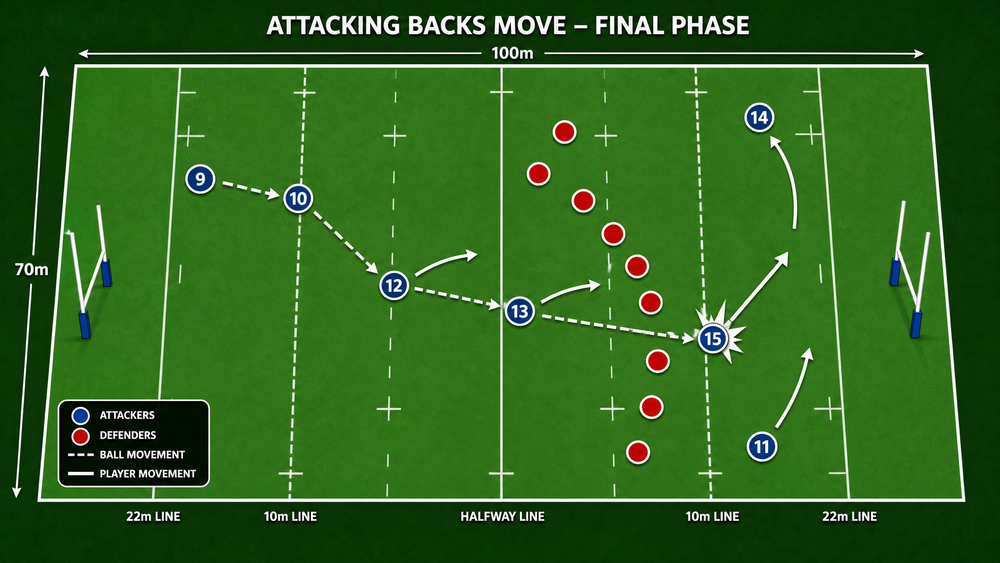
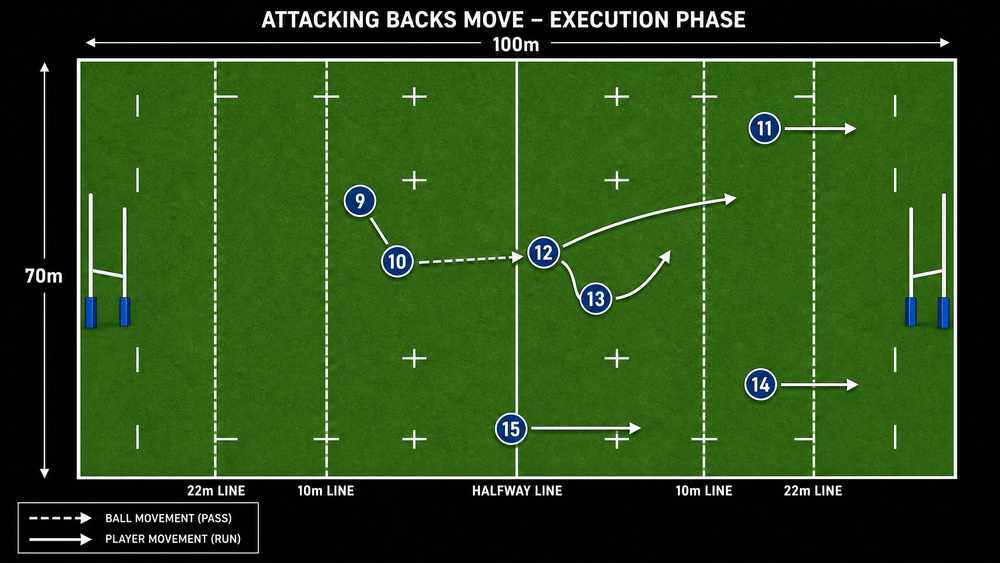
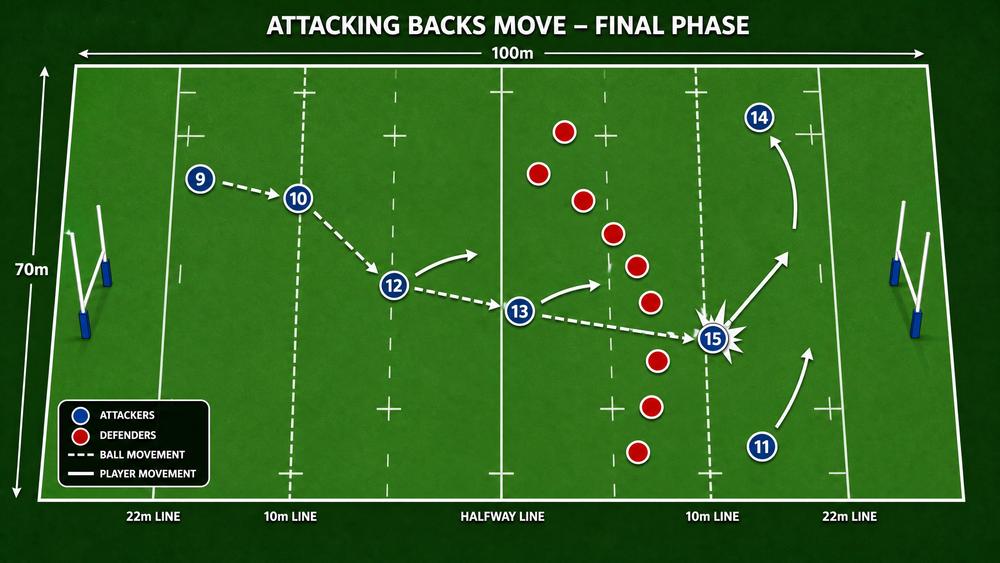
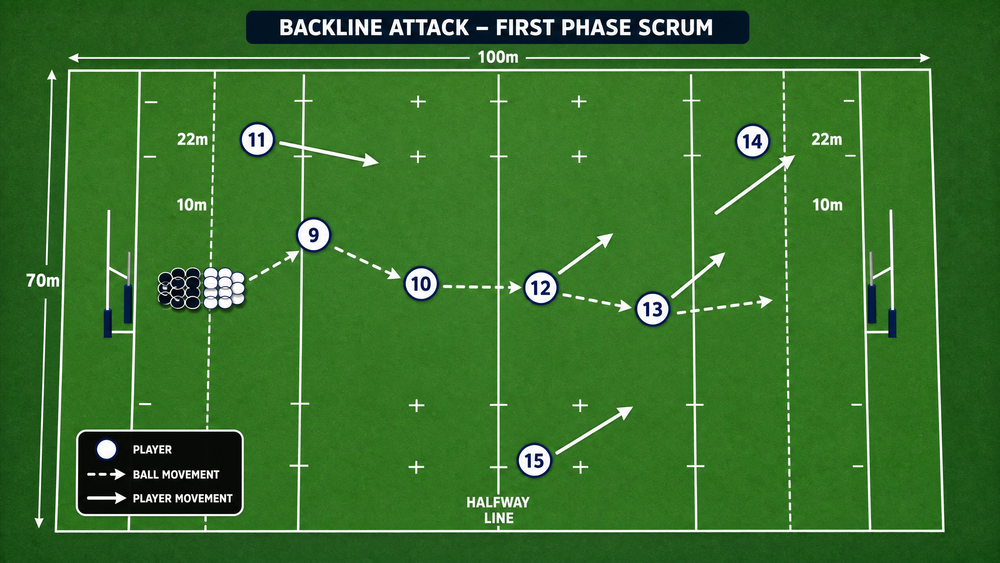
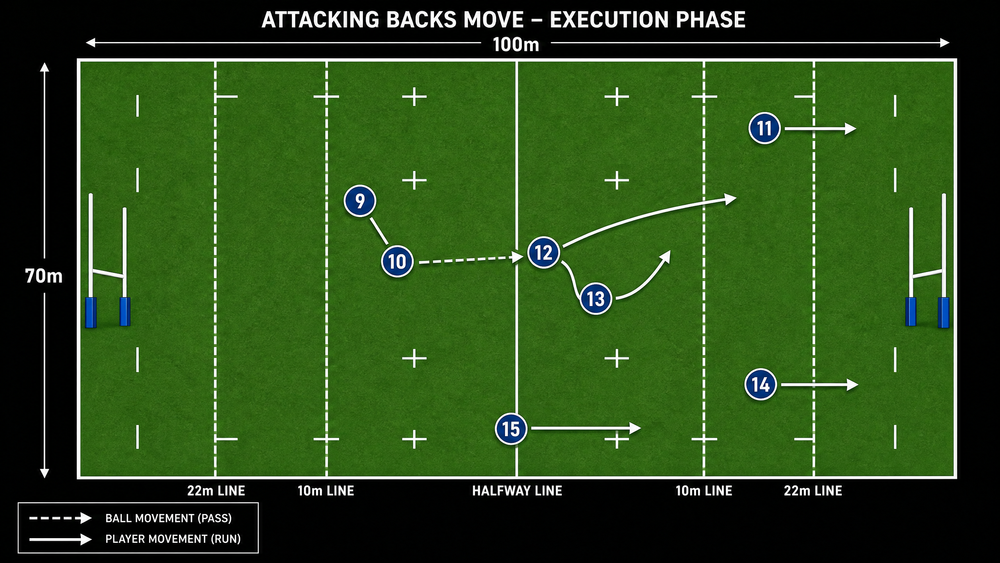
This first-phase attacking backs move is built to create a line-break opportunity before the defence can reset. The ball travels through 9 (scrum-half), 10 (fly-half), 12 (inside centre), and 13 (outside centre), then reaches 15 (fullback) sweeping from depth at pace. The shape gives 13 a genuine carry, keeps 11 and 14 available on the edges, and asks the defence to make two decisions: first on 13’s hard line, then on 15’s late arrival.
Run it from a clean ruck or scrum exit in the middle third, ideally 15 metres or more from touch. It is especially useful against a line that shoots at 10 or an outside defender who chases in too aggressively. The diagrams use a full 100 m × 70 m reference pitch, the maximum field-of-play dimension in World Rugby Law 1.1
Coaching objective: Make 10, 12, and 13 all look capable of carrying square, then put 15 into the space created by the defender’s commitment.
Setup
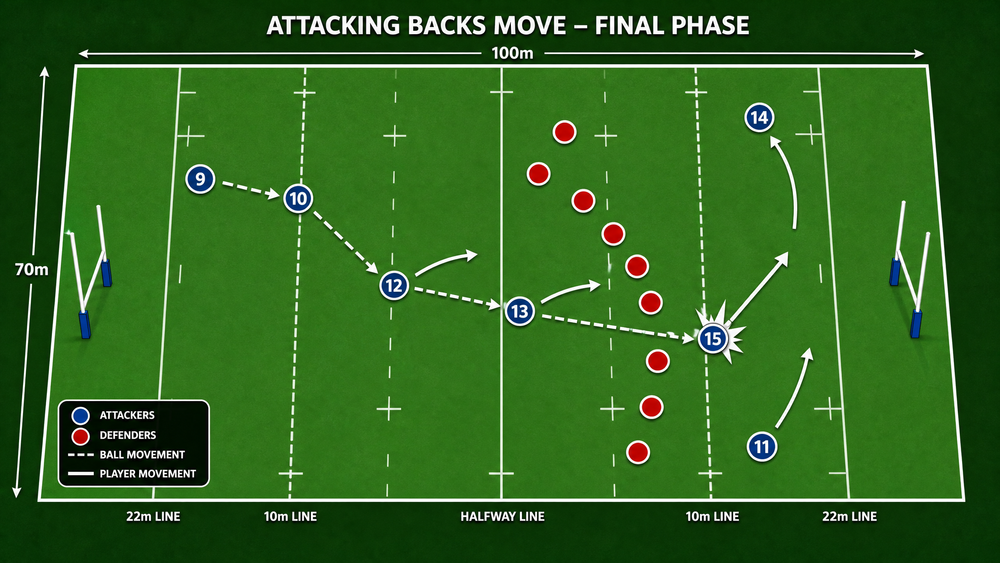
Place the first-phase ball source 15 metres in from the left touchline and 5 metres behind halfway. For the coaching block, mark a 40 m × 35 m channel. Put a two-cone gain-line 10 metres in front of the ruck and a break gate 8 metres beyond it. Start the move to the right, then reverse the picture so the backs learn it on both edges.
| Element | Coach instruction |
|---|---|
| Players | Use 9, 10, 12, 13, 15, 11, and 14. Begin with three passive defenders opposite 10–13, then progress to six live defenders. |
| Starting depth | Put 9 at 1.5 m behind the ball; 10 at 7 m depth and 5 m outside; 12 four metres outside 10 at 6–7 m depth; and 13 four metres outside 12 at 5–6 m depth. |
| Sweep and width | Start 15 at 10–12 m behind 13 and 5 m inside 14. Keep both wingers 3–5 m from touch, a fraction ahead of 15. |
| Equipment | Use 6–10 balls, 12–16 cones, six bibs, a ruck pad or shield, and a whistle. |

Call and scan
Use a simple call such as “Sweep Right.” 9 confirms the side before arriving at the ruck. 10 scans their defender’s launch, while 15 scans the outside defender and 14’s width. The call provides the framework, but the players must still take the picture in front of them.
Step-by-Step Instructions
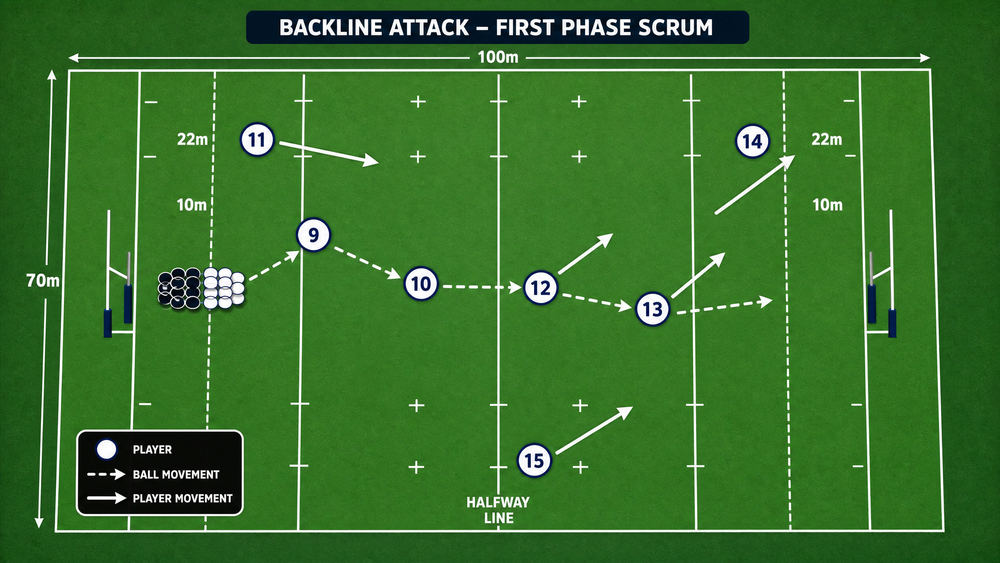
Secure and present. Win the first ruck and place the ball on the attacking side, one metre behind the bodies. The ball must be visible immediately; do not let a slow recycle disguise poor timing.
Launch through 9. On the lift, 9 takes one step toward the ruck and passes across their body to 10. Aim for release inside roughly 0.7 seconds, chest-high and in front of 10’s outside shoulder. 9 follows for inside support.
Fix through 10. 10 catches with two hands and runs square for two or three metres. They show a real carry, hold the first defender, then pass firmly to 12. Do not allow 10 to drift across the pitch; the line must be threatened before the ball moves.
Connect through 12. 12 receives about a metre behind the gain-line, squares their hips toward the posts, and carries the ball in two hands for two steps. If the outside defender bites in, 12 gives the flat pass to 13; if that defender drifts hard, 12 may carry through the inside shoulder.
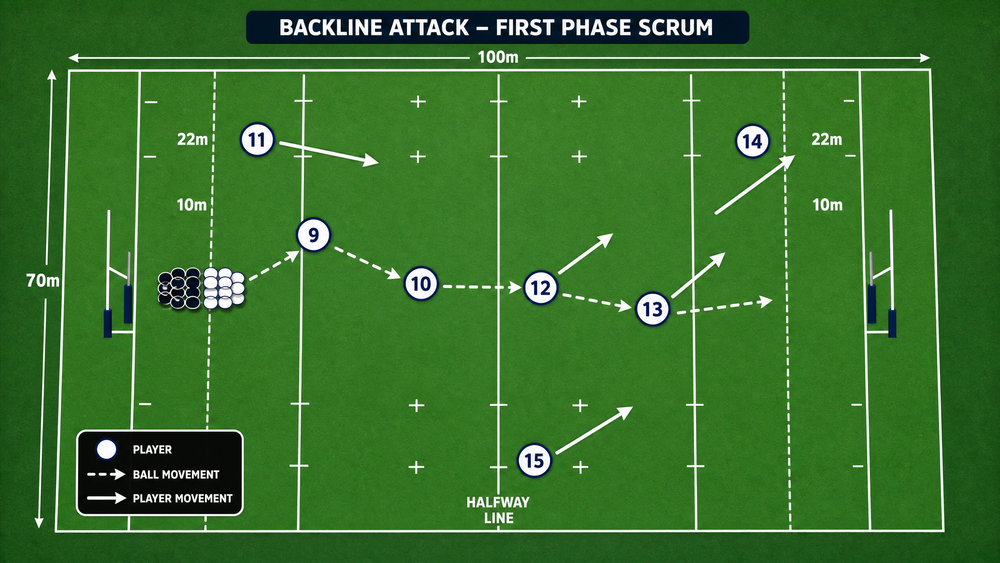
Let 13 fix the edge. 13 accelerates onto a hard, slightly out-to-in line at the inside shoulder of the outside defender. They take the ball in two hands, read hips and shoulders at the defender’s last two steps, and release late to 15 only after the defender has declared. If the defender turns in, 13 carries through the outside space.
Sweep with 15. 15 moves as 9 lifts the ball and sweeps on a 35–45 degree line behind 12 and 13. They should arrive outside 13 at 8–10 m depth, call loudly, show hands early, and run through the catch. 15 attacks the outside half of the next defender, then either accelerates through the gap, draws and passes to 14, or steps back inside.
Finish and reload. 14 holds width until 15 has the ball, then tracks inside for the final pass. 11 mirrors as far-side coverage. Award the score only when the carrier and two support players go through the break gate or form the next ruck inside three seconds.
Key Coaching Points
| Priority | What good looks like |
|---|---|
| Square threat | 10 and 12 face the goal line at transfer, so the defence cannot simply slide. |
| Pace from depth | 15 receives while accelerating at 8–10 m depth, rather than standing flat or waiting. |
| Late decision | 13 passes only after the outside defender commits; a pre-set pass gives the defender a free tackle. |
| Pass quality | Each pass is chest-high, in front, and catchable without the receiver braking. |
| Real width | 11 and 14 keep the final defender honest and communicate throughout the move. |
| Support habit | The two nearest attackers arrive at the line-break or contact point immediately. |
Common Mistakes
| Mistake | Correction |
|---|---|
| 10 or 12 drifts sideways. | Put a 3 m straight-running gate in front of each receiver; no pass is allowed before it. |
| 15 leaves too early. | Cue the sweep from 9’s lift, then demand 15’s acceleration as the ball travels from 10 to 12. |
| 13 passes before engagement. | Freeze the picture and insist on two strong steps at the defender before the release. |
| 14 creeps infield. | Mark a 3 m touchline lane for 14 until 15 has received. |
| Players admire the break. | Count the score only if two support players complete the next action. |
Variations & Progressions
Start with a no-defence walk-through, then add three passive defenders who give a visual picture. Progress to live defenders who cannot rush until 9 lifts the ball. Finish with six live defenders in the 40 m × 35 m channel: award two points for a clean gate break and four if the following ruck is won inside three seconds.
| Variation | Adjustment and purpose |
|---|---|
| Out-the-back sweep | 12 passes behind 13 directly to 15, while 13 runs the same hard decoy line. This punishes defenders who over-commit to 13. |
| 13 carry / 15 reload | 13 carries when the defender stays square; 15 folds behind as offload or clean-out support. This rewards players for taking the available picture. |
| Wide finish | 15 draws the last defender and passes to 14, with 11 sweeping behind as coverage. This tests edge timing against a narrow line. |
Age Adaptations
| Age group | Adaptation and emphasis |
|---|---|
| Under 8 | Use a 20 m × 20 m tag grid with 9, 10, and one sweep runner. Remove the late pass; coach safe running, catching, and calling. |
| Under 10 | Use 9, 10, 12, 13, and 15 in a 25 m × 25 m channel against tags or shields. Emphasise staying square and passing in front. |
| Under 12 | Add 11 and 14, a live 4v4 edge, and the 13-to-15 decision. Coach recognition of a defender who bites, drifts, or sits. |
| Under 14 | Run the full seven-attacker shape against six defenders from a realistic ruck and insist that the second phase is secured. |
| Under 16 and open age | Add variable defensive calls and a 10 carry option. Film two repetitions and review timing, scanning, and support after the break. |
End by asking players to name the three pictures: 13 carry, 15 sweep, or 14 finish. When they can explain the read and execute the shape in both directions, the play is ready for the match plan.
References