

Rugby
The Decoy Crash Ball: Breaking the Gainline
Master the art of the crash ball by incorporating effective decoy runners to manipulate the defense and guarantee gainline success.

What you need
1 standard Rugby ball, 6 training cones, 2 to 3 tackle shields (optional)
The Decoy Crash Ball: Breaking the Gainline
A highly effective set play designed to manipulate defensive lines, commit defenders to false threats, and guarantee gainline success through a powerful inside centre carry.
1. Overview
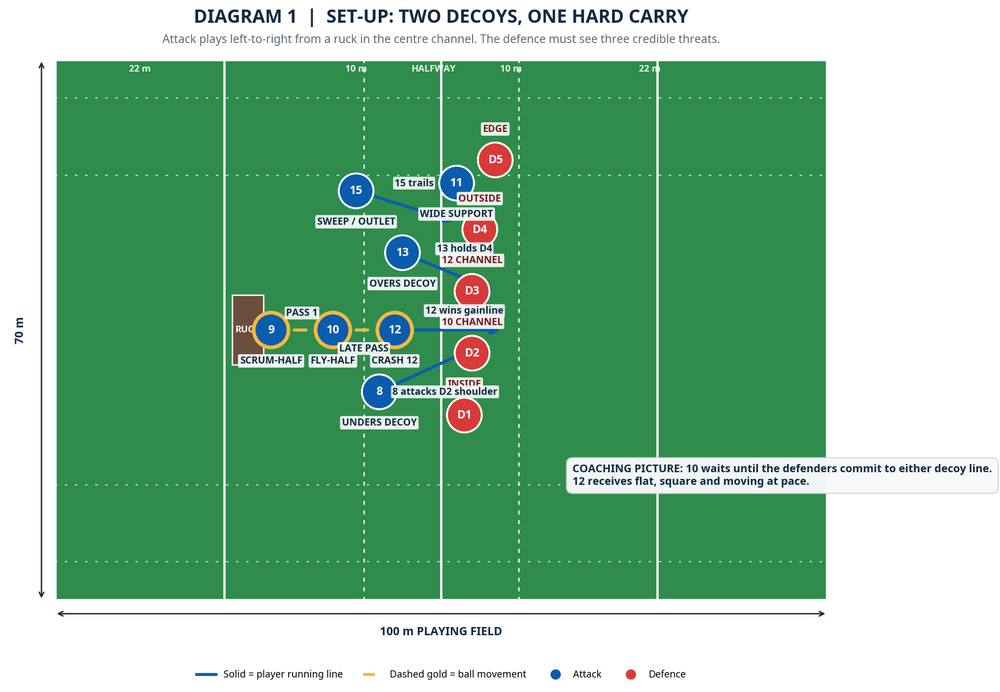
The Decoy Crash Ball is an essential attacking structure that uses intelligent running lines to freeze the opposition defence. By deploying an "unders" decoy (the Number 8 or a loose forward) and an "overs" decoy (the Outside Centre, 13), the attacking unit forces the defensive line to hesitate. This hesitation creates a momentary seam in the 10–12 defensive channel. The Inside Centre (12) then exploits this seam by taking a late, flat pass at maximum pace, ensuring the attacking team crosses the gainline and generates rapid front-foot ball for subsequent phases.
This play is particularly effective when operating between the 22-metre and halfway lines on a standard 100m x 70m pitch, where the defence is often aggressively seeking to close down the space. It forces defensive decision-making under extreme pressure and punishes teams that drift too early or fail to communicate.
2. Setup
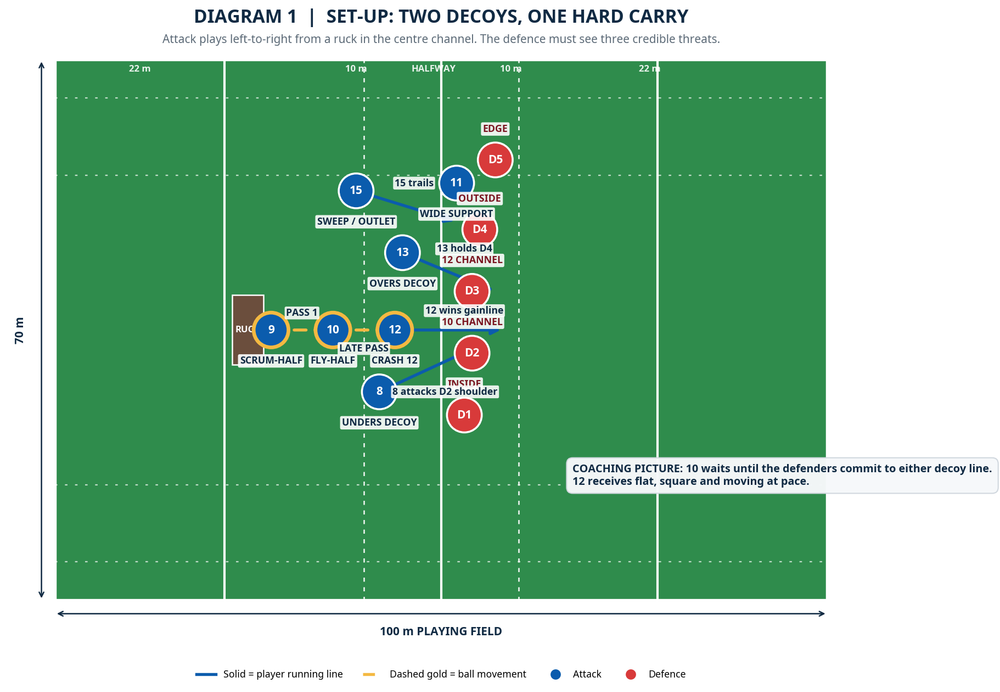
To run this set play effectively during a training session, coaches should prepare a structured environment that mimics match-day conditions.
Equipment Needed:
- 1 standard Rugby ball.
- 6 training cones to mark starting positions and the defensive gainline.
- 2 to 3 tackle shields for initial contact progression (optional, before moving to live defence).
Pitch Setup and Player Positions:
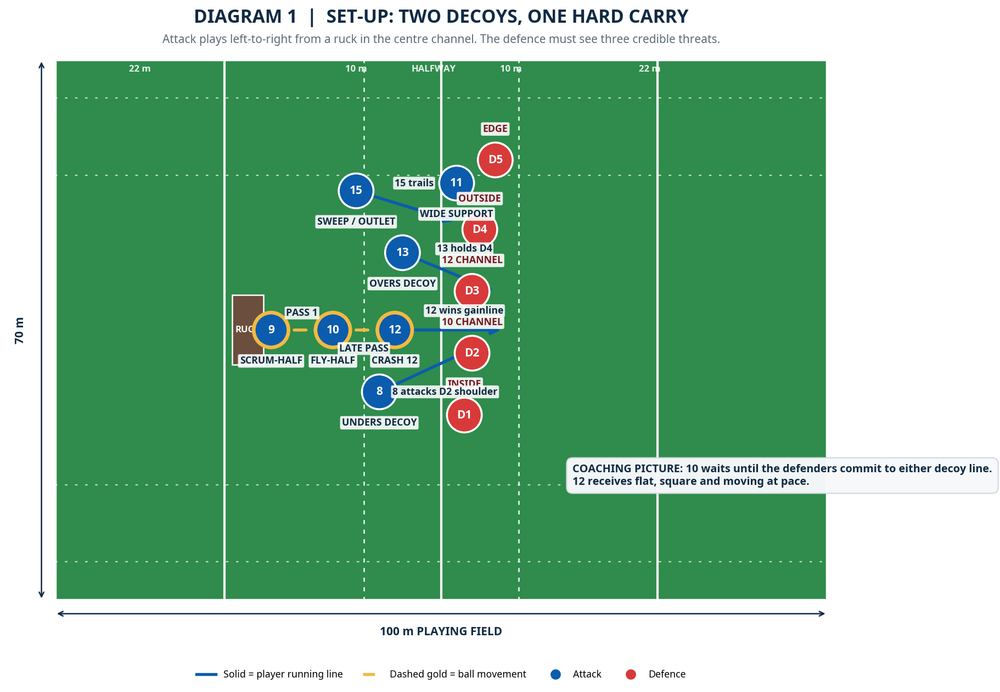
Set up the attacking formation left-to-right starting from a central ruck position.
- Scrum-half (9): Positioned at the base of the ruck, ready to deliver a fast, sweeping pass.
- Fly-half (10): Positioned flat, approximately 8 metres wide of the ruck, acting as the primary playmaker.
- Inside Centre (12): Positioned slightly deeper than the Fly-half, ready to accelerate squarely into the defensive line.
- Number 8 (8): Positioned inside the 12, running a hard "unders" line aimed directly at the inside shoulder of the second defender.
- Outside Centre (13): Positioned wider, running a hard "overs" line to fix the outside defensive drift.
- Fullback (15) and Wing (11): Positioned in the backfield and wide channels to offer trailing support or an outlet pass if the defence completely collapses inward.
3. Step-by-Step Instructions
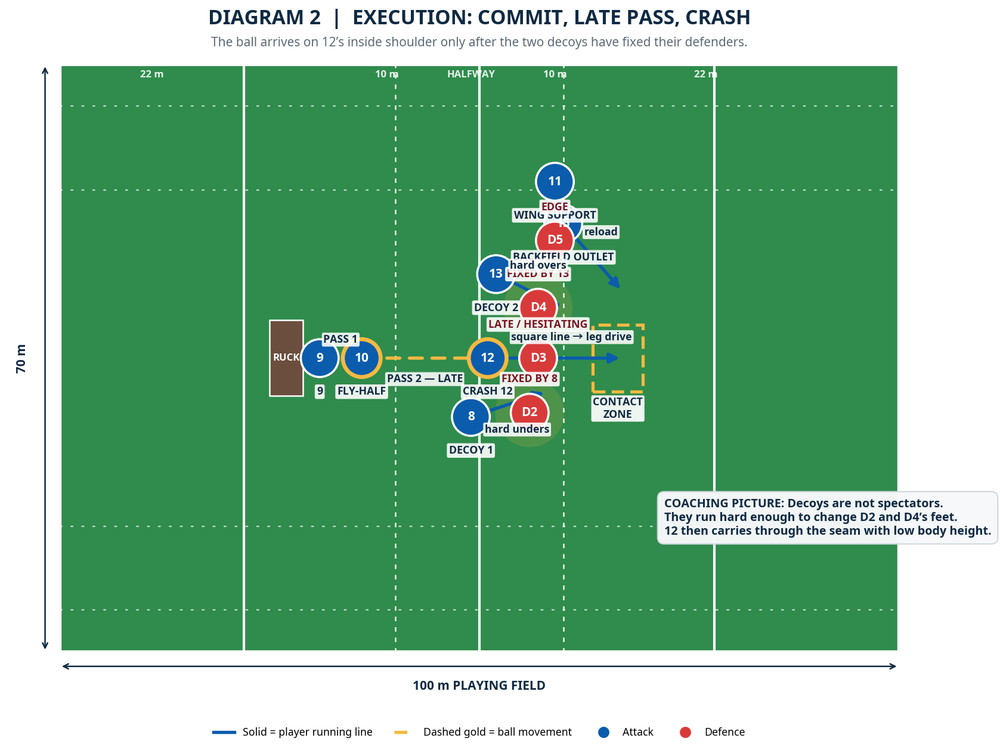
Execute the play with precise timing and aggressive running lines. The sequence relies entirely on the Fly-half's ability to hold the ball until the last possible moment.
Step 1: The Delivery
The Scrum-half (9) clears the ball rapidly from the base of the ruck, delivering a crisp pass to the Fly-half (10). The Fly-half must catch the ball while moving forward, immediately squaring their shoulders toward the opposition try line to threaten a direct run.
Step 2: The Decoy Commitment
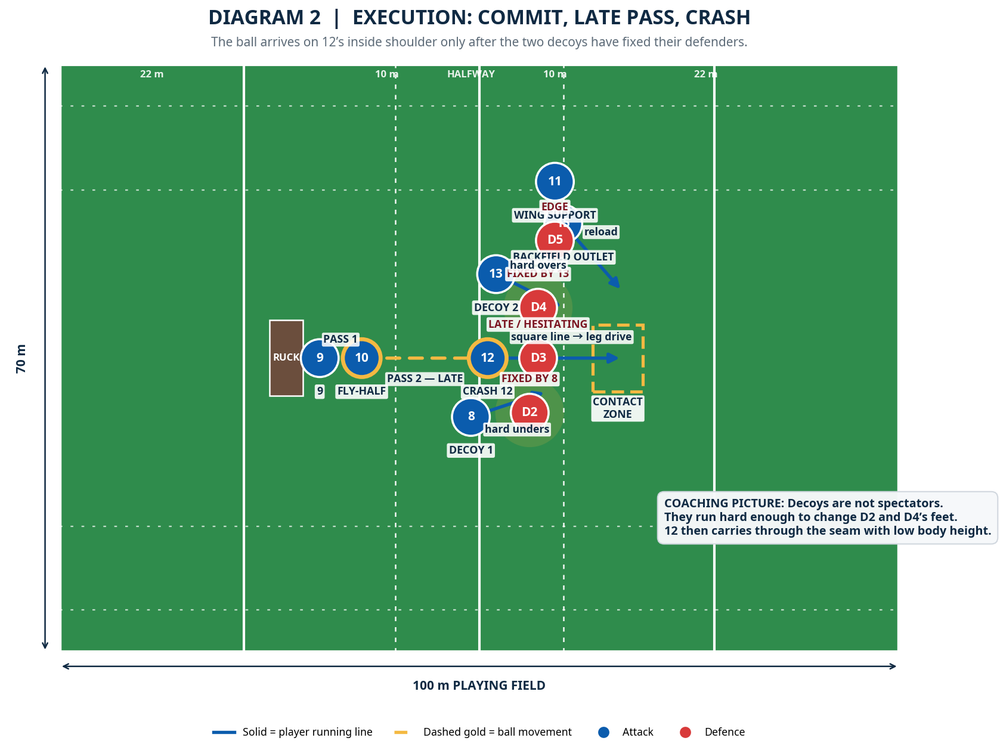
As the Fly-half receives the ball, the Number 8 runs a hard, aggressive "unders" line, calling loudly for the ball and targeting the gap between the first and second defenders. Simultaneously, the Outside Centre (13) runs a sharp "overs" line to hold the wider defenders in place. Both decoys must run as if they are guaranteed to receive the pass.
Step 3: The Late Pass
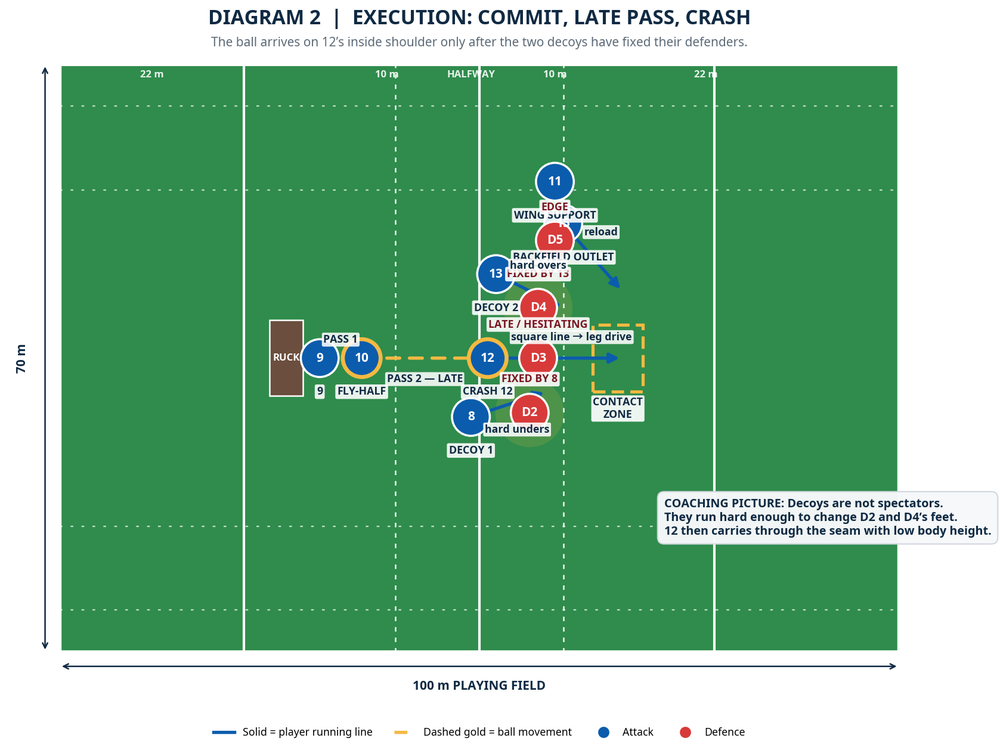
The Fly-half holds the ball until the defensive line visibly commits—either by planting their feet or turning their shoulders inward to track the decoys. Only at this critical moment of defensive hesitation does the Fly-half deliver a short, flat pass to the Inside Centre (12).
Step 4: The Gainline Crash
The Inside Centre (12) receives the ball at full pace, maintaining a square running line. As they approach the contact zone, they must lower their body height, initiate strong leg drive, and power through the compromised defensive seam.
Step 5: The Fast Ruck
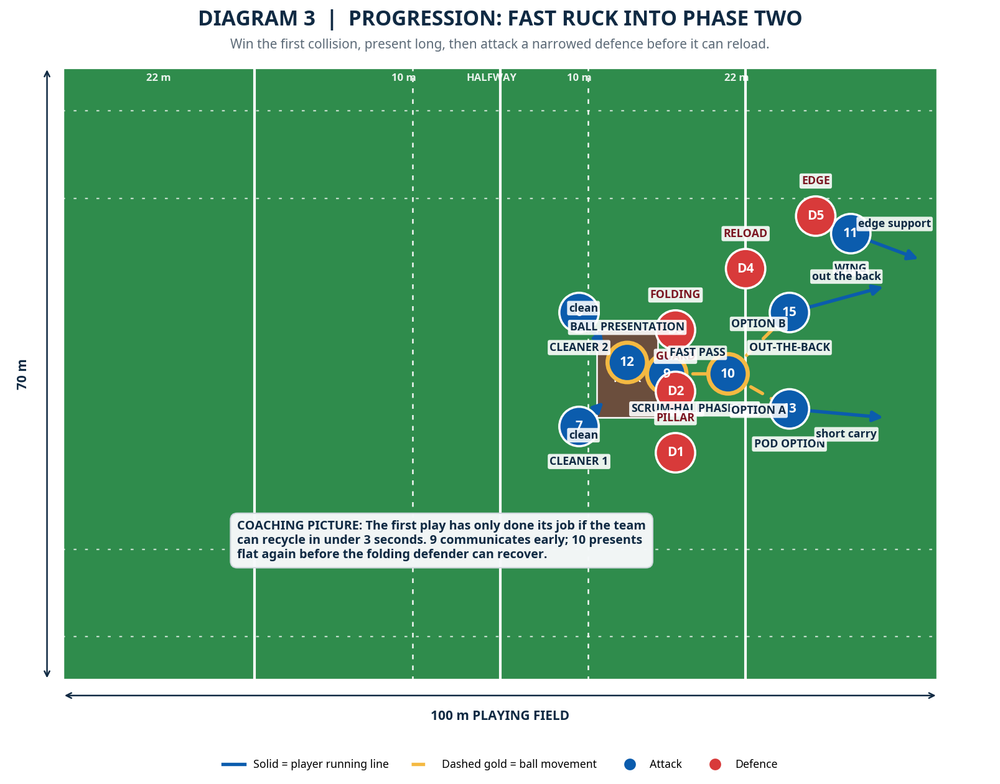
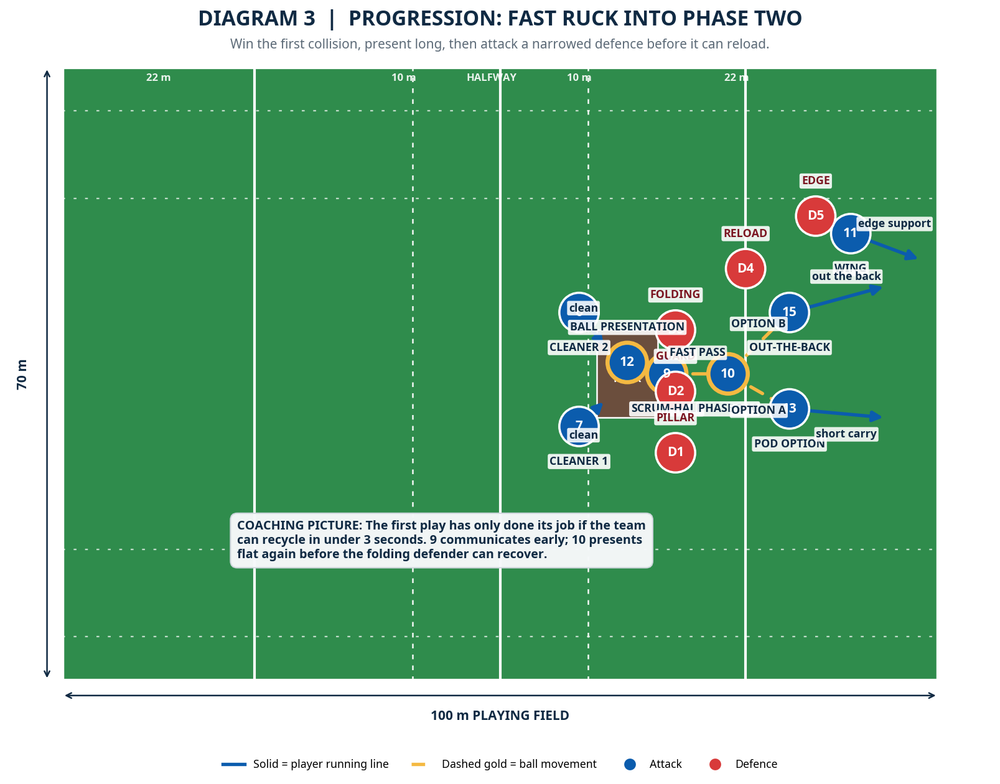
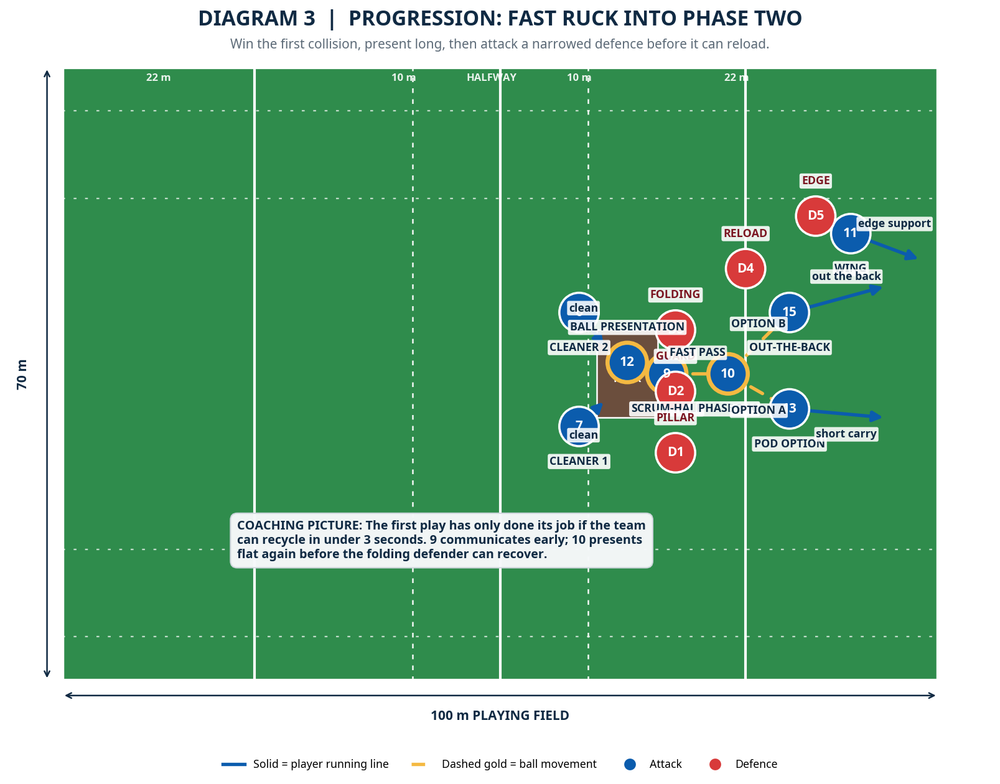
Upon taking contact, the Inside Centre fights to stay on their feet for an extra metre before going to ground and presenting the ball cleanly (long placement). The supporting players (typically the Number 8 and trailing forwards) must arrive within three seconds to secure the ruck, providing the Scrum-half with lightning-fast ball for Phase Two.
4. Key Coaching Points
To ensure the play succeeds in a match environment, coaches must emphasize several critical technical details during practice.
- The Fly-half's Patience: The timing of the pass from the 10 is the most important element. If the pass is delivered too early, the defence will simply drift onto the 12. The 10 must be brave, take the ball to the line, and pass late.
- Authentic Decoy Running: Decoy runners are not spectators. They must sprint with intent, call for the ball, and present their hands as targets. A jogging decoy will be ignored by any competent defensive line.
- Square Shoulders: Both the Fly-half and the Inside Centre must keep their hips and shoulders square to the try line. Running sideways pushes the attack toward the touchline and allows the defence to drift easily.
- Contact Technique: The crash ball runner (12) must anticipate the collision. They need a low body height, a strong core, and aggressive leg drive upon contact to ensure they fall forward and retain possession.
5. Common Mistakes
Watch for these frequent errors during training and correct them immediately to build a reliable attacking unit.
- Early Passing: The Fly-half panics under defensive pressure and shovels the ball away before the decoys have fixed their assigned defenders.
- Telegraphing the Play: The Inside Centre gives away the play by starting their run too early or staring directly at the Fly-half rather than scanning the defensive line.
- Poor Support Lines: The supporting forwards arrive late to the breakdown because they stopped to watch the collision, resulting in isolated ball carriers and holding-on penalties.
- Static Receiving: The Inside Centre catches the ball while standing still, losing all momentum and allowing the defence to dominate the collision.
6. Variations & Progressions
Once the core play is mastered, introduce these variations to keep the defence guessing and challenge the attacking players.
Progressions:
- Live Defence: Remove the tackle shields and introduce a fully live, unstructured defensive line to test the Fly-half's decision-making under genuine pressure.
- Phase Two Integration: Do not stop the drill after the crash ball. Force the team to immediately execute a second phase, attacking the short side or the newly narrowed defensive line before they can reload.
Variations:
- The Decoy Hit: If the defence begins to consistently ignore the decoys and gang-tackle the Inside Centre, instruct the Fly-half to actually pass to the Number 8 on the "unders" line to punish the defensive read.
- Lineout Launch: Adapt the starting position from a central ruck to a midfield lineout, using the blindside winger as an additional decoy option.
7. Age Adaptations
This set play can be tailored to suit the developmental stages of different age groups.
- Under 10 to Under 12: Focus heavily on the basic mechanics of catching, passing, and running straight. Simplify the play by using only one decoy runner. Ensure all contact is heavily controlled and prioritize safe falling and ball presentation over aggressive collisions.
- Under 14 to Under 16: Introduce the dual-decoy system and begin emphasizing the timing of the late pass. At this age, players can handle the tactical concept of "fixing a defender" and should be encouraged to read the defensive line's body language.
- Open Age / Senior: Run the full, complex play at match speed. Demand split-second decision-making from the Fly-half, brutal efficiency at the breakdown, and immediate realignment for subsequent phases.
