

Rugby
Five-Man Defensive Line Speed & Alignment Drill
Build a connected five-player defensive line that launches together, wins the inside space and makes dominant, legal tackles.

What you need
balls, cones
Overview
This 20-minute defensive line speed and alignment drill teaches a five-player unit to launch together, stay connected and win the space in front of the ball without losing their inside shoulder. The defensive aim is simple: make the attack play behind the gainline, force the carrier back inside or into a dominant double contact, then reload in shape. It is not a sprint race. The unit must arrive fast and level.
Use five defenders (1-5), four attackers (6-9) and a coach or feeder. Defenders work from inside to outside; player 1 is the inside guard and player 5 owns the touchline. Attackers receive, carry, tip or pass but must stay live. Rotate roles every two minutes so players learn both the threat and the defensive picture.
Setup
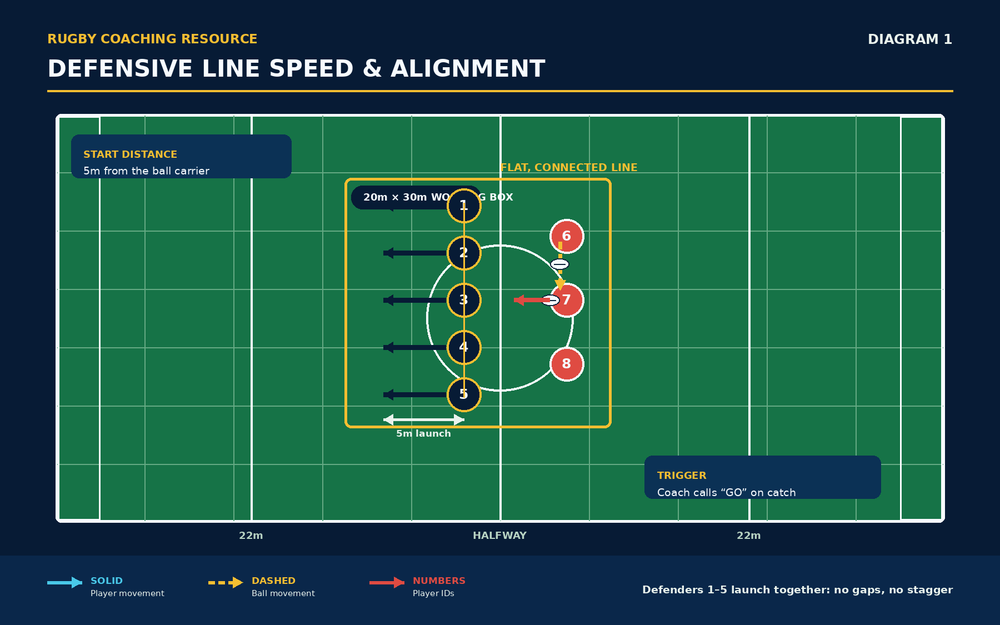
On the full pitch, place the channel between the 22m and halfway lines where possible. Mark a 20m-long, 30m-wide rectangle with four corner cones; add a cone line 5m inside the attacking end as the defensive start line and a 3m scoring gate at either far corner. Put defenders 1-5 shoulder-to-shoulder on the start line, about 5-6m from the initial ball receiver. Space them at roughly 5m intervals, close enough that an outstretched arm could almost touch the next defender’s shoulder.
Attackers 6, 7 and 8 begin in a shallow line 5m beyond the ball; player 9 is a trailing or outside option. The coach stands behind the attacking line with a ball and controls the release. Use two balls so the next group is ready immediately. Work at 70% intensity for the first two minutes, then lift to match pace. A rep lasts 6-8 seconds; give 20 seconds for reset and feedback. Complete three sets of five live reps, with 60 seconds between sets.

Step-by-Step Instructions
Set the line (0-2 seconds). Defenders adopt a square, athletic stance: feet just wider than hip width, knees flexed, chest over toes and eyes on the near hip of the player opposite. Player 1 calls “line” once everyone is set; player 5 replies “edge”. The call confirms the unit is connected before the ball moves.
Trigger and launch (2-4 seconds). The coach passes to attacker 6. On the catch, player 1 calls “go” and all five defenders take their first three steps together. The first step is forward, not sideways. Defenders sprint for three to four metres, then shorten their stride as the carrier reaches decision distance. A late launch from one player creates the very gap the attack wants.
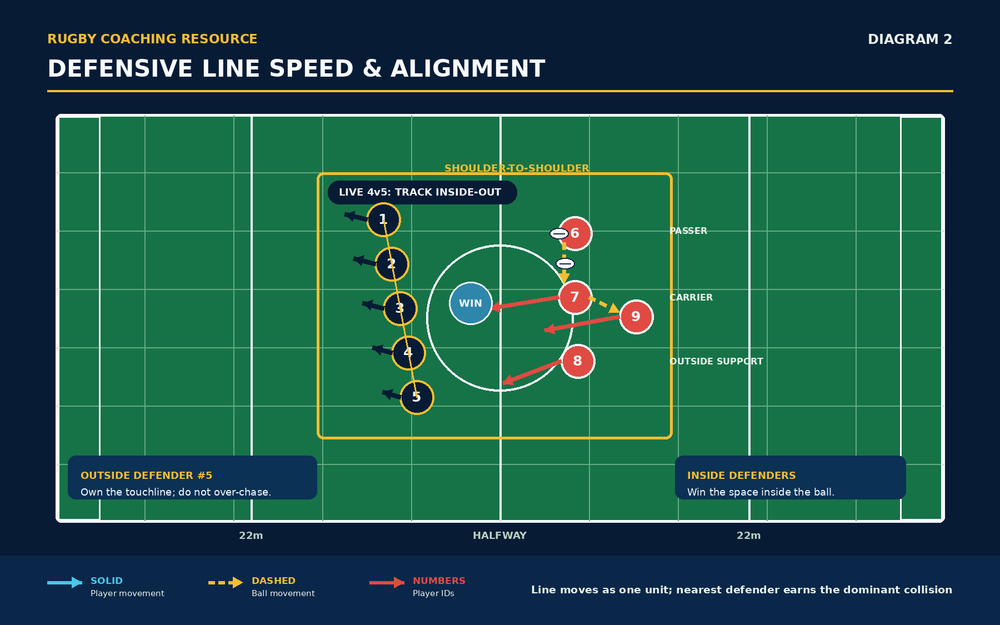
Scan and align (4-5 seconds). As the ball travels, players scan ball-carrier, next threat and inside shoulder in that order. Defenders keep their numbers visible in a connected line, with no player more than half a metre ahead or behind the next defender. Inside defenders close the inside seam; outside defenders keep the touchline as an extra defender.
Make the tackle decision (5-8 seconds). The nearest defender owns the collision: sink, track the near hip, fit the shoulder and wrap. The next defender is the immediate assist, arriving square and low rather than diving past the ball. Players beyond the tackle continue their line until the ball is clearly won or the carrier is stopped. Blow the whistle when the ball carrier is held, pushed back, forced into touch or crosses the gainline.
Reset with a named fix. In the 20-second recovery, ask one question only: “Where did the line bend?” Give a single corrective cue—“inside up”, “shorten earlier”, “hold edge” or “talk sooner”—then restart. Keep explanations short so the drill remains an effort-and-decision practice, not a standing lecture.
Key Coaching Points
- Launch off the pass, not the coach’s arm. The catch is the shared trigger. This makes line speed transferable to match play.
- Win space with feet first. Fast feet bring defenders into the tackle window; frantic diving removes them from the line.
- Square hips, connected shoulders. Players can drift slightly on the outside but must not turn their hips and chase across the field.
- Inside-out ownership. Player 1 protects the inside first; every defender names their inside threat before moving to the next attacker.
- Use a common language. “Go”, “up”, “hold”, “edge” and “fold” must be loud, early and specific. Quiet communication is a late defensive line.
- Tackle safely and legally. Head is to the safe side, eyes up, shoulder contact below the ball and wrap-and-squeeze through contact. Reduce speed immediately if technique fails.
Common Mistakes
The line looks like a staircase. Usually one or two players are reacting to movement rather than the ball catch. Rehearse three synchronized launches with no attackers, then return to live play.
Defenders fly past the carrier. They have sprinted for too long. Mark a “brake zone” 2m before contact and coach short, powerful steps with feet underneath the hips.
The edge defender bites in. Player 5 is ball-watching or lacks trust in the inside pair. Give player 5 the explicit call of “edge” and reward a forced touchline or pass behind the carrier.
A defender drifts before winning the inside. Stop the rep and walk the line back. The first job is to remove the inside shoulder; only then can the unit shepherd outward.
Variations & Progressions
Progression 1: Add a real pass option. Allow attackers 6-9 to use one pass, tip-on or unders line. Defenders must still launch together but now scan the next threat and communicate “push” or “hold”. Score the defence two points for a dominant stop behind the gainline, one for a contained tackle and zero if the attack breaks or gains more than 3m.
Progression 2: Fold after contact. After a tackle, the coach plays a second ball within three seconds from either side. The closest two defenders contest or complete the tackle; the remaining three fold hard around the rear and rebuild the line. This tests whether speed and connection survive the first collision.
Variation 1: Touch-only tempo. Use two-hand touch, count a “tackle” when the carrier is touched by a square defender, and insist on a 2m retreat before the next phase. This is ideal for high-rep pre-contact sessions.
Variation 2: Defend a 15m red zone. Narrow the channel to 15m and place a scoring line 10m behind the defenders. Attackers have two phases to score. The reduced space demands faster identification, tighter spacing and a hard edge.
Age Adaptations
For Under 8 and Under 10, use a 15m x 20m channel, three defenders versus two attackers, touch only and 50-60% pace. Teach one message: “Move forward together, keep your friend beside you.” Keep reps to five seconds and praise alignment more than collision. For Under 12, progress to four defenders versus three attackers in a 20m x 25m area; introduce safe tackle technique only when it has been coached separately and is age-appropriate. For Under 14 and older, use the full five-versus-four shape, live passing and controlled tackle completion. At every age, players who lose shape reset behind the line rather than chase from an unsafe angle. The standard is fast, connected, legal and repeatable—not reckless line speed.
