

Rugby
Scrum-Half Passing Accuracy: Three-Gate Breakdown Transfer Drill
A practical breakdown-to-first-receiver drill that develops a No. 9’s body shape, release speed and accurate pass selection under escalating pressure.

What you need
5–6 rugby balls, 18–22 cones, 3 coloured bibs or flat markers, 2 tackle shields or ruck pads, 1 stopwatch
Overview
This is a purposeful passing drill for scrum-halves (No. 9), built around the moment immediately after a ruck when a team needs the ball to arrive early, flat and in front of the next decision-maker. It is not a line-passing warm-up. Every repetition starts with a realistic ruck picture, asks the 9 to scan three options and demands an accurate pass through a defined gate before the receiver moves the ball on. The focus is on repeatable technique: get square to the ball, load the feet, present the hands early, finish the pass at the receiver’s chest and reset quickly for the next phase.
Use the drill after the warm-up, before units work, or as a technical primer for a fast-ruck game model. Allow 18–22 minutes. On a full 100 m x 70 m rugby pitch, set the grid 10 m inside a touchline and either side of halfway.
| Session outcome | What good looks like |
|---|---|
| Passing accuracy | The ball arrives at chest height, slightly in front of the receiver, without forcing a reach or a stop. |
| Release speed | The 9 passes within 1.5 seconds of the feeder’s cue in the base version. |
| Decision-making | The 9 identifies the called gate before collecting, then commits to the appropriate pass. |
| Repeat effort | The 9 reloads behind the next breakdown marker with balanced feet and clear communication. |
Setup
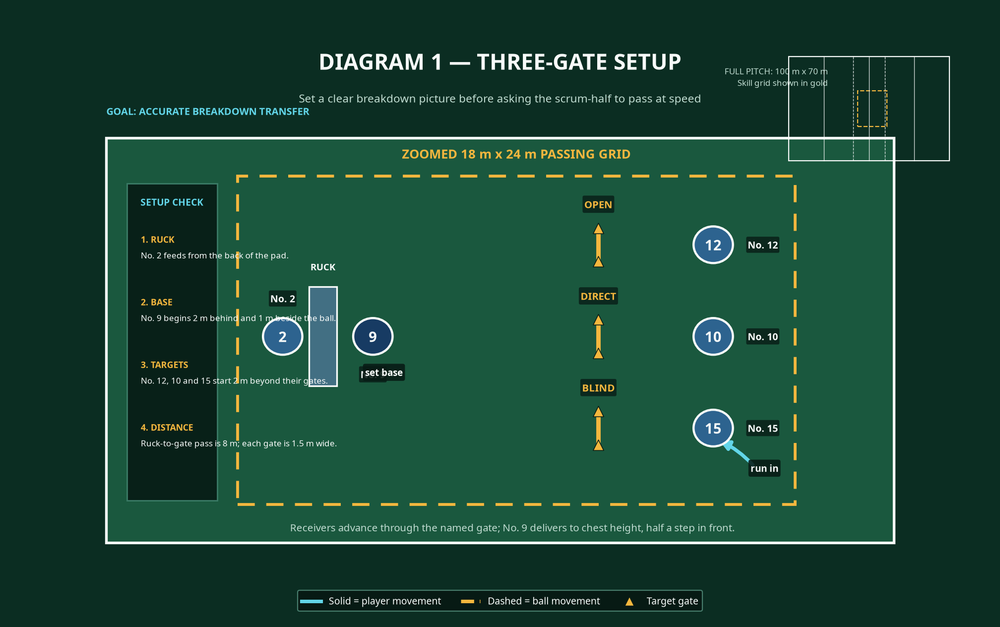
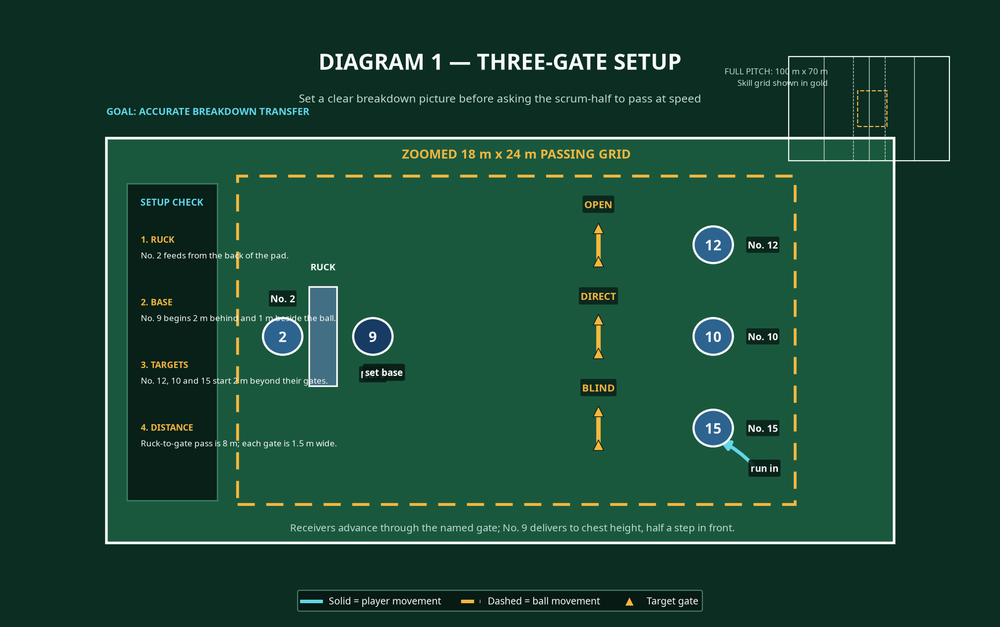
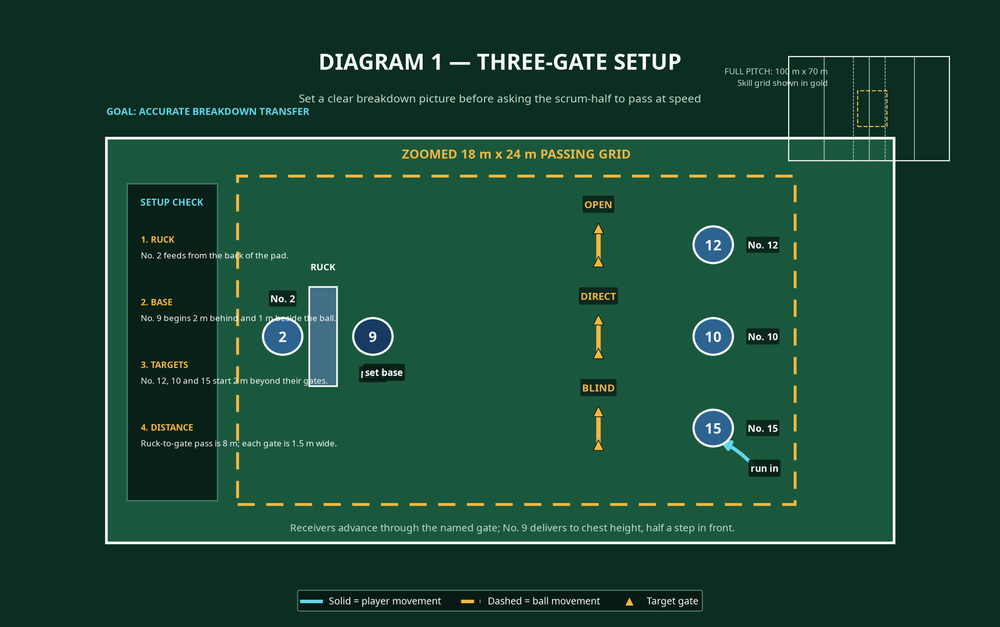
Mark out an 18 m long x 24 m wide rectangle. The long side runs across the field, parallel to the gain line. Put three coloured passing gates, each 1.5 m wide, 8 m from the ruck cone: a left gate for the open-side option, a centre gate for the direct first receiver and a right gate for the blind-side option. Set the gates 6 m apart. Use two tackle shields or hit pads on their sides to represent the ruck and place a ball on a small cone behind them.
Allocate one player as the feeder, ideally a hooker (No. 2) or a forward who regularly arrives at ruck, and one working scrum-half (No. 9). Position a fly-half (No. 10) in the centre gate, an inside centre (No. 12) in the open-side gate and a fullback (No. 15) or second 9 in the blind-side gate. The three receivers start 2 m behind their gate and advance through it on the feeder’s call. With eight players, use a second feeder and a second 9 so that the work-to-rest ratio stays sharp. Place four spare balls with a coach 3 m behind the feeder.

| Equipment | Quantity | Coaching use |
|---|---|---|
| Rugby balls | 5–6 | One live ball, four or five rapid-restart balls. |
| Cones | 18–22 | Outline the rectangle, mark ruck, gates and return lane. |
| Coloured bibs or flat markers | 3 | Identify left, centre and right passing gates. |
| Tackle shields or ruck pads | 2 | Give the 9 a genuine visual picture of the breakdown. |
| Stopwatch | 1 | Audit the 1.5-second release target in later blocks. |
Step-by-Step Instructions
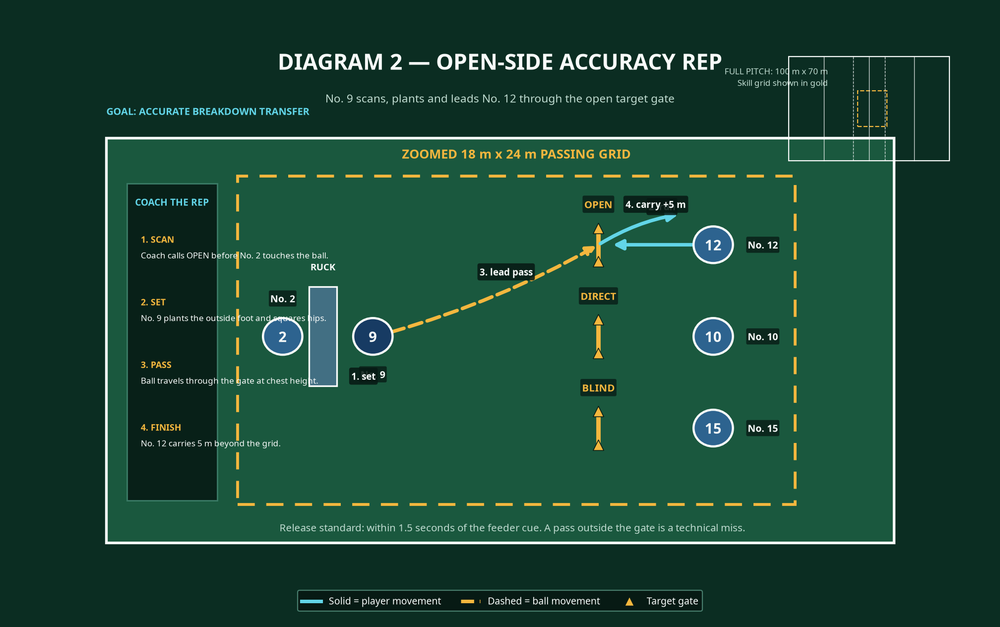
Build the picture. The feeder stands over the ruck marker facing the intended attacking direction. The 9 begins 2 m behind and 1 m to the side of the ball, in a low ready position. Receivers hold their starting points quietly, eyes on the 9. The coach calls a colour—left, centre or right—before the feeder touches the ball.
Cue the release. On the coach’s whistle, the feeder rolls or places the ball cleanly at the back of the ruck. The 9 scans the called gate before stepping to the ball. Insist on a short, efficient approach; the 9 should not run around the ball or drift past the back foot.
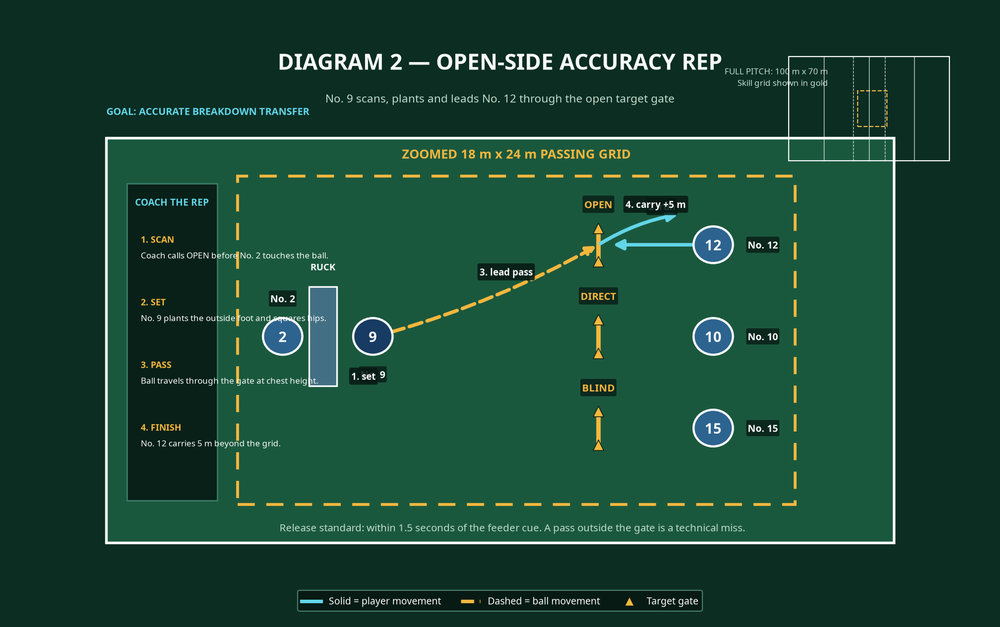
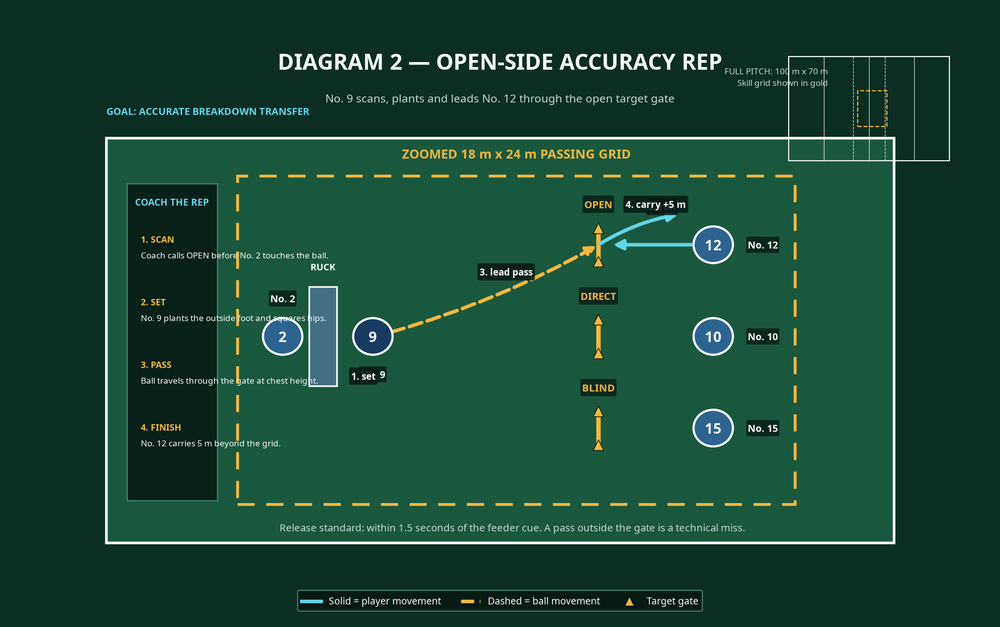
Set and pass. The 9 plants the outside foot, squares the hips toward the target and collects with two hands. The receiver accelerates through the named gate. The 9 delivers a firm spiral or conventional two-hand pass through the gate, chest-high and a half-step in front of the runner. The ball must travel cleanly through the 1.5 m channel; a pass outside the gate is a technical miss even if caught.
Complete the transfer. The receiver catches while moving, gives a clear call of “yes”, and carries 5 m beyond the gate. The feeder immediately points to the next ruck cone, 8 m away. The 9 tracks behind the feeder at controlled pace, resets, and receives a fresh call. Run three consecutive passes before the group rotates.
Rotate with intent. After one three-pass set, rotate 9 to receiver, receiver to feeder and feeder to the back of the queue. Keep each active block to 45 seconds, followed by 30 seconds of coaching and reset. Aim for three blocks per side before progressing.
Key Coaching Points
| Coaching point | Coach’s language on the grass |
|---|---|
| Arrive early, not rushed | “Beat the ball to the breakdown; be set before it is available.” |
| Own the base | “Outside foot plants, hips square, eyes up—then pick it up.” |
| Show the ball early | “Hands present before the ball arrives; do not carry the ball back behind your hip.” |
| Pass to space | “Lead the receiver through the gate, not into the gate.” |
| Finish both hands | “Point the hands at the target and let the fingers finish the ball.” |
| Talk early | “Call colour, name and ‘yes’ before the ball is lifted.” |
Common Mistakes
The first error is over-running the ball. It creates a pass from behind the body and pulls the receiver toward the ruck. Put a cone at the 9’s plant point and insist on a balanced collection. The second is opening the shoulders early; correct it with two slow repetitions where the 9 freezes after the plant and points both hips at the gate.
A third mistake is a receiver who leaves late or runs square. The pass may be technically sound yet still look poor because the target has not offered a clear line. Coach receivers to move only on the feeder’s ball cue and to attack their gate with a 10–15 degree outward angle. Finally, watch for a 9 who stares at the ball. Call the gate late enough that the 9 must scan first, then drop the eyes only for the final collection.
Variations & Progressions
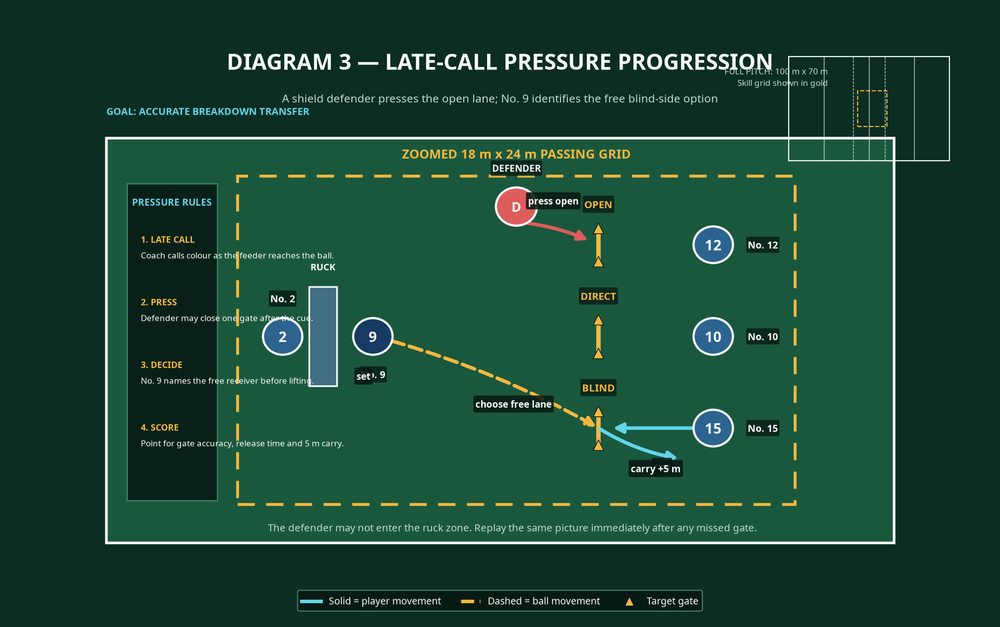
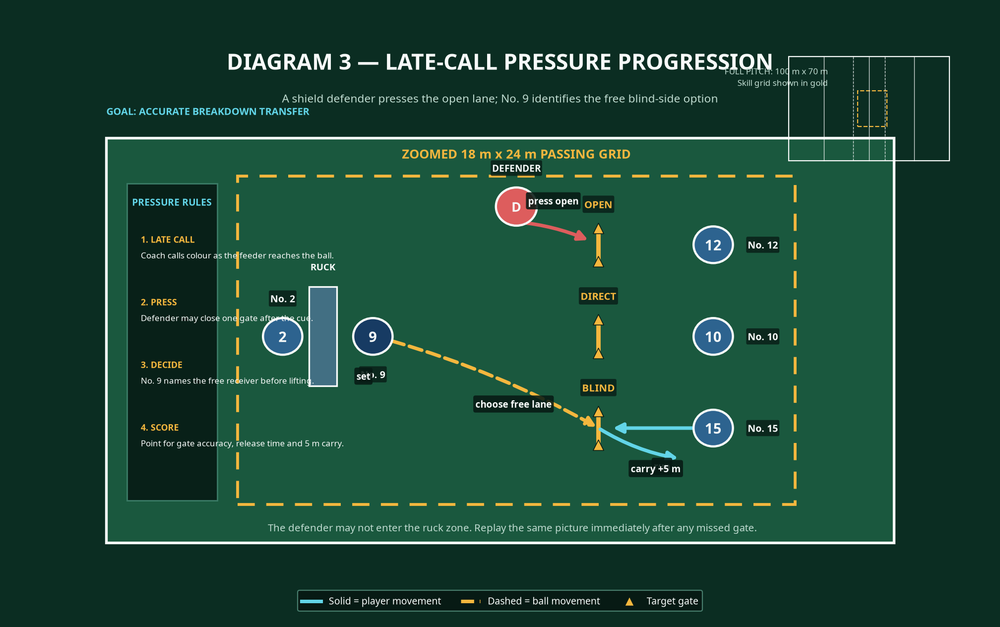
Start with the guided colour progression: the coach calls the gate early and receivers jog through it. This is the right entry point for a young or inexperienced 9, because it separates technical repetition from decision pressure. Then move to a late-call progression. The coach gives the colour as the feeder reaches the ball, so the 9 must arrive in balance and pass within 1.5 seconds. Record three successful passes out of four before switching sides.
For the game-ready progression, add a defender with a tackle shield 4 m in front of the ruck. The defender may press one gate after the feeder’s cue but cannot enter the ruck zone. The 9 must identify the open option, call the receiver’s name and pass to space. If the defender touches the ball or the pass misses its gate, replay the same picture immediately. A final variation is to make the 10 play a short second pass to the 12, which rewards an accurate first transfer and tests the whole connection from ruck to midfield.
Age Adaptations
For Under-8 and Under-10, remove the ruck pads, use two gates rather than three and shorten the passing distance to 4–5 m. Allow the 9 to set the ball on a cone before passing, and reward catches in front of the body rather than chase speed. At Under-12 and Under-14, use the full three-gate layout but keep the gates 6 m from the ruck; the coach gives the colour early and defenders remain passive. Introduce the phrase “arrive, square, pass” so every player has a simple technical sequence.
At Under-16 and open age, retain the 8 m pass and apply the 1.5-second release standard. Add the shield defender, require receivers to make live running lines and demand a second action after every catch. For senior groups, score each set: one point for gate accuracy, one for release time and one if the receiver carries over the gain-line cone. This gives your 9s a measurable standard and gives the unit a reason to communicate under fatigue.
Finish by asking the 9 what made the best passes feel different. The answer should be consistent: they arrived early, saw the picture before touching the ball and passed through the receiver’s running line—not merely toward a stationary teammate.
