

Football
Slalom Dribble & Precision Finishing Drill
Develop your players' close ball control, agility, and clinical finishing under pressure with this dynamic attacking drill.
What you need
Footballs, Training Cones, Full-size Goal
1. Overview
The Slalom Dribble & Precision Finishing Drill is a high-intensity attacking exercise designed to improve a player's ability to maintain close ball control while navigating through tight spaces, followed immediately by a composed finish on goal. This drill replicates match scenarios where an attacker must weave through defenders before getting a shot off. It is highly effective for developing agility, bilateral dribbling skills (using both feet), and the psychological composure required to finish accurately when fatigued.
This drill is ideal for the technical warm-up phase or the main attacking segment of your training session.
2. Setup
To set up this drill, you will need a standard football pitch (or a half-pitch measuring approximately 50m x 64m) and the following equipment:
- 1 Full-size goal
- 6-8 Training cones (tall or disc cones)
- An ample supply of footballs (at least 8-10)
- 1 Goalkeeper
- 4-8 Outfield players
Pitch Layout:
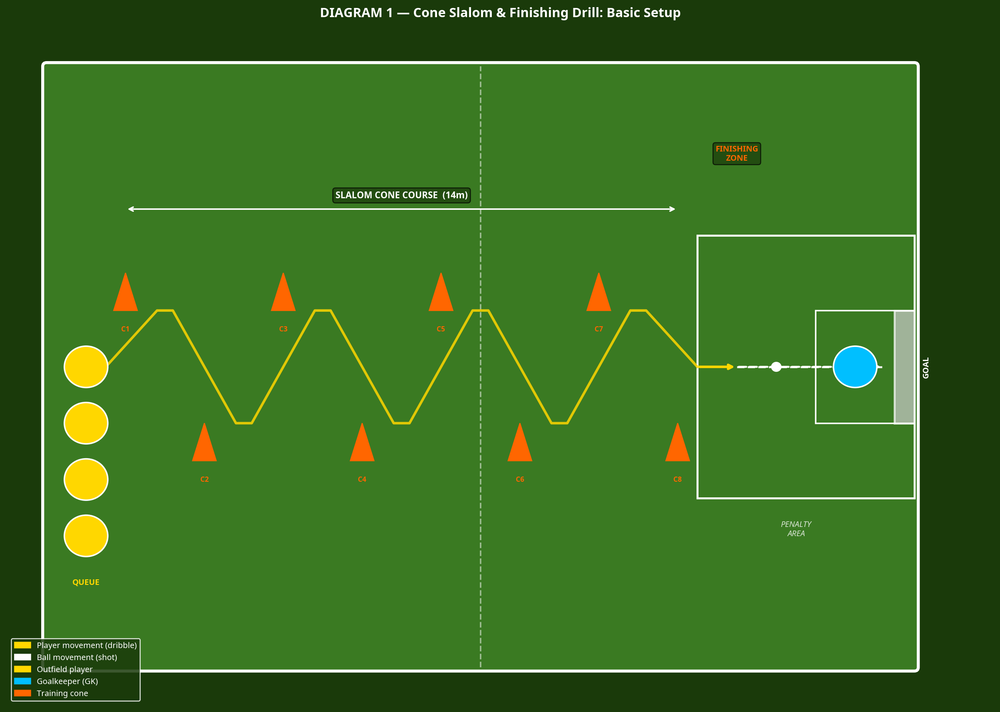
Position the starting point approximately 25-30 meters from the goal, centrally aligned or slightly offset to encourage angled finishes. Set up a slalom course using 6-8 cones spaced roughly 1.5 to 2 meters apart, depending on the age and skill level of your players. The final cone should be situated around the edge of the penalty area (18-yard box), creating a clear "finishing zone" between the last cone and the penalty spot.
3. Step-by-Step Instructions
- Starting Position: Players line up at the starting point (P1, P2, P3, etc.) with a football each. The goalkeeper takes their position in the goal.
- The Slalom: On the coach's whistle, the first player (P1) begins dribbling through the cone slalom. The player must weave in and out of every cone, keeping the ball close to their feet.
- The Transition: As the player clears the final cone, they must take a slightly heavier touch out of their feet into the designated "Finishing Zone" to set up the shot.
- The Finish: Without breaking stride, the player strikes the ball towards the goal, aiming for the corners.
- Rotation: After shooting, the player collects their ball (if it missed the goal or rebounded) and jogs back to the end of the queue. The next player in line begins their run as soon as the previous player takes their shot.
4. Key Coaching Points
- Close Ball Control: Encourage players to take multiple small touches rather than fewer large ones while navigating the cones. This keeps the ball protected and allows for rapid changes of direction.
- Use Both Feet: Players should utilize the inside and outside of both the left and right foot to maneuver the ball efficiently through the slalom.
- Head Up: While it is natural to look at the ball during the slalom, players must scan forward to assess the goalkeeper's positioning as they exit the final cone.
- The 'Setup' Touch: The touch exiting the final cone is critical. It must be angled towards the goal and pushed slightly ahead to allow the player to step into the shot with power.
- Composed Finishing: Emphasize accuracy over raw power. Players should aim for the bottom corners, using the side-foot for placement or the laces for a driven finish.
5. Common Mistakes
- Looking Down Continuously: Players staring only at the ball often run into the final cone or fail to see the goalkeeper's positioning, leading to poor shot selection.
- Taking Touches That Are Too Heavy: Pushing the ball too far ahead during the slalom results in a loss of control and disrupts the rhythm of the drill.
- Stopping Before Shooting: Players sometimes stop the ball dead after the slalom before shooting. Correct this by emphasizing a fluid motion where the final touch naturally sets up the strike.
- Leaning Back on the Shot: Leaning back causes the ball to sky over the crossbar. Remind players to keep their knee over the ball and their chest pointing towards the target area.
6. Variations & Progressions
To keep the drill challenging and engaging, introduce the following variations:
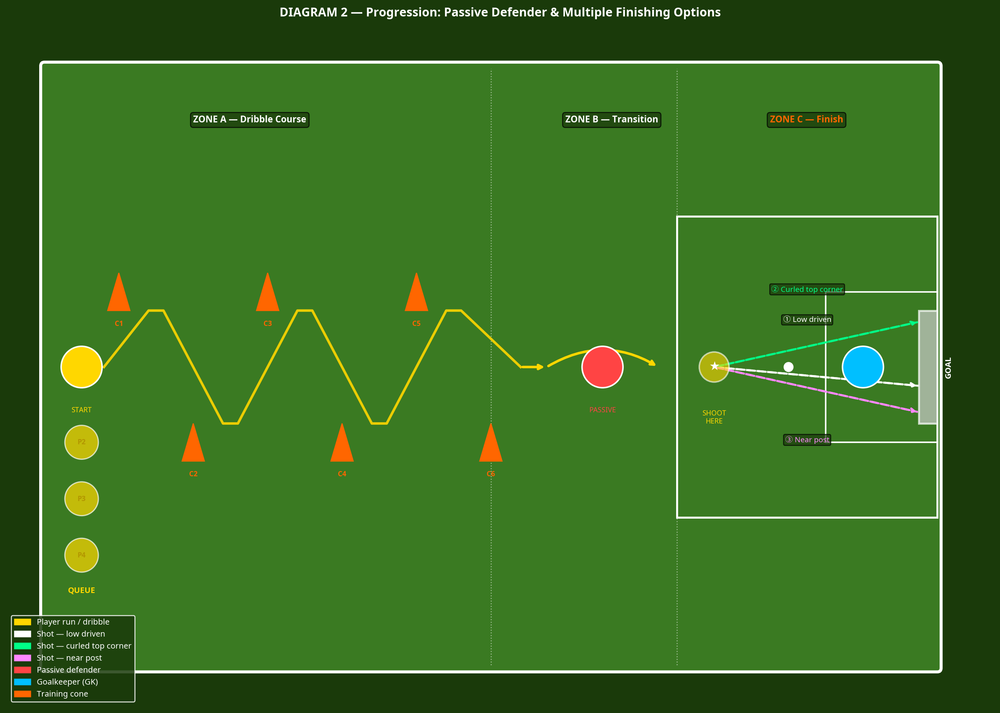
- Passive/Active Defender: Introduce a defender (as shown in Diagram 2) after the slalom course. Initially, the defender can be passive (acting as a visual obstacle), and later progress to active (applying light pressure to block the shot).
- Weak Foot Only: Mandate that the final shot must be taken with the player's weaker foot.
- Time Limit: Challenge players to complete the slalom and get their shot off within a specific time frame (e.g., under 6 seconds) to increase intensity and game realism.
7. Age Adaptations
- Under 8 / Under 10: Increase the distance between the cones to 2.5 - 3 meters to make the slalom easier. Focus heavily on basic dribbling mechanics rather than shooting power.
- Under 12 / Under 14: Standardize the cone distance at 1.5 - 2 meters. Introduce the requirement to use specific surfaces of the foot (e.g., outside of the foot only).
- Under 16 / Open: Decrease the cone distance to 1 - 1.2 meters to demand elite close control. Introduce an active defender and require the shot to be taken from outside the penalty area.
