

Rugby
Wide Overlap Play from Lineout: The 'Slice' Move
A high-tempo attacking set play from a full lineout designed to manipulate the defensive line, draw the outside centre, and create a lethal wide overlap for your winger.

What you need
Rugby balls (at least 3 for quick reps), Cones (to mark the gain line and starting positions), Tackle shields (optional, for defenders to hold during initial walk-throughs)
1. Overview
The "Slice" move is a classic wide overlap set play executed from a full 7-man or 6-man lineout. The primary objective is to generate quick front-foot ball, fix the defensive midfield using a hard-running decoy, and exploit the resulting space on the outside edge. This play is highly effective when used in the middle third of the pitch or just outside the opposition's 22-metre line, where there is ample width to exploit.
By running a forward (typically the openside flanker) on a hard, unders line as a decoy, the attacking team forces the defending inside centre (12) or fly-half (10) to bite inward. This creates a disconnect in the defensive line, allowing the attacking 12 and 13 to drift wide and deliver the final pass to the winger (14) or the fullback (15) joining the line, resulting in a clear overlap.
2. Setup
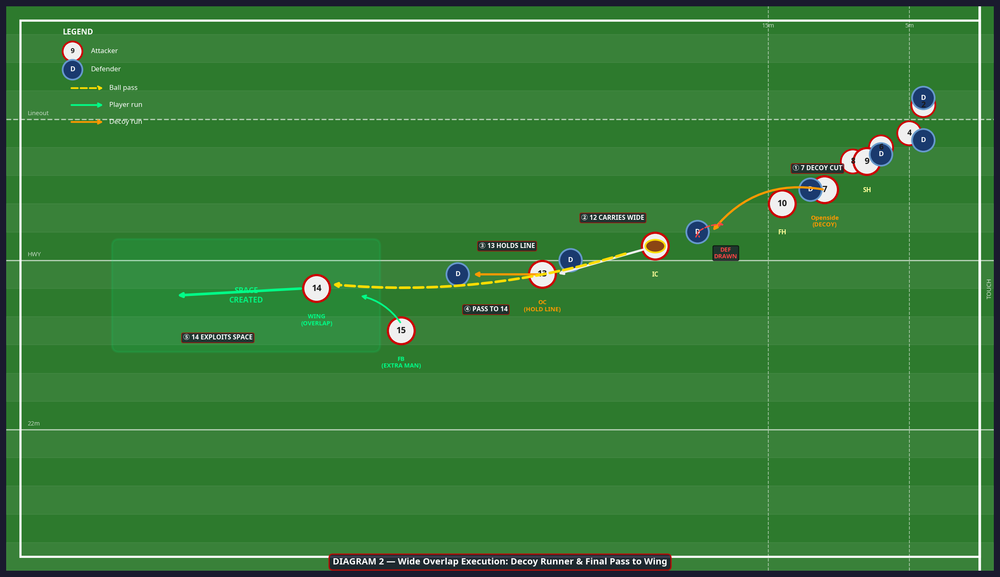
Pitch Setup:
- Location: Ideally between the 10m line and the opposition's 22m line.
- Width: A full 100m x 70m pitch allows for maximum width, but the play requires at least 40 metres of open space on the attacking side of the lineout.
Player Positions:
- Forwards: Standard full lineout setup (e.g., 2 throwing, 4/5 jumping, 6/8 lifting). The openside flanker (7) positions themselves at the tail of the lineout, ready to peel off.
- Backs: The scrum-half (9) is at the base. The fly-half (10) stands relatively flat to take the ball on the gain line. The inside centre (12) and outside centre (13) align with depth to allow for lateral movement. The winger (14) holds maximum width on the touchline. The fullback (15) positions themselves behind the centres, ready to inject pace as an extra man.
3. Step-by-Step Instructions

- The Catch and Delivery: The hooker (2) throws to the middle or back jumper (e.g., the lock, 4). The jumper delivers clean, quick ball off the top to the scrum-half (9).
- The First Pass: The scrum-half (9) fires a fast, flat pass to the fly-half (10), who is attacking the gain line.
- The Decoy Run (The 'Slice'): As the ball leaves the scrum-half's hands, the openside flanker (7) peels from the tail of the lineout and runs a hard, aggressive "unders" line (cutting back inside) directly at the channel between the defending 10 and 12.
- The Midfield Shift: The fly-half (10) takes the ball to the line, selling the dummy pass to the decoy (7). The defending 12 is forced to step in to cover the threat of the forward runner.
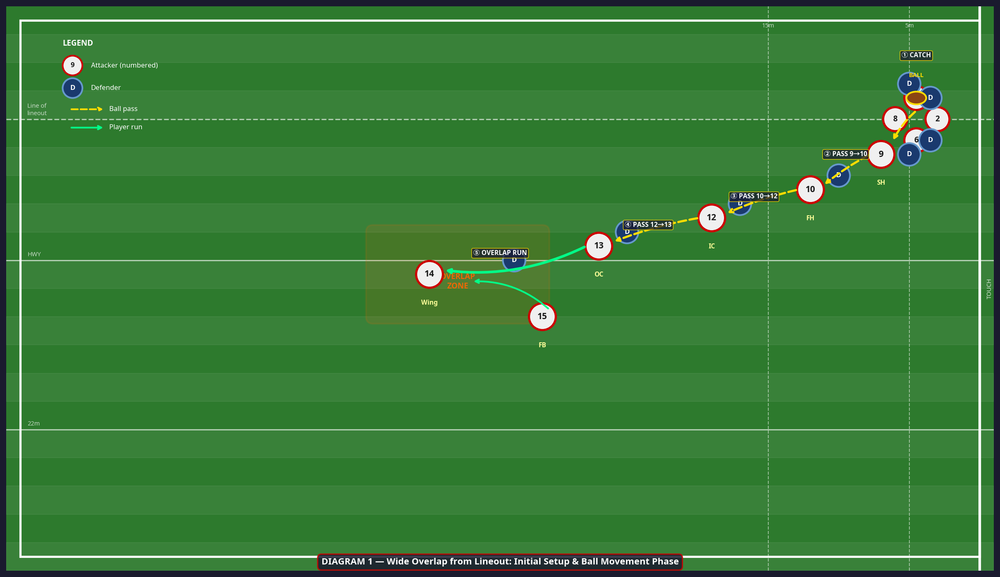
- The Wide Pass: Having fixed the inside defence, the fly-half (10) passes behind the decoy to the inside centre (12), who is drifting outwards.
- Holding the Edge: The outside centre (13) runs a straight, hard "overs" line to fix the defending 13. This prevents the defence from simply sliding out.
- The Overlap Execution: The inside centre (12) passes across the face of the 13 to the winger (14), who has maintained their width. Alternatively, the fullback (15) can enter the line outside the 13 to create a 2-on-1 against the defending winger.
- The Finish: The winger (14) accelerates into the space created on the outside edge, aiming for the corner.
4. Key Coaching Points
- Speed of Ball: The entire play hinges on the speed of the delivery from the lineout. Slow ball allows the defence to drift and nullifies the overlap.
- The Decoy Must Be Credible: The flanker (7) must run their line with 100% conviction, calling for the ball and expecting to receive it. If they jog or look disinterested, the defending 12 will ignore them and drift wide.
- Depth and Alignment: The 12 and 13 must start with sufficient depth. If they are too flat, they will overrun the pass or be easily closed down by a rushing defence.
- Holding Width: The winger (14) must resist the urge to creep infield. Staying on the touchline stretches the defence to its breaking point.
- Fixing the Defender: The 10 and 13 must commit their opposite numbers before passing. Passing too early allows the defence to slide; passing too late results in a tackle.
5. Common Mistakes
- Drifting by the Fly-Half: If the 10 drifts sideways before passing, they consume the space meant for the outside backs. The 10 must attack the line squarely.
- Poor Timing on the Decoy: If the decoy runner arrives too early, they are out of the play. If they arrive too late, they block the pass to the 12.
- Telegraphing the Play: If the 10 looks exclusively at the wide runners and ignores the decoy, the defence will read the play immediately.
- Winger Crowding: The winger coming infield too early, suffocating the space and allowing the defending winger to cover both the 13 and the 14.
6. Variations & Progressions
- The 'Pop' Option: If the defending 12 reads the wide play and drifts early, the fly-half (10) can actually pop the ball to the decoy runner (7) crashing through the gap.
- The Inside Ball: The 12 can receive the ball and immediately play a short inside pass to the blindside winger (11) coming off their wing, exploiting the space left by the drifting defence.
- Adding the Fullback: Instead of the 12 passing directly to the 14, the 12 passes to the 13, and the fullback (15) joins the line outside the 13, creating a 3-on-2 scenario on the edge.
7. Age Adaptations
- Under 10s / Under 12s: Simplify the play. Remove the forward decoy runner. Focus purely on quick hands down the line (9-10-12-13-14) and teaching the players to draw their man before passing.
- Under 14s: Introduce the decoy runner, but perhaps use the blindside winger (11) instead of a forward, as they may be more accustomed to running backline angles.
- Under 16s / Open: Execute the full play as described. Emphasize the importance of the 10 taking the ball to the line and the precise timing of the decoy run.
