

Football
4v4 Channel Transitions: Counterpress to Switch
Develop relentless counterpressing and rapid attacking transitions in this high-intensity 4v4 small-sided game.

What you need
Flat markers or cones for pitch boundaries and channels, 4 x 2m mini-goals, Bibs (two contrasting colors), Large supply of footballs
Overview
Transition moments dictate modern football. The split second after the ball is lost or won is when teams are most vulnerable, and when the best teams are most lethal. This high-intensity 4v4 small-sided game conditions players to react instantly in these phases.
By incorporating wide channels and a strict six-second counterpress rule, coaches can train their players to lock the opponent in upon losing possession, and to secure the first pass and exploit space rapidly upon regaining it. It is an excellent main-session drill for developing team cohesion, transitional speed, and spatial awareness.
Setup
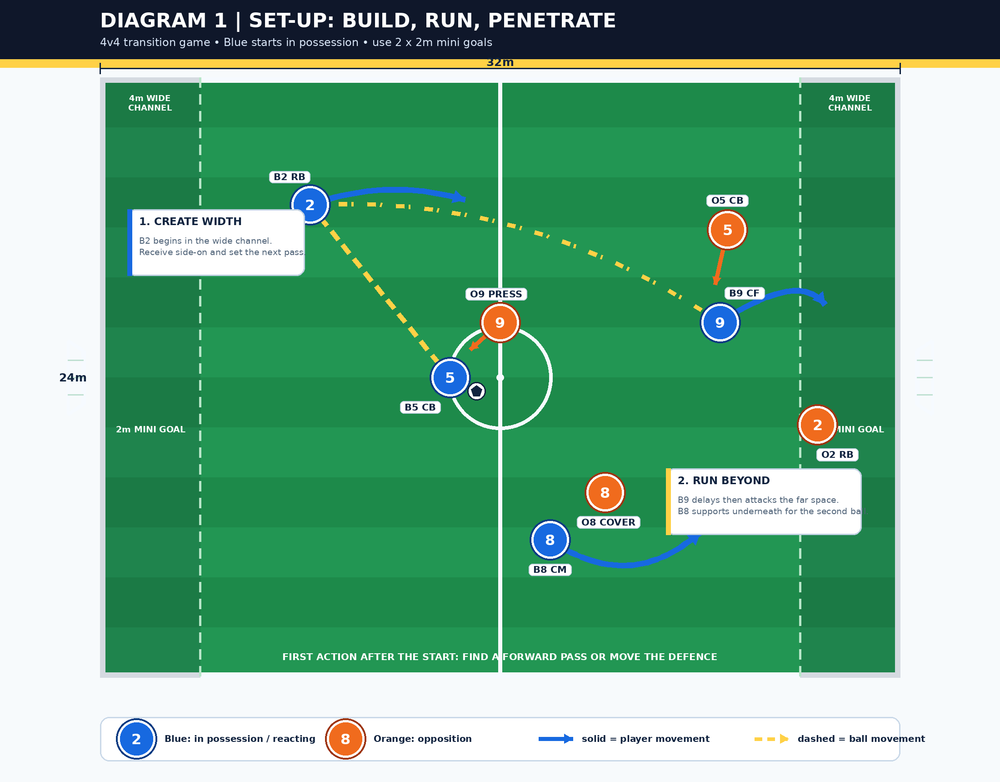
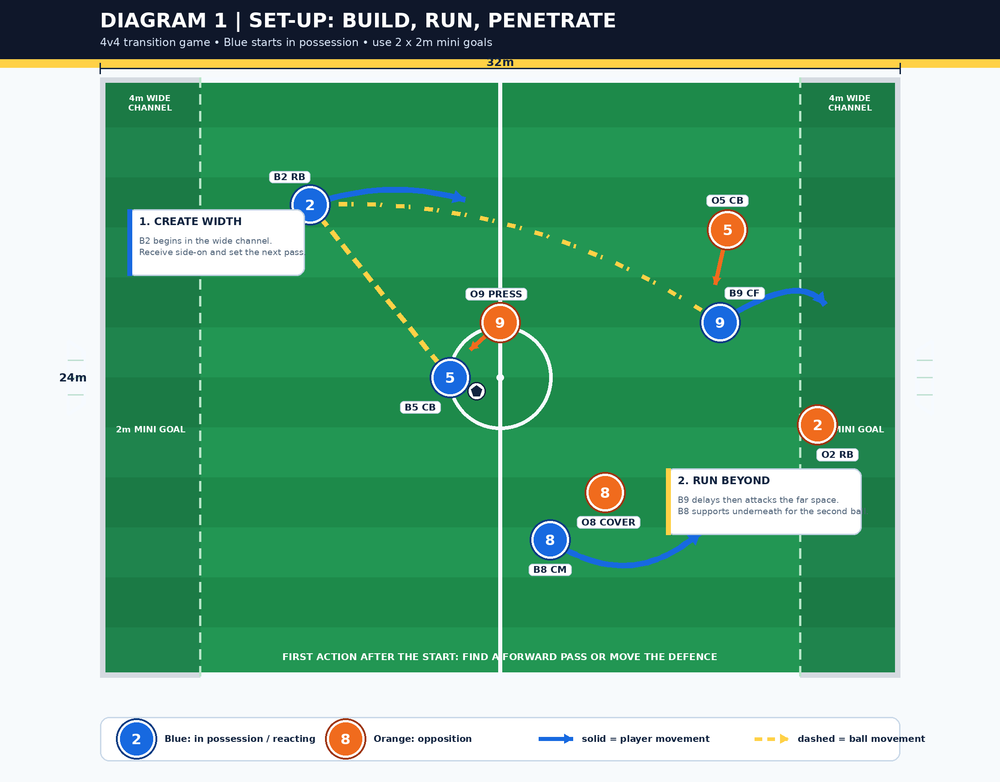
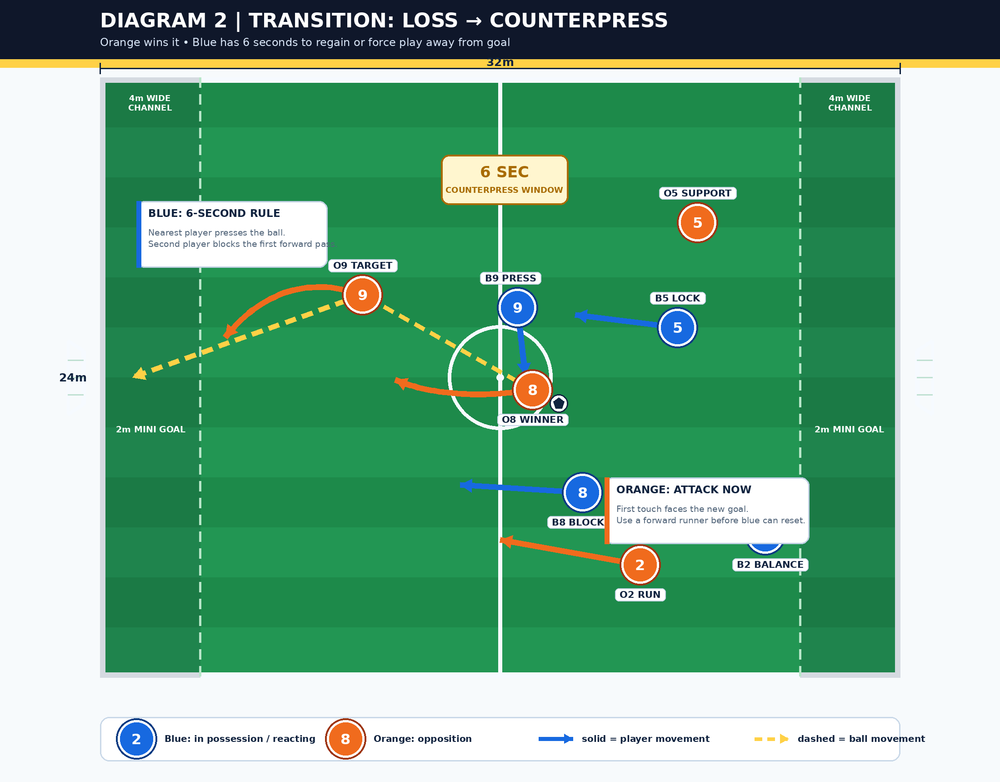
To ensure the drill flows at match speed, proper setup is critical. You will need a pitch size of 32m length by 24m width, which provides enough space for realistic passing while keeping the pressure high.
Mark out a 4m wide channel down both flanks using flat markers or cones. Place two 2m mini-goals at each end of the pitch, positioned centrally.
Divide your squad into two teams of four. For this example, we use Blue and Orange. A typical shape for this 4v4 is a 1-2-1 diamond (e.g., one centre-back, two wide players/midfielders, and one striker). Provide a large supply of footballs next to the coach on the touchline to keep the game continuous when the ball goes out of play.

Step-by-Step Instructions
- Initiate Play: The coach serves the ball to the Blue team to start the drill. Blue must attempt to build possession and score in either of the Orange team's mini-goals.
- Utilize Channels: To score, the attacking team must have at least one player occupying the wide 4m channels to stretch the defensive block.
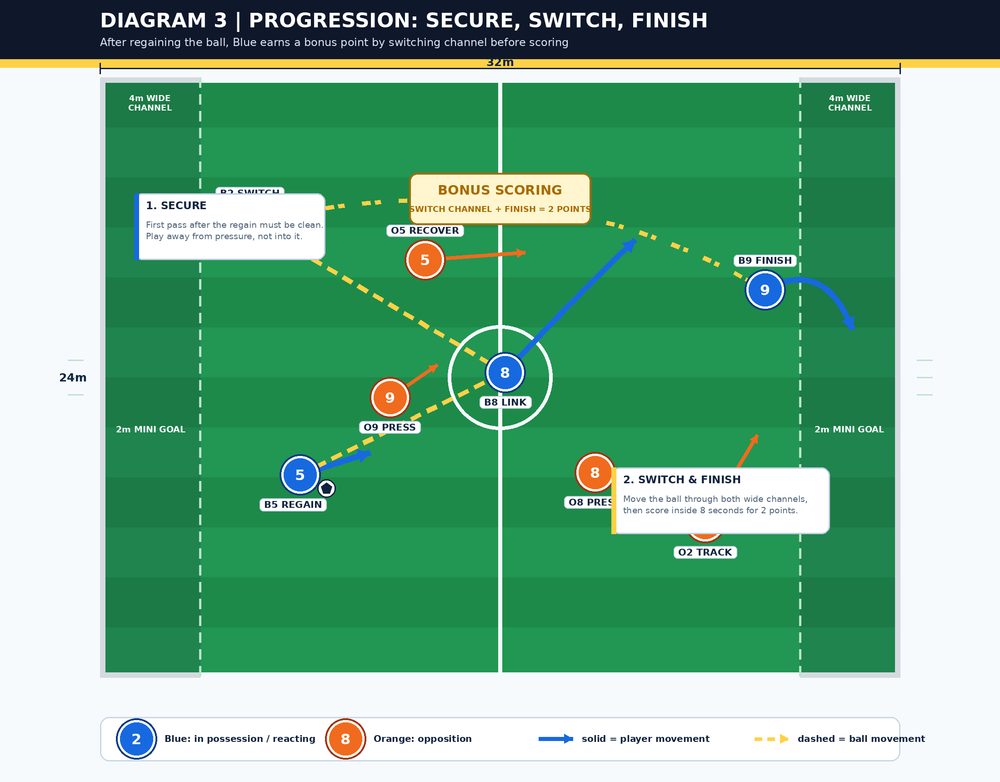
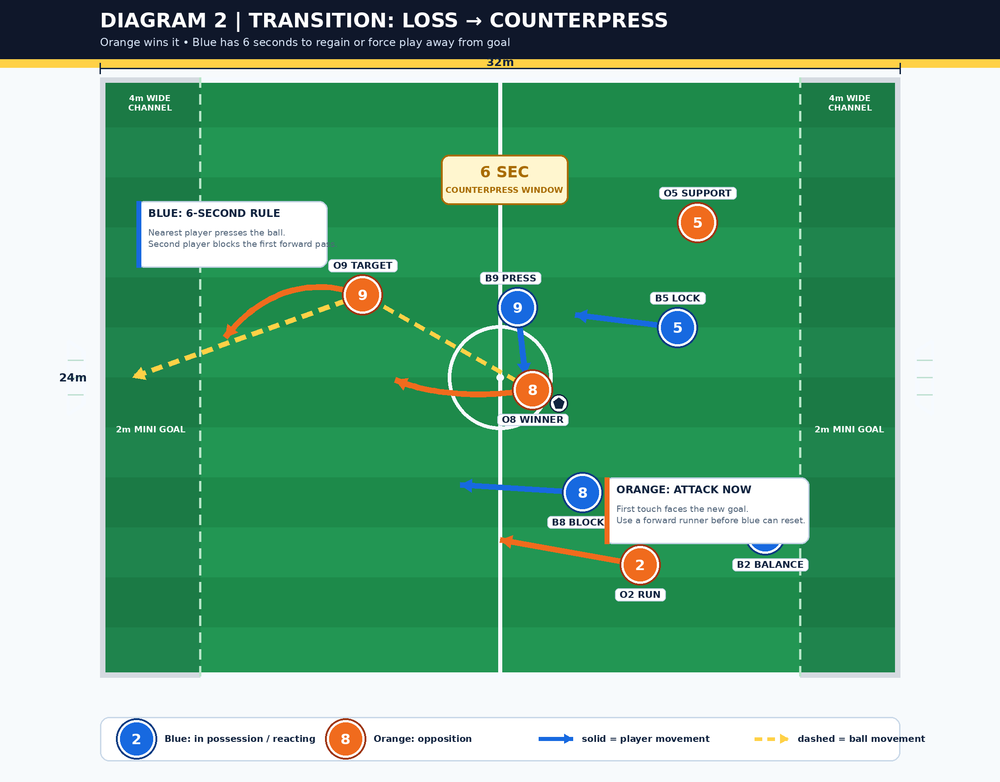
- React to Loss of Possession: If Orange intercepts the ball or tackles a Blue player, the transition phase begins immediately.
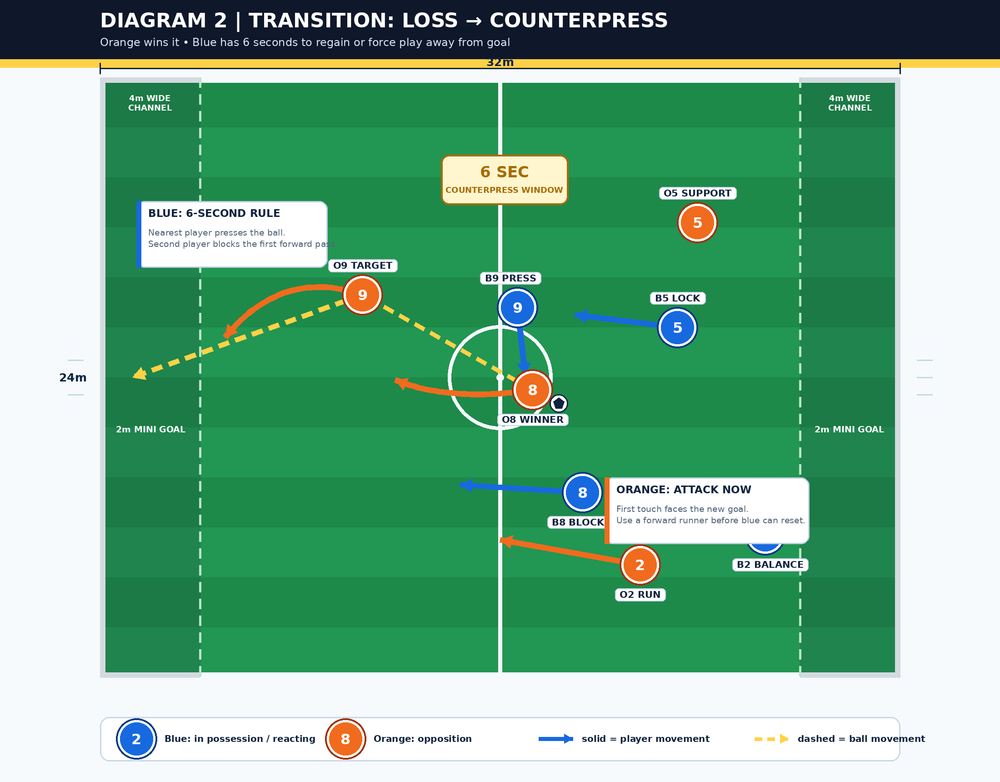
- The Six-Second Counterpress: Upon losing the ball, the Blue team has exactly six seconds to counterpress aggressively. Their objective is to win the ball back or force Orange to play backwards or out of bounds.
- The Attacking Transition: If Orange wins the ball, they must attempt to score as quickly as possible, exploiting the disorganized Blue shape before they can recover.
Key Coaching Points
Effective execution of this drill relies on coaching the specific triggers and behaviors of transitional play.
First, emphasize the immediate reaction to losing the ball. The closest player to the ball must press the ball carrier instantly to delay the forward pass, while the second closest player must block the most dangerous passing lane. There should be no hesitation or disappointment; the reaction must be aggressive and coordinated.
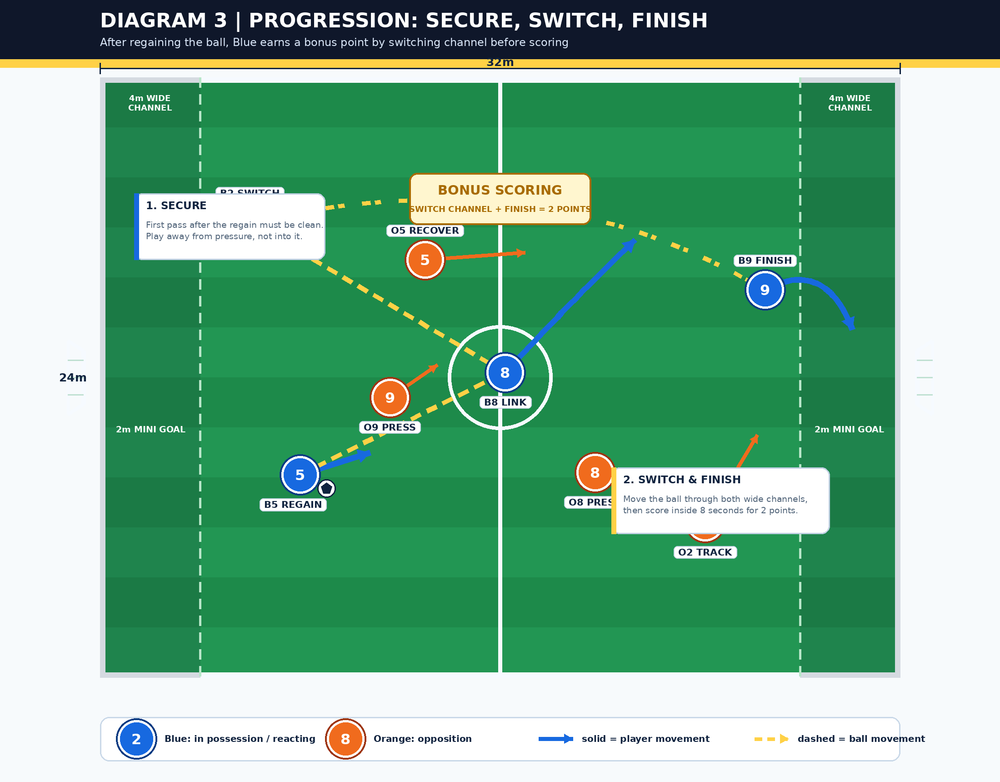
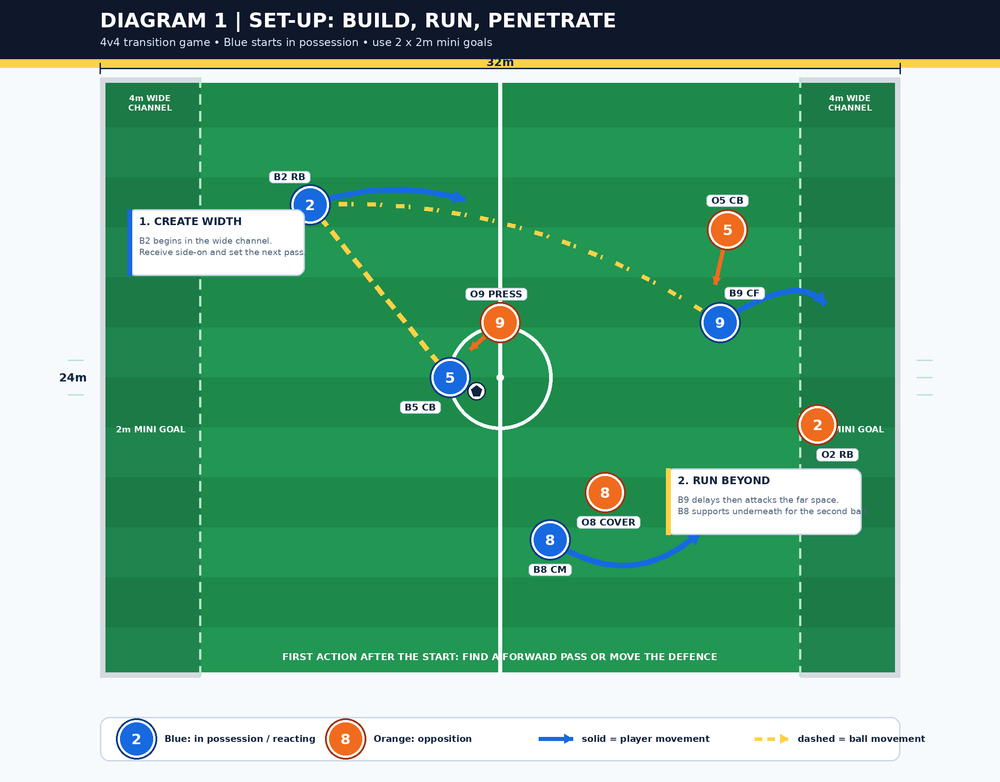
Second, coach the first pass after regaining possession. When a team wins the ball, the first pass is the most important. It must be clean and directed away from the immediate pressure. Encourage players to find a teammate in space rather than turning blindly into a tackle.
Third, focus on attacking with speed. In an attacking transition, the objective is to exploit the opponent's disorganization. The first touch should be forward if space allows, and runners must sprint aggressively to offer forward passing options.
Common Mistakes
Coaches should watch for several common errors that break down the drill's effectiveness.
A frequent issue is dropping deep instead of pressing. When the ball is lost, players often naturally drop back to defend their goal. In this drill, you must demand they step forward to engage the ball carrier immediately to enforce the counterpress.
Another mistake is forcing the forward pass upon regain. Players who win the ball often try to play a killer pass immediately, even if it is heavily contested. Teach them to secure the ball with a safe pass if the forward option is not clearly available.
Finally, watch for static wide players. The 4m channels are useless if players do not make dynamic movements into them. Wide players must time their runs to arrive as the ball is played, rather than standing still and waiting for it.
Variations & Progressions
To increase the difficulty and focus on different tactical elements, introduce these progressions.
The Switch Bonus: Award two points if a team wins the ball, switches play through both wide channels, and then scores within eight seconds. This encourages expansive play immediately after securing possession.
Touch Limits: Restrict players to two touches in the central zone, but allow unlimited touches in the wide channels. This forces quick combination play centrally while encouraging 1v1 dribbling out wide.
Age Adaptations
For younger age groups (Under-10 to Under-12), the tactical demands of a coordinated counterpress may be too complex.
Instead of a strict six-second rule, simply encourage them to "win it back quickly." You can also increase the pitch size slightly to give them more time on the ball, and use larger goals with goalkeepers to increase scoring success and enjoyment. Focus heavily on the technical execution of the first pass after winning the ball.
