

Basketball
Baseline Box Inbound: Double Down Screen to Wing Pop and Rim Cut
Teach a dependable FIBA baseline inbound that uses a box alignment, two legal down screens, and simple defender reads to create a wing shot or rim finish.
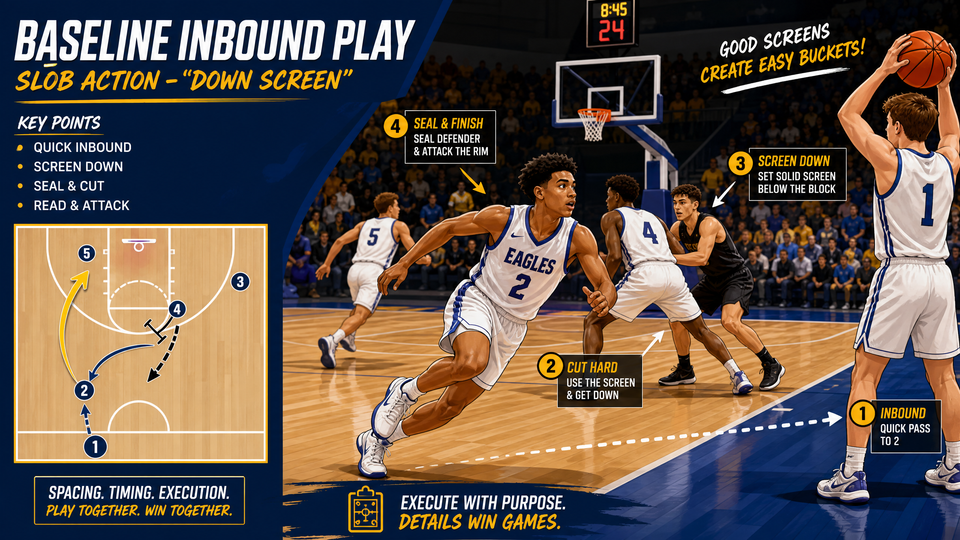
What you need
1 regulation basketball, FIBA half-court and basket, 8 flat markers or cones, 10 pinnies for offense and defense, Coach’s whiteboard or clipboard
1. Overview
Baseline Box Inbound — Double Down Screen to Wing Pop and Rim Cut is a five-player baseline out-of-bounds (BLOB) set that gives your team two clean first-look scores without overloading the inbounder. The box alignment crowds the lane, makes the defense negotiate traffic, and then releases two receivers in opposite directions: a wing pop for Player 2 and a rim cut for Player 3. Players 4 and 5 create the separation with disciplined down screens, then become your rebounding and sealing presence.
Use it after a dead ball under your basket, particularly when you have a reliable shooter at the 2, a quick cutter at the 3, and two players who can screen without drifting. It is most effective against a team that denies hard, top-locks wing cuts, or switches every screen. The diagrams use a FIBA full-court reference of 28 m × 15 m; the working half-court is 14 m × 15 m. FIBA also requires the throw-in player to release the ball within five seconds, so teach the inbounder to identify the first read early rather than holding the ball and hoping the action appears. 1
2. Setup
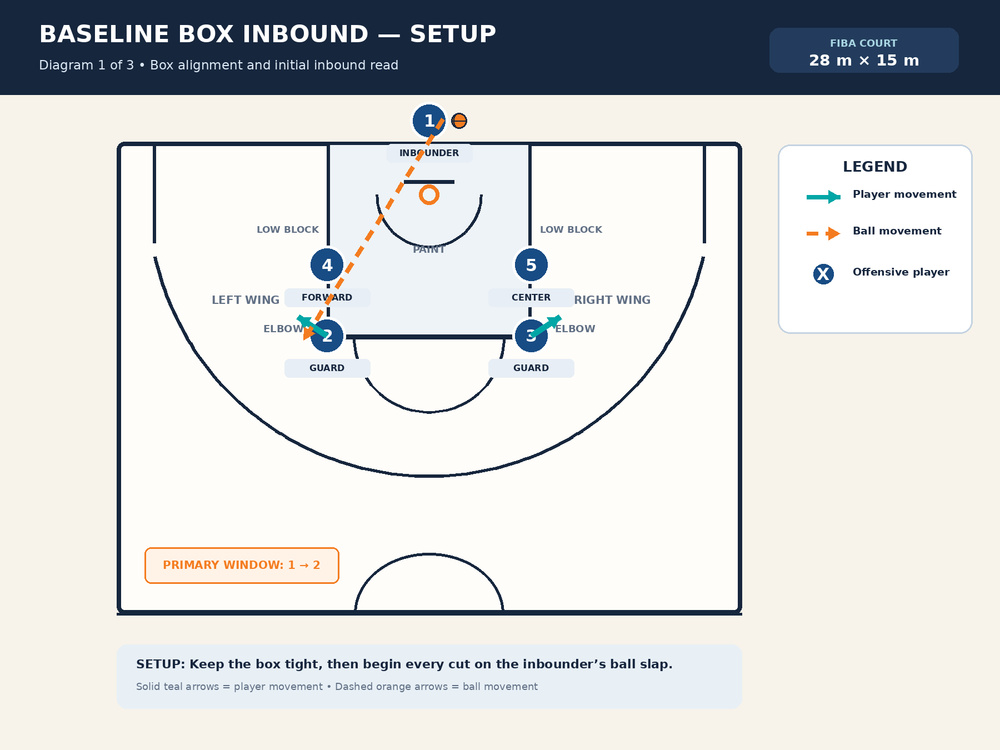
Set the action on the offensive baseline, using the painted lane and elbows as landmarks. Put Player 1, the point guard (PG), at the referee’s designated inbound spot. Player 2, the shooting guard (SG), begins at the left elbow; Player 3, the small forward (SF), begins at the right elbow. Player 4, the power forward (PF), starts at the left low block, while Player 5, the center (C), starts at the right low block. Flip left and right if your preferred shooter is on the opposite side.
| Player | Start spot and spacing | Primary responsibility |
|---|---|---|
| 1 — PG | Out of bounds on the baseline, ball ready; scan the defender and both wings. | Trigger, read, and deliver a direct pass. |
| 2 — SG | Left elbow, with feet about 0.5 m outside the lane line. | Use 4’s screen to pop to the left wing. |
| 3 — SF | Right elbow, with feet about 0.5 m outside the lane line. | Use 5’s screen, then cut to the rim if the defender top-locks. |
| 4 — PF | Left low block, about 1 m above the baseline. | Set the left down screen; release to weak-side rebound. |
| 5 — C | Right low block, about 1 m above the baseline. | Set the right down screen; seal and hunt the front of the rim. |
Use one ball, eight flat markers or cones, pinnies, and a full basket. Mark each wing window with a cone roughly 0.5 m inside the three-point arc and 2–2.5 m below the free-throw-line extended. Rehearse without defenders first, then add live matchup defense.
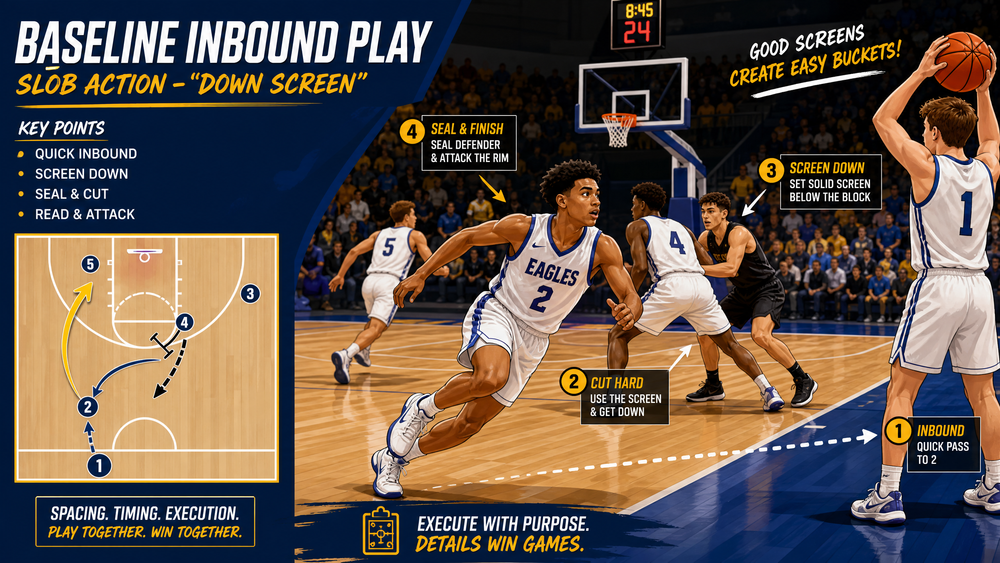
3. Step-by-Step Instructions
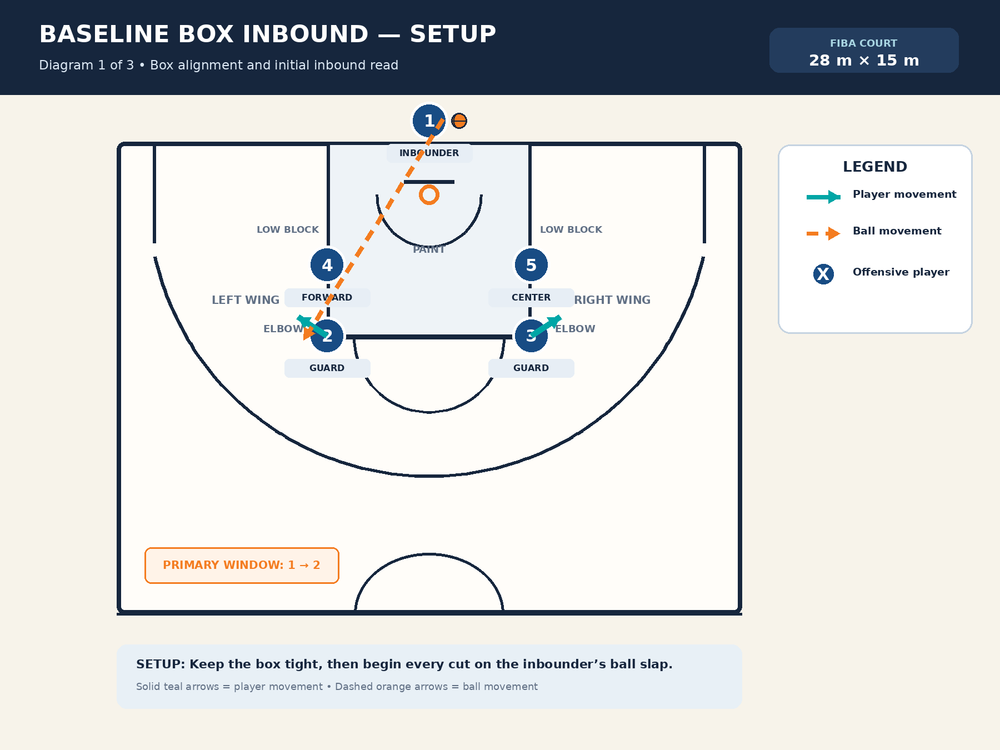
Build the box and name the target. Put 2 and 3 at the elbows, with 4 and 5 on the low blocks. Before the ball is live, call the primary side: “Two” targets 2’s wing pop; “Three” flips it. Player 1 scans the pop and counter before the trigger.
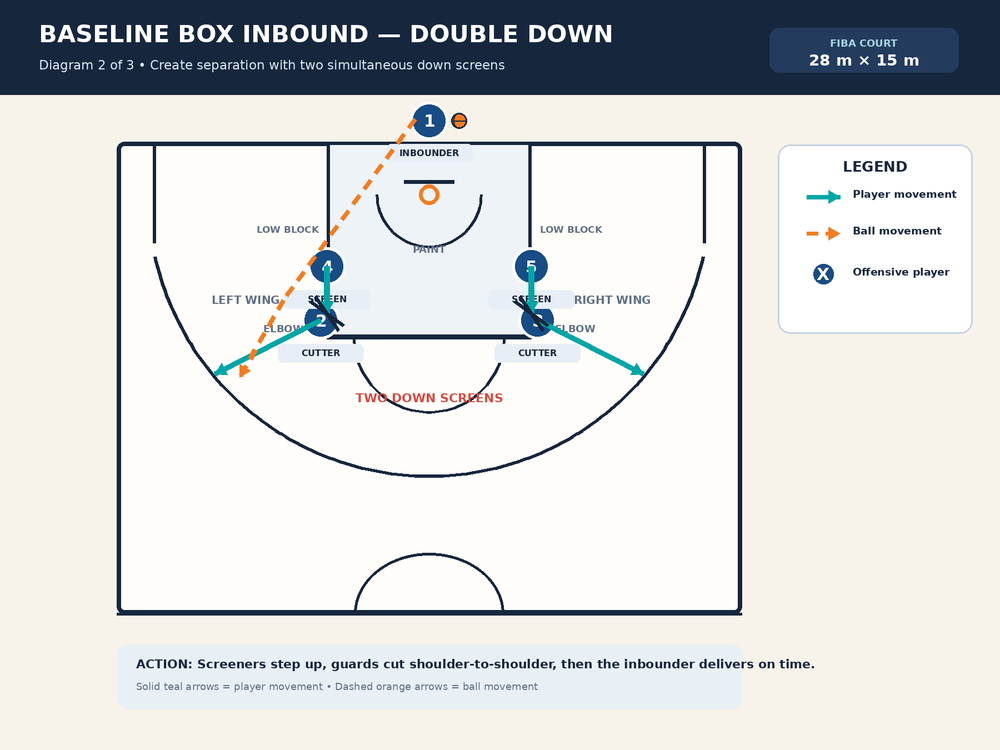
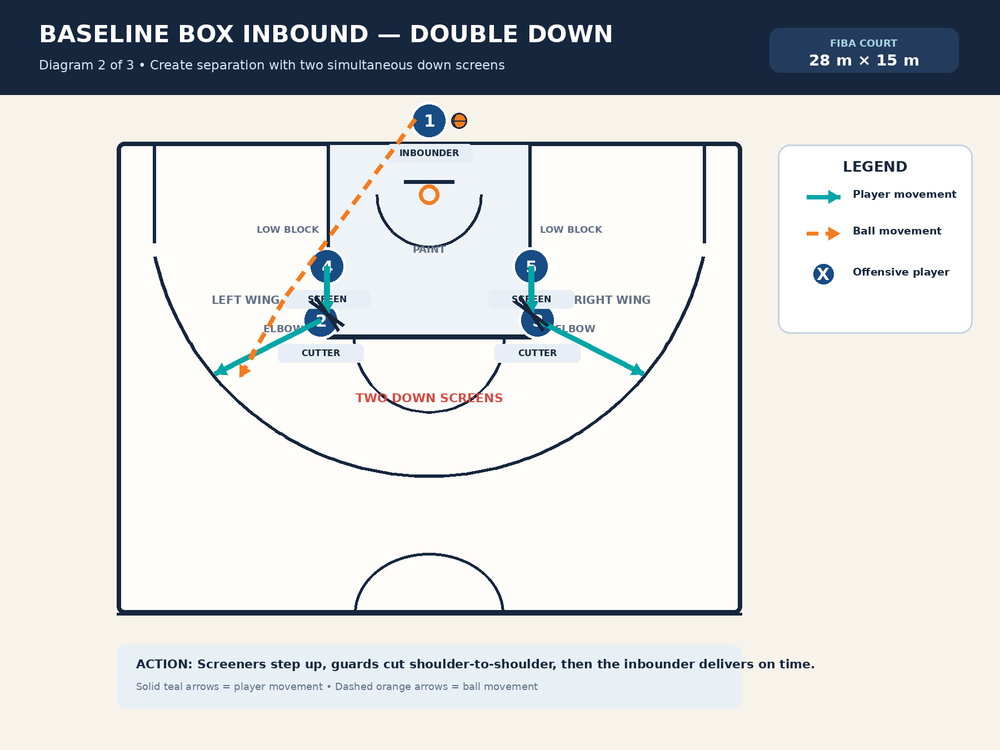
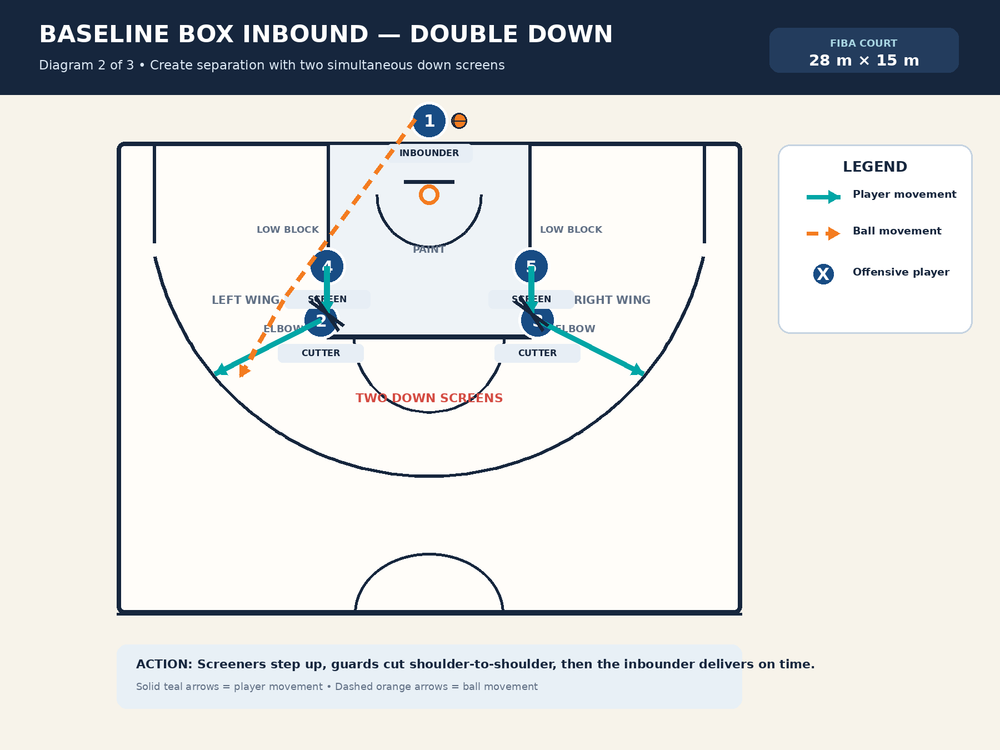
Trigger on the ball slap. When 1 slaps the ball, 4 and 5 take one hard step up the lane toward the elbow line. Their job is to arrive first and set a legal, stationary screen approximately 0.75 m below the cutter’s defender. Their chest faces the sideline, their feet are wider than shoulder width, and their hands stay tight to the body. Do not let the screeners chase the defender.
Create the cut window. On the same trigger, 2 and 3 sell a short step toward the paint, then sprint shoulder-to-shoulder off their respective screens. The first three strides are decisive. 2 uses 4’s screen and flares toward the wing cone. 3 uses 5’s screen, initially showing the same wing route. The screen-cutter distance should be close enough to brush a jersey; a 0.5 m gap is enough for a defender to squeeze through.
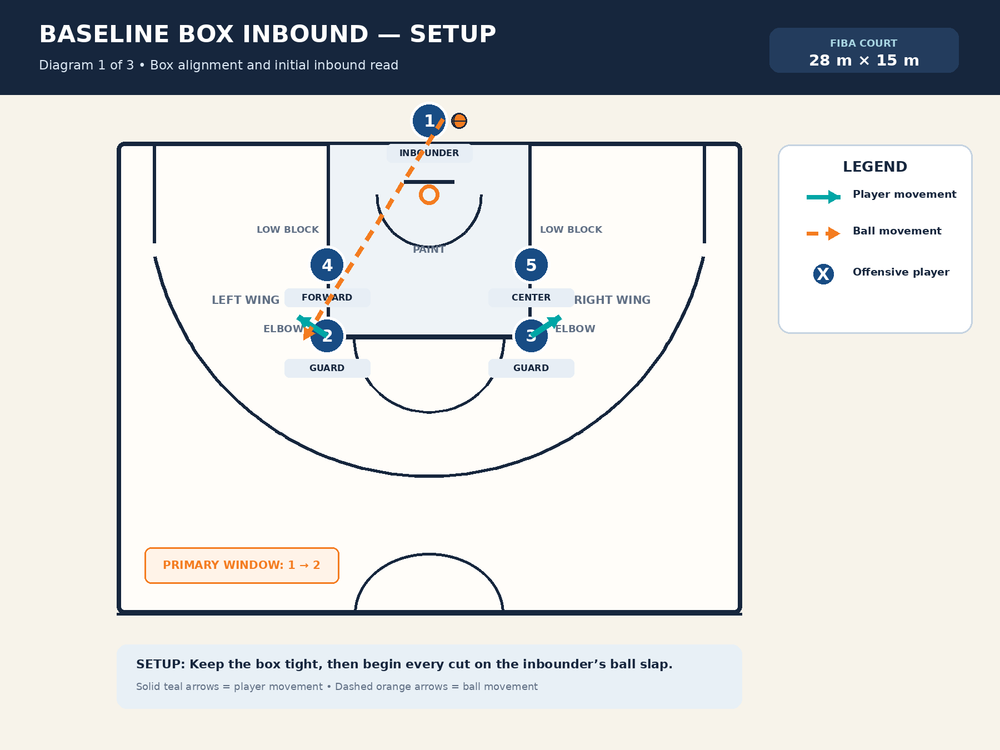
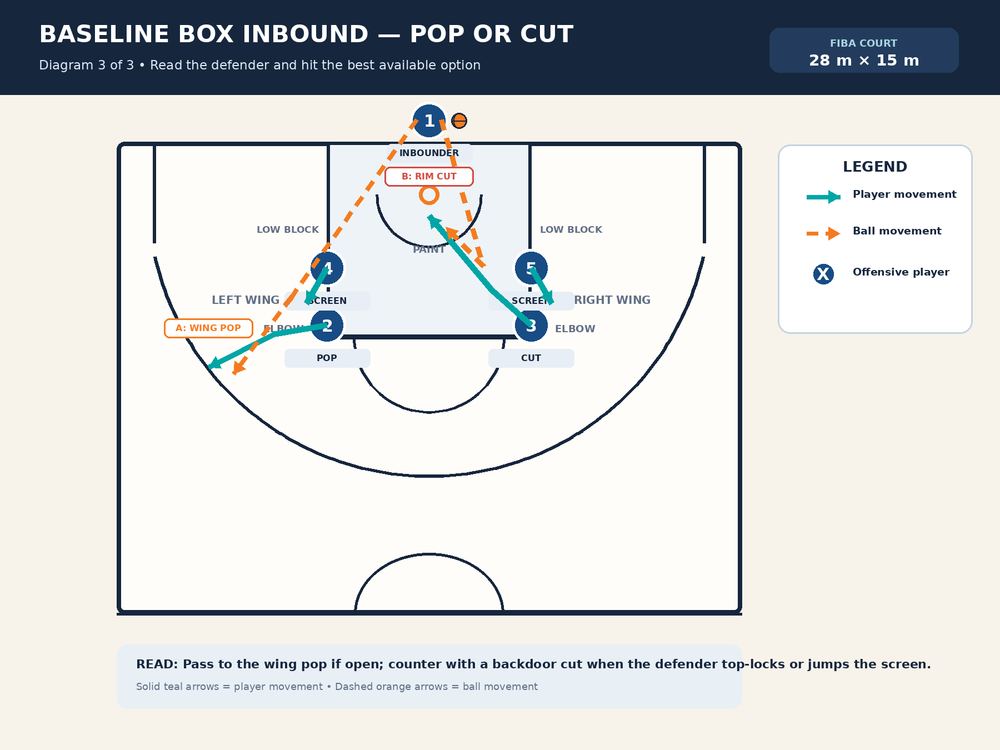
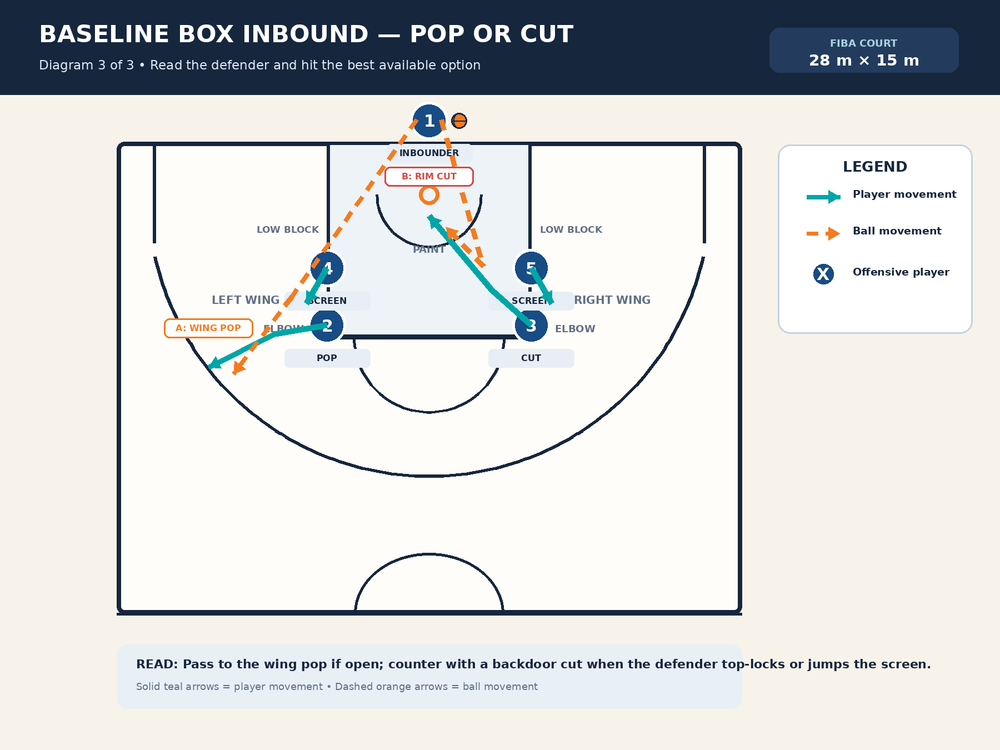
Make the first read: 2’s wing pop. If 2’s defender trails over the screen, 1 throws a sharp chest pass or outside-hand bounce pass to 2 at the wing. The pass should arrive at 2’s shooting pocket, not at the knees. 2 catches with inside foot down, squares immediately, and shoots or attacks the closeout. On the pass, 4 turns and pursues the weak-side rebounding lane, while 5 pins the nearest big on the front of the rim.
Make the counter read: 3’s rim cut. If 3’s defender top-locks, jumps to the high side, or tries to deny the wing pop, 3 plants the outside foot and cuts backdoor through the middle of the paint. 1 gives a straight-line lead pass to the space just above the restricted area. Do not throw the ball directly at the cutter’s back. Lead 3 to the rim so the catch becomes a one-step finish. If the defense switches, 5 immediately seals the smaller switch defender for a second interior option.
Use the safety valve and finish the possession. If both first options are covered at about 3.5 seconds, 4 flashes to the near elbow (or use 5 as the fixed safety). Player 1 passes safely, steps in bounds, and the team flows into its half-court offense. One screener seals; the other attacks the weak-side board.
4. Key Coaching Points
| Coaching point | What the coach should demand |
|---|---|
| Timing before speed | Screeners move on the slap; cutters leave only when the screen is set. A fast early cut destroys the screen. |
| Legal, physical screening | Feet are planted, hips low, hands in, and the screener absorbs contact without leaning or extending. |
| Shoulder-to-shoulder routes | The cutter must brush the screener and sprint into space. Rounded routes allow the defender to recover. |
| Inbounder eyes and pass shape | 1 scans rim, wing, and safety in that order. Pass on time, with a flat trajectory and a target hand. |
| Read the defender, not the call sheet | A trail means pop; top-lock or denial means backdoor; switch means seal the mismatch. |
| Rebounding discipline | 4 and 5 finish the screen by finding a body and attacking opposite lanes, not admiring the shot. |
5. Common Mistakes
The most common breakdown is a moving screen. Freeze the screener on the catch and require a visible stop before the cutter leaves. Next, correct the wide curl: 2 or 3 must brush the screener rather than drift around it. A cone 0.5 m from the screener gives players a visible route target.
Also correct the telegraphed inbound pass. Player 1 looks at the rim cut first, then snaps eyes to the wing. Finally, prevent a no-safety scramble by installing one rule: “Red” sends 4 to the near elbow while the others space and rebound.
6. Variations & Progressions
| Variation or progression | How to run it | Coaching benefit |
|---|---|---|
| Single-side teaching version | Keep 3 in the weak-side short corner and run only 2 off 4’s screen. | Makes the first practice repetition simple and lets 1 master a single pass. |
| Switch counter | Tell 5 to screen then immediately seal the switched guard on the front of the rim; 1 looks 2, then 5. | Punishes automatic switching and develops post seals. |
| Zone version | Have 2 and 3 flare to both short corners while 4 flashes to the nail. 1 reads the low defender first. | Creates a clean entry against a compact 2–3 or matchup zone. |
7. Age Adaptations
For Under 8, remove the double screen. Use one cutter, one target cone, and a coach as inbounder; reward a strong pass and a two-foot finish. For Under 10, retain the box but teach only the wing pop against a passive defender.
For Under 12, add the second cutter and shoulder-to-shoulder route. At Under 14, add the top-lock cue and require 3 to call “backdoor.” For Under 16 and open-age groups, make the action live, allow switching and denial, and grade legal screens, a pass by 3.5 seconds, and two players on the glass.
Finish with three consecutive live reps from each side. A group advances only after it creates a shot-quality advantage on two of the three reps without a turnover or moving-screen call.
