

Basketball
Post Moves & Footwork: Catch, Read, Finish Drill
A repeatable 20-minute post-development drill that teaches the 5 to establish position, read pressure, and finish with a decisive baseline or middle move.

What you need
1 FIBA basket and half-court, 4-6 basketballs, 6 flat cones, 2 contact pads, 1 stopwatch or practice clock
Overview
The Post Moves & Footwork: Catch, Read, Finish Drill gives coaches a progression for teaching interior players how to create a scoring chance without rushing the shot. It is not a catalogue of fancy moves. The emphasis is on the habits that travel into games: win the low-block catch, land balanced on two feet, identify where the defender is vulnerable, and finish through the available gap. Run this drill in the skill-development portion of practice, ideally after a short finishing warm-up and before live 1v1 or shell work. It is designed around the 5, but 4s, bigger wings, and guards who must punish a switch can all take reps.
Use one FIBA half-court within the full 28 m × 15 m court. The working area is the lane, the two low blocks, and the adjacent wings. Keep each coaching block short and specific: one move at a time, then a decision. The benchmark is not simply makes. The benchmark is whether the player gets a legal, balanced catch and produces the correct finish from the defender’s body position.
Setup
Set up on one basket with six players: a 1 (point guard) at the top or slot, a 3 (wing) on the right wing, a 5 on the right low block, and three players waiting behind those spots to rotate. Place one flat cone approximately 1.5 m from the baseline to mark the low-block starting point, and another cone on the opposite block for the next group. Use four to six balls, two contact pads, six flat cones, and a stopwatch. If you have 12 or more players, mirror the drill at both baskets.
The passer stands 6–7 m from the post. The 5 starts with their inside foot near the lane line, body between the defender and the ball, and a clear target hand. A coach or a designated defender starts behind and slightly above the post player. The coach calls either "baseline" or "middle" before the catch in the early phase; later, the defender’s top foot and pressure provide the read. Keep the lane clear in the teaching phase so players can see the finish window.
Court Picture: Entry, Seal and Catch

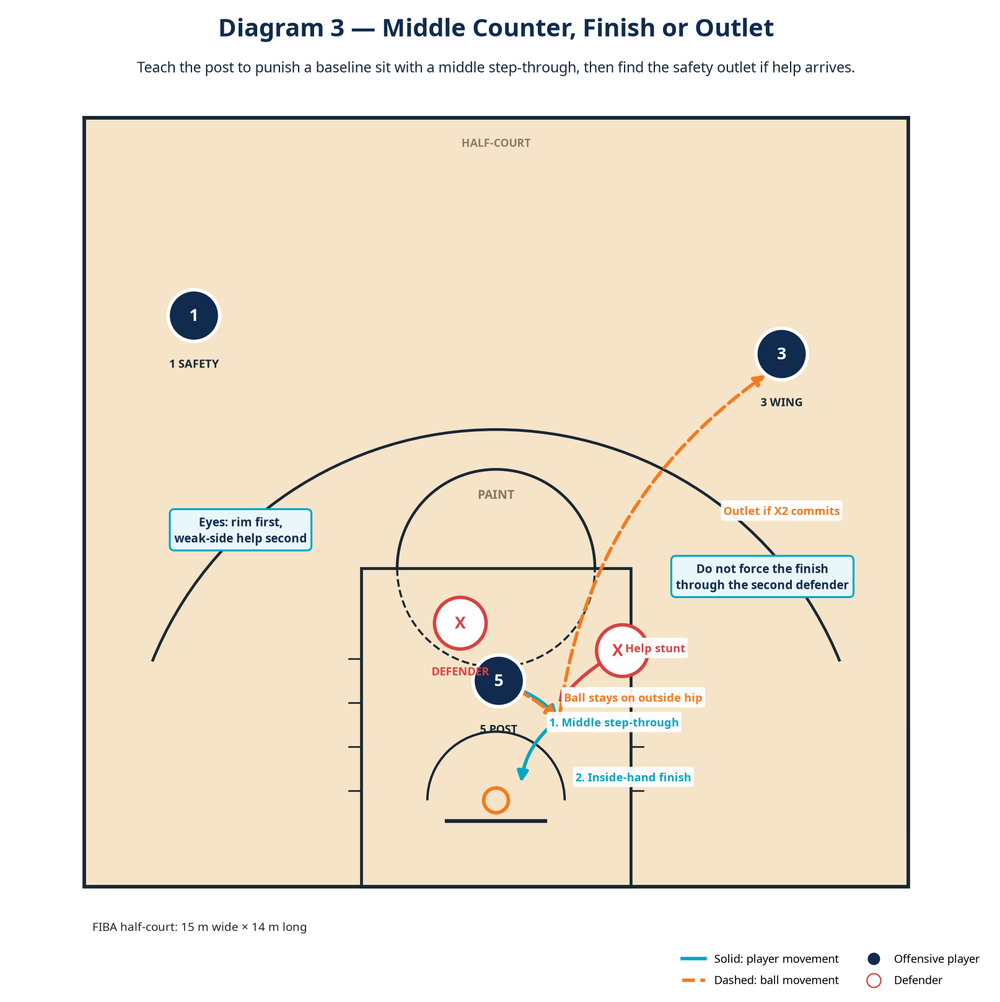
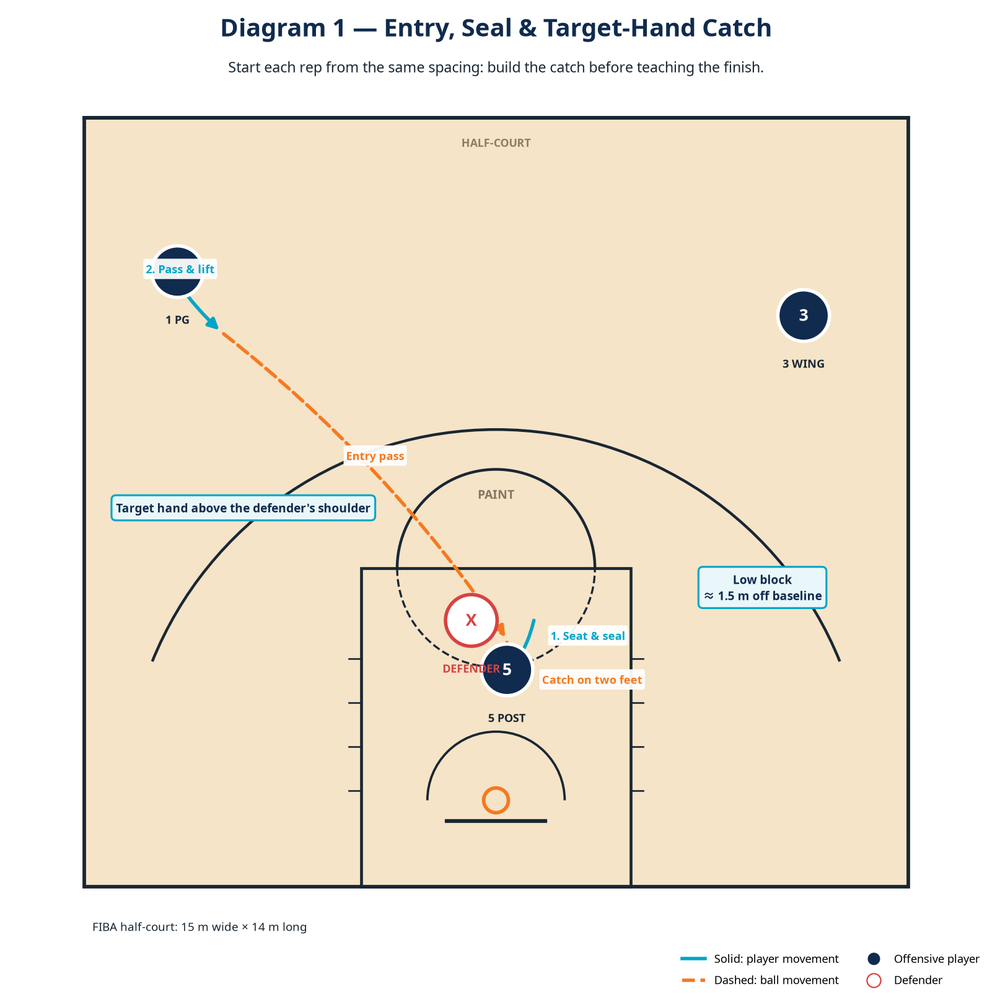
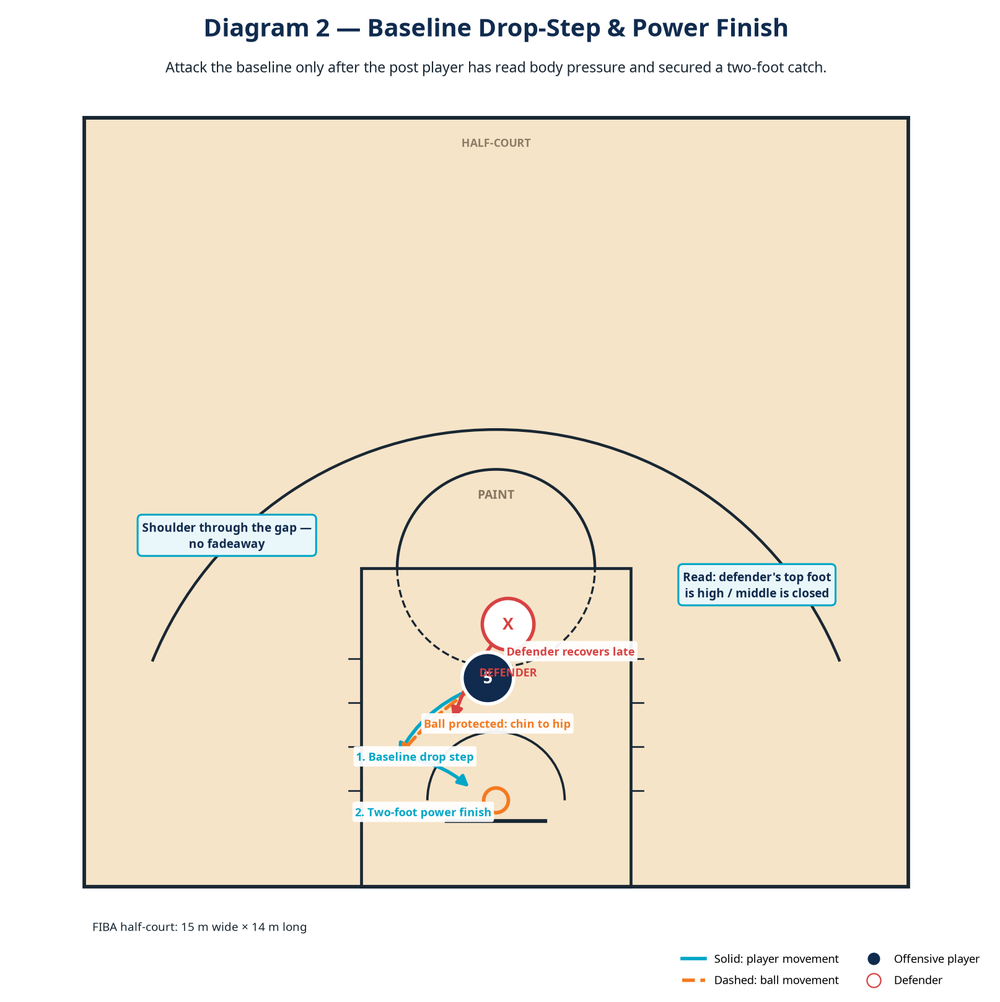
Diagram 1 is your non-negotiable: the post has to win the catch. The 1 makes the entry, the 5 seats the defender, and the 3 holds wing spacing. Explain that the low block is a scoring launch point, not a place to hold the ball. If the 5 cannot establish a shoulder-to-chest seal, reset the rep rather than allowing a poor, floating catch.
Step-by-Step Instructions
Teach the stance without a defender for 90 seconds. The 5 starts at the cone, shows a target hand, receives a pass, jump-stops on two feet, chins the ball, and names their pivot foot. Require a low base: knees bent, hips under the shoulders, elbows controlled. One player takes six catches before rotating.
Add the seal and entry for 3 minutes. The defender gives 50% resistance from behind. On the coach’s clap, the 5 makes contact with their lower body, turns the chest toward the passer, and presents the outside hand. The 1 delivers a firm chest-level or bounce entry to the target side. The 5 catches, freezes for one second, and the coach checks balance, ball security, and space to the baseline. Rotate 1 to 5, 5 to defender, defender to the passing line.
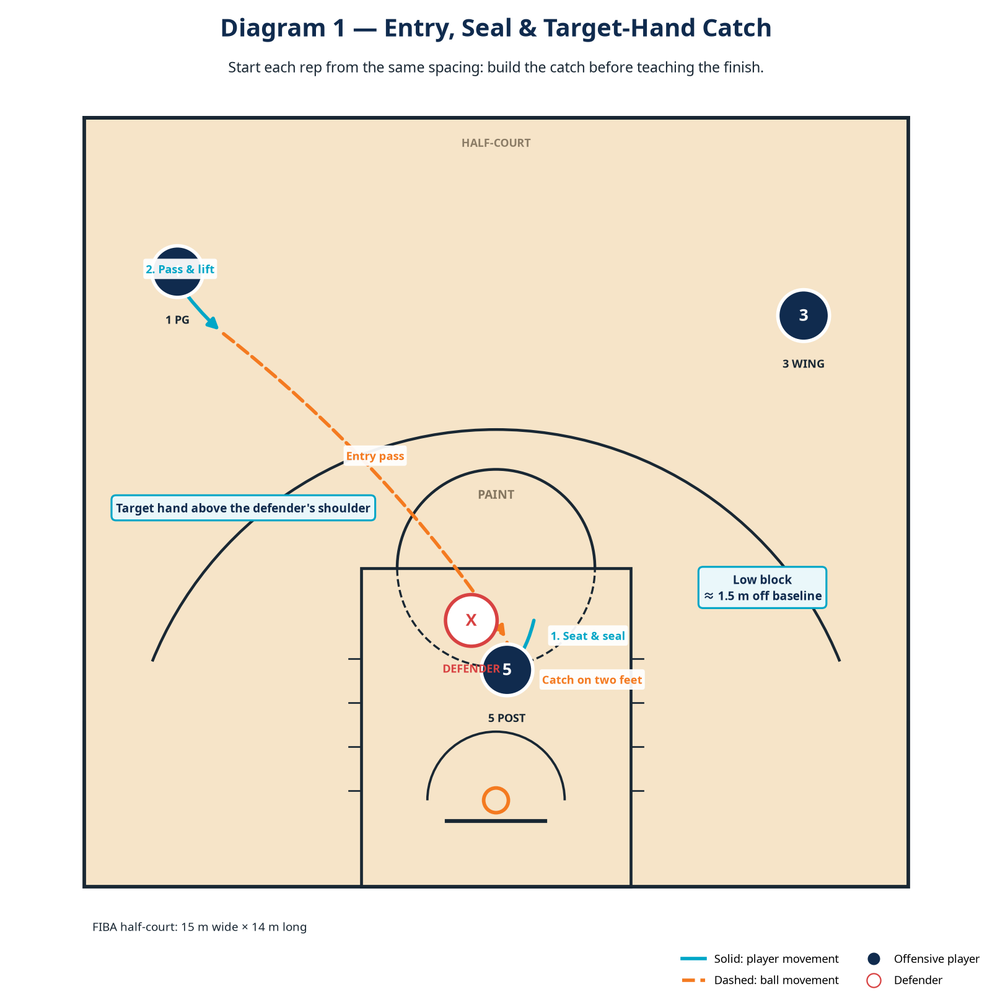
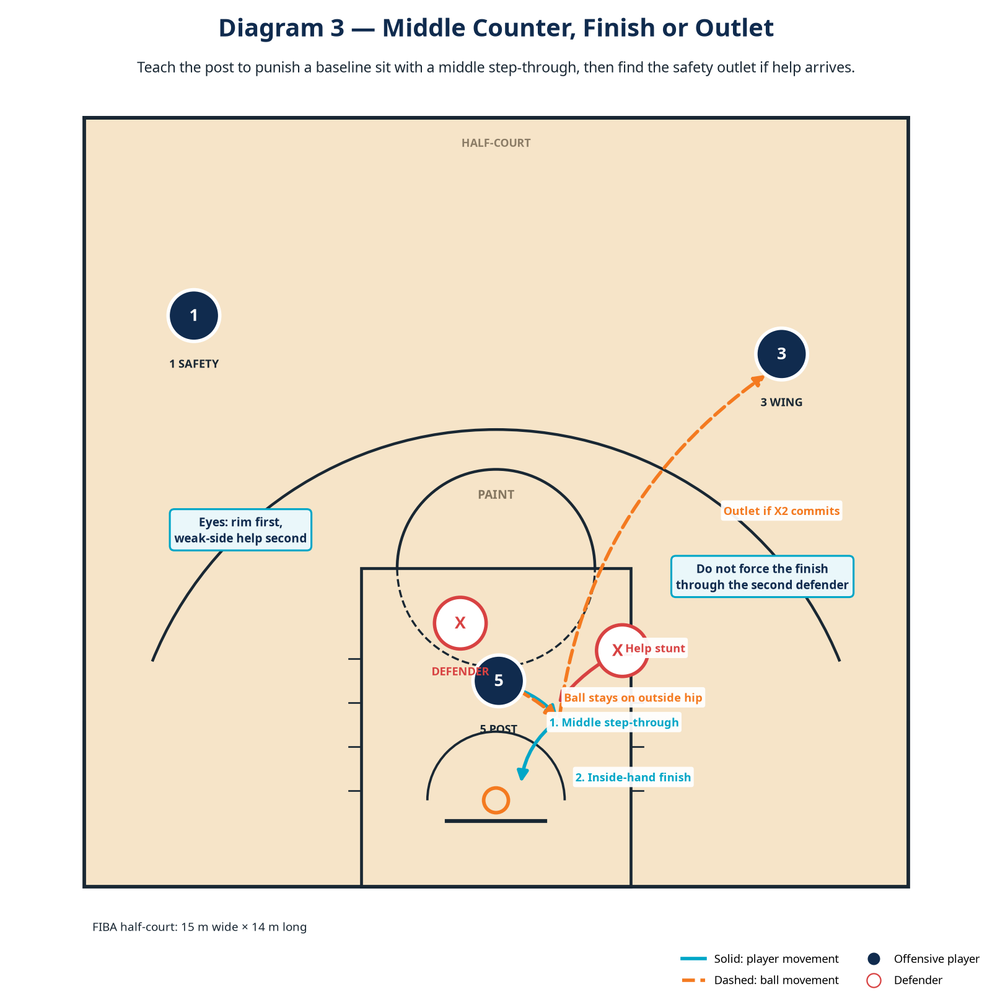
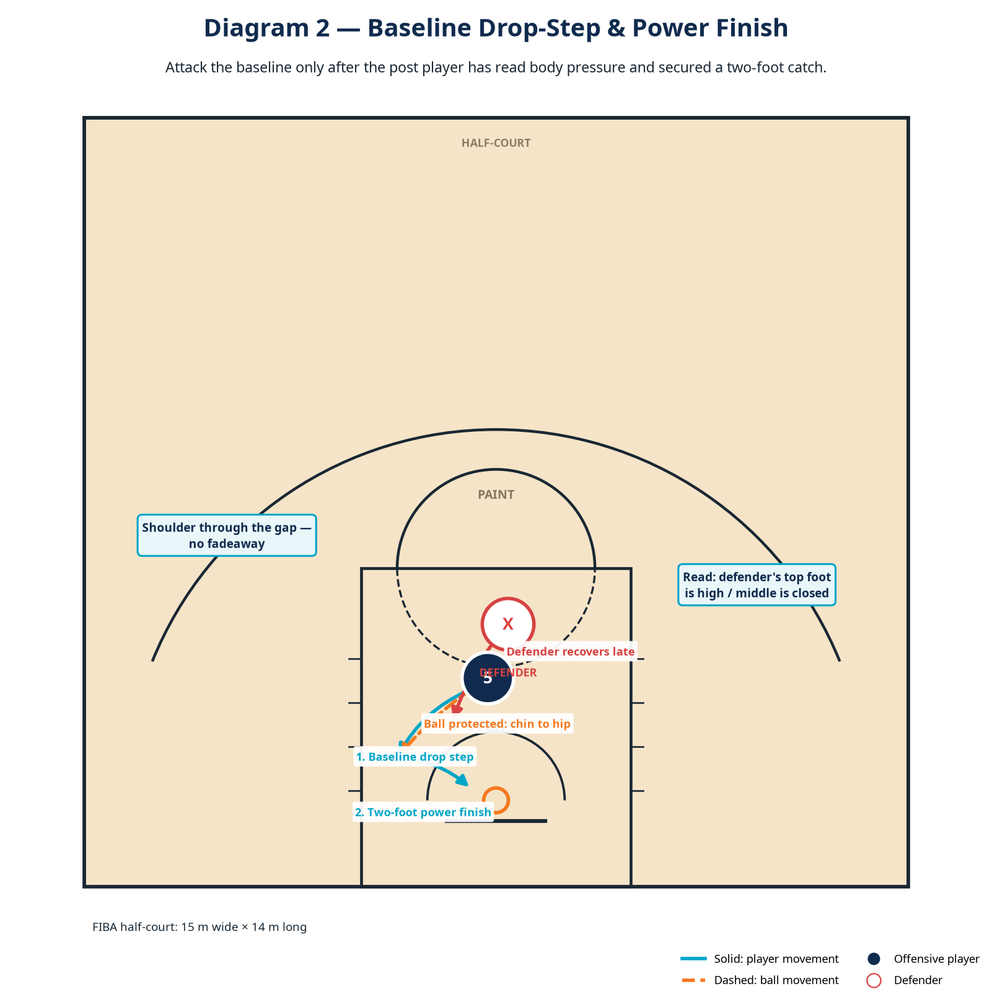
Install the baseline drop-step for 4 minutes. On the call "baseline," the 5 keeps the inside pivot foot down, sweeps the free foot toward the baseline-side gap, and brings the ball from chin to outside hip. The second foot lands under control before the power finish. The player finishes off two feet through the outside shoulder; no drifting under the backboard and no turnaround fade. Start with pads, then allow the defender to recover and contest vertically.
Court Picture: Baseline Drop-Step
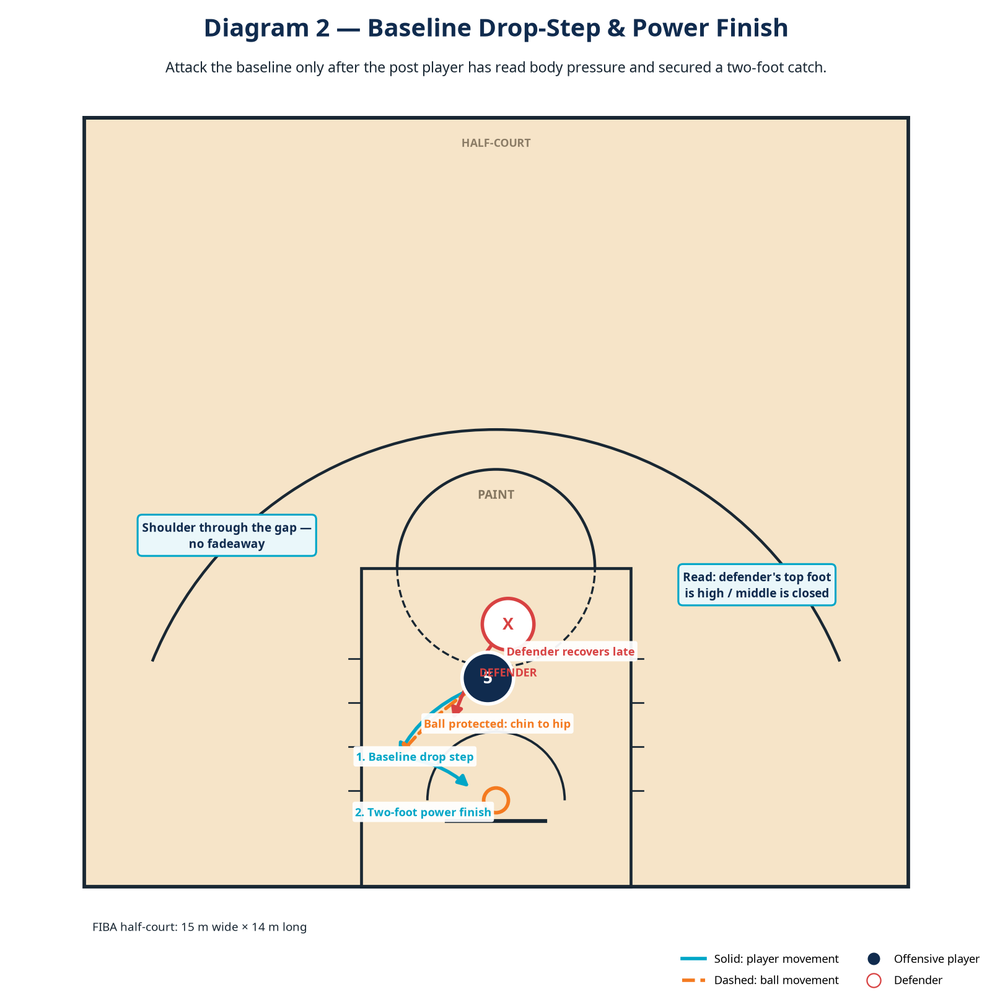
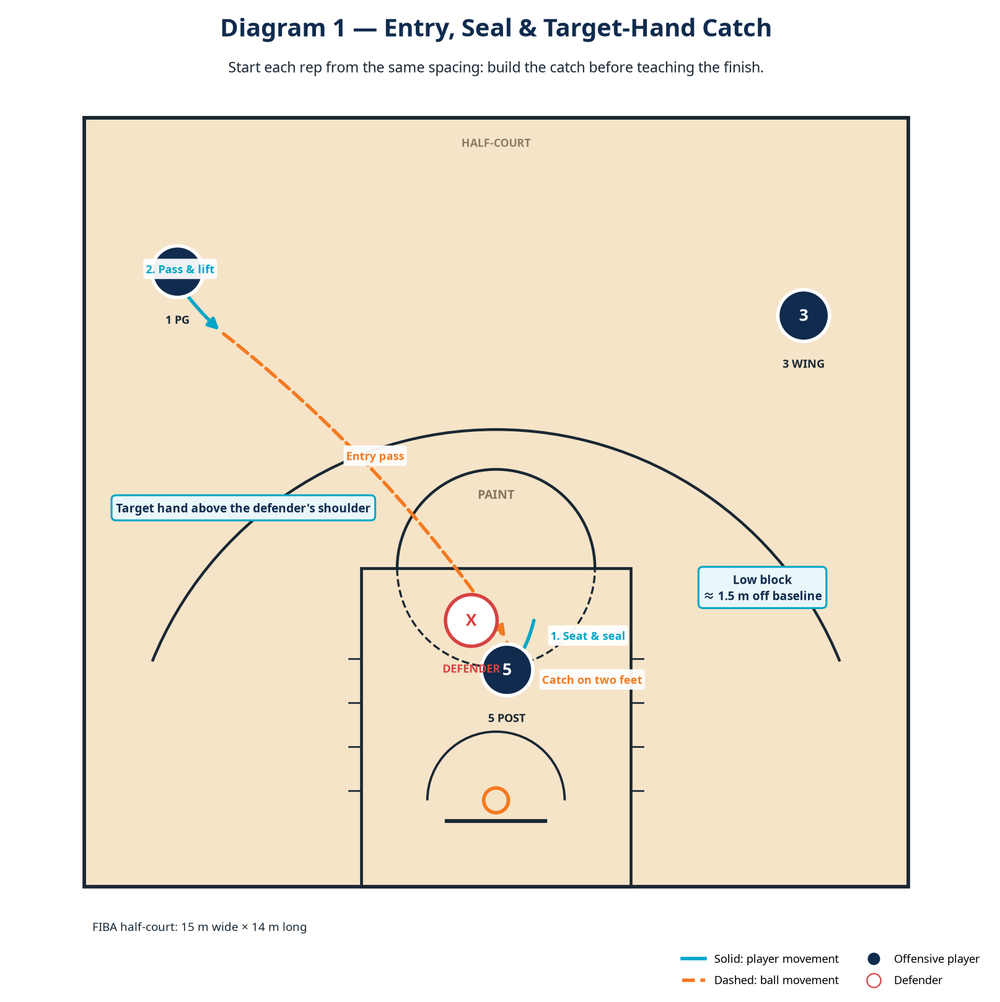
Install the middle counter for 4 minutes. On the call "middle," the 5 reverse-pivots or step-throughs toward the middle, keeps the ball on the outside hip away from the defender, and attacks the rim with an inside-hand finish. Coach the eyes to go to the rim first. If the primary defender sits on the baseline, the middle is usually the immediate counter; do not ask young players to fake three times before moving.
Add the help defender and outlet for 4 minutes. Put a second defender at the nail or on the weak-side lane line. The 5 catches, makes the first read, then must either finish before help arrives or fire a clean pass to the 3 on the wing. The 3 stays shot-ready with knees bent and hands visible. Award one point for a correct score, one point for a correct kick-out that arrives in the shooter’s pocket, and zero for a forced attempt into the second defender.
Court Picture: Middle Counter or Outlet
- Finish with live constrained 1v1 for 3–4 minutes. The passer enters the ball and becomes the safety outlet. The 5 has a maximum of two dribbles and five seconds to score or make the outlet. The defender plays live after the catch. Change sides every two minutes so players practice both pivot feet and both finishing hands. Track decisions as well as makes: a well-read outlet is a winning rep.
Key Coaching Points
| Coaching focus | What the coach should demand |
|---|---|
| Win the catch | The 5 makes contact first, then shows a target. Do not let the pass arrive before the seal is established. |
| Two-foot control | Catch with a jump-stop, chin the ball, and identify the pivot before the first move. This removes travelling and rushed fades. |
| Read the defender’s feet | A defender high on the middle shoulder invites the baseline drop-step; a defender sitting baseline invites the middle counter. |
| Protect the ball | Keep the ball on the outside hip during the first step. The ball should not swing through the defender’s reach. |
| Finish through the gap | Drive the shoulder through the open window and finish from balance. Encourage vertical force, not a sideways lean. |
| Make the second read | When help commits, the 5 must find the 3 or the 1 quickly. A post touch that creates an open perimeter shot is a successful possession. |
Common Mistakes
The first common error is catching upright. Stop the rep and have the player repeat the jump-stop without a shot; the correction is a lower hip position before the ball arrives. The second is opening the ball into the defender. Put a pad on the defender’s side and tell the player to move the ball from chin to the outside hip as the foot steps. The third is pivoting before reading. Make the 5 freeze for a one-count and verbally call "baseline" or "middle" before moving. The fourth is fading away from contact. Use a finishing pad and demand a two-foot power finish through the shoulder. Finally, watch the perimeter players: a standing passer or wing who drifts into the lane eliminates the outlet and ruins the spacing.
Variations & Progressions
Make it easier: Remove the defender and use cone gates to show the baseline and middle finish lanes. This is useful when first teaching a jump-stop, pivot identification, and ball protection.
Build the decision: Use a guided defender who shows one clear foot position: top foot high for baseline, baseline sit for middle. The defender contests only after the first dribble. This keeps the read honest without overwhelming the player.
Make it game-like: Add a live help defender, a five-second decision clock, and a scoring system of two points for a paint finish, one point for an on-time outlet that becomes a catch-and-shoot, and minus one for a turnover or forced attempt. Progress to 2v2 by adding a weak-side shooter and helper.
Age Adaptations
For Under-10 and Under-12, work from a spot inside the lane rather than the low block, eliminate body contact at first, and teach only one move per day. Use a verbal cue such as "see the space, step to the space" and allow a one-dribble finish. A foam pad can represent the defender before young players work against live pressure.
For Under-14 and Under-16, use the full low-block starting point, require the jump-stop and two-foot finish, and introduce the defender’s top-foot read. Keep contact legal and controlled, but insist that players keep their line rather than backing away. Include both hands and both blocks.
For older or more advanced groups, run the full live version with a second defender, a two-dribble limit, and a required outlet read. Ask players to call their own read before the move, then review their decision on the next rep. The move is only advanced when the footwork, balance, and decision are all repeatable at game speed.
