

Basketball
Horns Lift 3: A Timed Three-Point Set Play from the FIBA Horns Alignment
Install a clean Horns action that uses a ball screen, weak-side lift, and skip-pass read to create a balanced catch-and-shoot three for your 2 guard.
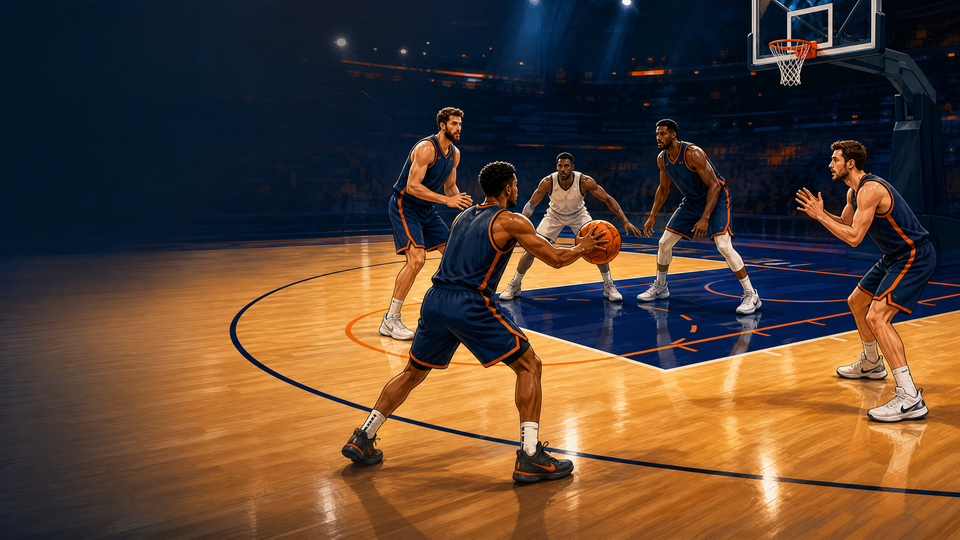
What you need
1 basketball, 6 flat cones, 2 contact pads (optional), whiteboard or court diagram
Overview
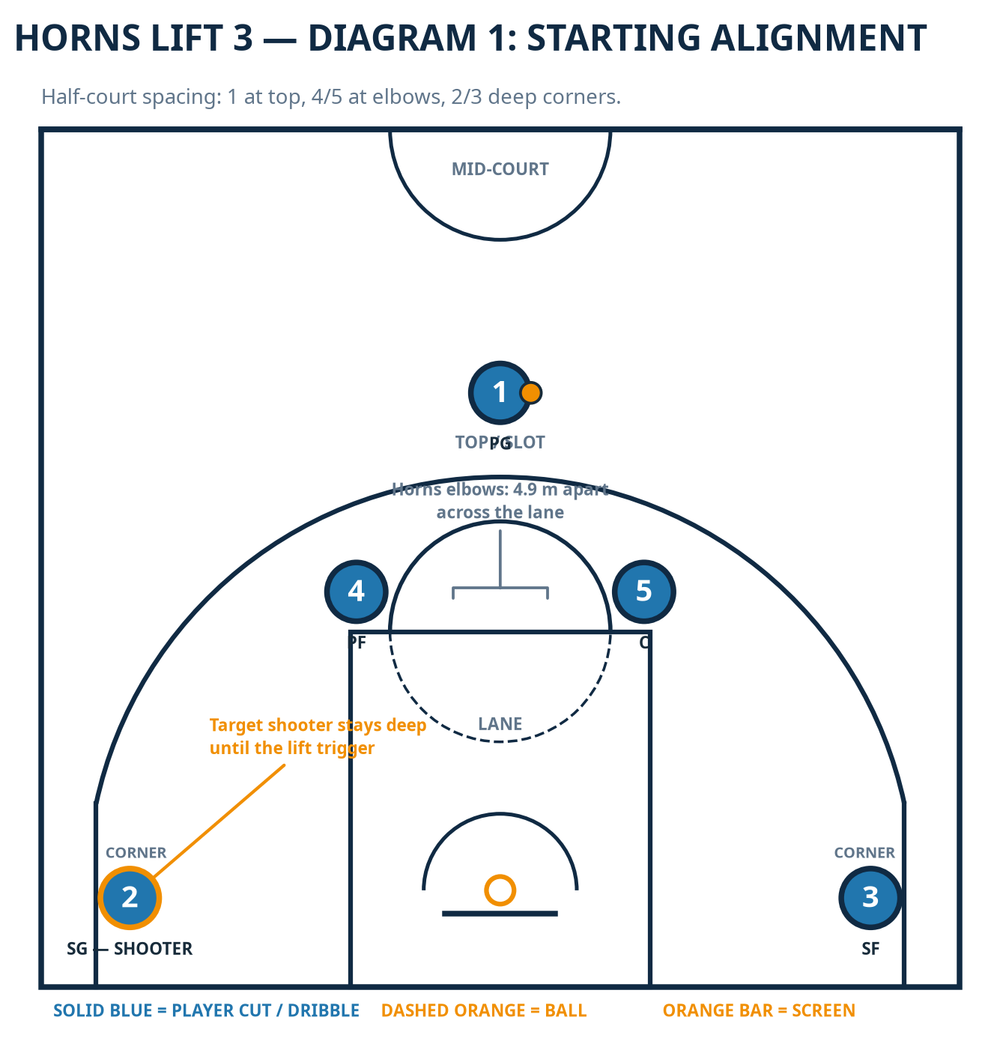
Horns Lift 3 creates a clean catch-and-shoot three for the 2 guard from the left slot. It begins in Horns—1 at the top, 4 and 5 on opposite elbows, 2 and 3 in corners—then forces the defense to choose between the ball screen, rolling 5, and lifting shooter. Use it after a timeout, against a paint-packed pick-and-roll coverage, or when the low defender regularly tags the roller.
The first option is 2’s rhythm three one step above the break. The counters are 5 on the roll and 3 on the right-side drift. Coach it as a read-based action: 1 attacks the first defender who leaves a threat.
| Action target | Timing goal | Why it works |
|---|---|---|
| 2’s lift to left slot | 0.7–1.0 seconds after 1 clears 5 | It meets the help shift. |
| 1’s skip pass | On 2’s outside-foot plant | It reaches the shooting pocket on time. |
| 5’s roll | Immediately after contact | It occupies the rim protector. |
Setup
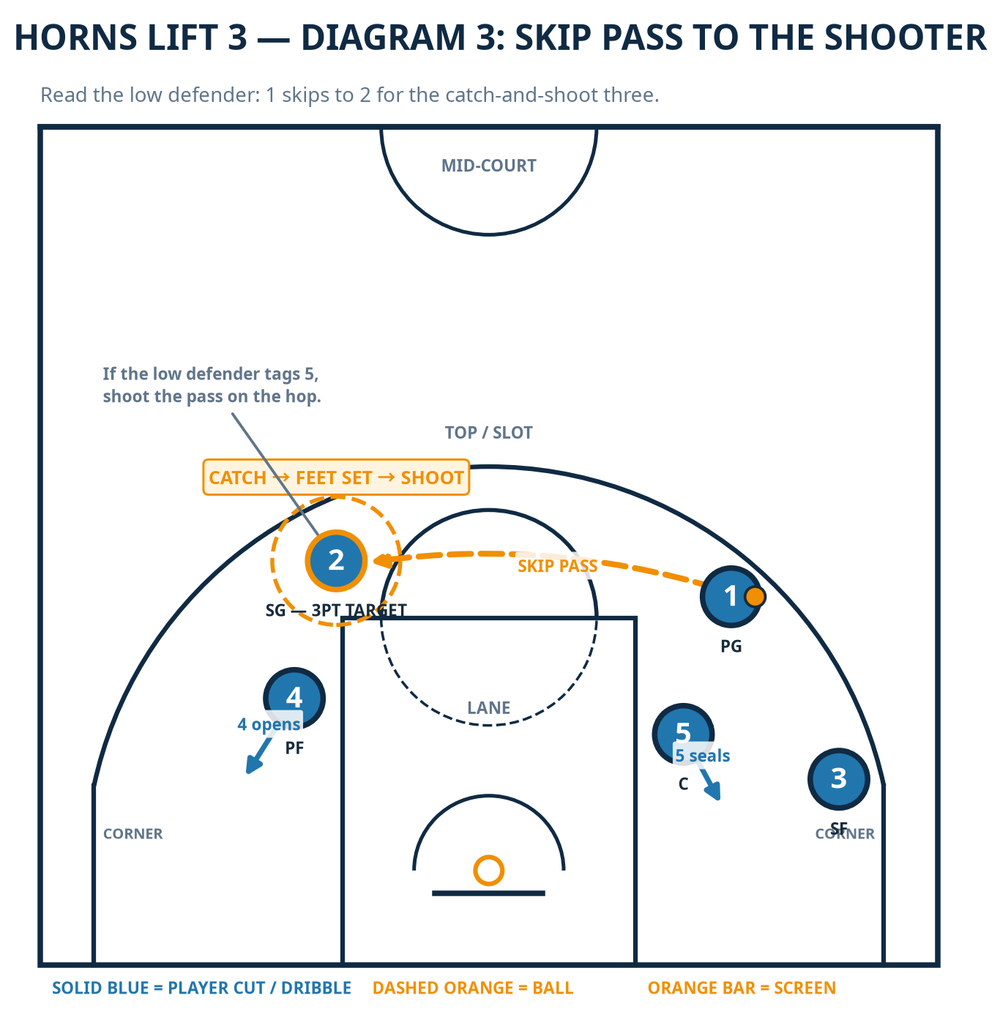
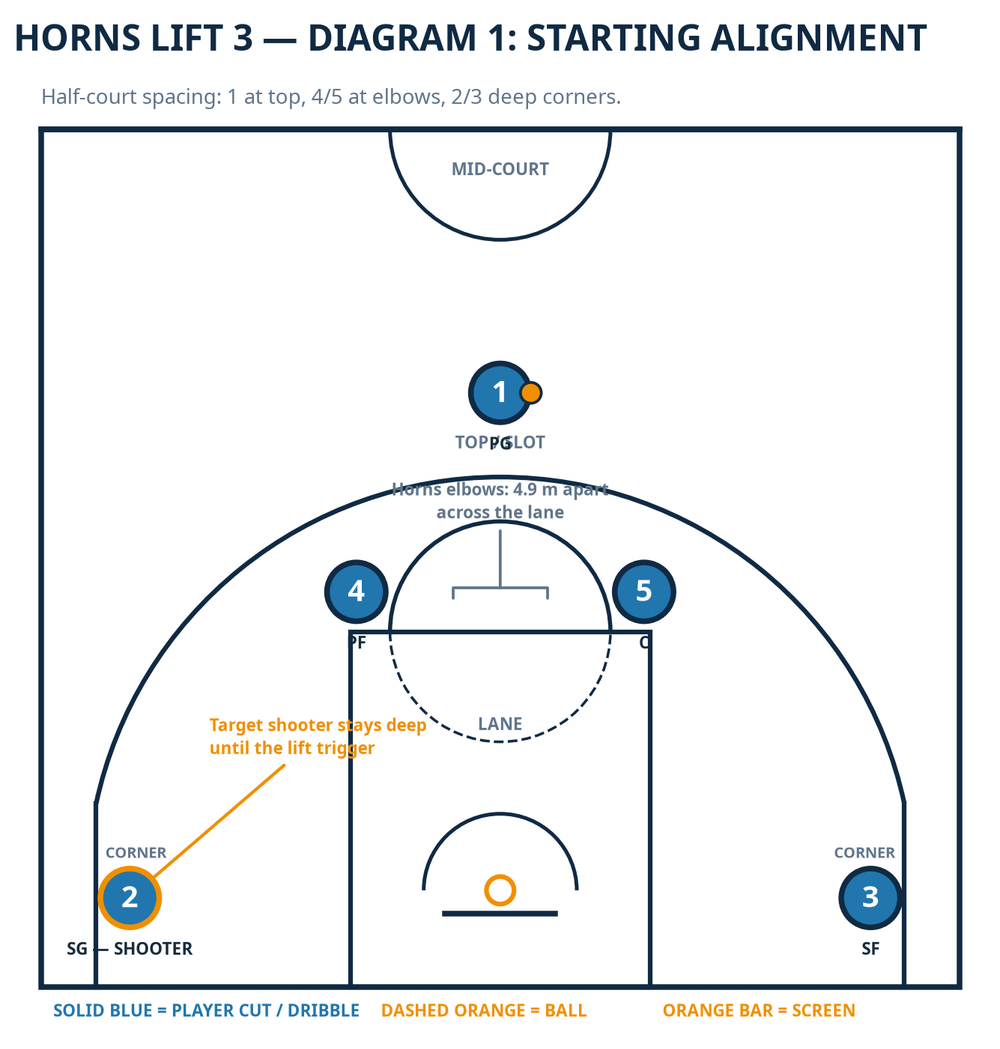
Use a FIBA court (28 m × 15 m) in the frontcourt. You need five players, one basketball, and six flat cones to mark elbow, corner, and slot landmarks. Place 1 (point guard) at the top, about 8.5–9 m from the baseline; 4 (power forward) on the left elbow; 5 (centre) on the right elbow; 2 (shooting guard and target) deep in the left corner; and 3 (small forward) deep in the right corner.
Start without defenders, then add guided and finally live defense. The call is “Horns Lift.” It tells 2 to wait until 1 clears 5 before moving.
Step-by-Step Instructions
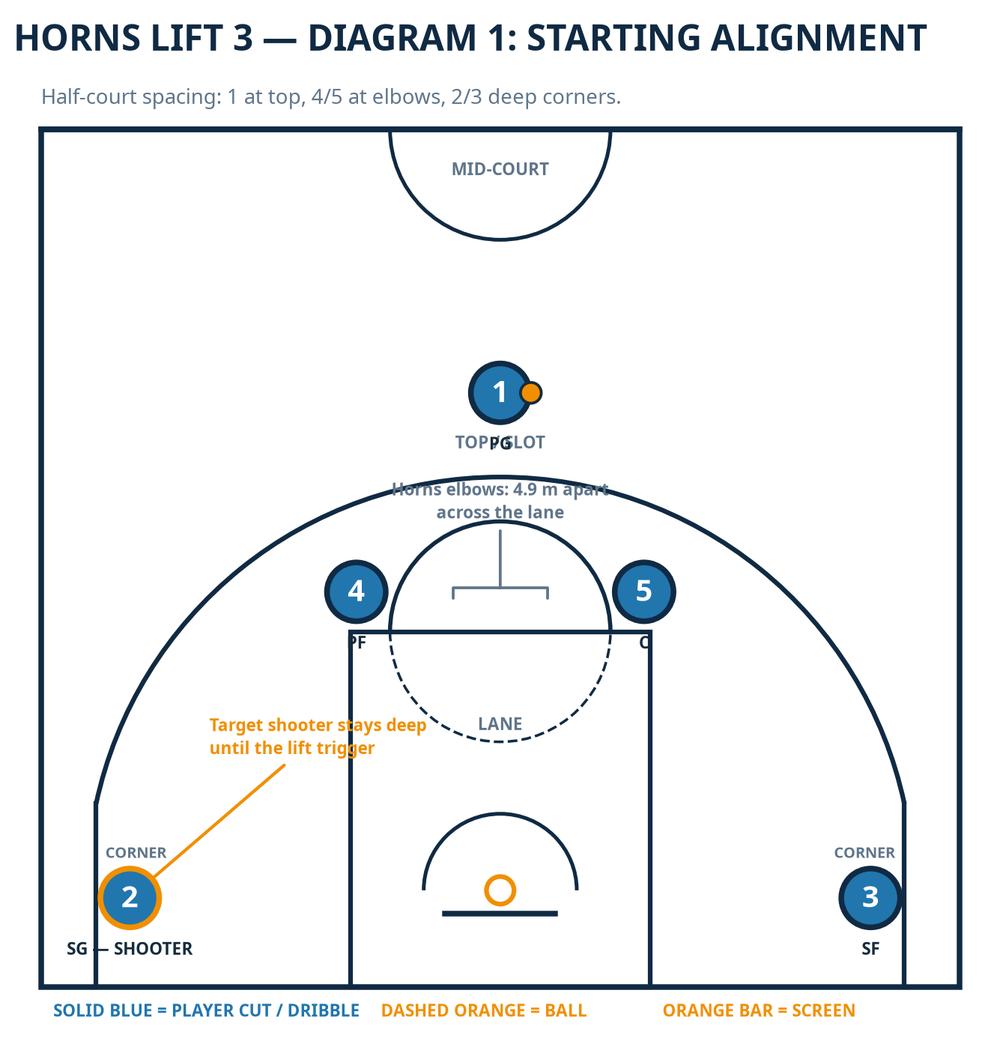
Enter Horns. 1 uses a live dribble at the top, with 4 and 5 showing hands at elbow height. Keep 2 and 3 deep enough that their defenders cannot stunt at the ball without giving up a passing window; demand 4.5–5 m from corner to nearest elbow player.
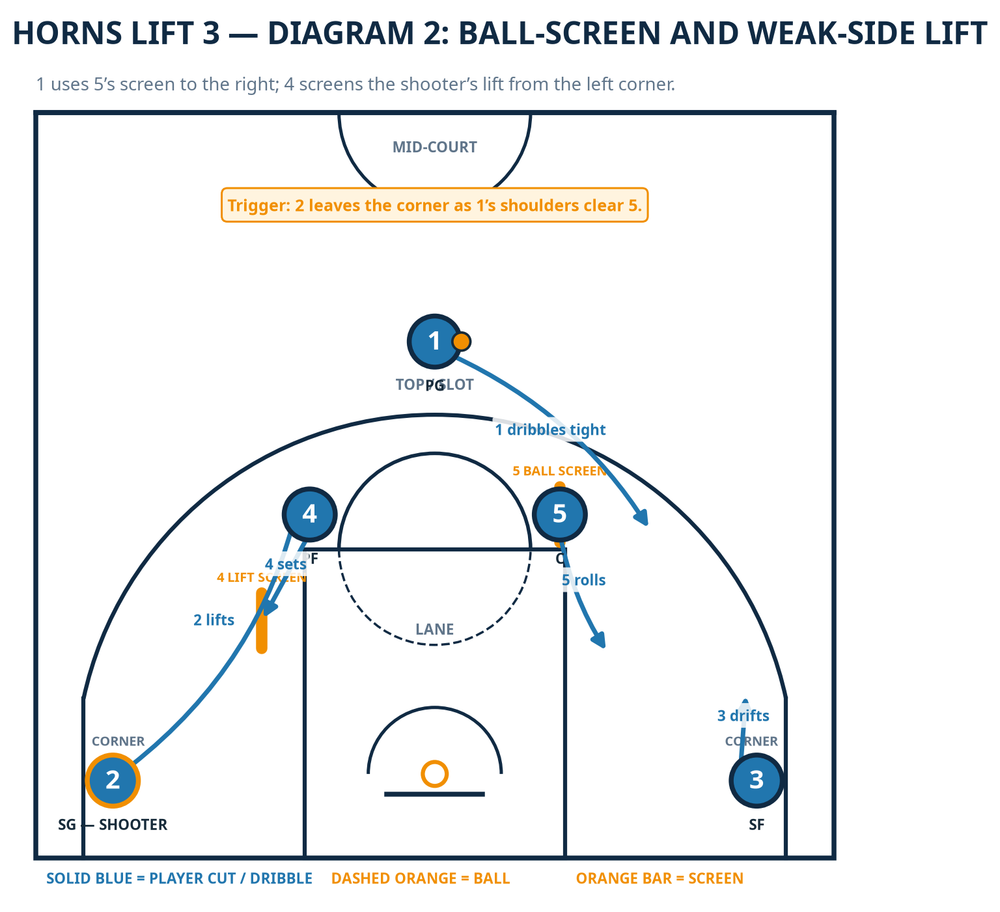
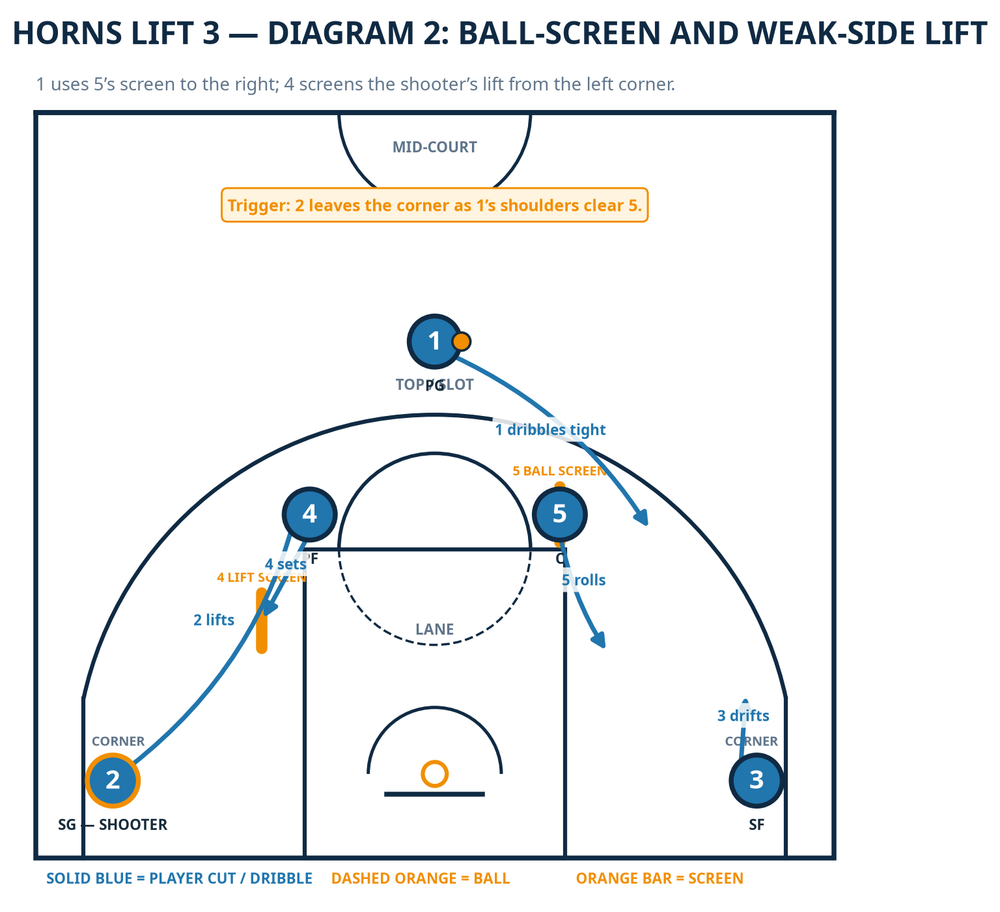
Set 5’s ball screen. 5 steps up from the right elbow to screen 1’s defender about 8 m from the baseline, angled toward the right slot. 5 arrives early, is stationary, and does not lean. 1 takes two hard dribbles tight off 5’s hip; a loose route lets the defender slide underneath.
Trigger 2’s lift and 4’s screen. As 1’s shoulders clear 5, 4 sprints down from the left elbow to set a firm flare/lift screen on 2’s defender near the left lane line, roughly 4.5 m from the baseline. At the same instant, 2 explodes up from the corner, brushes shoulder-to-shoulder past 4, and lifts to the left slot beyond the three-point arc. The target is a catch point about 1 m above the arc and 1.5–2 m left of the top. This is not a rounded jog: 2 must change pace, arrive balanced, and present both hands.
Create the roll and spacing read. Immediately after screening, 5 opens to the ball and rolls into the right side of the lane with hands high. 3 drifts up the right sideline by 1–1.5 m, preserving the longest possible closeout. 4 pivots after screening and opens toward the left short corner; do not let 4 stand in the driving lane. These three movements force the defense to cover the rim, two corners, and the lifted shooter.
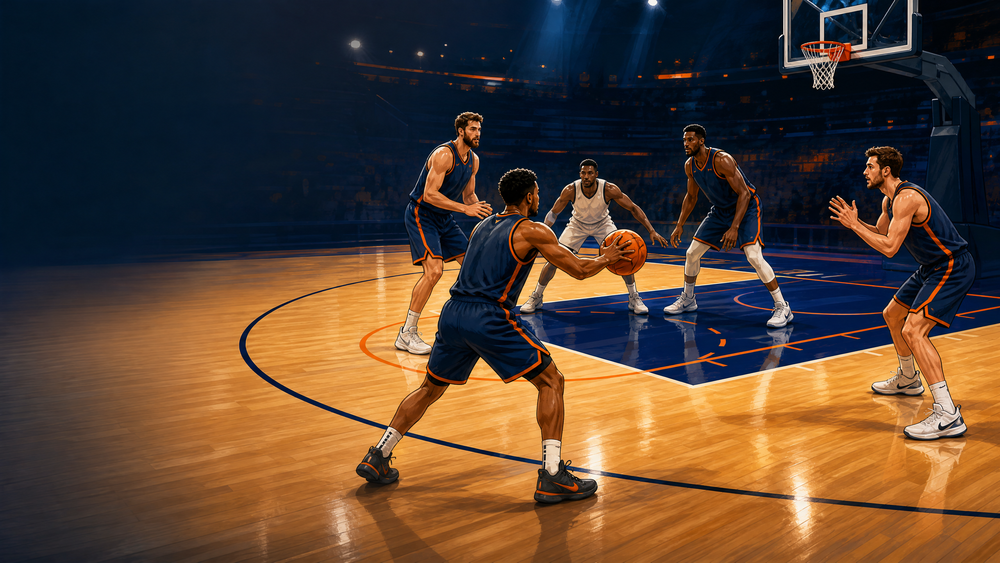
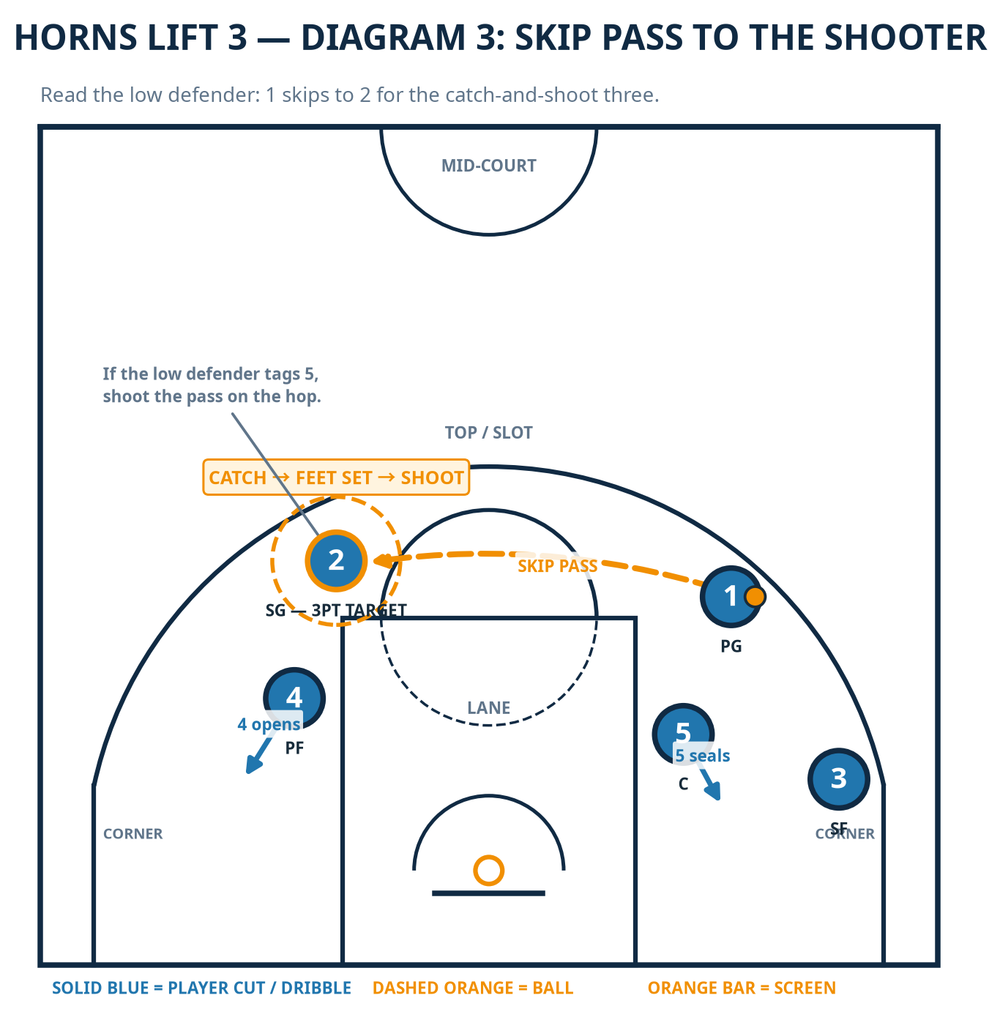
Teach 1’s progression. 1 comes off 5’s screen with shoulders square to the basket and reads the low defender. If the low defender tags 5 or turns their head toward the lane, 1 throws the one-hand or two-hand skip to 2 immediately. The pass should travel above the lane-line defenders and arrive on 2’s shooting side. If 2’s defender stays glued to the lift, 1 hits 5 on the roll. If the weak-side defender collapses from 3, skip to 3 for the secondary three. If the on-ball defender goes under and no pressure forces the action, 1 may take the open pull-up three only if that is within your shot profile.
Finish the primary shot. 2 catches on the hop or a 1–2 footwork pattern matched to the pass, with knees loaded before the ball arrives. The first look is catch-and-shoot; one extra dribble only occurs when a flying closeout takes away the shot. On every shot, 5 and 4 crash from opposite sides of the lane while 1 and 3 retreat to protect transition. Use the coaching command: “Lift, show hands, shot-ready before the catch.”
Key Coaching Points
- Screen angle is the engine. 5’s hips should point toward the right sideline, encouraging 1’s defender to trail over the screen. A square or late screen turns the action into a crowded handoff.
- 2 must sell the corner. Keep 2’s heels near the baseline until the trigger. Early movement lets the defender top-lock the lift or switch the flare without pressure.
- Teach the trigger, not a count. 2 moves when 1 clears 5, not merely on “one, two.” This preserves timing against different coverages and different ball-handler speeds.
- Pass to the shooter’s pocket. 1 should release the skip when 2 plants, leading them neither toward the sideline nor into 4’s screen. Require 10 made skip-pass catches to each side before live defense.
- Bigs do not admire the shot. 5 rolls into the restricted-area line; 4 opens to space, then rebounds from the opposite lane line. Their activity is what holds the help defenders.
- Use game language. Tell 1: “Read the nail, then the low man.” Tell 2: “Your feet beat the pass to the spot.” Clear language makes film correction fast.
Common Mistakes
| Mistake | What it looks like | Correction cue |
|---|---|---|
| 2 lifts early | Defender follows comfortably; no screen advantage | “Wait for 1’s shoulders.” Rep the trigger without a ball. |
| 4 screens too high or moves | 2’s defender slips underneath or an offensive foul occurs | “Set at lane-line depth; arrive, stop, absorb.” |
| 1 dribbles away from 5 | No paint touch, no help rotation | “Hip-to-hip off the screen.” Mark the dribble path with cones. |
| Skip pass floats | Closeout reaches 2 before the catch | “Pass on the plant.” Use a firm, high line drive. |
| 3 stays in the corner | A low defender can cover both 3 and 5 | “Drift with the drive, not after the pass.” |
Variations & Progressions
Variation 1 — Reject into a pin-down. If the defense jumps to ice or overplay the right-side ball screen, 1 rejects 5 and drives left. 4 immediately turns to set a pin-down for 2 from the left corner; 5 seals the weak-side rim protector. This keeps the same spacing but changes the defender’s chase angle.
Variation 2 — Spain-style second screen. For older teams, 4 screens 5’s defender after setting the lift screen, then pops to the short corner. This can free 5 for a lob or force a switch that leaves 2 open on the flare.
Progression — Live coverage reads. Run hard hedge, drop, and switch. Give 1 three points for the correct first read and one for a made shot; reward the decision, not just the result.
Age Adaptations
For Under 10, reduce to 1, 5, and 2. Put 5 at one elbow, use a stationary cone as the lift screen, and let 1 make a direct pass to 2. Move 2 one step inside the three-point line so the shot matches developing strength.
For Under 12–Under 14, use all five but move the shooting spot 0.5–1 m inside the arc if mechanics break down. Teach the primary skip and 5’s roll first, then add 3’s drift.
For Under 16 and open age, use the full progression against switching, top-locking, and help-side stunts. Add a 7–8 second shot-clock constraint. Film spacing: shallow corners and late screens break the play before poor shooting does.
Practice Plan: 18 Minutes
Start with 4 minutes of walk-through—freeze each player at the initial alignment, ball-screen, lift screen, catch point, and rebound positions. Spend 6 minutes on 0v5 and guided defenders, requiring five consecutive clean primary threes or correct roll reads. Use 6 minutes of 5v5 live, scoring one point for a paint touch, two for a correct skip, and three for a made three. Finish with 2 minutes of special-situation rehearsal: sideline out, timeout huddle, then execute the call with one possession to score.
The standard is not merely producing a three. The standard is creating a three where 2 catches balanced, unhurried, and on time because every other player has forced the defense to make a choice.
