

Basketball
4-Out, 1-In Motion Continuity: Wing Ball-Screen Attack
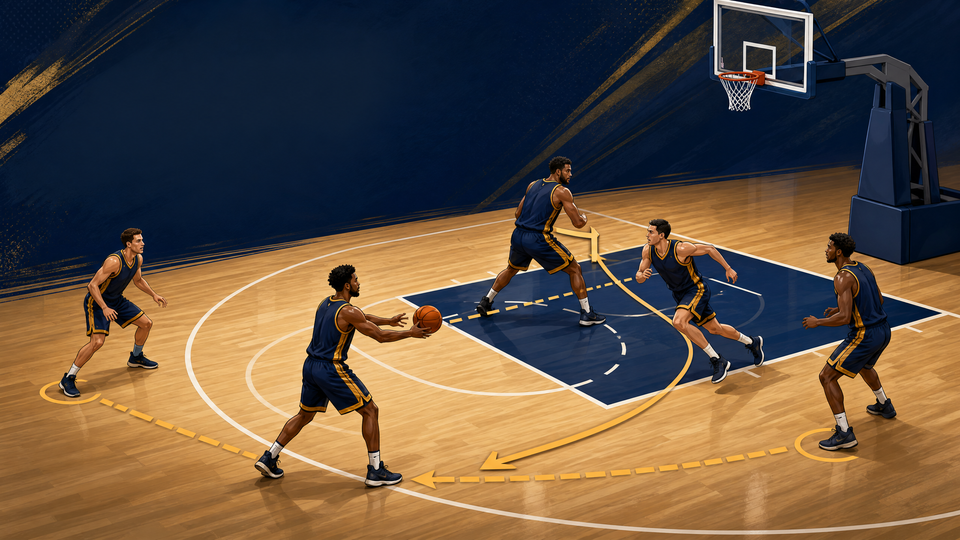
Install a repeatable 4-out, 1-in continuity that gives your team a wing ball-screen attack, weak-side movement, and a clear reset when the first advantage is gone.
What you need
1 basketball, 1 regulation basket, 6 flat cones or court markers, training bibs for progression defenders, visible shot clock or 12-second timer
Overview
This is a 4-out, 1-in motion continuity built for coaches who want structure without turning every possession into a scripted call. The action starts with a right-wing dribble entry, flows directly into a flat ball screen, and then uses a weak-side exchange to stretch help. If the first ball-screen read does not produce a lay-up, short-roll pass, or clean catch-and-shoot, the offence simply kicks out, cuts through, and repeats on the next side. Your players learn one repeatable language: create an advantage, fill behind it, and keep the floor balanced.
Use this as a half-court base against man-to-man teams, particularly when you have a mobile 5 who can screen, roll, and make a simple pass. It is most effective after transition has been stopped, after a dead-ball inbound, or any time your group needs a reliable possession that maintains spacing. Run the same pattern to either side; the left-side version is a mirror image.
Setup
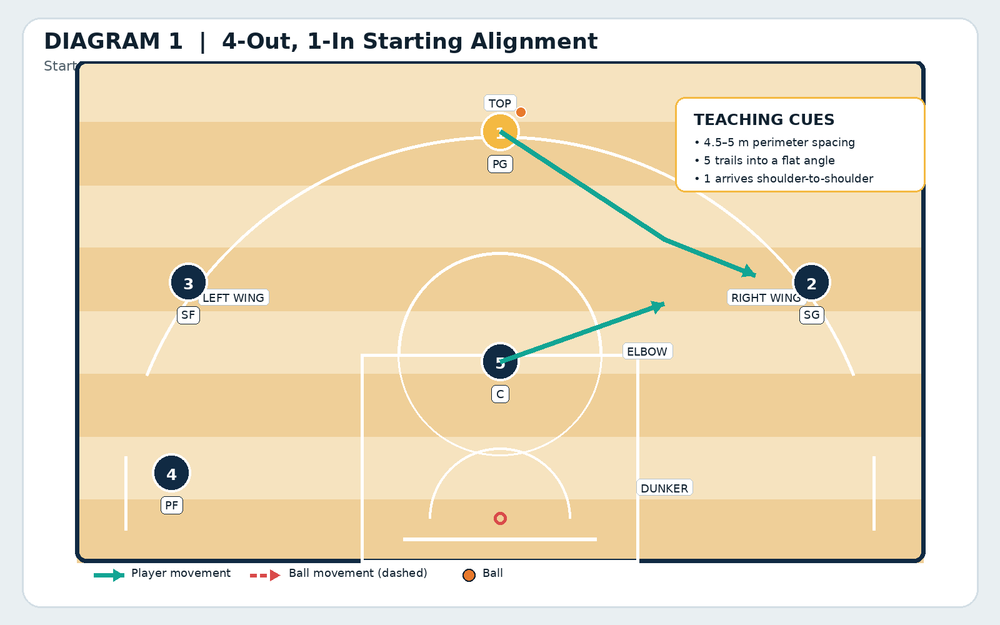
Set the action on a FIBA court measuring 28 m x 15 m. Work in the offensive half court, from the baseline to the mid-court line, and place a cone on each wing, both corners, the top, and the ball-screen landing spot. Keep perimeter players 4.5–5 m apart whenever possible. That distance is what turns a small driving gap into a real advantage.
| Player | Starting spot | Job in the action |
|---|---|---|
| 1 — Point Guard | Top, 1 m above the three-point arc | Initiates the entry, uses the screen, and makes the first read. |
| 2 — Shooting Guard | Right wing, just outside the arc | Lifts or drifts to stay visible; becomes the shake option. |
| 3 — Small Forward | Left wing | Exchanges to the top on the ball-screen cue and occupies the weak-side helper. |
| 4 — Power Forward | Left corner | Holds corner spacing and is ready on the baseline drift. |
| 5 — Centre | High-post area, around the left elbow | Follows the ball, screens on the wing, then rolls or short rolls. |
You need five offensive players, one ball, six cones or flat markers, and a basket. For your first teaching block, add no defenders. Once the rhythm is clean, use two guided defenders at the ball screen, then progress to 5-on-5. Plan 25 minutes: five minutes for walk-through, eight minutes for 5-on-0, seven minutes for guided defence, and five minutes for live scoring constraints.
Step-by-Step Instructions
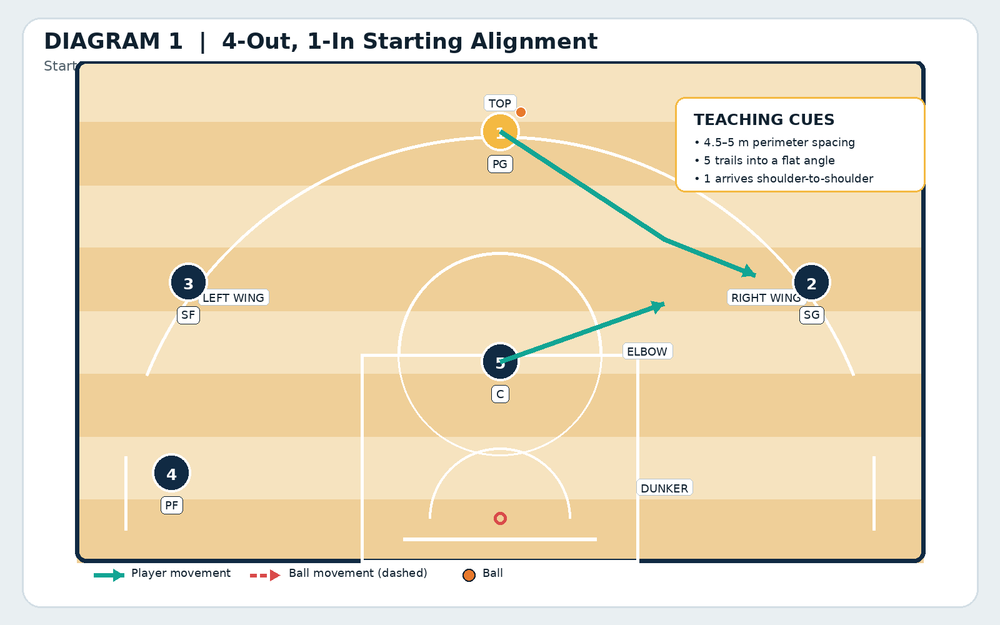
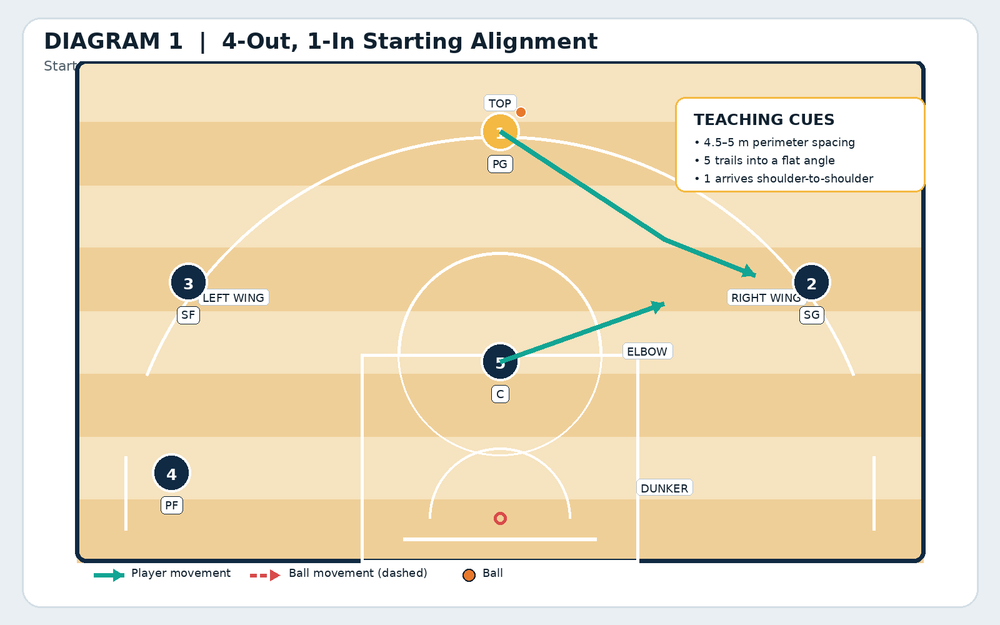
Start in balanced 4-out, 1-in spacing. 1 is at the top with the ball; 2 is on the right wing; 3 is on the left wing; 4 is in the left corner; and 5 is near the left elbow. Do not let 2 creep below the break or 3 sink into the corner. The first advantage depends on keeping the middle open.
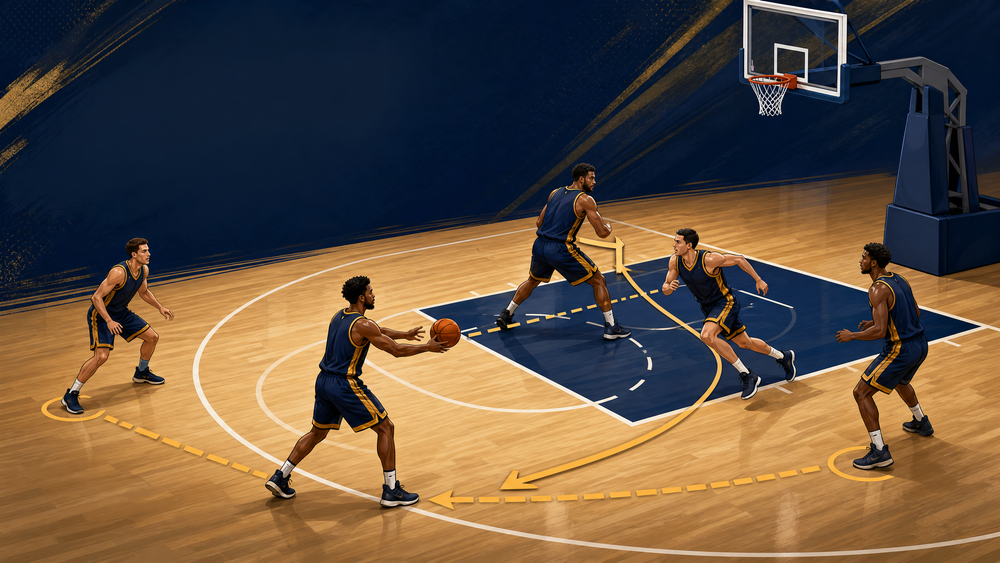
Make the dribble entry. On the coach’s call, 1 takes two controlled dribbles toward the right wing and arrives outside the three-point line. 1’s chest should face the basket, not the sideline. As 1 moves, 5 follows into a flat screening angle, arriving about 0.5–1.0 m below 1’s defender. This trail must take roughly two seconds; a sprinting 5 gets there too early and clogs the wing.
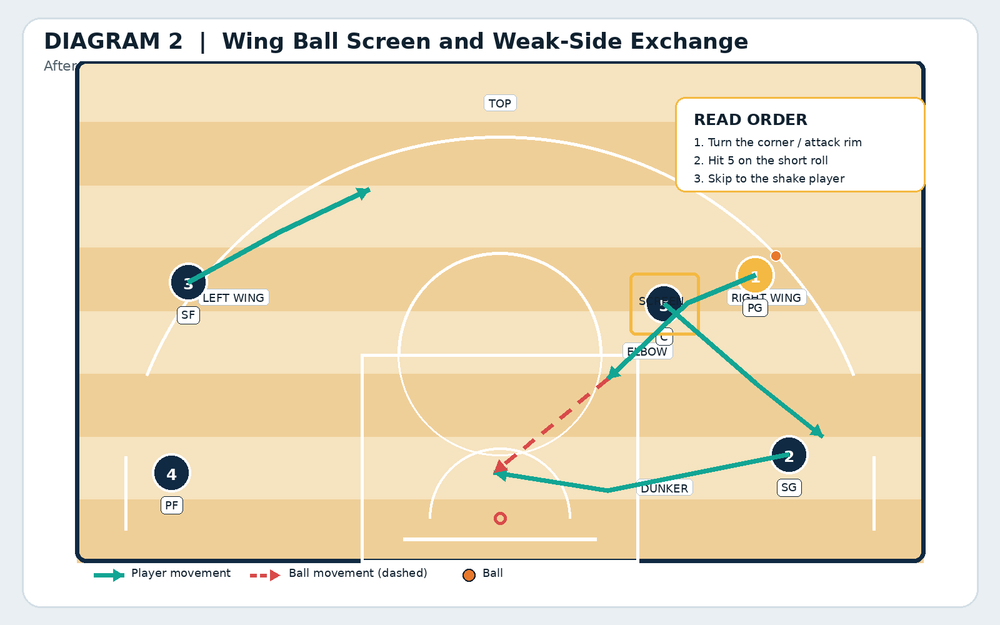
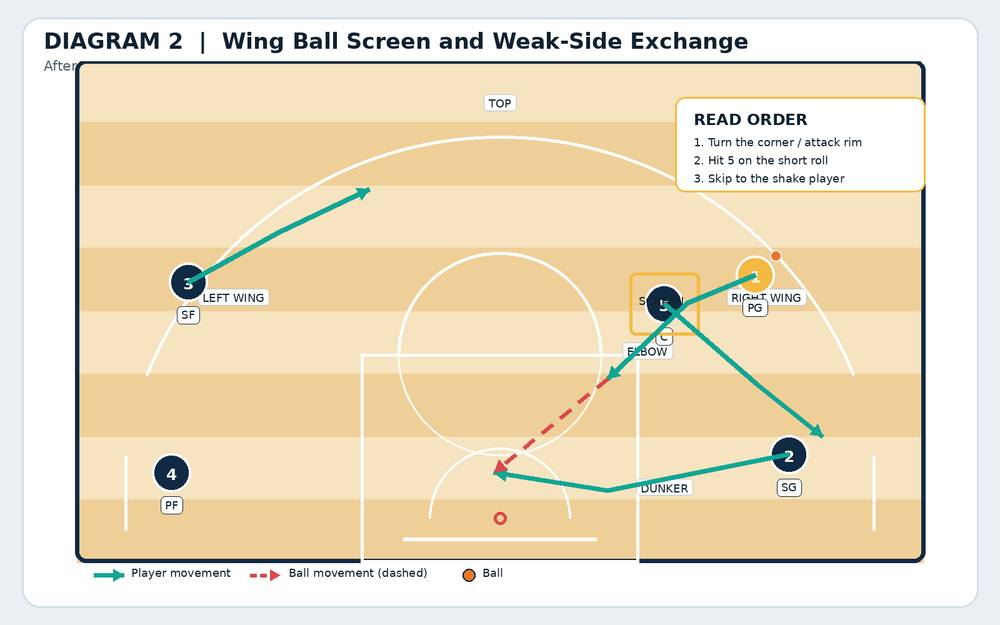
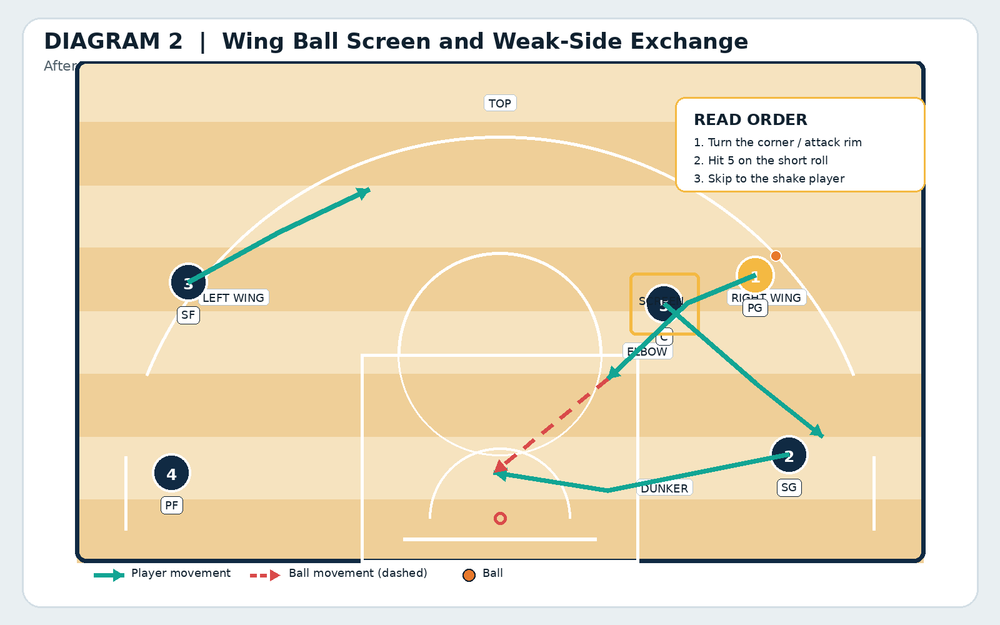
Set the wing ball screen. 5 establishes legal screening position, feet wider than shoulder width, torso still, and hands protecting the body. 1 brushes the screen shoulder-to-shoulder and comes off tight enough to make the on-ball defender collide with 5’s line. Teach 1 to take the screen toward the middle first. The initial read is the rim: if the defender is screened and the low defender is late, 1 attacks the paint in two hard dribbles.
Exchange on the weak side. As 1 uses 5, 3 lifts from the left wing toward the top while 2 slides or drifts to the right corner. 4 stays deep in the left corner until the ball enters the paint, then drifts along the baseline only if their defender commits. This movement begins exactly when 1’s shoulder reaches 5’s screen. Early movement allows defenders to switch their vision; late movement makes the help side static.
Make the three-read decision. First, 1 finishes if the lane is open. Second, if the low defender tags 5, 1 passes to 5 on the short roll around the free-throw-line area. Third, if the defence collapses from the weak side, 1 skips to 3 lifting at the top. Demand that 1 makes the decision by the second dribble after clearing the screen. Holding the ball longer than that allows the defence to recover.
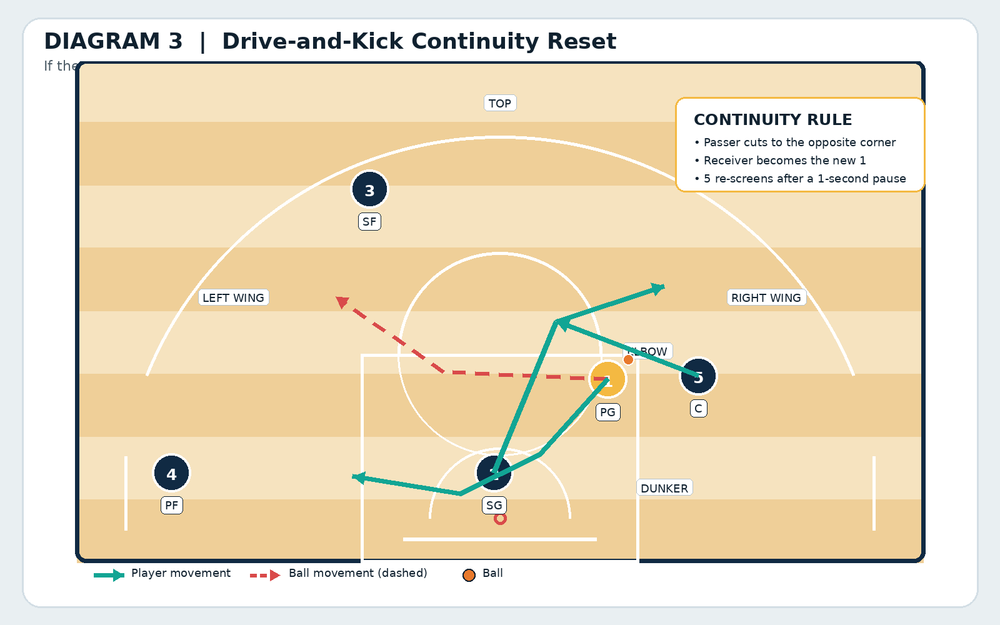
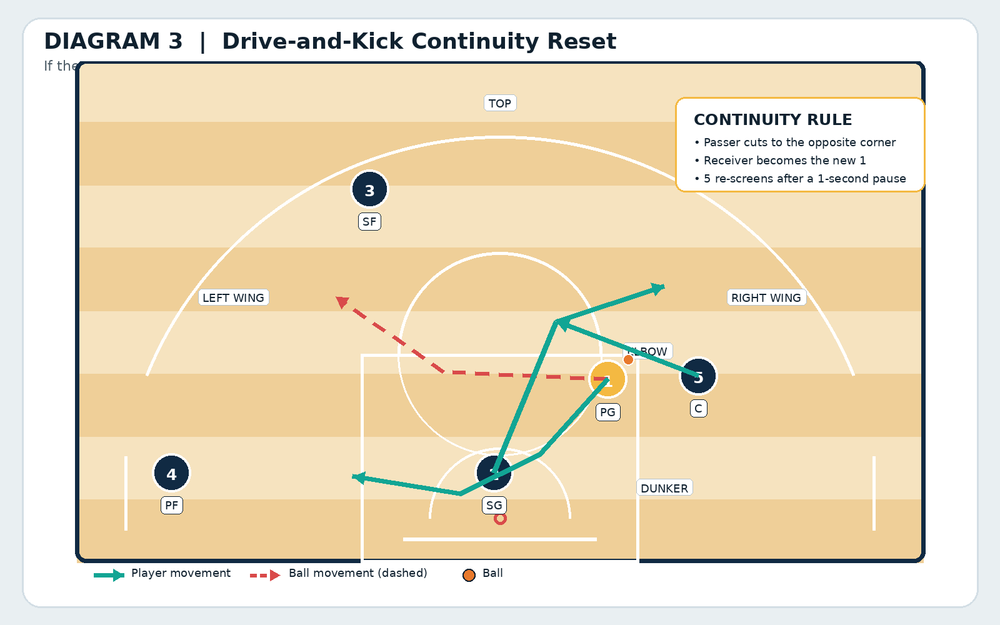
Flow into continuity. If 1 drives but cannot finish, 1 kicks the ball to 3 at the top and immediately cuts through to the opposite corner. 3 is now the new 1. 2 lifts from the corner into a new wing outlet, 4 remains as the opposite corner spacer, and 5 pauses for one beat before re-screening for the new ball handler. The offence has returned to the same 4-out, 1-in picture on the other side.
- Finish every repetition with a decision. In practice, do not allow players to simply execute the pattern and stop. The possession must end with a rim finish, a short-roll decision, a catch-and-shoot, or a second-side reset. This gives the continuity purpose rather than making it a dance.
Key Coaching Points
| Priority | Coach’s language | Why it matters |
|---|---|---|
| Spacing | “Stay one pass apart and outside the help.” | The ball screen only creates a scoring gap when the help defender has real ground to cover. |
| Screen angle | “Screen the defender’s hip, not the ball.” | A flat, legal screen directs 1 into the middle and keeps the sideline from becoming a second defender. |
| Pace | “Arrive under control, then explode.” | 1 must change speed after using the screen to beat the trailing defender. |
| Timing | “Move on the screen, not before it.” | The weak-side exchange must occupy help precisely as 1 turns the corner. |
| Short roll | “Catch on two feet; see rim, corner, then opposite wing.” | 5 becomes a decision-maker, not just a screener. |
| Continuity | “Pass, cut, fill; do not admire your pass.” | The reset keeps the defence in repeated ball-screen decisions. |
Common Mistakes
The most common error is crowding the ball side. Correct it immediately by freezing the action and walking 2 back to wing depth and 5 to the correct screening angle. A second error is 1 rejecting the screen without reading the defender. Permit the reject only when the defender jumps over the screen and the lane is genuinely open.
Watch for 5 slipping before contact or turning while screening. Use a one-second still-screen rule in early practice, then release it once 5 consistently arrives on balance. Also correct 3 for lifting too early; their cut should be triggered by the ball handler’s shoulder reaching the screen, not by the dribble entry. Finally, eliminate passive catch-outs. The receiver at the top must catch ready to shoot, drive, or initiate the next ball screen.
Variations & Progressions
Start with 5-on-0 shadow reps, calling out each movement and pausing at the screen. Progress to 5-on-2, with a defender on 1 and a helper at the nail; score one point for a correct read and two points for a paint touch. Next, make it 5-on-5 with a 12-second clock and award the defence a point if the offence loses spacing or fails to generate a paint touch.
For a tougher version, have the defence switch the screen. Train 5 to seal the smaller defender, while 1 immediately relocates for a return pass. You can also call Spain after the initial screen: 2 back-screens 5’s defender, then pops to the wing. Keep this as an advanced add-on so your base continuity remains clean.
Age Adaptations
With Under-10 and Under-12 players, remove the formal ball screen at first. Teach pass, cut, fill, and corner spacing using cones; allow 5 to hand off rather than screen. Use a wider teaching area around the arc and reward paint touches, not made shots.
With Under-14 and Under-16 groups, install the wing ball screen but simplify 5’s read to roll or hold. Use guided defenders and insist on legal screening mechanics before adding live play. For older or open-age teams, include the short-roll read, switch counter, and second-side re-screen. Across every age group, keep the language consistent: spacing, screen, read, fill.
