

Basketball
Box Elbow Screen: High-Low Baseline Inbound for a Rim Finish
Install a practical box-set baseline inbound that uses two legal up-screens to free a wing entry and a timed high-low pass for a direct finish at the rim.

What you need
1 basketball, FIBA-marked half court, Whistle, 5 flat floor markers for initial teaching reps, Clipboard or whiteboard
1. Overview
Box Elbow Screen is a five-player baseline out-of-bounds (BLOB) set designed to create a direct rim finish before the defense can organize help. Two low-block players set legal up-screens, 4 pops to the strong-side wing for the entry, and 5 dives from the weak elbow the moment 4 catches. It is a reliable choice after a timeout, late in a quarter, or whenever the offense needs a simple action with clear reads.
Use it first against man-to-man defense. It also punishes teams that switch by allowing 5 to seal a smaller defender at the rim. The diagrams use a FIBA half court; the full playing court is 28 m x 15 m, and the inbounder must release the throw-in within five seconds. 1
Primary objective: Create a clean wing catch for 4, then deliver 5 to the rim before the weak-side helper can tag the cut.
2. Setup

Run the play at one end of a standard 28 m x 15 m FIBA court. Put 1 (point guard) about 1 m behind the baseline, centered on the rim. Set 2 (shooting guard) on the strong-side low block and 3 (small forward) on the weak-side low block, both about 0.6 m outside the lane line. Position 4 (power forward) at the strong elbow and 5 (center) at the weak elbow, level with the free-throw line. Use the lane and elbow lines as visual landmarks rather than relying on cones.
| Player | Starting location | First responsibility | Cue |
|---|---|---|---|
| 1 — PG | Baseline, out of bounds | Inbound and read | “Rim, wing, safety.” |
| 2 — SG | Strong low block | Up-screen for 4 | “Sprint, stop, be wide.” |
| 3 — SF | Weak low block | Up-screen for 5 | “Set it; hold it.” |
| 4 — PF | Strong elbow | Pop, catch, feed 5 | “Two feet, eyes inside.” |
| 5 — C | Weak elbow | Delay, then rim run | “Win the first step.” |
You need one ball, a whistle, a half court, and five offensive players. Add defenders after the first five clean walkthrough reps. A focused installation should take 15–18 minutes: three minutes of positioning, five minutes of guided routes, five minutes of guided defense, and five minutes live.
3. Step-by-Step Instructions
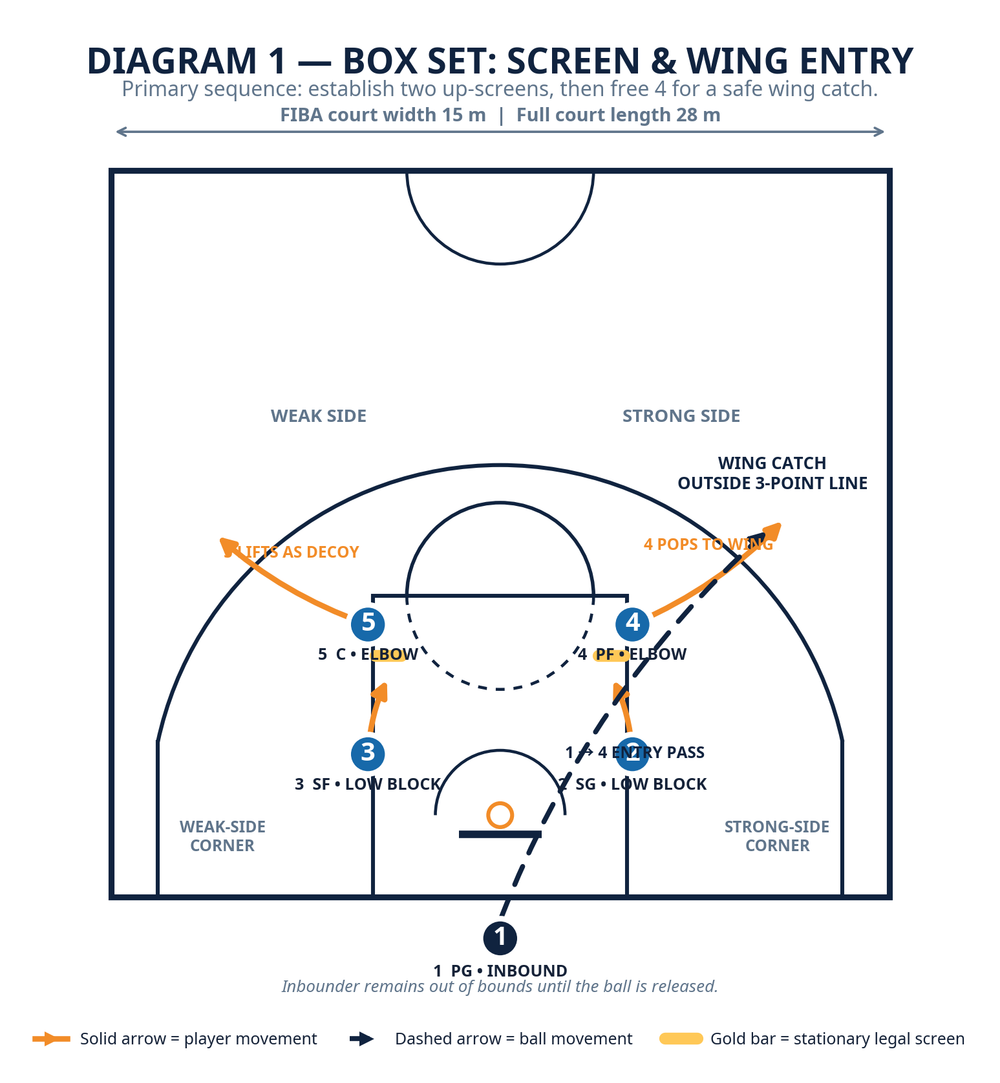
Phase 1 — Box alignment and wing entry

Call the set before 1 receives the ball. Use a short signal such as “Box 4.” Every player must know that 4 is the entry target and 5 is the primary finisher.
On the whistle, 2 and 3 sprint upward from the low blocks. They jump-stop before contact, establish a shoulder-width base, and keep their chest square to the route. 2 sets below the strong elbow for 4; 3 mirrors the screen on the weak side for 5.
4 waits for a half-count, then cuts tightly off 2. 4 first threatens the middle of the paint, brushes the screener’s shoulder, and flares to the strong wing about 1 m outside the three-point arc. The inside step forces a trailing defender into the screen.
5 lifts one controlled step and holds. This occupies help but keeps the lane open. 5 must not sprint to the basket while the inbound pass is still in the air.
1 shows the ball at the rim, then passes firmly to 4’s outside hand. Deliver the pass within roughly 1.5 seconds of the whistle. If 4 is denied, 1 immediately checks the safety release rather than holding the ball.
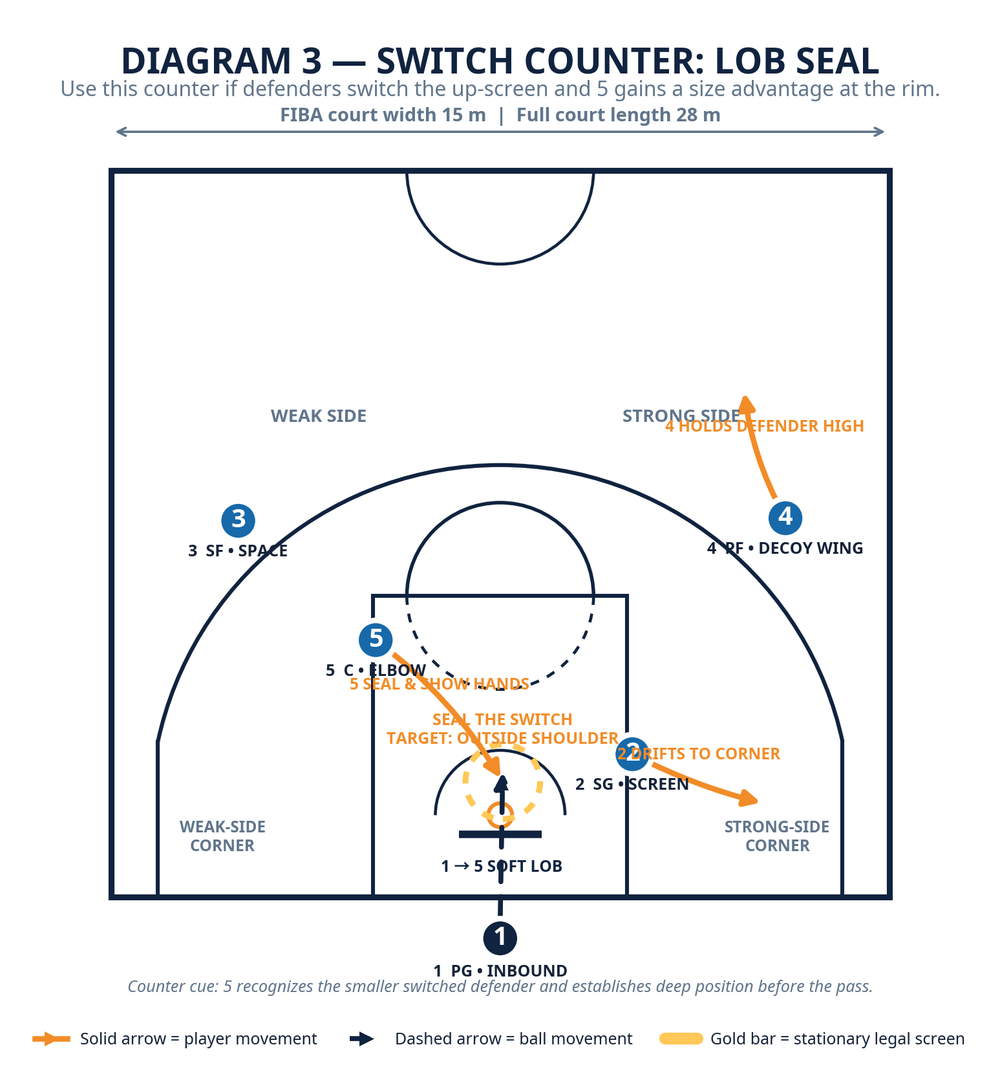
Phase 2 — High-low finish

4 catches on two feet and chins the ball. The first look is inside; no extra dribble is needed unless the defender has recovered squarely.
As 4 secures the ball, 5 explodes to the rim. 5 cuts across the front of the basket, shows both hands, and aims to reach the restricted area in about one second. 3 holds spacing to discourage help.
4 leads 5 with the correct pass. Use a bounce pass when help is high, a chest pass through a clear window, or a soft lob only after 5 has sealed a smaller defender. Do not make 5 stop and gather.
5 catches in stride and finishes through the rim line. Encourage a two-foot gather, a strong glass finish, and an immediate second jump if the first attempt is contested.
Flow into your half-court offense if no finish appears. 4 keeps the ball on the wing, 2 lifts as an outlet, 3 fills the weak corner, and 5 seals or moves to the dunker spot. Rehearse the flow so a defended first option does not become a dead possession.
4. Key Coaching Points

Be legal before being physical. Screeners arrive, jump-stop, and hold their space; moving on contact turns good design into an offensive foul.
Teach the order. The sequence is screen, pop, catch, then cut. Early movement by 5 closes the high-low window.
Demand shoulder-to-shoulder cuts. A wide route by 4 gives the defender daylight and ruins the wing passing angle.
Coach 1’s eyes. A credible rim fake before the entry can freeze the low defender long enough for the wing catch.
Make 4 a fast decision-maker. Catch on two feet, chin the ball, and pass, shoot, or flow within one second.
Name the safety plan. 5 calls “here” after winning position; 4 calls “safety” if the inside pass is covered.
5. Common Mistakes and Corrections
| Mistake | Immediate correction |
|---|---|
| Moving or leaning screen | Freeze the rep; jump-stop, chest up, and hold the base. |
| 5 cuts before 4 catches | Key 5’s cut to the sight or sound of 4’s catch. |
| Soft or telegraphed inbound | Rehearse a firm outside-hand pass after a rim fake. |
| 4 drifts wide off the screen | Make 4 brush a coach’s hand placed at 2’s shoulder. |
| No bailout when 4 is denied | Drill 2’s corner safety release every rep. |
6. Variations & Progressions

Variation A — Safety-valve corner release
If 4 is denied, 2 pivots out of the screen and drifts to the strong corner. This is 1’s first bailout. Once 2 catches, 4 can screen away for 5, preserving a high-low concept from a different entry.
Variation B — Switch counter: lob seal
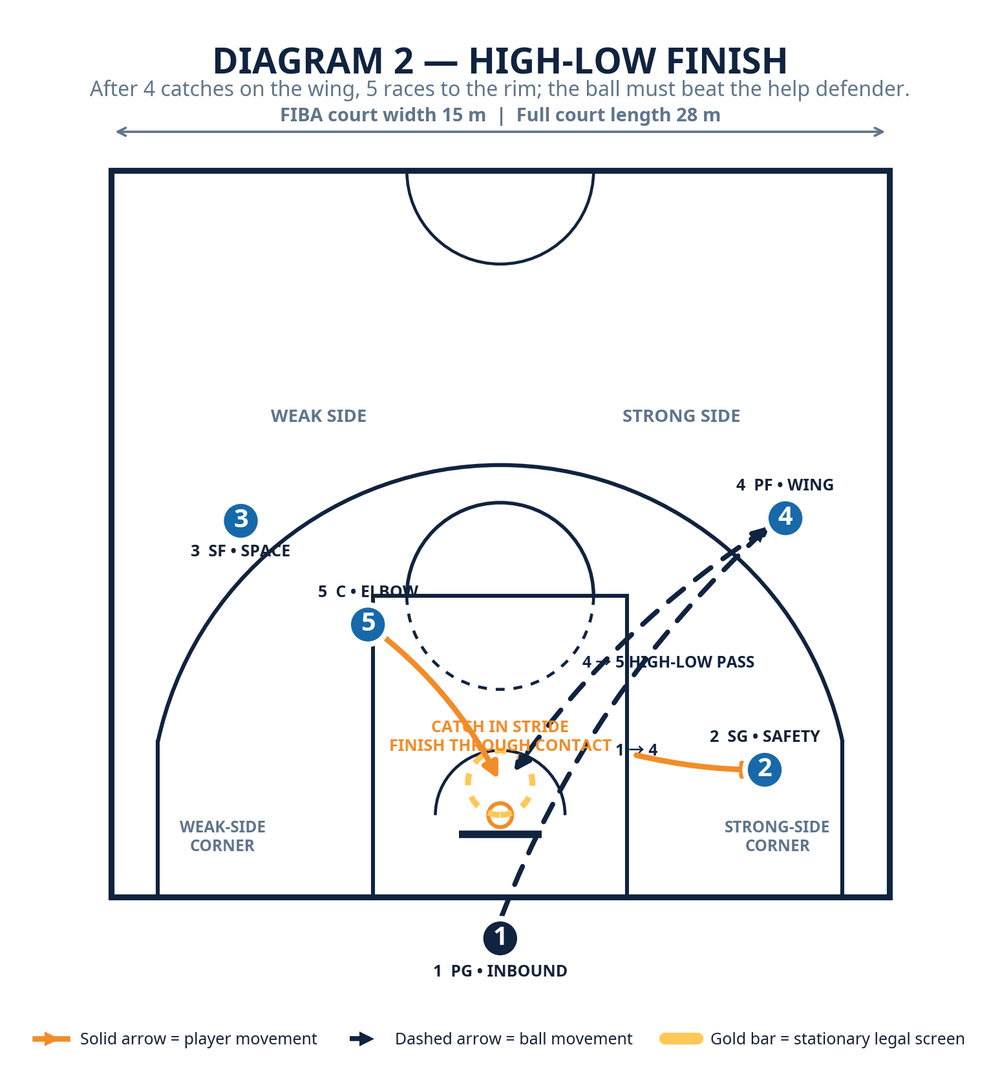
Use this when the defense switches the up-screen. 5 recognizes the smaller defender, seals on the outside shoulder, and flashes both hands at the front of the rim. 1 skips the wing entry and drops a controlled soft lob to 5 while 4 holds the defender high.
Variation C — Shooter option for 4
If 4’s defender goes under the screen or help collapses early on 5, 4 keeps the catch for a rhythm wing jumper. Teach 5 to turn and offensive-rebound rather than blindly completing the cut.
Progress from no defense, to guided trail defense, to live defenders who may switch, top-lock, or deny the first pass. In eight live reps, chart clean wing catches, rim catches, finishes, and turnovers. The numbers tell you whether the issue is spacing, timing, or pass quality.
7. Age Adaptations

Under 8 / Under 10: Use one screen—2 for 4—and make 5 a simple weak-block target. Shorten the entry pass inside the arc if needed. Prioritize safe stops, spacing, and a completed pass.
Under 12: Add the full box shape and use the verbal rhythm, “screen, pop, catch, cut.” Reward legal screens and timing even when the finish misses.
Under 14 / Under 16: Add the safety release, force 4 to read help, and demand a score-or-flow decision within two seconds of the catch.
Open / Advanced: Scout how opponents guard the screen. Back-cut 4 against top-locking; call the lob seal when aggressive switching places a smaller defender on 5.
