Basketball
Box 2: Under-Basket Inbound Play
Install a reliable box-set baseline inbound with a rim cut, screener-slip counter, and safety outlet that coaches can teach in one focused practice block.
What you need
2 basketballs, Half-court or full FIBA court, 10 reversible pinnies, 4 floor cones, Whistle, Whiteboard or clipboard, Visible five-count timer
Overview
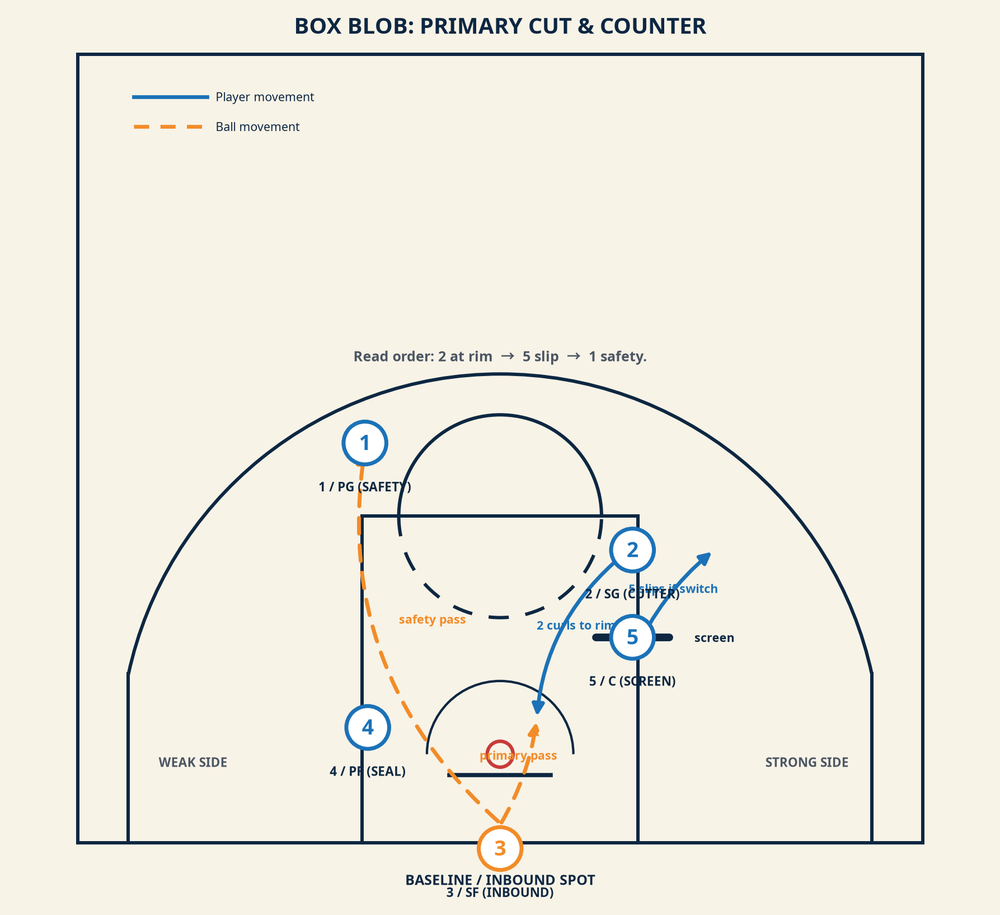
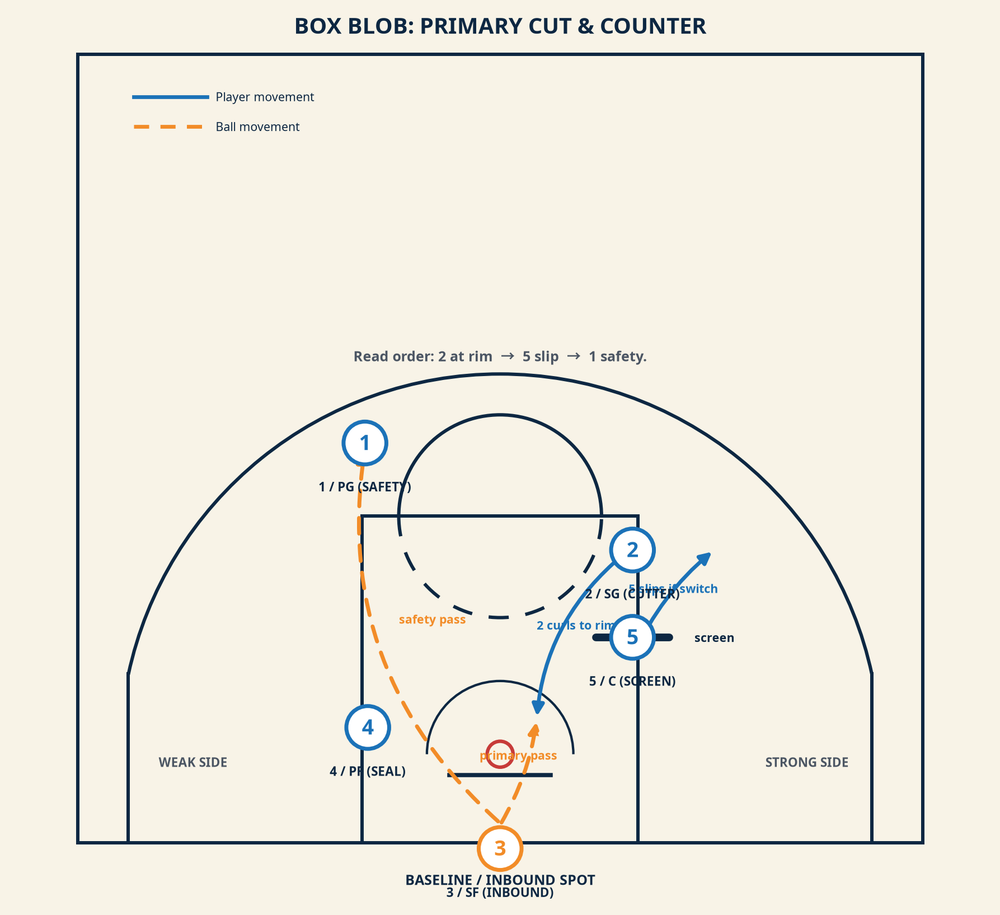
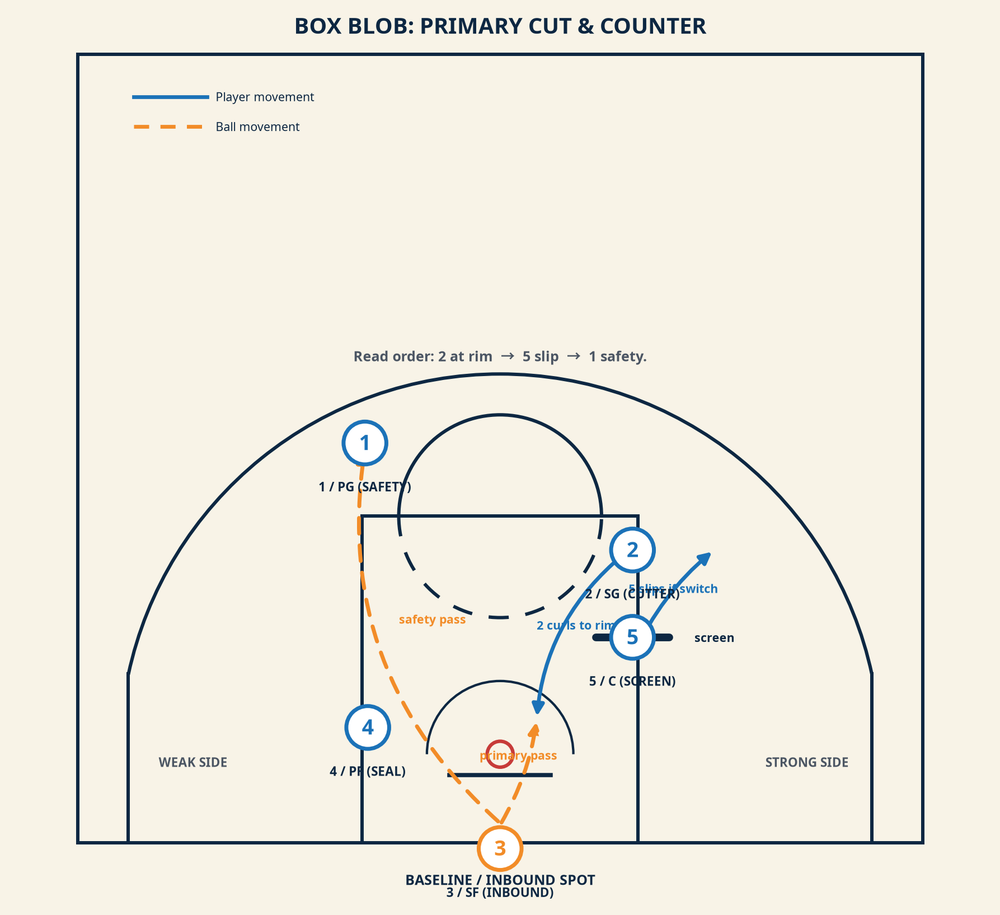
This Box BLOB (baseline out-of-bounds) is a dependable under-the-basket inbound package for a coach who wants a simple first look, a built-in counter, and a safe way to keep possession if the defense takes away the rim. The action uses a compact four-player box in the lane, then creates separation through a decoy cross-flash and a lift-and-screen for the shooting guard. Your primary finish is a catch at the rim by 2 (shooting guard); the counter is 5 (center) slipping when the defense switches or top-locks the screen. The point guard is deliberately held as the safety valve, not asked to crowd the scoring action.
Use it after a dead ball on the attacking endline, especially after a timeout or any baseline throw-in near the basket. A FIBA court is 28 m x 15 m, and the thrower-in must release the ball within five seconds, so train a decisive early trigger.1
Call: “Box 2.” The number tells the group that 2 is the first live scoring option. If the ball cannot enter cleanly, call “Green” and flow directly to your half-court offense through 1.
Setup
Use one basket and the attacking half-court. Put a coach or manager on the baseline with a whistle and visible five-count. In the teaching phase, use four cones at the elbows and low blocks; remove them once players own the landmarks. Install with five attackers, then add five defenders.
| Player | Starting location | Job on the call |
|---|---|---|
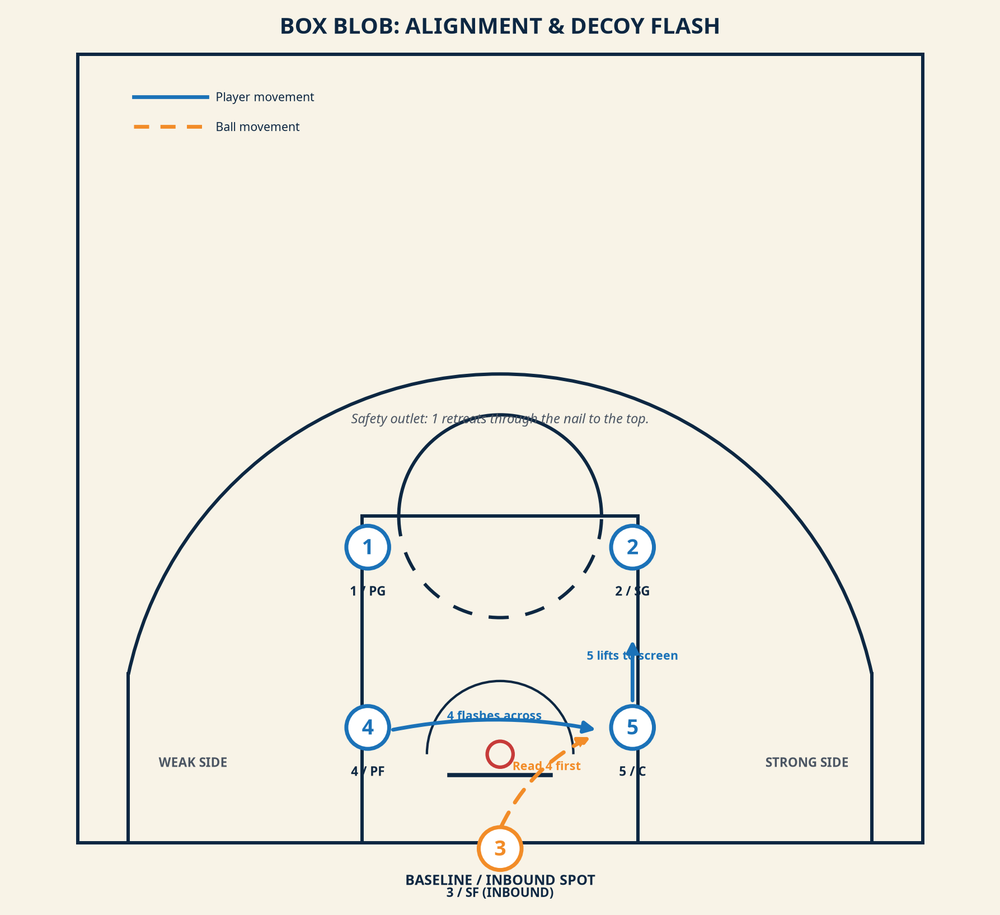
| 3 – SF / inbounder | Out of bounds, centred under the rim, 0.6 m behind the endline | Deliver the ball, then enter as a weak-side spacer. |
| 1 – PG | Weak-side elbow, about 5.8 m from the endline | Clear to the top as the safety receiver and organizer. |
| 2 – SG | Strong-side elbow, one step outside the lane line | Set up the defender, then curl to the rim as the primary option. |
| 4 – PF | Weak-side low block, 1 m above the endline | Cross-flash as a decoy, then seal the smaller defender. |
| 5 – C | Strong-side low block, 1 m above the endline | Lift into a legal screen for 2; slip if the defense switches. |
Keep the box compact but do not let defenders guard two cutters. Start roughly 0.6 m inside the lane line and 1 m above the endline or free-throw line. The inbounder holds a balanced stance, sees the rim first, then the cutter, then safety.
Step-by-Step Instructions
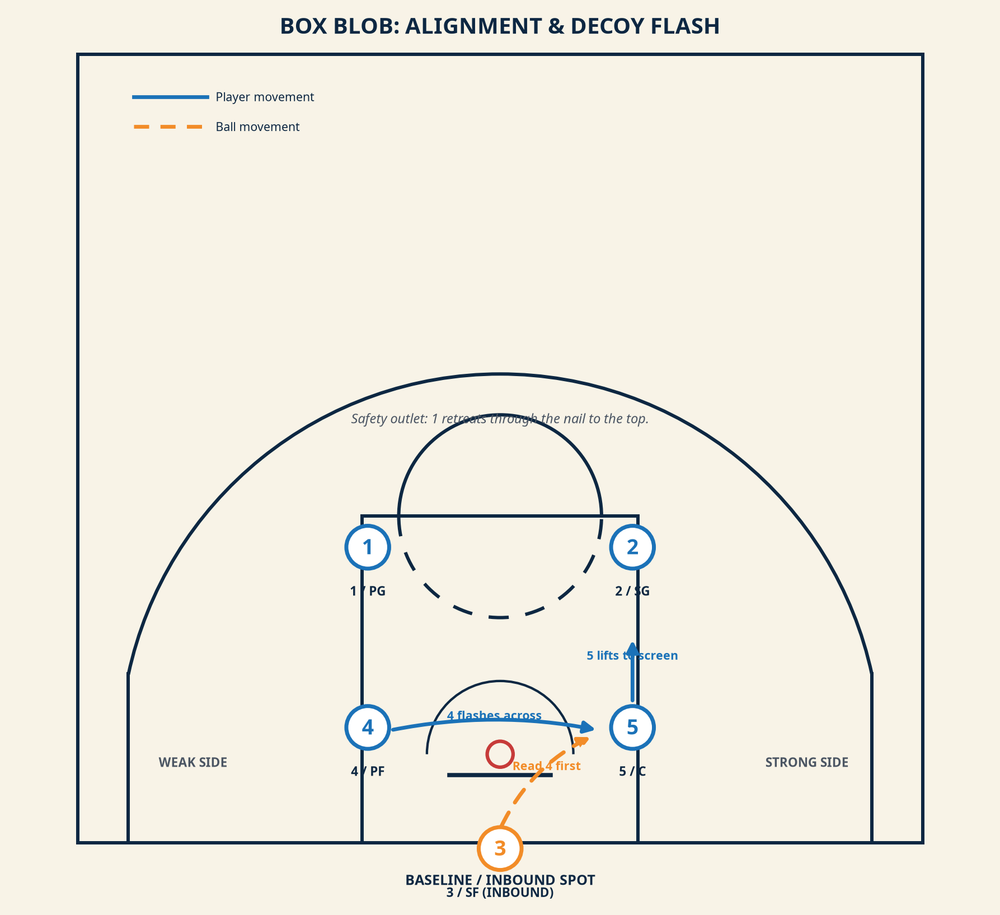
Call, match up, and trigger. Start in the box. 3 shows the ball, calls “Box 2,” and waits until every offensive player is still. On the referee’s hand signal or the coach’s cue, 3 gives a sharp ball slap. Treat the slap as time zero: the first cut starts immediately, with the ball normally delivered by count three or four, never at the edge of the five-count.
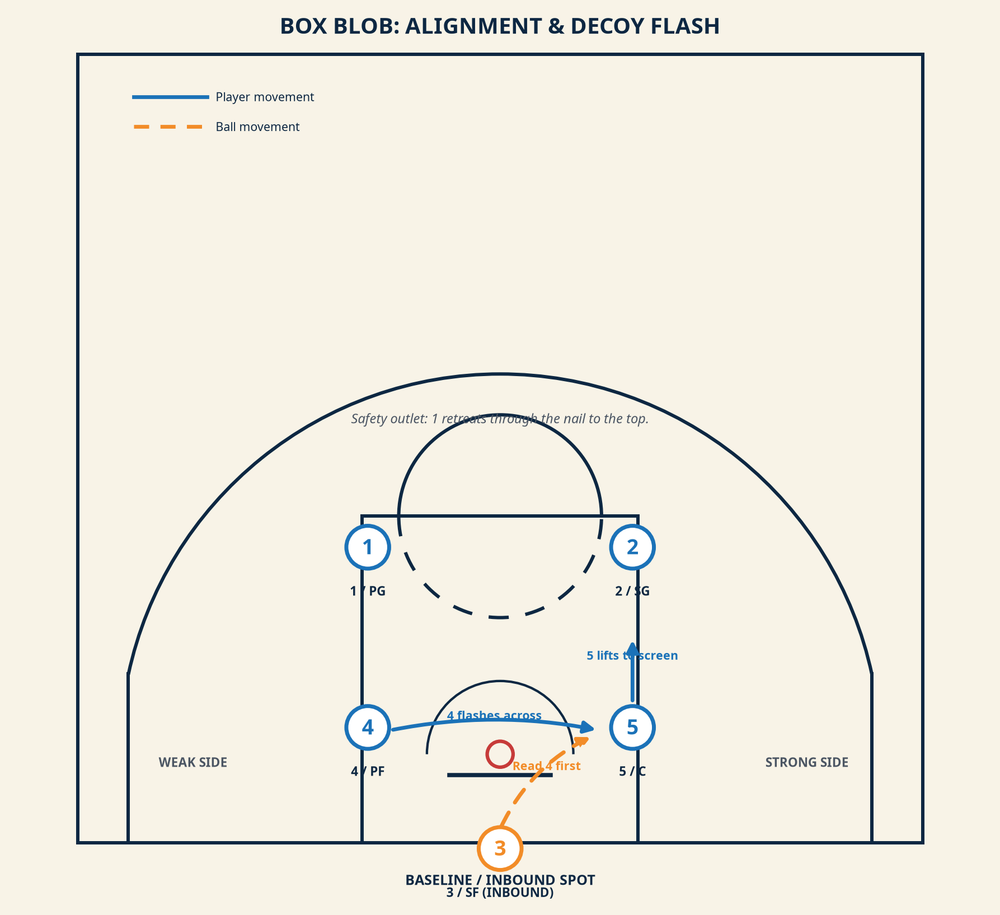
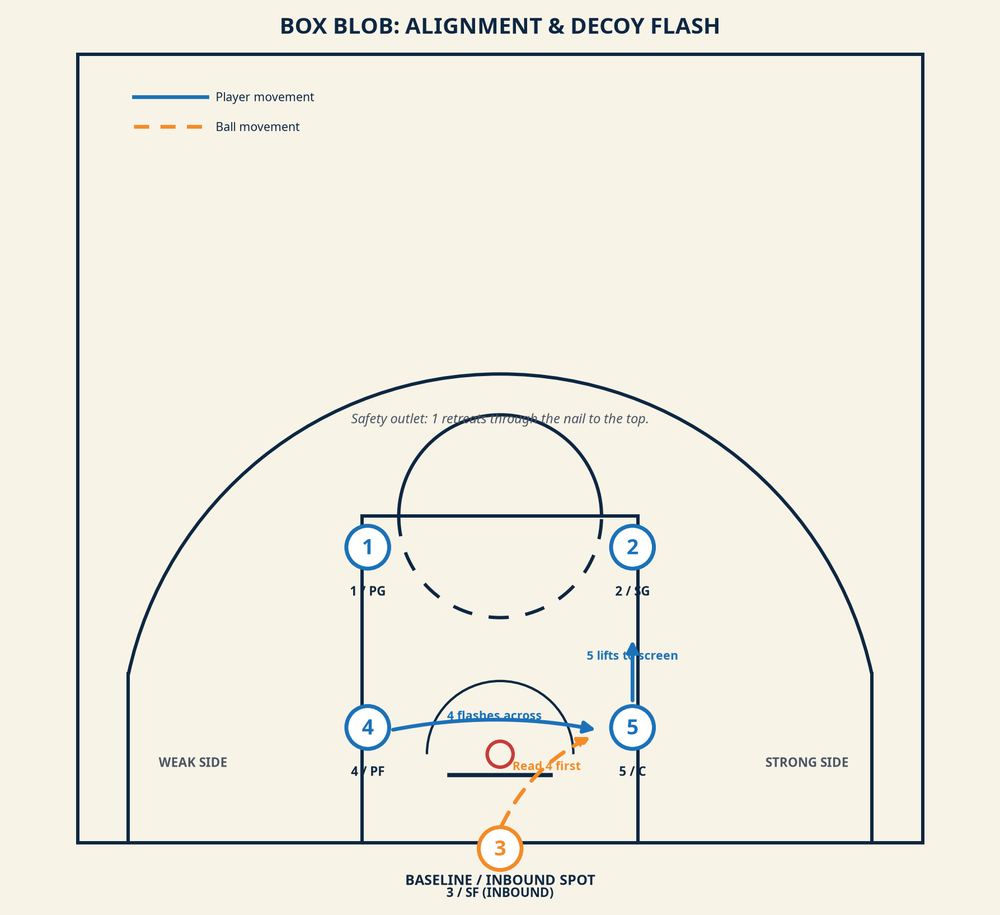
Clear the safety lane. At the slap, 1 retreats through the nail to the top, roughly 6.75 m from the basket. 1 stays visible to 3 and out of the scoring pass line.
Create the decoy. 4 sprints from the weak-side low block across the lane to the strong-side block. The cut ends in a two-foot seal. 3 reads 4 only if the defender trails; otherwise the flash pulls help and hides the screen action.
Build the screen. As 4 clears, 5 lifts from the strong-side low block to a point just below the strong-side elbow. 5 arrives first with a wide base and chest to the sideline. The screen is stationary before 2 arrives; 5 gives a tight route without moving into the defender.
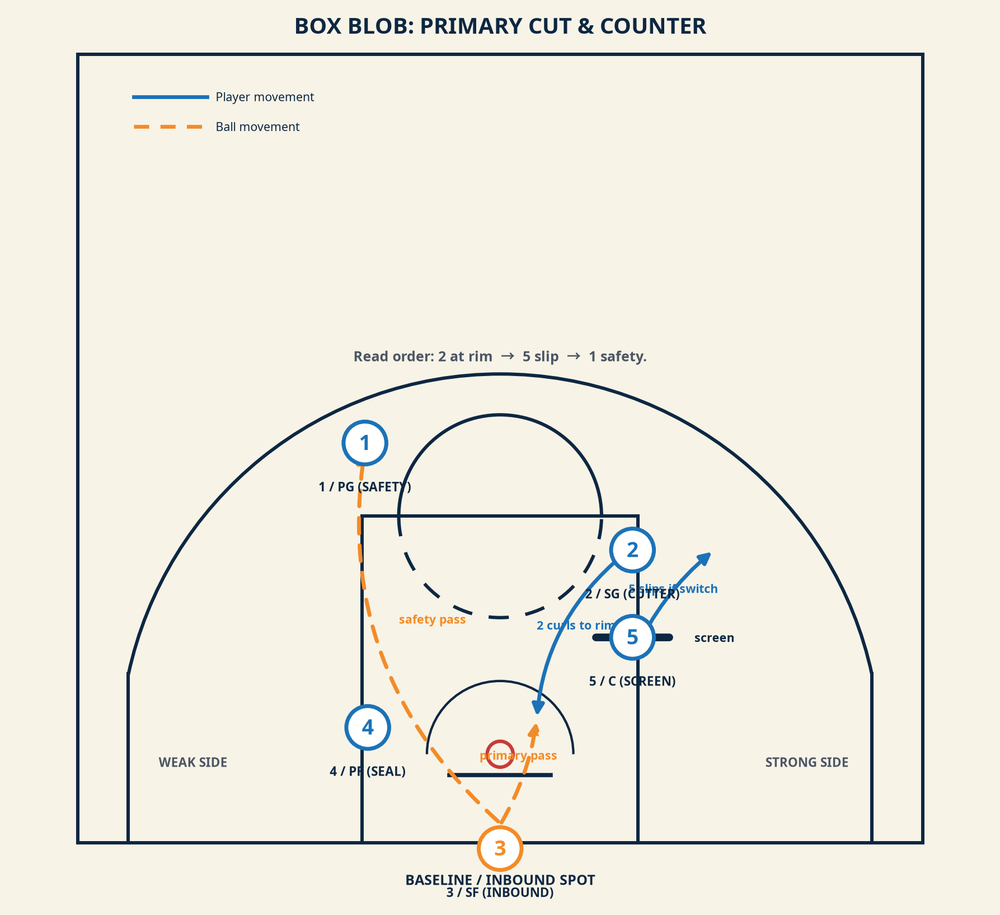
Win the primary cut. 2 takes a short V-cut toward the strong-side wing to move their defender, plants the outside foot, then cuts shoulder-to-hip off 5’s screen. 2 curls downhill through the lane and presents a target hand above the waist at the front of the rim. The cut must arrive about 1.5–2.0 seconds after the ball slap. 3 steps into a firm two-hand chest pass or short bounce pass; the pass leads 2 away from the defender and into a one-step finish.
Read the counter, then protect possession. If 2’s defender trails, switch, or overplays the curl, 5 immediately slips to open space at the strong-side elbow or short corner. 3’s read order is 2 at the rim, 5 on the slip, then 1 at the top. If neither inside look is clean by count four, 3 delivers to 1. After any inbound, 3 enters to the weak-side corner and the team flows into its normal spacing. Do not force a window that is no longer there.
Key Coaching Points
| Teaching cue | What the coach should demand |
|---|---|
| “The slap starts the race.” | Every movement is tied to one audible trigger. Late cuts let defenders jam the lane. |
| “Screen is early; cutter is violent.” | 5 arrives and becomes stationary before 2 turns the corner; 2 changes speed and cuts tight enough to brush the screener. |
| “Show the target late.” | 2 does not wave for the ball from the elbow. Show a hand only as the cut reaches the finishing window. |
| “Pass to space, not to a player.” | 3 throws to the rim-side shoulder of 2, away from the trailing defender. |
| “Seal, then finish.” | 4 completes the decoy with contact and a two-foot seal; do not float through the paint. |
| “Safety is a success.” | A clean pass to 1 and organized flow is a winning possession when the rim is taken away. |
Common Mistakes and Immediate Corrections
If 2 rounds the curl, use a cone at the screen hip and require a brush cut. If 5 moves, freeze the rep: 5 must arrive, balance, and wait before 2 turns the corner.
Correct 3 for staring at 2: use the snapshot order 4, 2, 5, 1. Keep 1 at the top; drifting into the lane removes the safety pass and clogs the rim.
Variations and Progressions
Variation 1 – Lob 4. Against a smaller switch-heavy unit, turn 4’s cross-flash into a high catch at the rim. Use touch passes and reserve it for an explosive 4.
Variation 2 – Screen-the-screener. If opponents deny 2’s curl, 4 reverses to screen 5 into the weak-side elbow for a 3–5 m jumper. Add it only after the primary action is sharp.
Progression – Live reads. Start against guided man-to-man, then add switches, top-locking, and a compact 2–3 zone. Against zone, 4 parks in the short corner, 5 screens the middle defender, and 2 flashes into the seam. Grade timing, legal screening, read order, and shot quality.
Age Adaptations
For Under 8 and Under 10, use only 3, 2, and 5: 5 stands as a stationary guide screen, 2 cuts to the rim, and 3 passes. Keep defenders passive until players can identify the baseline, paint, and target hand. For Under 12, add 1 as safety and 4 as the decoy, but permit one clear verbal cue from the coach at the ball slap.
For Under 14 and Under 16, use a live defense and require a switch-versus-trail read. At open/advanced level, use hand signals to alter the read order and chart conversion by option. Every level needs a sharp trigger, legal screen, decisive cut, and outlet.
References