

Basketball
Pressure-Proof Free Throw Routine: Make–Reset–Rebound Circuit
A coach-ready 20-minute routine that teaches players to reproduce the same calm, balanced free-throw process under fatigue and consequence.
What you need
2 basketballs, 2 flat cones, stopwatch, clipboard or tally sheet, one FIBA regulation basket
Overview
This is not a casual ‘shoot until you are tired’ activity. It is a routine-building drill that gives each player a repeatable sequence from the moment the ball is received until the ball is through, rebounded, and returned. The aim is to make the free throw a controllable skill: same feet, same breath, same eyes, same finish, whether the player is fresh in a development block or winded at the end of practice. Use this drill after your shooting work, at the end of a competitive practice, or before a scrimmage when you want players to shift from physical execution to mental execution.
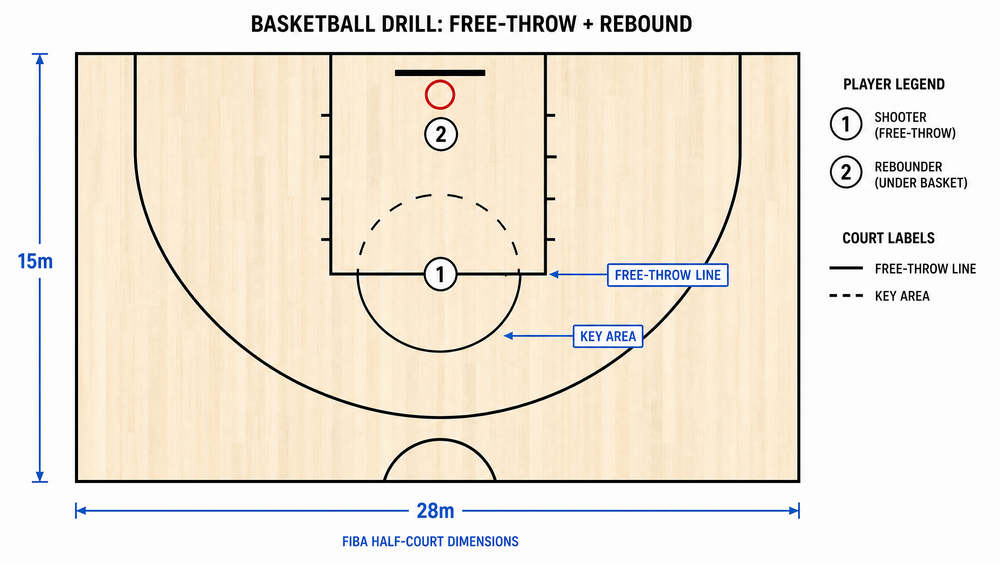
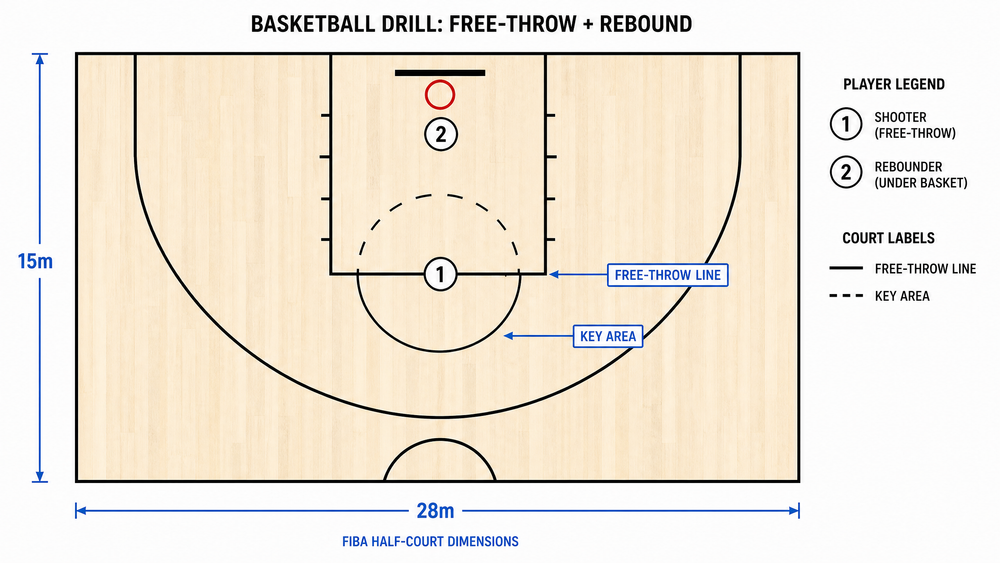
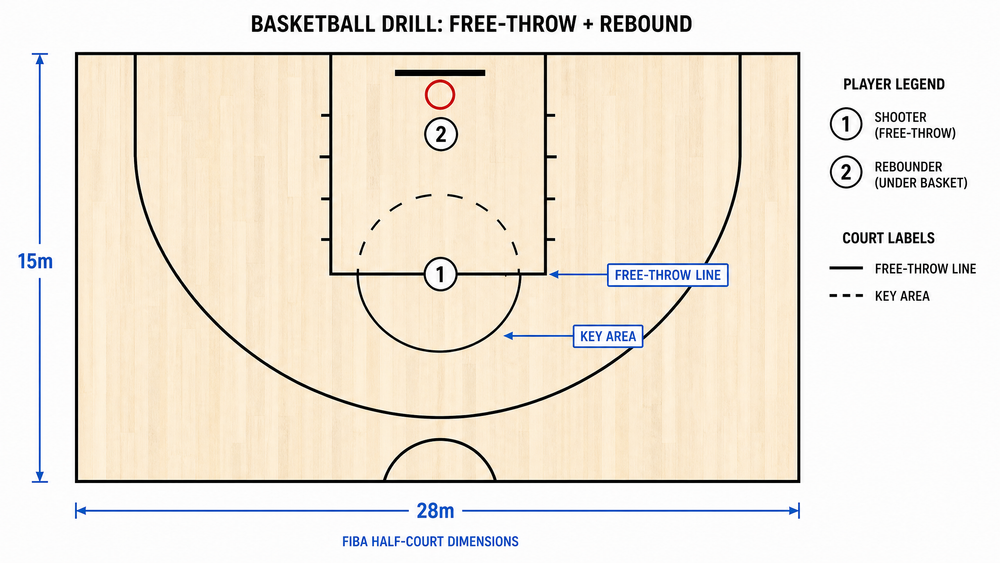
For a FIBA session, anchor the work at the regulation line: the free-throw line is 3.60 m long, and its furthest edge sits 5.80 m from the inner edge of the endline. A FIBA playing court measures 28 m x 15 m. [1]
Coach’s outcome
By the end of the circuit, every shooter should be able to name their own three-to-five second pre-shot routine, hold a balanced follow-through until the ball reaches the rim, and give a composed response to both makes and misses. We are coaching process discipline, not only the make percentage.
Setup
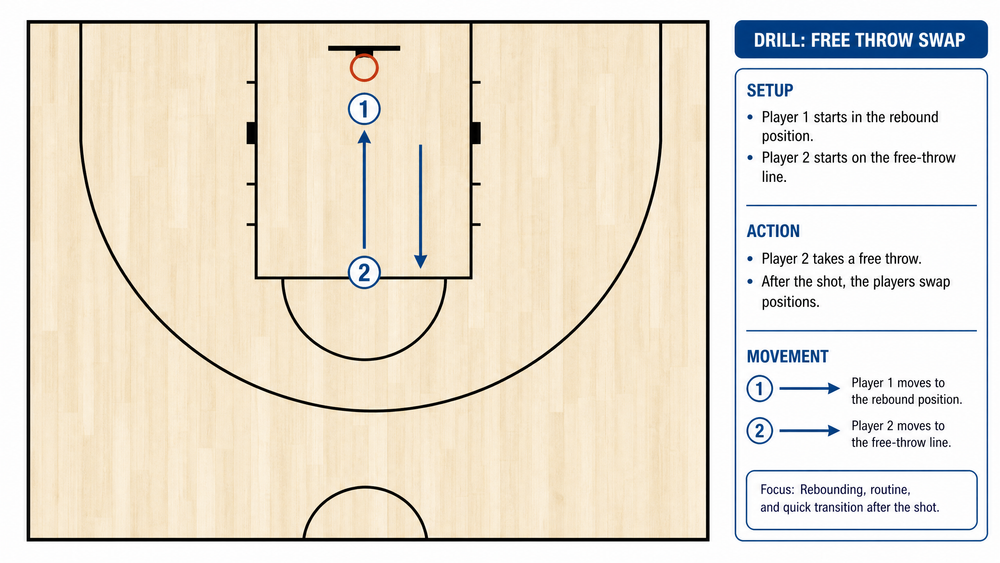
Use one basket, a regulation free-throw line, two basketballs, one clipboard or tally sheet, and two flat cones. Put a cone one metre behind the free-throw line as the shooter’s waiting mark. If space allows, mark a recovery lane from the baseline to the cone so the next shooter is never wandering across the key. Start with two players; add a third player as a scorer or rotate pairs quickly. In standard position numbering, Player 1 is the primary ball-handler/shooter, Player 2 is the wing partner and return passer, and Player 5 is the optional interior rebounder. Any position can shoot; the numbers simply keep the rotation clear.
| Detail | Coaching instruction |
|---|---|
| Court area | One FIBA half-court within the 28 m x 15 m floor; work at one regulation basket. |
| Player 1 | Shooter at the centre of the free-throw line, beginning one metre behind it. |
| Player 2 | Rebounder/return passer on the first legal lane-space spot or just outside the key in a non-officiated session. |
| Player 5 (optional) | Second rebounder on the opposite low block; use this role with larger groups. |
| Equipment | 2 balls, 2 flat cones, stopwatch, clipboard, and a visible make/miss chart. |
| Work load | Three 10-shot blocks per player, 8–10 seconds per repetition, 60–90 seconds between blocks. |
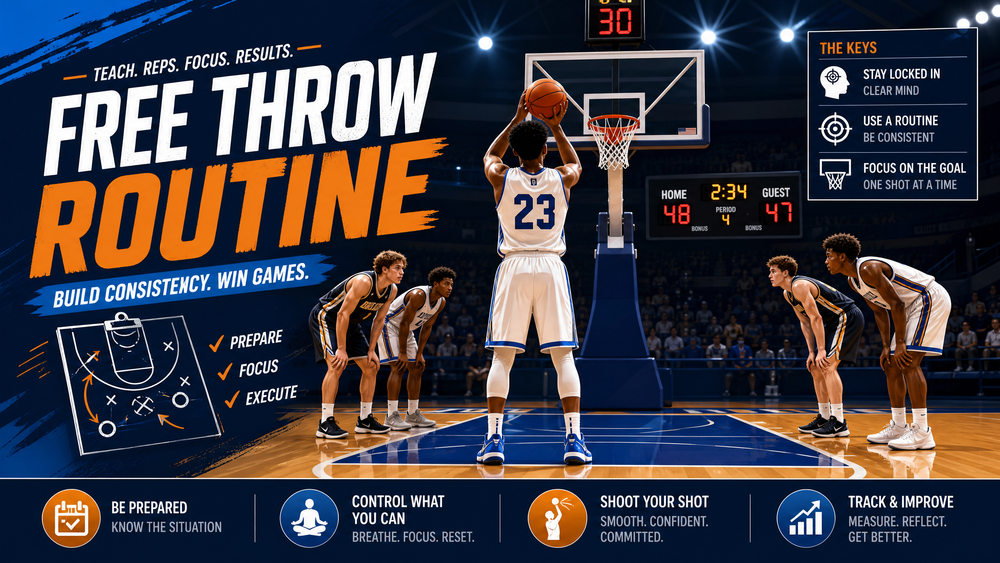
Set the standard before the first shot: a player does not begin the routine until both feet are organised. A rushed first rep teaches a rushed habit.
Step-by-Step Instructions
Establish the routine without a ball. Bring Player 1 to the waiting cone. On your cue, they step to the line, set their feet shoulder-width apart with the shooting-side foot fractionally forward, look at their chosen target, take one controlled breath, and freeze in a high follow-through for two seconds. Give each player three dry repetitions. Keep the language simple: ‘Feet. Breathe. Eyes. Finish.’
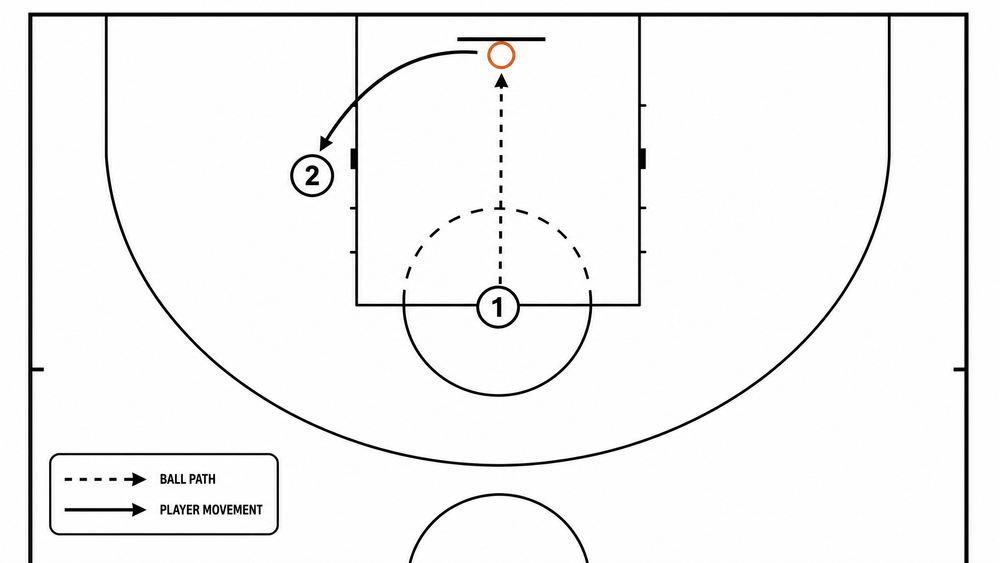
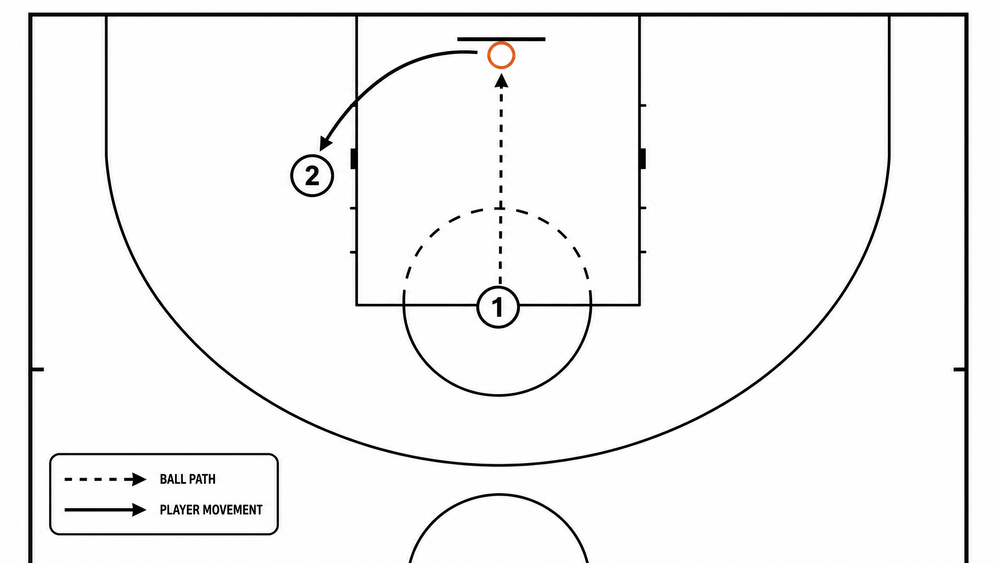
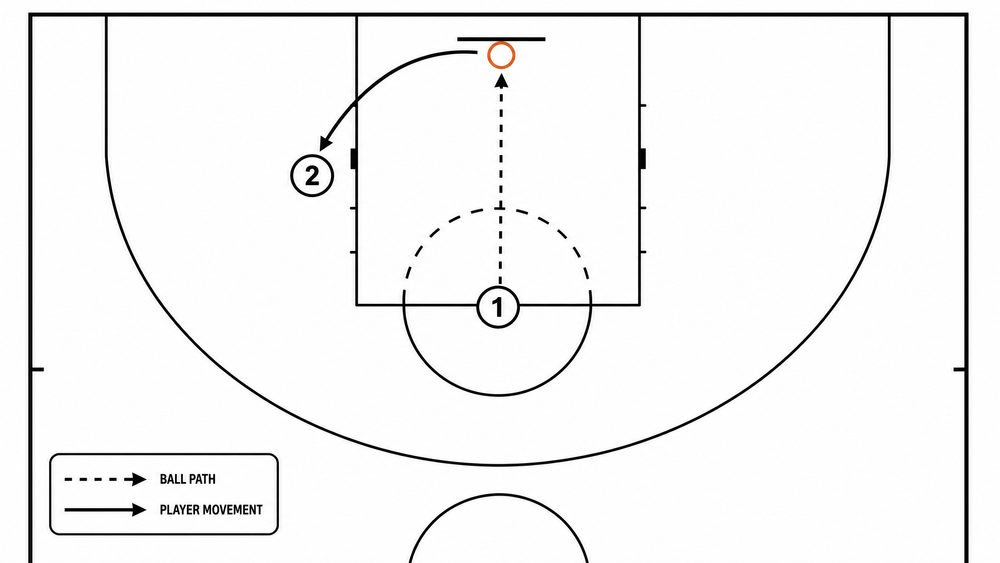
Introduce the ball and the reset. Player 2 chest-passes the ball to Player 1 only after Player 1 is set. Player 1 performs the exact routine, shoots, holds the finish until the ball reaches the rim, and listens for the coach’s process call: ‘balanced’, ‘straight’, or ‘reset’. Player 2 rebounds the ball under control and returns it with a chest pass. Do five non-scored shots apiece; this is technique rehearsal, not a contest.
Run Block 1: baseline routine. Player 1 shoots 10 free throws in a maximum of 10 seconds per rep. Start the clock when the ball hits their hands; the player may take fewer seconds, but never skip their breath and target. Player 2 records three items: make/miss, whether the routine was completed, and one technical note. After the tenth shot, switch roles immediately. The shooter calls out their own routine word before each attempt, then says only ‘next’ after the result.
Run Block 2: make–miss response. Use the same 10-shot block, but add an automatic response. On a make, Player 1 turns, touches the waiting cone with one hand, and returns to the line. On a miss, Player 1 takes one long exhale, says their reset word, touches the cone, and returns with the same body language. The point is to prevent celebration after makes and visible frustration after misses. Player 2 must rebound cleanly and deliver the next pass to the shooter’s chest—do not let poor returns become an excuse for poor preparation.
Run Block 3: fatigue and consequence. Before each shot, Player 1 completes a controlled baseline-to-free-throw-line sprint and jogs back to the stripe, then starts the routine. Keep the effort short; the run is a light stressor, not conditioning. Set a pair target of 16 makes from 20 attempts. If the pair misses the target, they repeat only the final four shots after a 45-second coaching reset. Do not make players run punishments for a miss; coach the response and keep the volume purposeful.
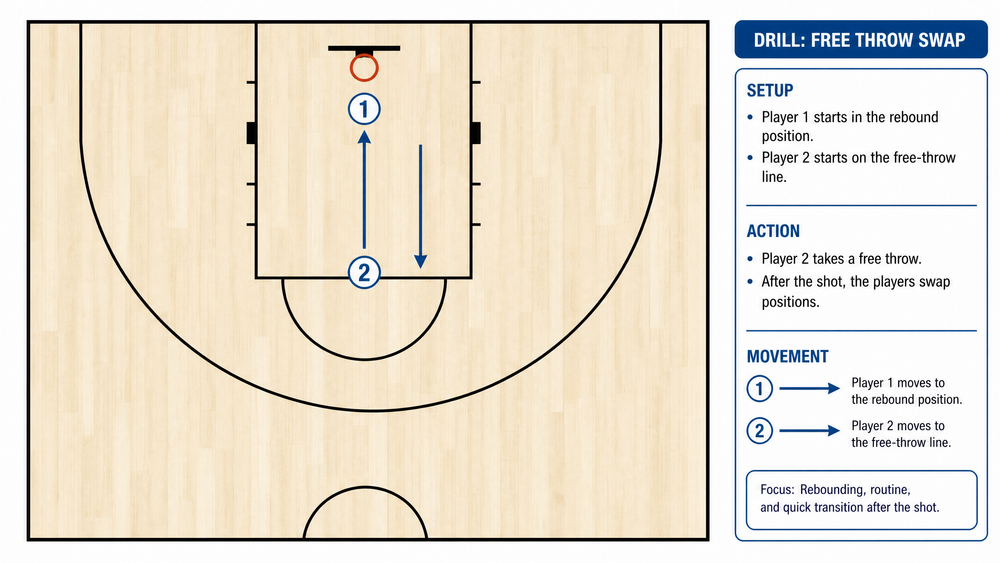
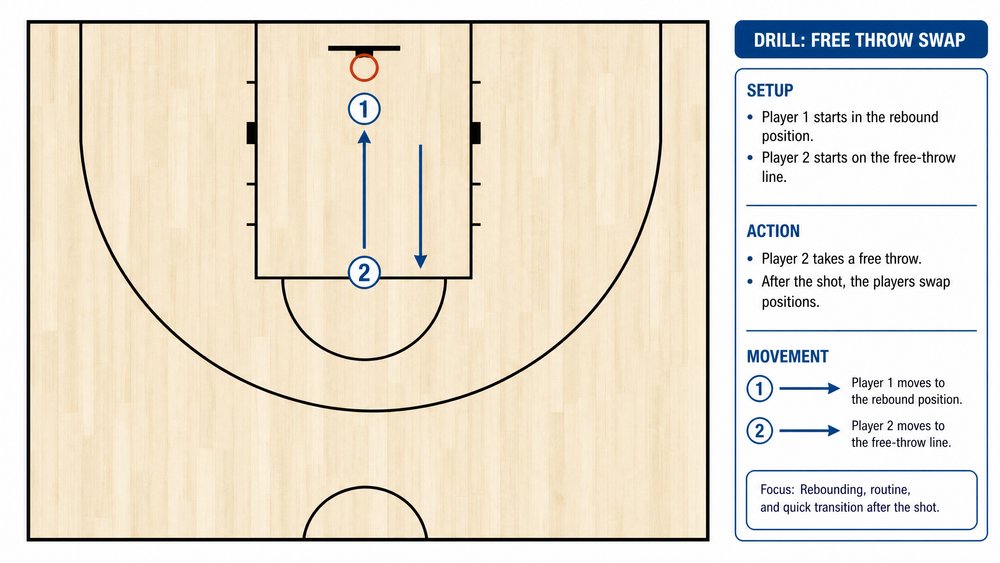
Rotate with purpose. In a group of three, Player 1 shoots, Player 2 rebounds and returns, and Player 5 charts. Rotate after every 10 shots. In a team station, run two baskets simultaneously, then bring the group together for 90 seconds of feedback: one routine win, one correction, and one next-session target per player.
Key Coaching Points
| Coaching cue | What the coach should see |
|---|---|
| Own the feet first. | Balanced base, heels not drifting, shooting-side foot naturally comfortable rather than forced into a straight line. |
| Use one breath to slow the moment. | A visible inhale/exhale before the lift; no extra dribbles or fidgeting once the player is ready. |
| Choose a small target. | Eyes settle on a consistent rim reference before the dip and stay quiet through release. |
| Load straight, rise straight. | Ball moves from a compact set point through the shooting line; knees and hips extend without a sideways sway. |
| Guide hand stays a guide. | Non-shooting hand supports the ball and leaves cleanly, without thumb pressure or side spin. |
| Finish and evaluate. | Wrist relaxed, fingers down, elbow extended, body held until the ball reaches the rim; evaluate the routine before the result. |
Common Mistakes
The first error to stop is inconsistent entry: players catch the ball, shuffle their feet, and shoot before they are organised. Send them back to the waiting cone for a dry rep, then restart. Second, watch for a player whose knees collapse inward or whose shoulders tip to the side; reduce the speed and rebuild a stacked, balanced stance. Third, correct the guide-hand thumb flick by having the shooter hold the guide hand open after release. Fourth, do not accept a player who drops their arm to watch the shot—ask them to ‘show the hand to the rim’ for two full seconds. Finally, eliminate emotional scorekeeping: if a miss changes posture, pace, or voice, call ‘reset’ and demand the same next-shot behaviour.
Variations & Progressions
Start younger or less confident players with the form ladder: take five shots from one metre inside the line, five from midway, then five from the regulation line only when the same routine and arc are retained. For a competitive middle progression, use the partner ladder: each pair must make two in a row before moving to the next target number, with the rebounder responsible for routine compliance. For older or advanced groups, use the late-clock pressure series: the coach gives the ball, counts down from eight, and awards the team one point for a make plus one point for a complete routine. A made shot with a skipped routine counts as one, never two.
Age Adaptations
| Age group | Distance and volume | Coaching emphasis |
|---|---|---|
| Under 8 | Shoot 2.5–3 m from the basket; two blocks of five. | Comfortable balance, soft release, and a fun reset word. |
| Under 10 | Progress toward the regulation line as strength permits; two blocks of eight. | One breath, eyes on target, and full follow-through. |
| Under 12 | Regulation line where mechanics hold; two or three blocks of 10. | Consistent ball path and calm make/miss response. |
| Under 14 | Three 10-shot blocks with partner charting. | Individual routine, score tracking, and accountability. |
| Under 16 and open | Three 10-shot blocks plus fatigue or pressure progression. | Game-speed recovery, self-coaching, and reliable execution under consequence. |
Coach’s Finish
Close by recording two numbers: each player’s make rate and their routine-completion rate. If a player makes 7 of 10 but completes only 5 of 10 routines, the coaching plan is still the routine. Give each player one actionable target for the next session, such as ‘same breath on all 10’ or ‘hold the follow-through through the rim contact.’ That is how free-throw work transfers from an isolated station to a late-game habit.
