

Basketball
Hit, Seal, Pursue: Progressive Box-Out and Rebounding Drill
Teach players to turn every defensive stop into possession by locating the opponent, creating a legal seal, pursuing the ball with two hands, and delivering a controlled outlet.
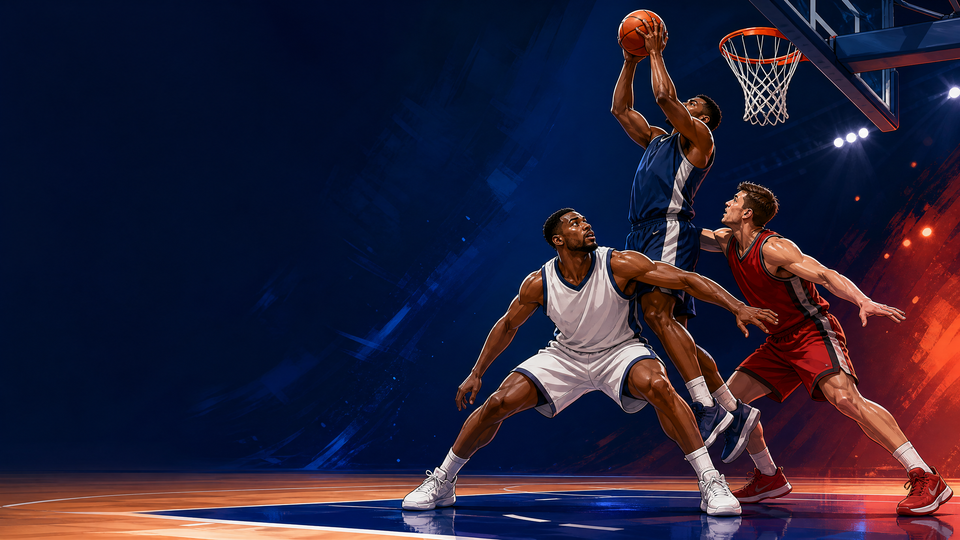
What you need
1 basketball hoop, 3-6 basketballs, 8 disc cones, two coloured bib sets, whistle, scoreboard or clipboard
Overview
The Hit, Seal, Pursue drill teaches a complete defensive-rebounding habit rather than treating a rebound as a jump-ball contest. Your players learn to react to the shot with a verbal call, locate their assignment, create legal body contact, maintain the seal while the ball is in flight, then pursue and secure the rebound. Finish every rep with a chin, pivot, and outlet so the team connects the stop to the next possession. Use it after introducing close-outs or shell defense, particularly when second-chance points are a concern.
Run the drill on one 15 m x 14 m half-court, representing one half of a FIBA court that measures 28 m x 15 m overall. Begin with 1v1 to teach the technique, build to 2v2 for responsibility on both sides of the lane, and finish with 3v3 when the outlet and weak-side rotations matter. Use one shared language: shot, hit, seal, pursue, chin, outlet.
Setup
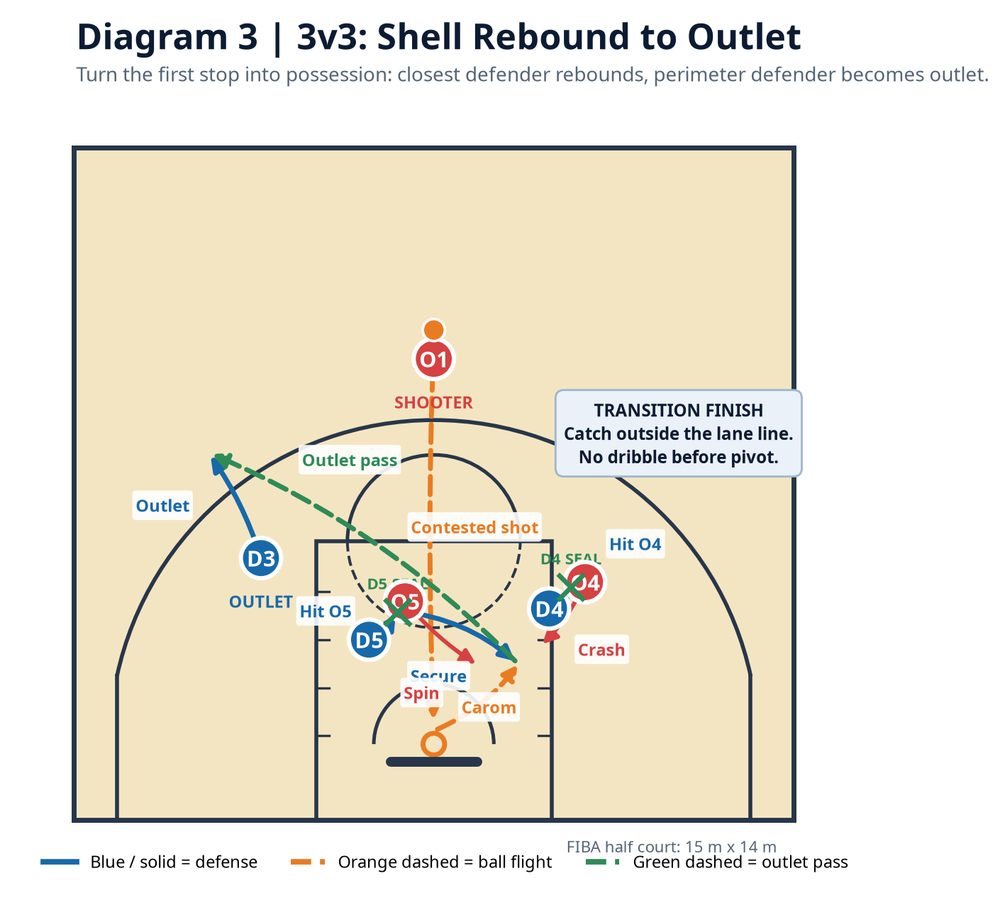
| Item | Coaching specification |
|---|---|
| Players | Six players are ideal: three defenders, numbered D3, D4, and D5, versus three attackers, numbered O1, O4, and O5. A coach or seventh player starts each rep as the shooter. |
| Space | Use one FIBA half-court. Mark two pursuit zones with disc cones: one cone 1.5 m outside each low block and one cone 2 m beyond the weak-side lane line. |
| Equipment | One hoop, 3-6 basketballs, 8 disc cones, two coloured bib sets, whistle, and a visible score board or clipboard. |
| Starting alignment | Put D5 and O5 on the ball-side lane line, D4 and O4 on the weak-side lane line, and D3 or O1 on the perimeter. The shooter begins at the wing or top, 6.75 m or more from the basket. |
| Work-rest ratio | Plan three 3-minute live blocks with 45 seconds to coach and rotate between blocks. Aim for 8-12 purposeful reps per player, not endless rushed repetitions. |
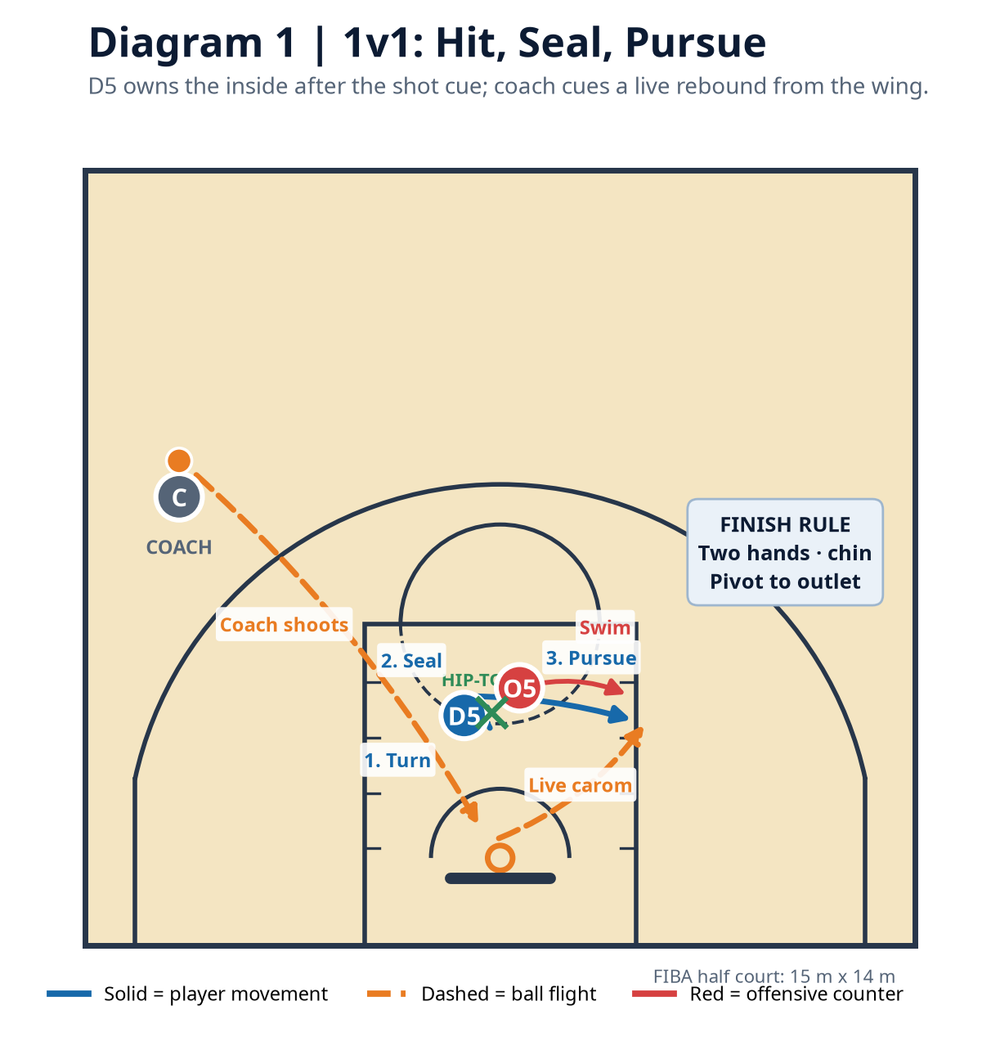
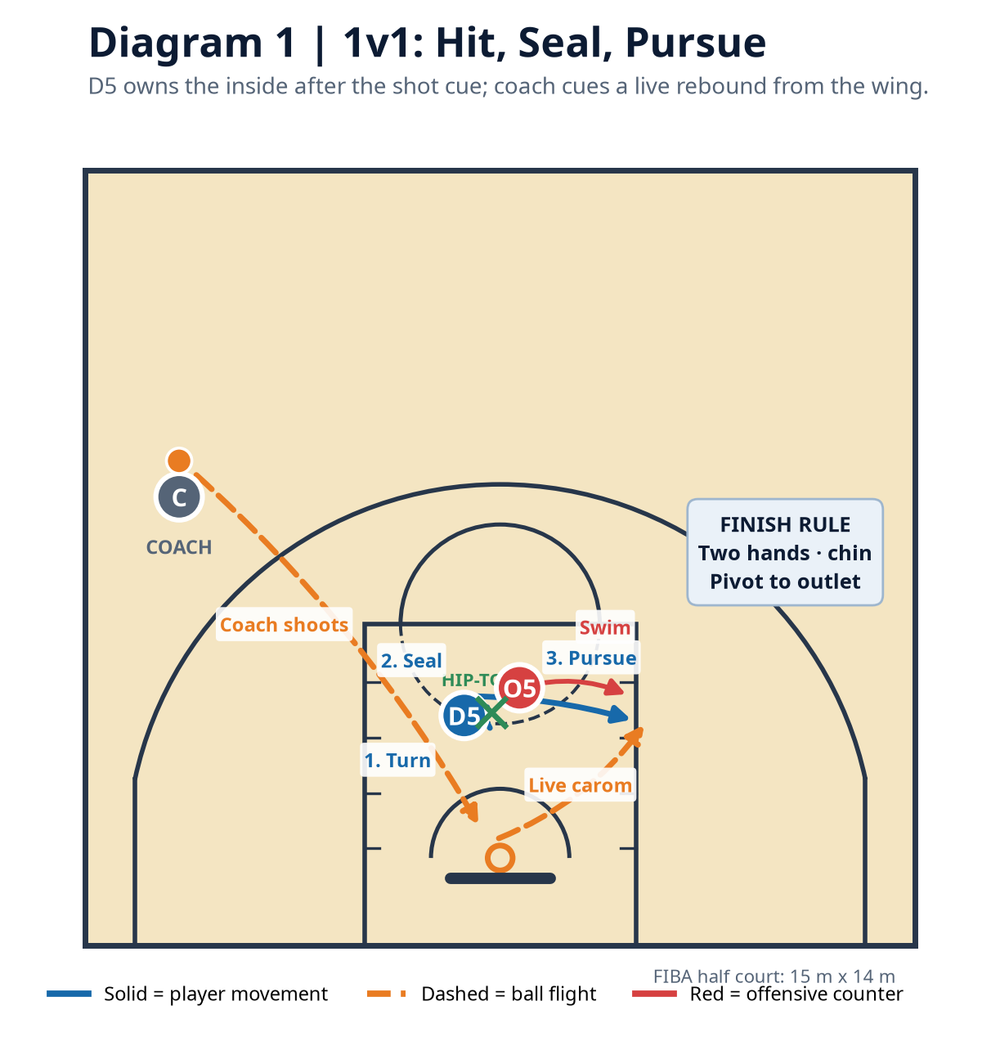
The coach starts on the wing; blue bibs defend and red bibs attack.
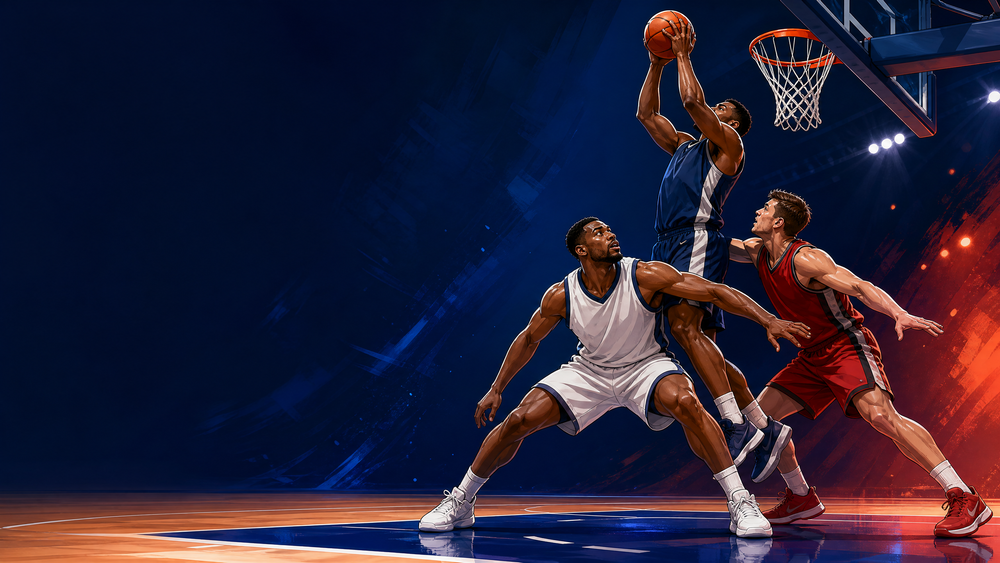
Diagram 1 — Teach the individual movement
Step-by-Step Instructions
Establish the 1v1 teaching rep. Place D5 one step inside O5, just above the low block. Tell D5 that their job begins at shot, not at the rim.
Give the shot cue. The coach says shot and releases a real shot toward the rim. D5 calls shot, turns to find O5, and reverse-pivots toward the opponent. O5 tries to get around the seal without grabbing or pushing.
Create legal contact. D5 makes first contact with the lower body, sitting hips into the attacker with a wide, balanced base. Arms remain bent and inside the frame; do not extend forearms. The defender should feel O5 on the body before shifting their eyes back to the ball. Freeze the first two reps here and check stance width, hip level, and balance.
Seal, then pursue. Once contact is established, D5 maintains the seal for the ball's flight, then releases to the live carom. Vary the rebound: short rim, weak-side lane, or two metres beyond the lane. D5 attacks the ball at its highest practical point with two hands. O5 earns a point for any tip, offensive rebound, or clean route around the seal.
Demand the possession finish. The rebounder lands with knees flexed, elbows out to protect space, chins the ball for a one-count, then makes a front or reverse pivot to outlet. The outlet receiver must be outside the lane line. A rebound that is stripped, bobbled, or thrown before the pivot does not count as a defensive win.
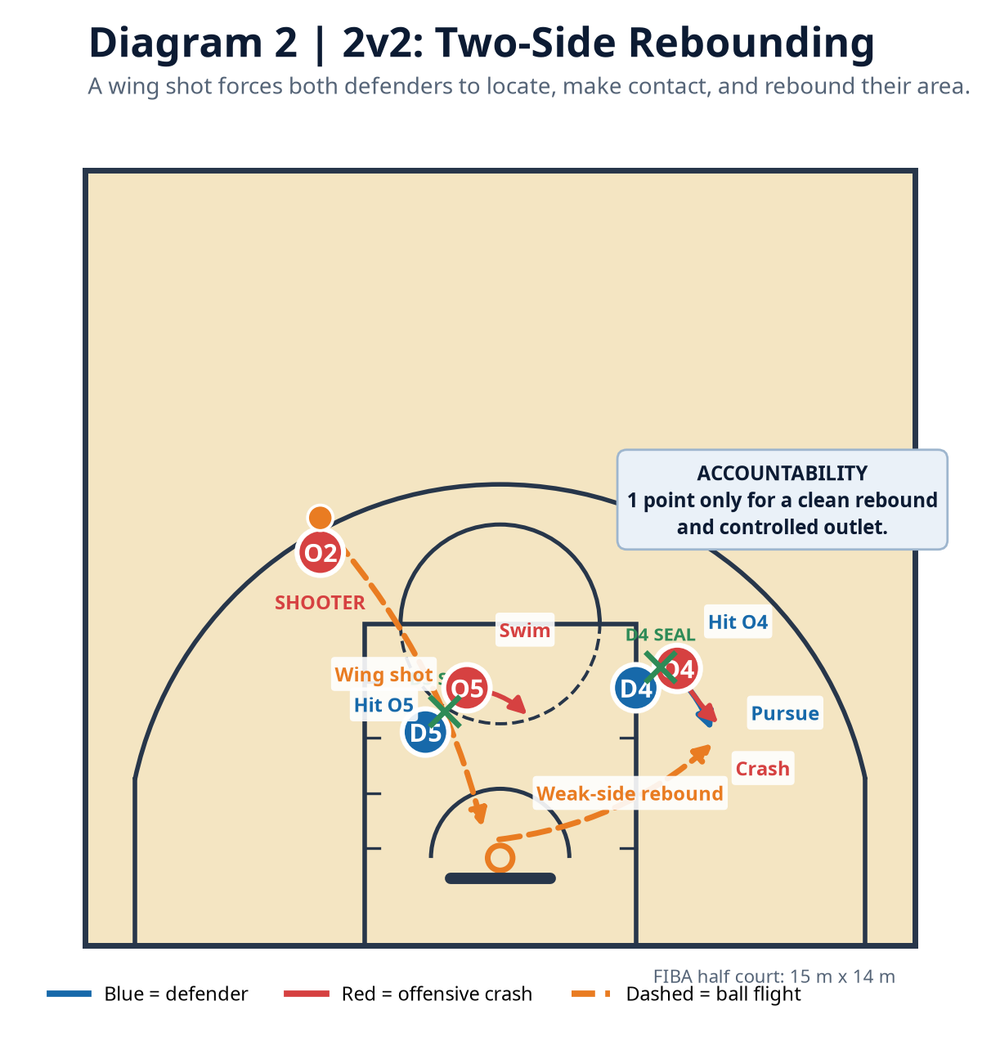
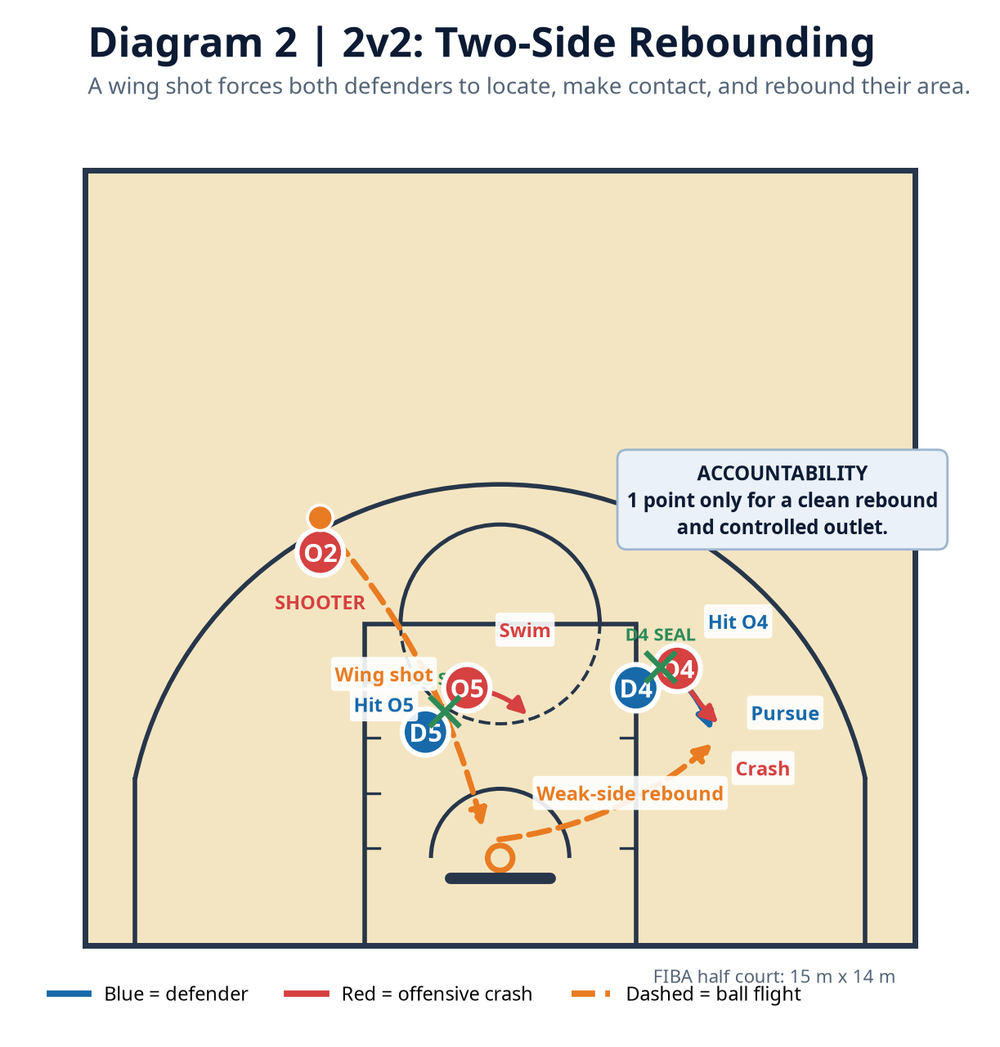
Progress to 2v2. Add D4 and O4 on the weak side. The coach shoots from the wing and names the rebound zone as the ball leaves the hand. D5 is responsible for O5; D4 is responsible for O4. Both defenders must call their assignment's number, make contact, then pursue their own area. Do not allow both defenders to chase the same ball while the weak-side attacker runs free.
Diagram 2 — Build weak-side accountability
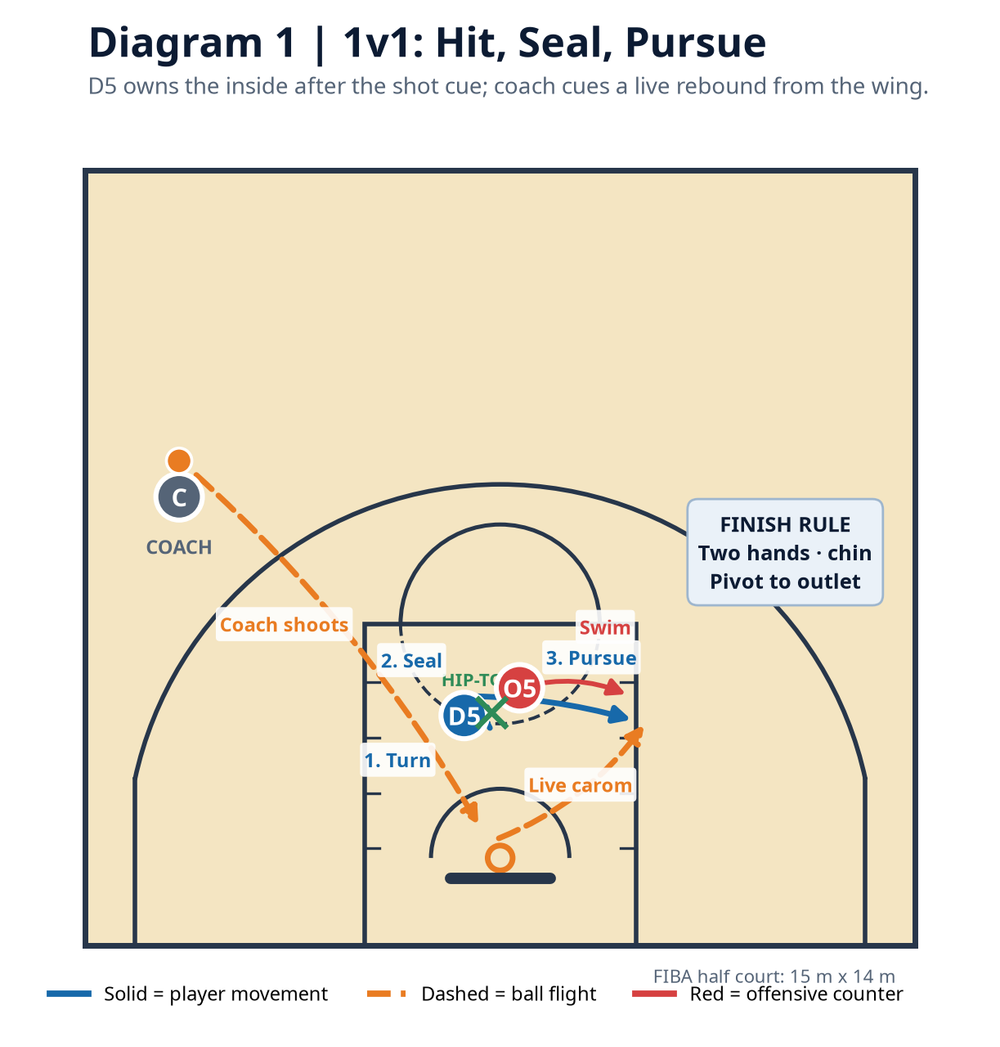
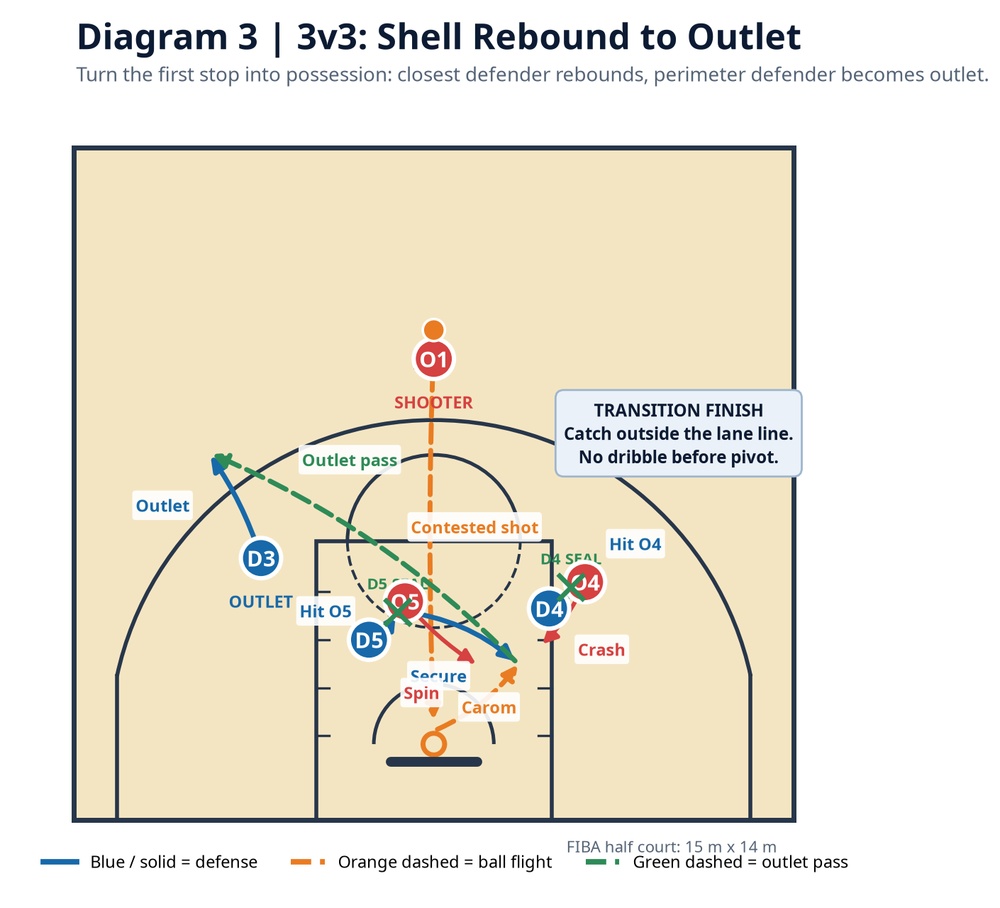
- Finish in 3v3 shell to outlet. Add D3 as the perimeter defender and O1 as the shooter. On the shot, D3 sprints to an outlet window near the free-throw-line extended, D4 and D5 finish their box-outs, and the nearest rebounder outlets to D3. Play the possession live for one transition pass. Award the defense one point only when it secures the ball and completes the outlet; award the offense one point for an offensive rebound, tip-out, or foul caused by a late seal. First to five rotates.
Diagram 3 — Convert the stop into transition
Key Coaching Points
| Cue | What the coach should demand |
|---|---|
| Find before you fly | A defender who jumps before locating the opponent is guessing. Make the initial pivot immediate and violent, then get the body between player and basket. |
| Hit with hips, not hands | Teach a low base, bent knees, chest up, and bent elbows. Legal rebounding contact starts through the core and lower body, never a shove with straight arms. |
| See man, then ball | Require the defender to establish contact first, then turn the head to track the ball. This sequencing prevents ball-watching. |
| Pursue with two hands | One-handed taps create loose balls. Attack the ball with two hands, pull it to the chin, and land balanced enough to pivot. |
| Own a zone, communicate a name | In 2v2 and 3v3, defenders call O4 or O5 as soon as the shot goes up. That verbal check exposes missed assignments immediately. |
| A rebound is unfinished without an outlet | Count the defensive point only after a secure catch, chin, pivot, and accurate pass to the designated outlet. |
Common Mistakes
| Error you will see | Immediate correction |
|---|---|
| Players stare at the shot and never touch an opponent. | Stop the rep and repeat it without a ball. On the whistle, defenders must pivot, find a body, and hold the seal for two seconds. |
| Defenders extend arms or push from behind. | Put a foam pad or cone between bodies and teach hip-to-hip contact. Remind players that strong legs and a low centre of gravity create the advantage. |
| Players make contact but release too early. | Count one-thousand-one after the shot. The defender may pursue only after feeling the attacker and seeing the ball's path. |
| Two defenders chase the same rebound. | Re-establish named match-ups and pursuit zones. In the next rep, give the offense an automatic point if either attacker is unchecked. |
| The rebounder brings the ball down or dribbles first. | Make the chin-and-pivot part of the scoring rule. Any low catch, loose ball, or pre-pivot dribble transfers the point to the offense. |
Variations and Progressions
| Variation | How to run it | Coaching purpose |
|---|---|---|
| Guided 1v1 | Coach tosses a predictable high rebound to the defender's side. O5 gives only 50 percent resistance for the first six reps. | Reduces fear of contact and gives beginners a repeatable picture of the correct sequence. |
| 2v2 random carom | The coach uses a bank shot, short shot, or rim miss. Attackers may swim, spin, or cross-face after contact. | Forces players to maintain the seal until the ball's actual path is known. |
| 3v3 score-and-outlet | Add a five-second outlet clock. The defense needs a clean rebound, chin, pivot, and pass to earn a point; offense keeps possession after an offensive board. | Makes rebounding tactical, competitive, and connected to transition offense. |
Age Adaptations
| Group | Adaptation |
|---|---|
| Under 8 / Under 10 | Use 1v1 only, a soft coach toss, and a 5 m x 5 m marked area. Teach the words find, bottom, ball. Avoid live swim moves and score technique rather than physical dominance. |
| Under 12 | Use 1v1 and 2v2 with a toss or short shot. Require a two-hand rebound and chin but allow a stationary outlet target. Keep live bouts to 15-20 seconds. |
| Under 14 / Under 16 | Use the full 2v2 and 3v3 progression, random caroms, named assignments, and live outlet pressure. Demand legal contact, weak-side responsibility, and transition precision. |
| Open / senior groups | Add a close-out before the shot, stunt-and-recover responsibility, late-clock shots, and a live transition finish after the outlet. Track defensive-rebound percentage during the block. |
End by asking: Which action actually won the rebound: the jump, or the work before the jump? When players consistently find, hit, seal, and pursue, defensive stops become reliable possessions rather than hopeful scrambles.
