

Basketball
Pressure-Proof Free Throw Routine: 3-Man Rotation
A structured 3-man free-throw routine that gives coaches a fast, repeatable way to train mechanics, focus, and late-game pressure performance.
What you need
1 basketball per group of 3 players, 1 FIBA-marked basket and half-court, Optional visible scoreboard or whiteboard, Optional cones to mark the passer and coach zones
Pressure-Proof Free Throw Routine: 3-Man Rotation
1. Overview
Free throws are a repeatable skill under pressure, not a break from basketball. This 15-minute 3-man rotation builds a dependable routine, a stable shooting base, and an honest response to fatigue. It gives every player a defined job—shooter, rebounder, or passer—so there is no standing around and no casual repetition. The drill is particularly valuable after transition work, competitive small-sided play, or a conditioning block, when players must slow their breathing and reproduce the same mechanics that they will need in the last minute of a game.
Run it with one group at each available basket. The design uses a FIBA half-court: 14m long by 15m wide, within a regulation 28m × 15m court.1 Set the shooter on the free-throw line, whose far edge is 5.80m from the inside edge of the endline under the FIBA court specification.2 The goal is not simply to count makes. Coach the player’s process: arrive balanced, settle the eyes, make the same number of dribbles, load smoothly, release cleanly, and hold the finish.
2. Setup
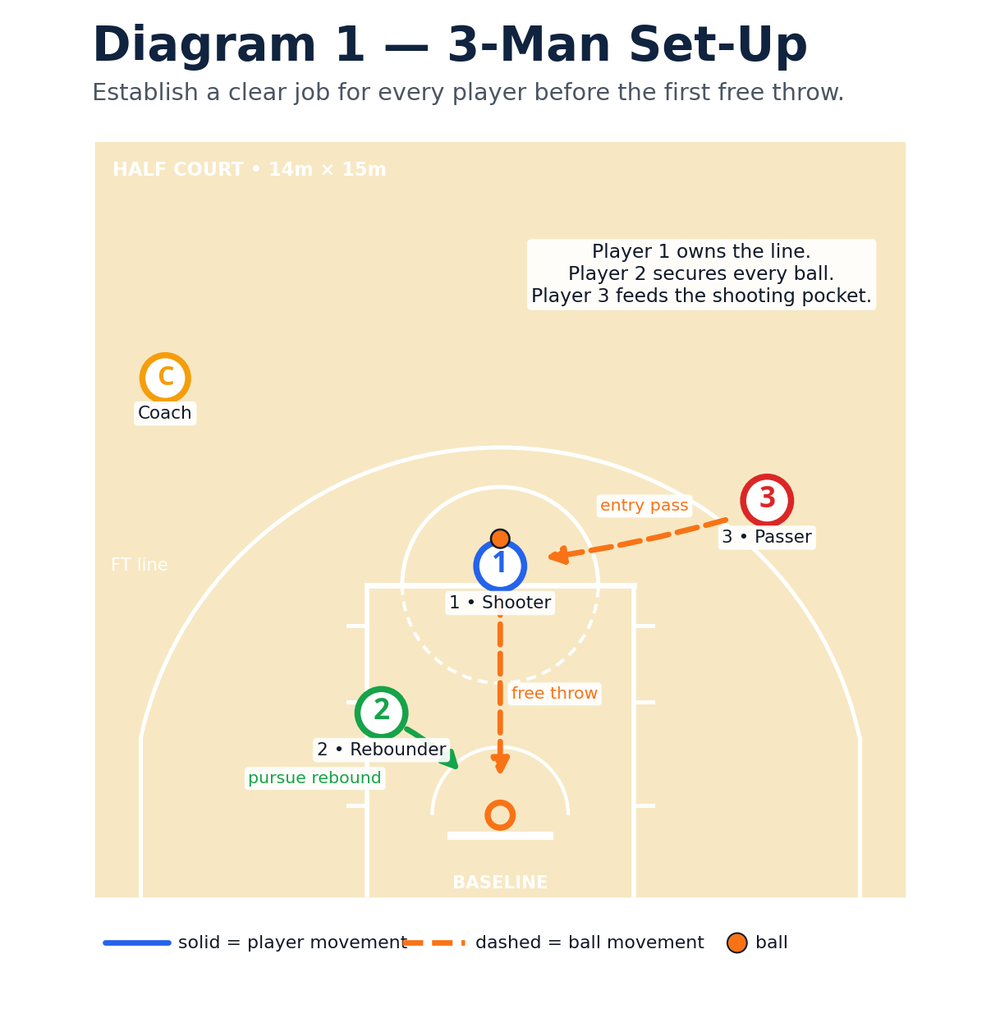
Use one ball and three players per basket. Establish the half-court working area before the group begins so that rotations do not drift into another basket’s space. Player 1 (the point guard / shooter) starts centred on the line. Player 2 (the wing / rebounder) starts in the first legal lane-space area on either side of the paint, while Player 3 (the forward / passer) stands 3–4m outside the free-throw circle on the wing. The coach works on the opposite wing, where they can see the shooter’s feet, elbow, and follow-through without blocking the passer’s lane.
| Element | Exact set-up standard | Coach’s reason |
|---|---|---|
| Court | One FIBA half-court, 14m × 15m | Retains a regulation visual context without wasting space. |
| Shooter | Both feet behind the 5.80m free-throw line; toes parallel or slightly staggered | Creates a stable, repeatable base. |
| Rebounder | On a lane-line position, 1.5–2m from the rim | Secures every make or miss rapidly. |
| Passer | Wing, 3–4m from the free-throw circle | Delivers the next ball without crossing the shooter’s line of sight. |
| Dose | Two shots, then rotate; five rounds | Gives each player 10 deliberate attempts in roughly 10 minutes. |
3. Step-by-Step Instructions
Set the standard before the first ball. Tell the group that the routine is identical on a make or miss: catch, identify the target, use the agreed dribbles, breathe, shoot, and freeze the follow-through. Give the group a clear target, such as 24 makes from 30 attempts.
Deliver a game-quality entry pass. Player 3 feeds Player 1 with a firm bounce pass to the shooting pocket. Player 1 catches with both hands, turns the ball so the shooting hand is ready, and establishes the feet before beginning the routine. Do not allow the passer to toss a soft or high ball that forces a repair before the shot.
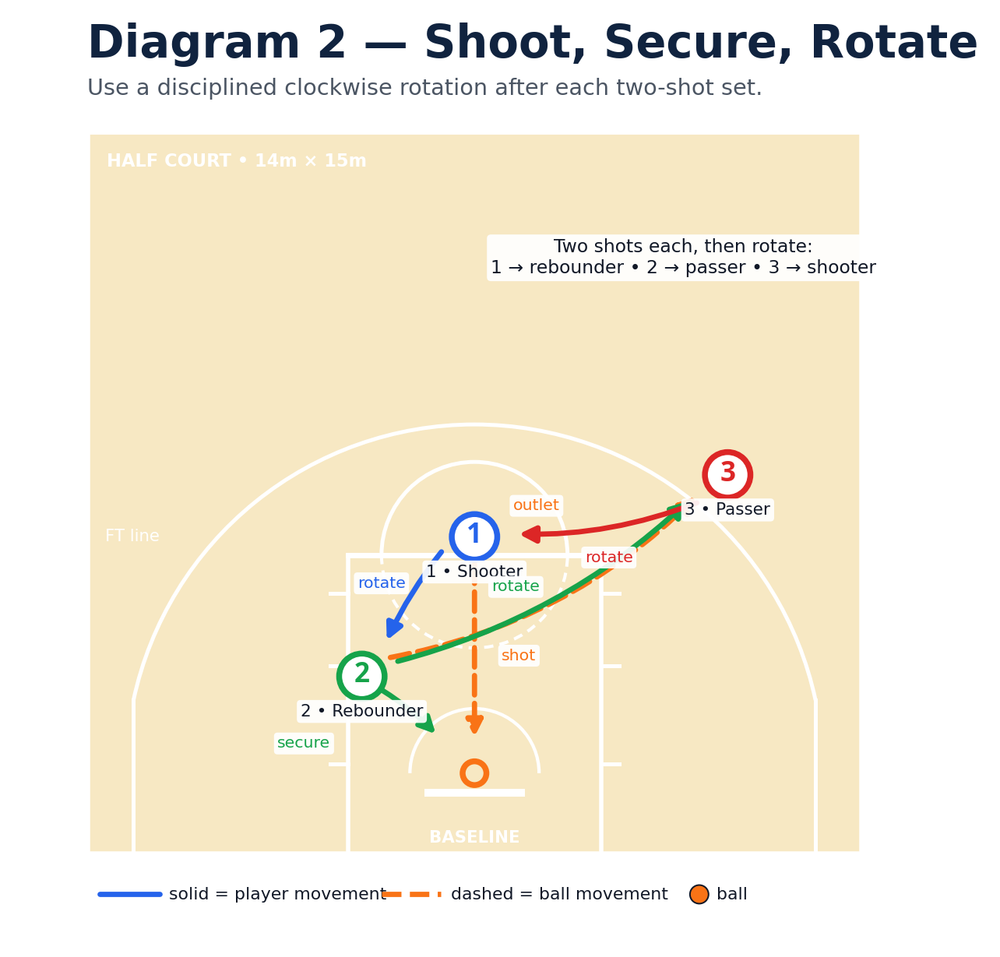
Execute the two-shot set. Player 1 takes two free throws. On every attempt, coach a 2–3 second settle: eyes on the back of the rim, knees loaded, elbow below the ball, and a straight upward release. The shooting hand finishes through the centre of the rim; the guide hand comes off quietly and does not turn the ball.
Rebound and outlet immediately. Player 2 tracks the ball from release, catches or secures it before the second bounce, and outlets to Player 3. Whether the shot drops or misses, Player 2 uses the same urgency. Player 3 then returns the ball to the next shooter’s pocket.
Rotate clockwise with no conversation. After two attempts, Player 1 becomes the rebounder, Player 2 becomes the passer, and Player 3 becomes the shooter. The coach calls the updated score aloud. The next shooter must be ready on the line within five seconds; that brisk transition protects repetition quality without turning the drill into a conditioning sprint.
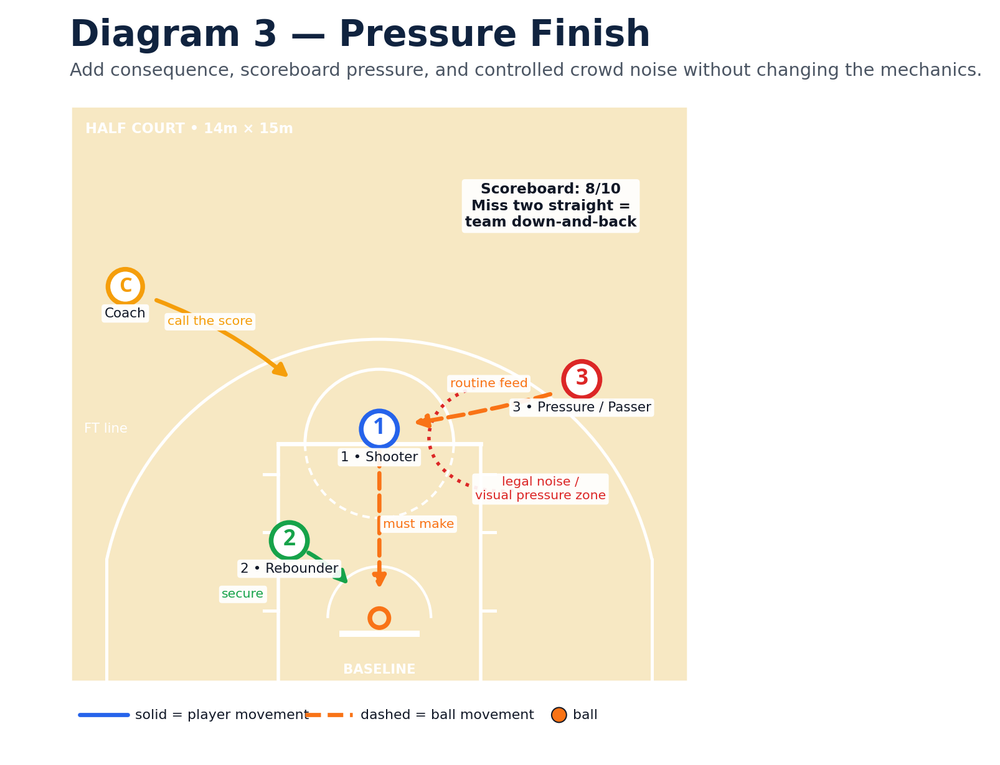
Finish with a consequence set. In the final five minutes, require each player to make the last two shots of their turn. A miss keeps that player at the line for one extra attempt, while the two teammates hold their roles. This adds accountability but avoids punishing a good routine merely because the ball was off-line by a small margin.
4. Key Coaching Points
Coach the same pre-shot rhythm every time. The player should be able to describe the routine in one sentence: for example, “Two dribbles, breath, eyes, lift, hold.” If the routine changes when the score changes, pressure will own the shot instead of the player.
Start from the floor. Watch the feet first. The shooter should load with even pressure through the mid-foot, flex the knees smoothly, and rise without leaning back or drifting forward. A quiet lower body gives the shooting arm a chance to repeat its path.
Create a clean ball path. The ball should travel from the shooting pocket to the release window with the elbow roughly under the ball. The guide hand supports but never steers. Ask players to hold the “gooseneck” until the ball reaches the rim; early hand drop is usually a symptom of the player watching rather than finishing.
Demand useful feedback. After each two-shot set, allow one short coach cue only: “More legs,” “finish high,” or “quiet guide hand.” Do not overload the player with a technical lecture between every attempt. A correction must be precise enough to apply on the next ball.
Keep the non-shooters professional. The rebounder must pursue, chin the ball, and outlet; the passer must hit the pocket. Those habits turn a shooting drill into a complete team practice standard.
5. Common Mistakes and Fast Corrections
| Common mistake | What the coach sees | Immediate correction |
|---|---|---|
| Rushed routine | Shooter catches and fires before the feet settle | Stop the set; require the same 2–3 second breath-and-eye sequence. |
| Falling backward | Heels lift early; ball comes up short | Cue “nose over toes, then rise straight.” |
| Guide-hand interference | Ball rotates sideways or drifts left/right | Have the player show the guide-hand palm to the side after release. |
| Lazy rebound/outlet | Ball bounces twice or the next pass floats | Reset the group and make the missed urgency visible on the scoreboard. |
| Chasing results | Shooter reacts emotionally to a miss | Re-state the process cue and let the next routine prove the response. |
6. Variations & Progressions
Begin with form-first rotation for a younger or less confident group. Move the shooter 1–2m closer, remove the score target, and award a point for a stable finish even if the ball misses. This lets the coach build a sound base before asking players to carry a full-distance free throw.
Progress to swish-or-reset for a technically capable group. Count only clean swishes, but preserve the two-shot rotation. The rule sharpens arc, line, and touch without changing the player’s routine. Use it in a short 3-minute block so the demand remains high and mechanics do not deteriorate.
Finish with the pressure scoreboard. Give the group a target such as 8 of 10. Player 3 may create legal noise from the wing; teammates can call the live score; the coach can announce a one-possession game scenario. If the group misses two consecutive free throws, send all three players for one controlled down-and-back, then restart the count at zero. Keep distractions away from the shooter’s landing space and never allow contact.
7. Age Adaptations
| Group | Adaptation | Non-negotiable teaching priority |
|---|---|---|
| Under 8 / Under 10 | Use a Size 5 ball, a lower basket if available, and a marked line 3–4m from the baseline. Shoot one ball each before rotating. | Balanced base and a high, relaxed finish. |
| Under 12 | Work from the age-appropriate line; use two-shot sets but track routine quality, not percentage. | Same preparation on every catch. |
| Under 14 / Under 16 | Use the full FIBA line and introduce an 8-of-10 team target. | Calm breathing and a repeatable ball path under fatigue. |
| Open / advanced | Use full FIBA conditions, swish-only blocks, and consecutive-make finishers. | Process discipline when the consequence is real. |
Coach’s Closing Challenge
Do not end this drill with “Who made the most?” End it with, “Whose routine looked the same on every ball?” The best free-throw shooters are not chasing a perfect mood. They trust a practiced sequence, give their teammates a quality rep, and make the final attempt look like the first.
