Basketball
Box Slice: Sideline Inbound Play Against Man-to-Man
Install a decisive sideline inbound package that creates a rim catch first, then flows cleanly into a safety-release counter against man-to-man defense.

What you need
1 basketball, two sets of contrasting bibs, court or half court with regulation markings, optional cones or foam pads for screen landmarks, whistle and clipboard
Overview
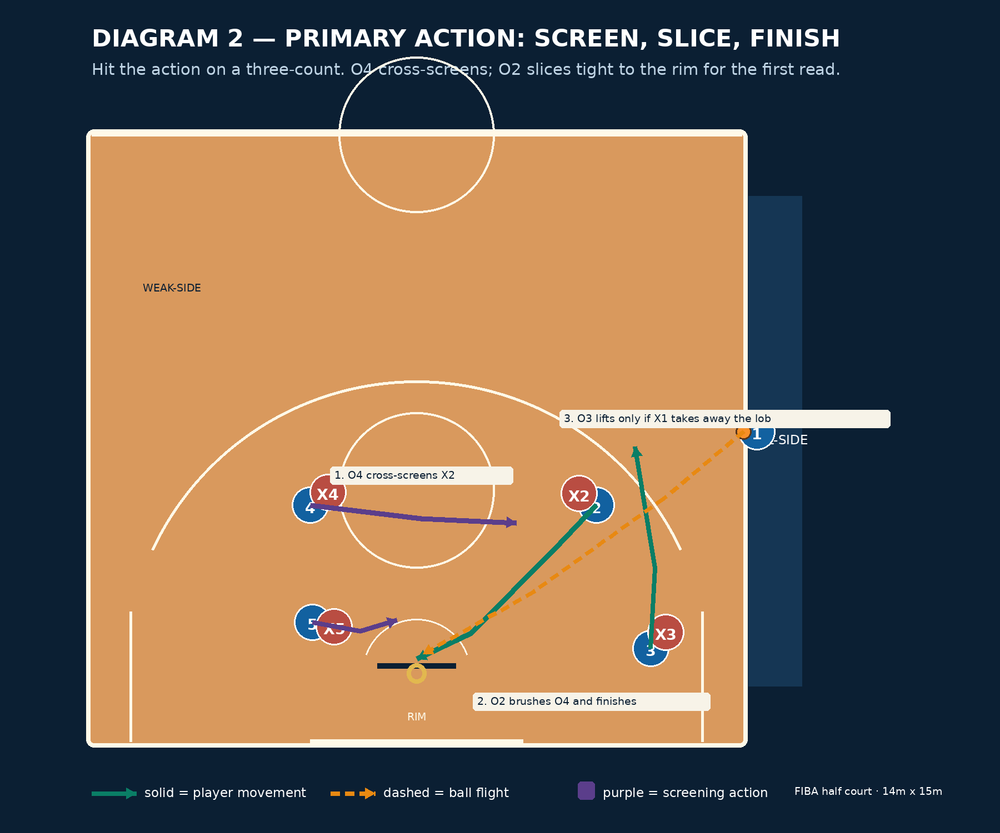
Box Slice is a sideline-inbound set that creates a rim catch against man-to-man denial. Use it after a dead ball on the right sideline, between the baseline and the free-throw-line extended. The advantage is direct: O4’s cross-screen makes X2 choose between protecting the rim and staying with O2; O2 attacks the late choice.
Keep the action compact around the lane. The read order is a lob or bounce pass to O2, O4 stepping to the ball-side wing as safety, then O3 lifting away from congestion. On a FIBA court, use the 28 m × 15 m playing area and the 4.9 m lane as fixed reference points; the box geometry makes the screening angle repeatable.1
Coach’s intent: Do not call this as a “trick play.” Call it as a fast, disciplined way to win the first two seconds of a sideline inbound with spacing, screen legality, and a clear read order.
Setup

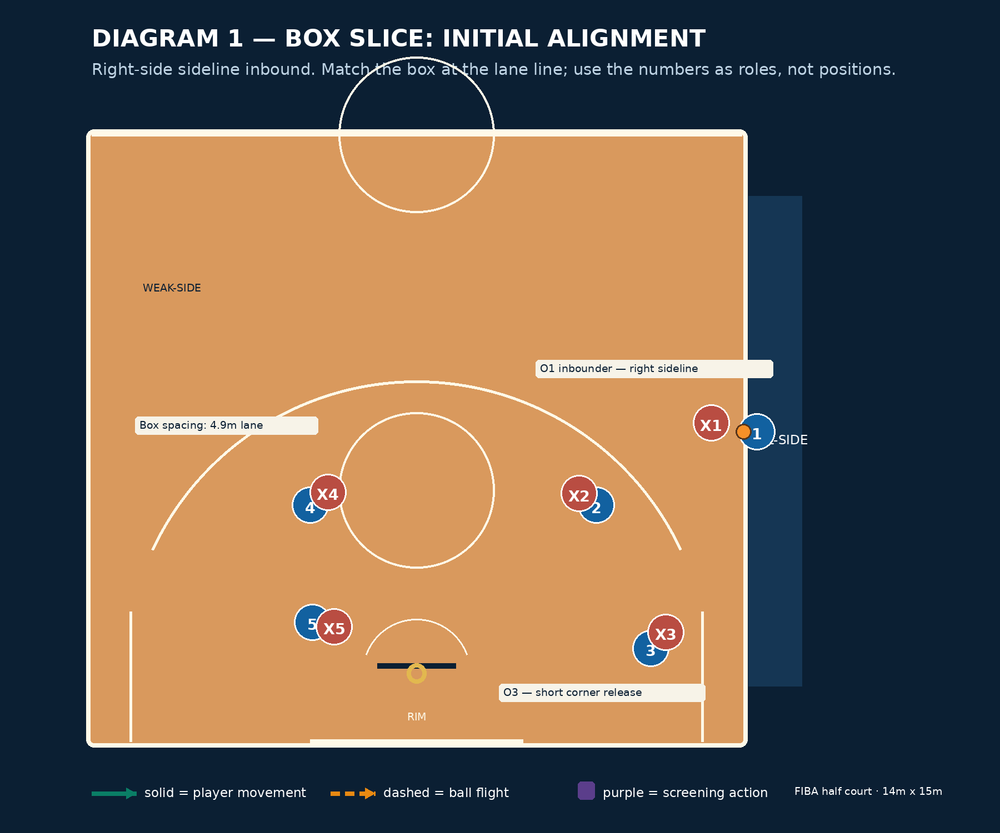
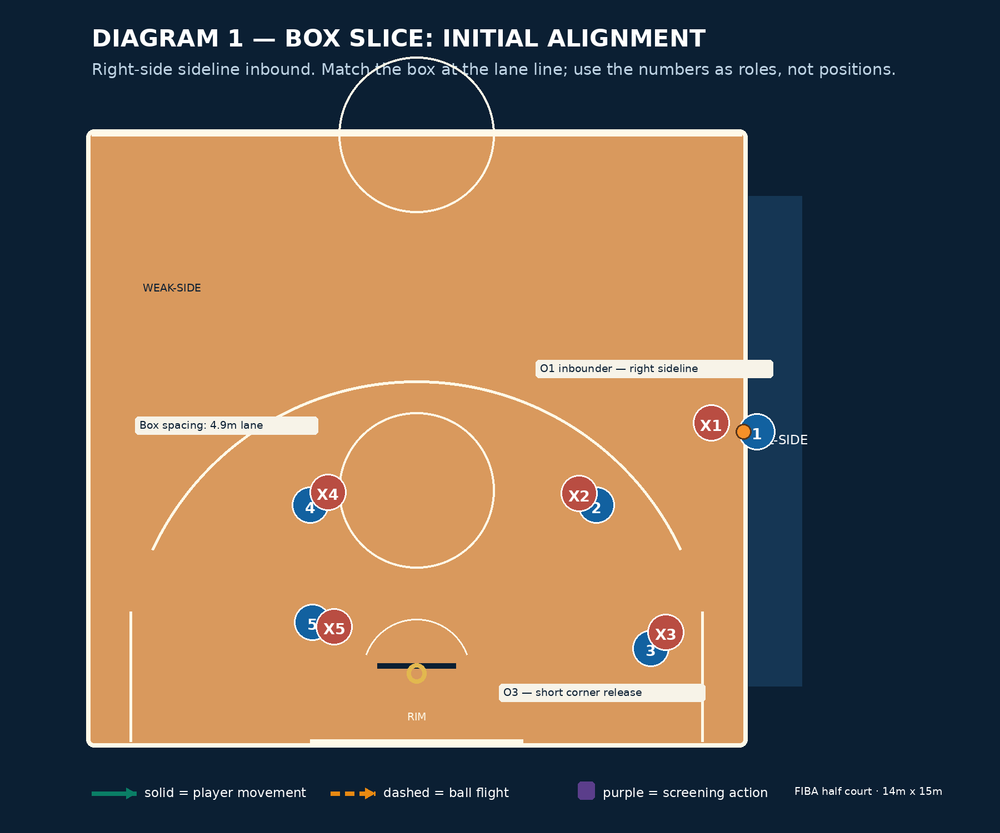
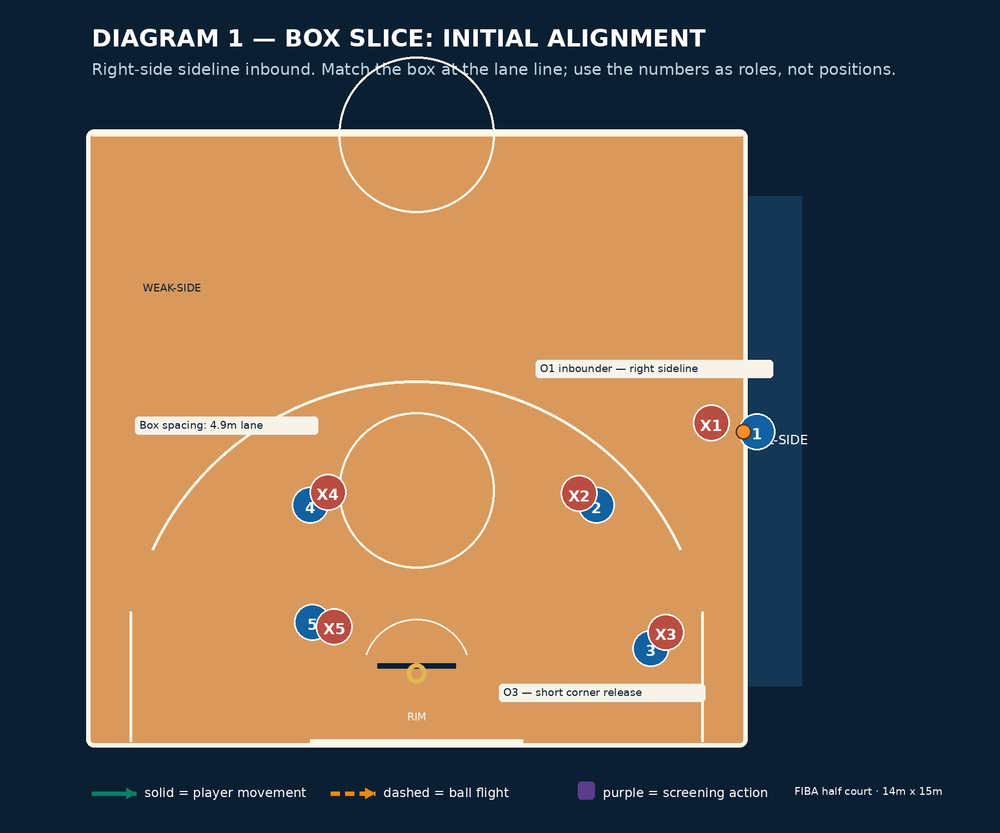
Use one ball, two bib colours, and 10 players to install the action live. Begin 2–3 m above the free-throw-line extended on the right sideline. Blue is offense, red is defense; solid arrows show movement and dashed orange arrows show ball flight.
| Player | Standard position | Starting job | Exact coaching landmark |
|---|---|---|---|
| O1 | Point guard | Inbounder and decision-maker | Out of bounds on the right sideline, 2–3 m above the free-throw-line extended. |
| O2 | Shooting guard | Primary rim runner | Ball-side elbow, with feet just outside the lane line and body angled toward O4. |
| O3 | Small forward | Short-corner decoy and safety lift | Ball-side short corner, 0.9–1.2 m above the baseline. |
| O4 | Power forward | Cross-screener and safety outlet | Weak-side elbow, one shoe outside the lane line. |
| O5 | Centre | Low seal and secondary screen | Weak-side low block, hips loaded to hold X5 behind the action. |
Set the four on-court players as a box around the lane. O2 and O4 should be approximately 4.9 m apart across the lane-line width, not drifting into the three-point arc. Tell every player the call: “Box Slice—rim, safety, outlet.” Those are the reads in order. O1 must make eye contact with O2 before the official hands over the ball, then scan O4 and O3 in that sequence.
Step-by-Step Instructions
Start with a still box. O2, O3, O4, and O5 hold until O1 receives the ball. O1 shows the ball overhead and takes a half-step back to widen the window. The stillness sells the first cut.
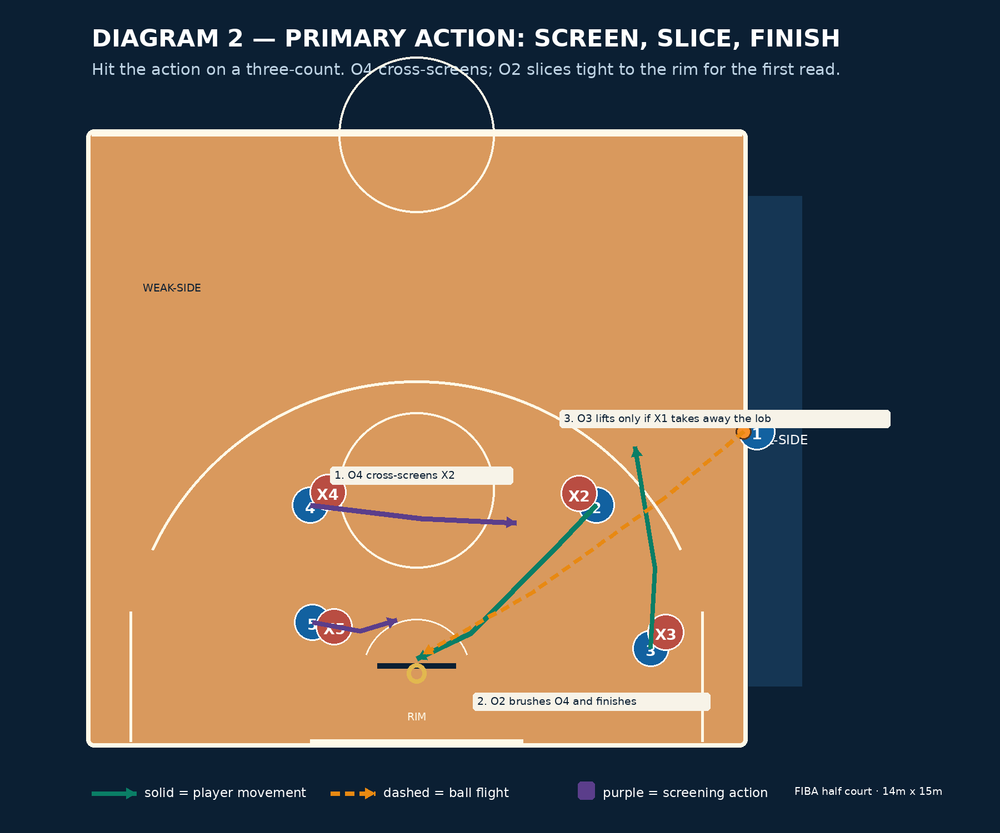
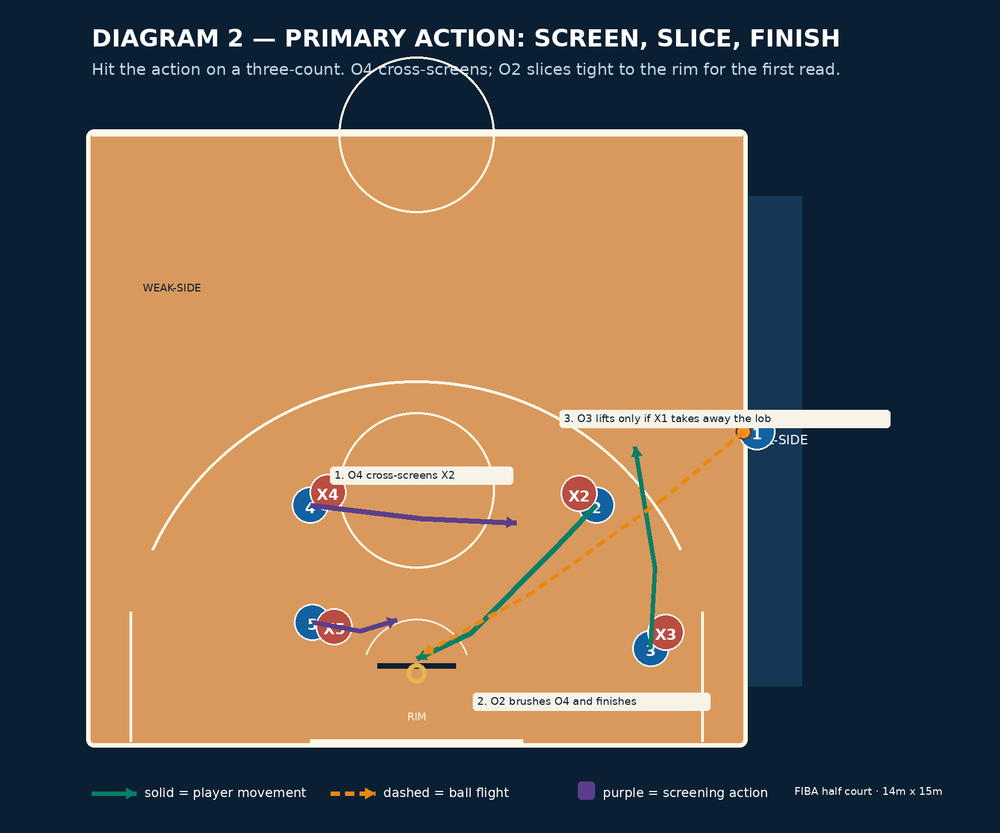
O4 wins the angle on count one. O4 sprints across from the weak elbow and gets chest-to-shoulder with X2. Feet stop before contact; knees are bent, hands tucked, torso vertical. Screen one step above the low block, never in the restricted area. O5 slides up and seals X5.
O2 slices shoulder-to-hip on count two. O2 waits 0.25–0.5 seconds for O4 to become stationary, then cuts downhill from the ball-side elbow to the near rim. Demand a high target hand and a finish away from the trailer. Use a soft lob versus a trailing defender, or a hard bounce pass to O2’s outside hand if X2 is behind or switches late.
O1 completes the first read by count two-and-a-half. If X2 is late, O1 delivers without waiting for a perfect picture. Target O2’s outside shoulder, 0.5–1.0 m from the rim, then step inbounds as emergency safety.
O3 lifts only on a denied lob. O3 holds the short corner through the screen. If X1 closes the rim line, O3 lifts up the sideline to the wing, preserving a diagonal pass without crowding O2’s finish. Stay wide for the kick-out.
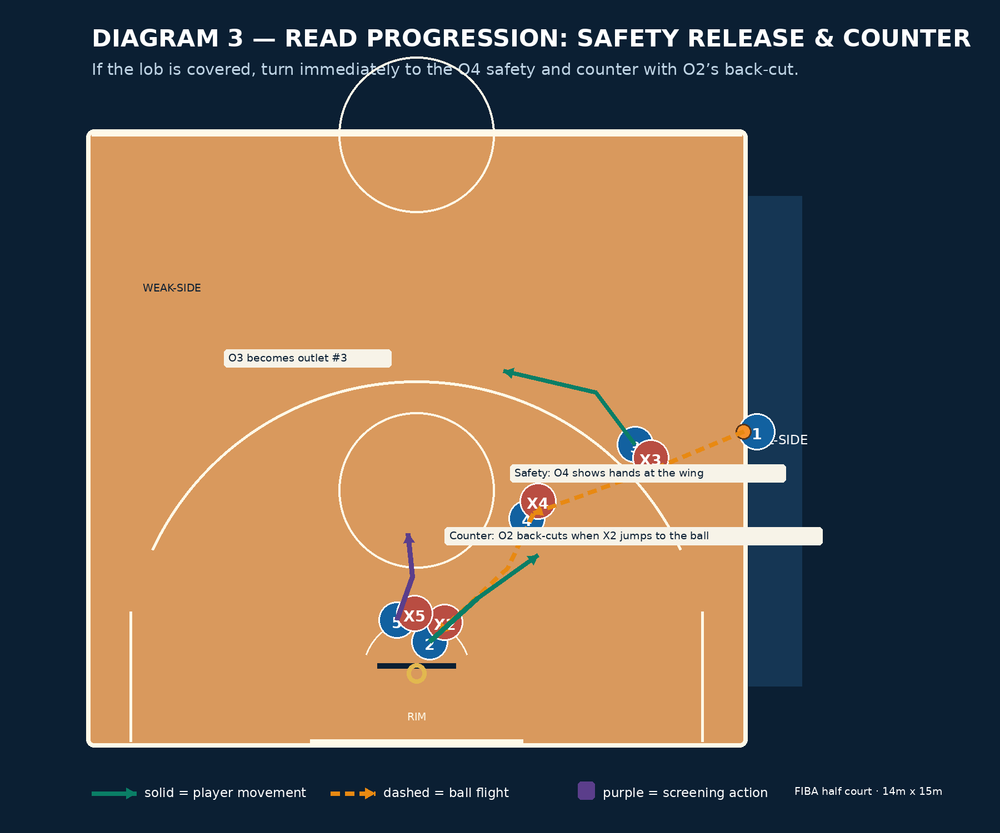
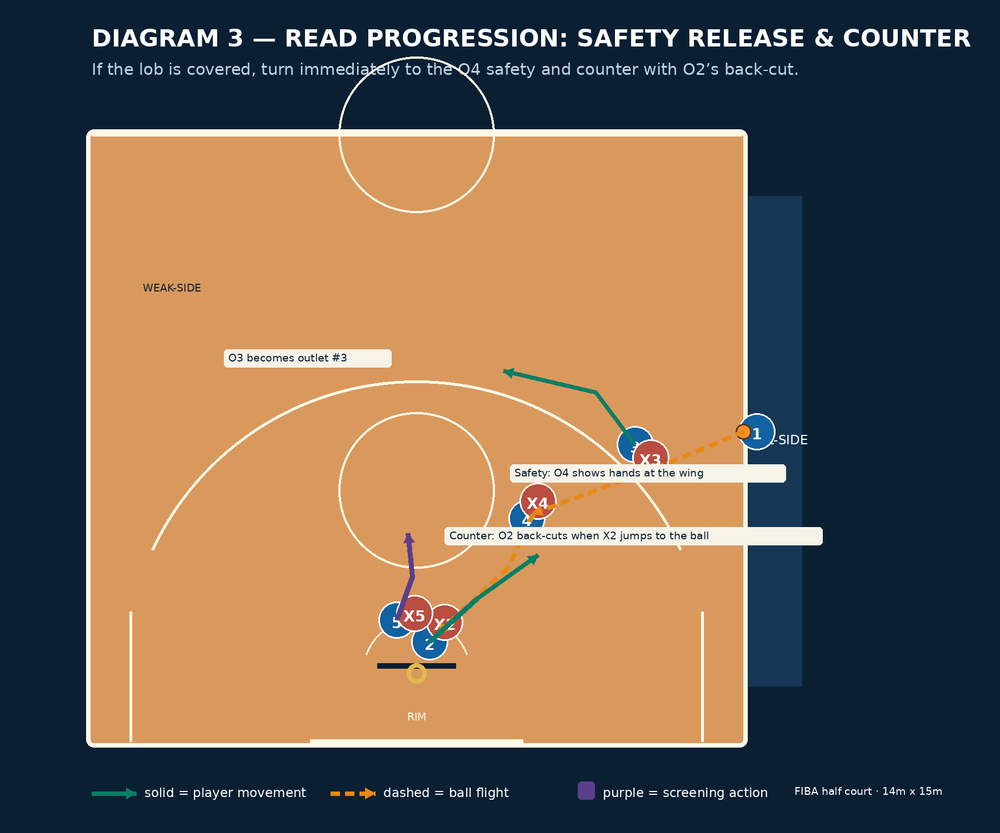
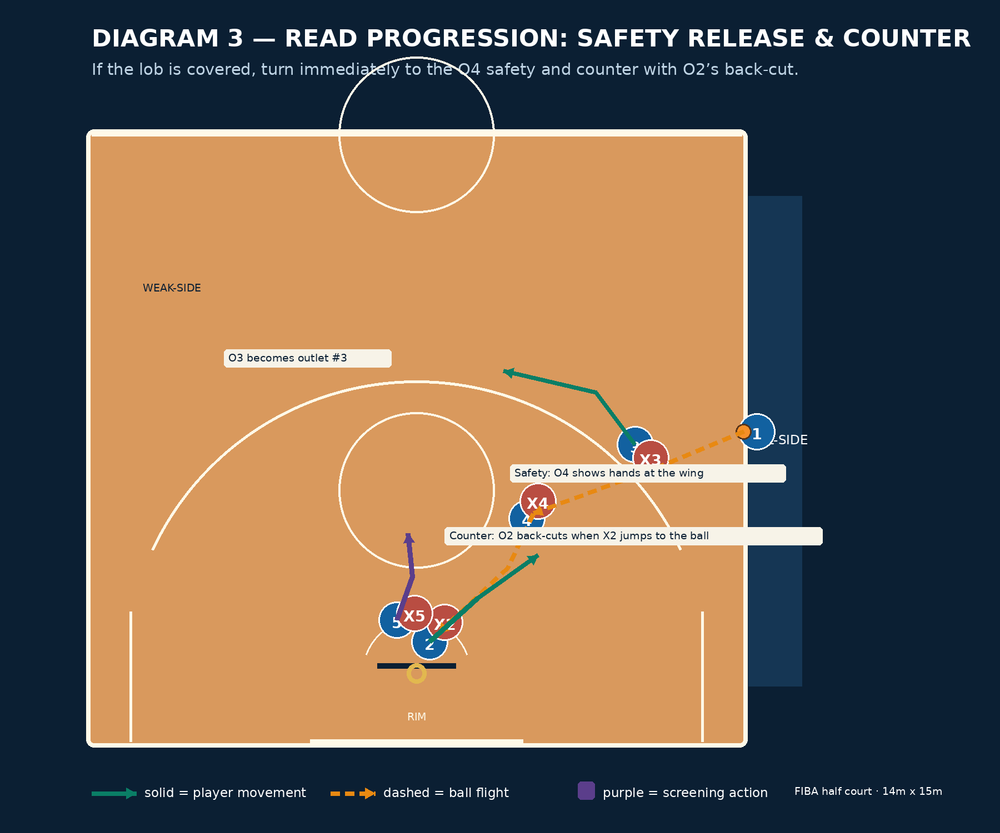
Flow to the safety and counter. If the first pass is covered, O4 opens to the ball-side wing with both hands visible. O1 hits O4; O2 plants and back-cuts when X2 jumps to the ball. O4 feeds the cut or reverses to O3—no reset.
Key Coaching Points
| Teaching point | What the coach should demand |
|---|---|
| Screen angle before speed | O4 must arrive first and be stationary before O2 uses the screen. A fast moving screen is a turnover, not a clever set. |
| Cut close enough to make contact relevant | O2 brushes the screener’s hip. A 1 m gap lets X2 slip through untouched. |
| Inbounder has a read order | Train O1 to say internally: “Rim, safety, outlet.” That prevents staring at the first option into a turnover. |
| Paint stays occupied but not crowded | O5 seals on the weak block; O3 remains in the short corner until the lob is denied. Keep one finish lane open. |
| Pass to a hand, not a space | O1 targets the outside hand and O2 receives with two hands whenever possible. No blind lob to the square. |
| Finish through the first bump | O2 expects a trailing hip and uses a two-foot power finish, inside-hand layup, or jump stop depending on the catch. |
Common Mistakes
| Error | Why it breaks the set | Immediate correction |
|---|---|---|
| O2 leaves before O4 is set | X2 follows with no screen contact and the lane remains closed. | Put a 0.5-second hold into the command: “Screen—wait—slice.” |
| O4 screens inside the restricted area | The angle is poor and the screener invites illegal contact. | Rehearse O4’s finish point one step above the low block. |
| O1 stares at O2 | X1 can sit on the lob and O4 is never rewarded. | Require O1 to call out the first open read during walk-throughs. |
| O3 cuts to the rim too early | The paint becomes congested and X3 can help at the basket. | Freeze O3 in the short corner until the ball leaves O1’s hands. |
| O5 chases a “big” screen | The weak-side help walks straight to the rim. | Coach a seal: wide base, hips to the defender, no extended arms. |
Variations & Progressions
Variation 1 — Curl for a jumper. When X2 shoots the gap under O4’s screen, have O2 curl toward the middle of the lane instead of continuing to the rim. O1 hits O2 at the dotted-circle area for a one-dribble pull-up or a quick pass to O5 sealing at the rim.
Variation 2 — Switch counter. If opponents switch the cross-screen, O4 immediately seals the smaller X2 on the ball-side block while O2 pops to the wing. O1’s first pass is now to O4 over the top, with O2 as the perimeter release. Drill this only after the base action is automatic.
Progression 3 — Live read scoring. In practice, award the offense 3 points for a rim catch in the first 2.5 seconds, 2 points for an O4 safety catch that creates a paint touch, and 1 point for O3’s clean outlet. Give the defense 2 points for a deflection or a forced five-second count. This rewards decisions, not merely running the pattern.
Age Adaptations
| Group | Adaptation | Coaching priority |
|---|---|---|
| Under 8 | Use three players: O1 inbounder, O2 cutter, O4 screener. Start without defenders and shorten the lane. | Teach “screen still, cut tight, catch with two hands.” |
| Under 10 | Keep O3 as a stationary corner outlet; use one defender on O2 and one on the inbounder. | Build confidence in the lob versus a hard bounce pass. |
| Under 12 | Run the full five-player alignment but allow O4 to screen with a foam pad or cone as a visual landmark before going live. | Establish spacing and legal screening habits. |
| Under 14 | Install the safety release and back-cut counter shown in Diagram 3. | Teach the inbounder’s first-to-third read progression. |
| Under 16 and open | Add switching, top-locking, and weak-side help rules for the defense. Film the first 2.5 seconds and grade screen angle, pass timing, and finish quality. | Execute the play as a read-based package, not a memorized route. |
Run the teaching progression as five minutes of walk-through, eight minutes of guided 5-on-5, eight minutes of live score-and-stop, and four minutes of pressure reps. End by requiring three consecutive clean executions on each sideline before the team leaves the action. FIBA publishes the official rules and court specifications; adapt the inbound location and timing language to the competition rules your team plays under.2
References