

Basketball
Elite Ball-Handling Circuit: Control, Pressure, and Transition Reads
A high-intensity, three-station dribbling circuit designed to build elite ball security, contact absorption, and full-court transition decision-making.
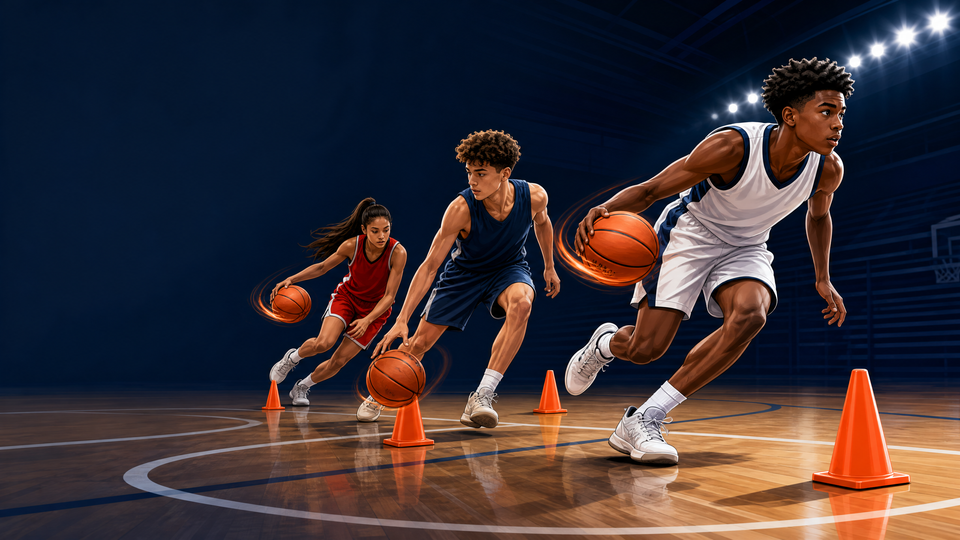
What you need
Basketballs (1 per player), 8-10 Training cones, Full FIBA regulation court
1. Overview
This high-intensity ball-handling circuit is designed to transition players from basic stationary dribbling to dynamic, game-like ball security. By running three distinct stations simultaneously, coaches can maximize repetitions and keep the entire squad active. The circuit progresses from tight-space mechanical control (Station 1) to handling physical pressure and creating separation (Station 2), and culminates in full-court transition decision-making (Station 3). Use this drill during the early-to-middle portion of a practice session to build conditioning alongside fundamental guard skills.
2. Setup
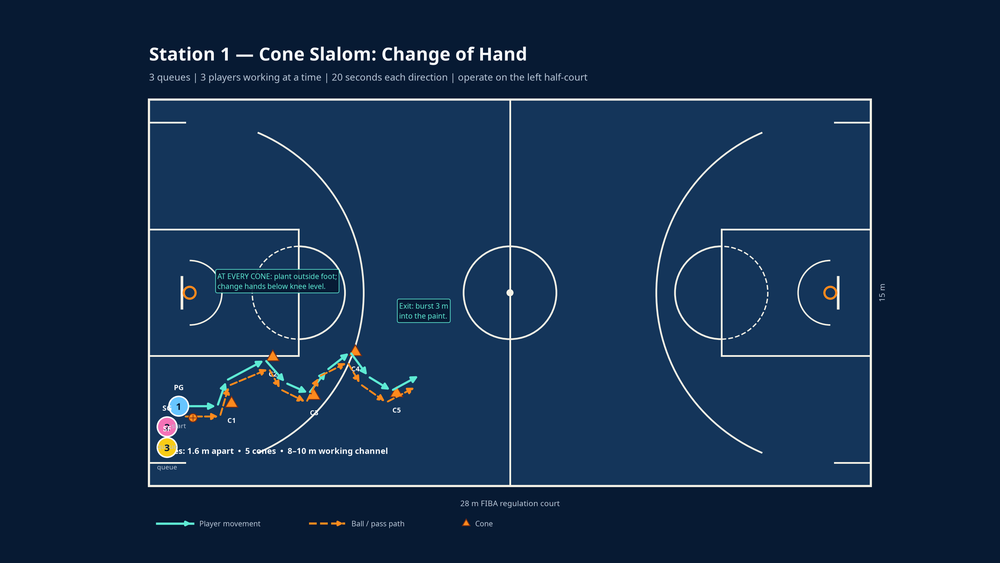
Divide your squad into three equal groups and assign one group to each station. You will need a full FIBA regulation court (28m x 15m), 8–10 training cones, and one basketball per player (or at least one per active pair in Station 2).
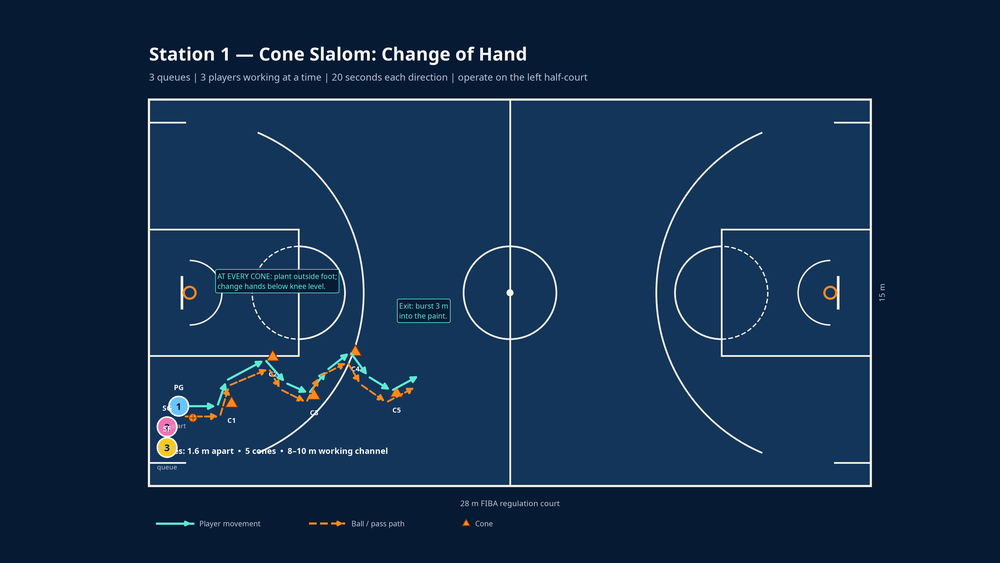
- Station 1 (Left Half-Court): Set up a slalom course using 5 cones spaced 1.6 meters apart, creating an 8–10 meter working channel.
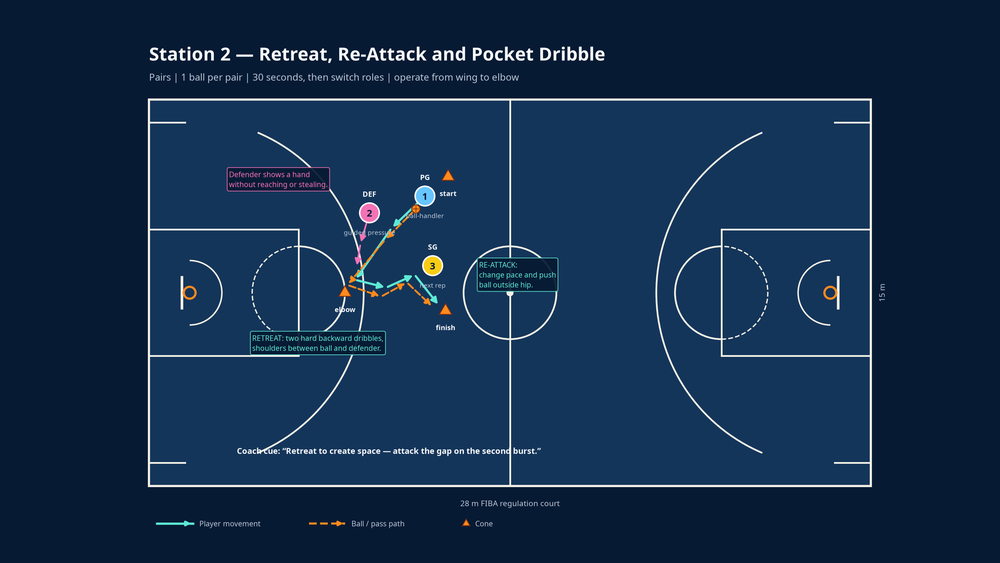
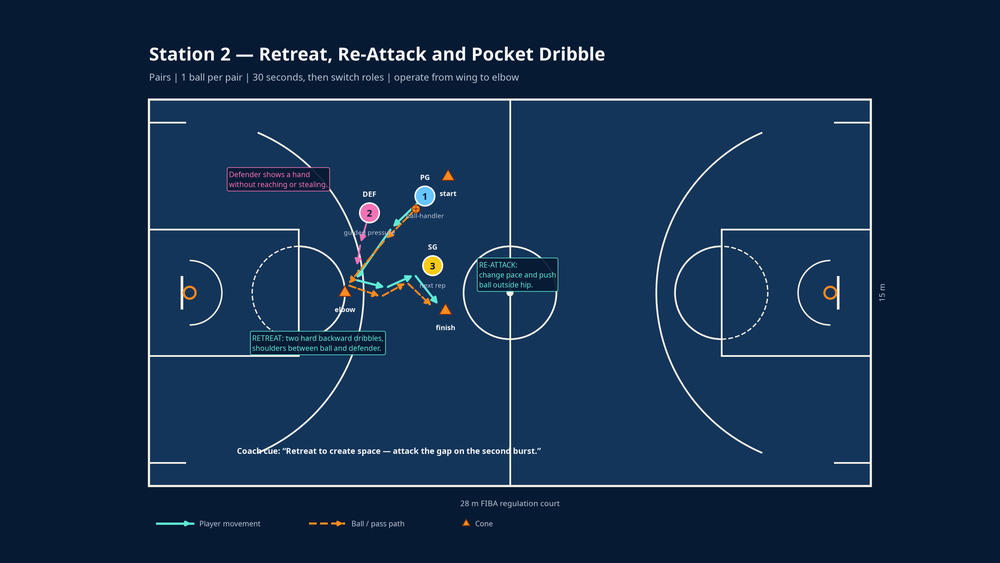
- Station 2 (Right Half-Court, Wing to Elbow): Mark a starting point on the wing and a finish line near the elbow. Pair players up (one ball-handler, one defender).
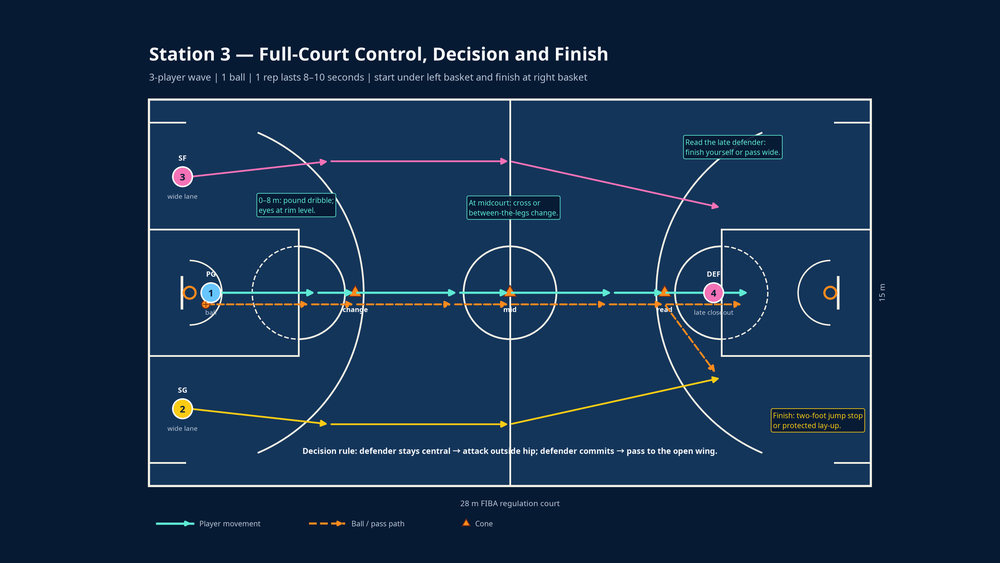
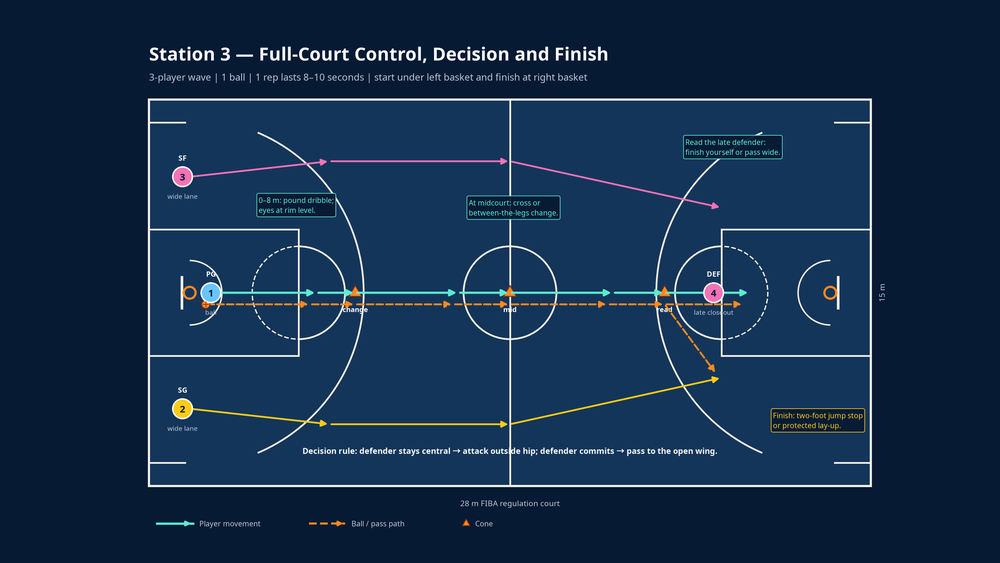
- Station 3 (Full-Court): Place reference cones at the opposite free-throw line extended, midcourt, and the far three-point arc to trigger specific dribble moves and reads.
3. Step-by-Step Instructions
Run the circuit for 12–15 minutes total, rotating groups every 4–5 minutes so every player completes all three stations.
Station 1: Cone Slalom & Burst
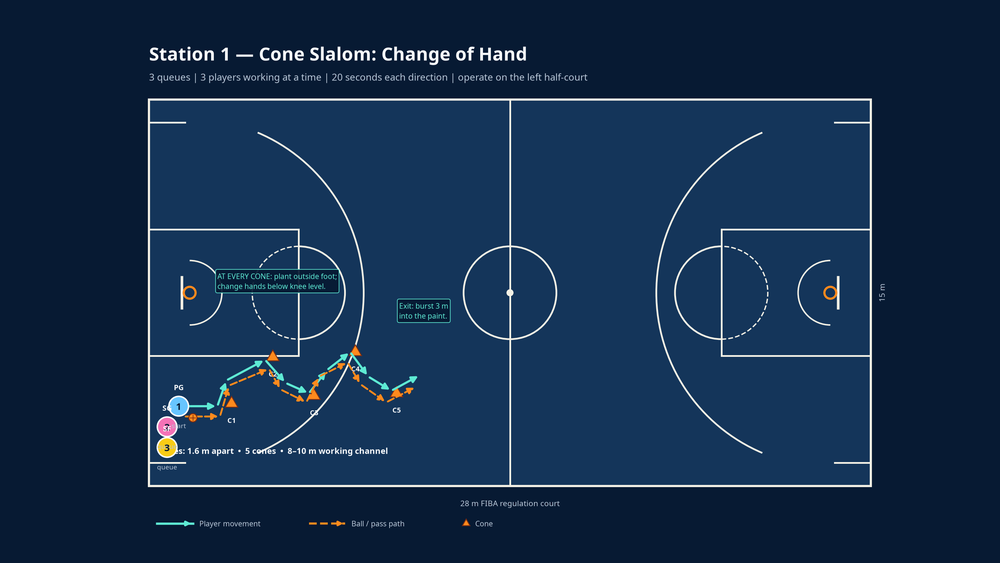
- Players line up at the baseline. The first player attacks the cone slalom at game speed.
- At each cone, the ball-handler must plant their outside foot and execute a sharp change-of-direction move (crossover, between-the-legs, or behind-the-back).
- The dribble must be kept below knee level during the change of hand.
- After clearing the final cone, the player must execute a hard 3-meter burst into the paint, finishing with a jump stop.
Station 2: Retreat, Re-Attack, and Pocket Dribble
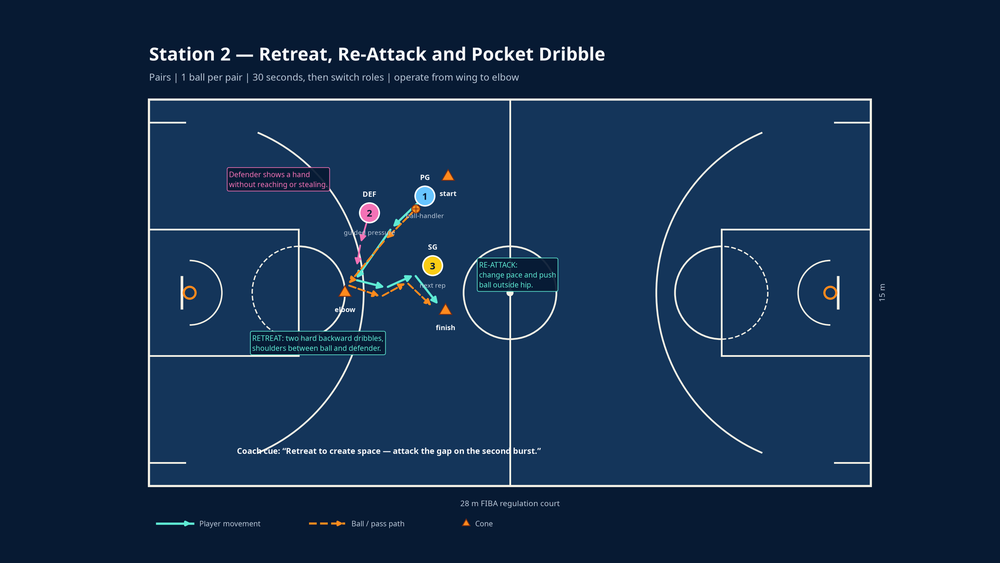
- The ball-handler (PG) starts on the wing. The defender (DEF) applies guided, physical pressure without reaching for a steal.
- The ball-handler absorbs the initial contact, then executes two hard backward retreat dribbles to create space. Shoulders must remain positioned between the ball and the defender.
- Once space is created, the ball-handler shifts pace, pushes the ball outside their hip, and re-attacks the defender's lead foot.
- The sequence finishes at the elbow cone. Pairs switch roles after 30 seconds of continuous work.
Station 3: Full-Court Control, Decision, and Finish
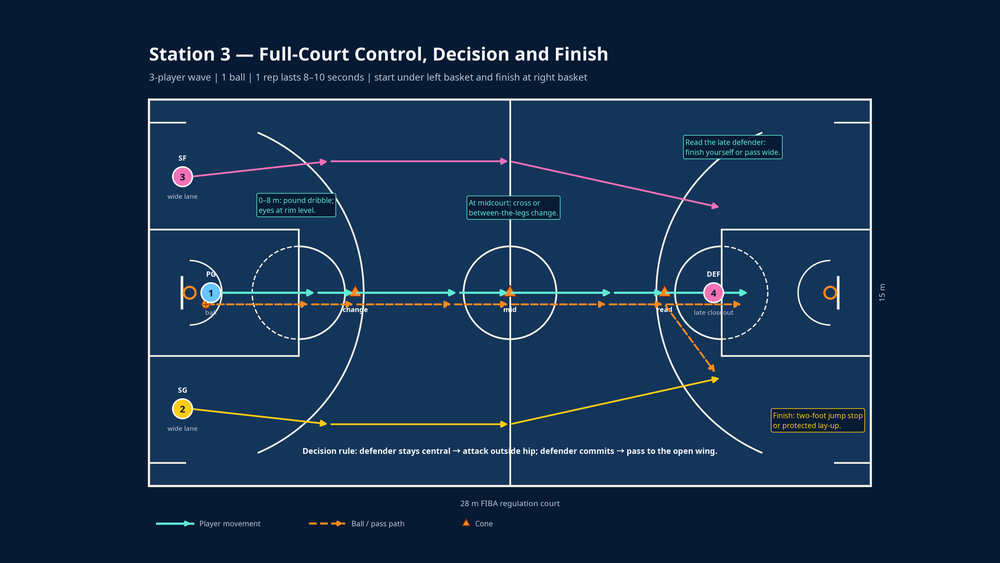
- A three-player wave starts under the left basket. The ball-handler (PG) pushes the ball up the middle, while two teammates (SG, SF) sprint the wide lanes.
- From 0–8 meters, the PG uses a heavy pound dribble, keeping their eyes at rim level to scan the floor.
- At midcourt, the PG executes a designated change-of-pace move (e.g., a cross or between-the-legs change).
- Approaching the far three-point line, a coach or designated late defender steps up. The PG must read the defender: if the defender stays central, the PG attacks the outside hip and finishes; if the defender commits fully to the ball, the PG passes to the open wing player for a layup.
4. Key Coaching Points
- Pound the Ball: Encourage players to dribble the ball with force. A harder dribble returns to the hand faster, reducing the window for a defender to poke it away.
- Eyes Up: Ball-handlers must learn to feel the ball rather than look at it. At every station, demand that players keep their eyes scanning the floor.
- Shoulder Protection: In Station 2, the off-arm and shoulder must act as a shield. The ball should remain in the "pocket" (near the back hip) when under heavy pressure.
- Pace Variation: Elite ball-handling is about changing speeds, not just moving fast. Emphasize the contrast between the slow, controlled retreat dribble and the explosive re-attack.
5. Common Mistakes
- Standing Up on the Dribble: Players often lose their athletic stance when changing directions. Remind them to drop their hips, not their chest.
- Exposing the Ball on the Retreat: Turning sideways during a retreat dribble exposes the ball to the defender. Players must keep their chest facing the defender while retreating.
- Pre-determining the Read: In Station 3, players often decide to pass or shoot before reading the defender. Force them to make the decision based entirely on the defender's momentum.
6. Variations & Progressions
- Two-Ball Slalom: Require players in Station 1 to navigate the slalom while dribbling two basketballs simultaneously (alternating or synchronous).
- Live Pressure: Upgrade Station 2 from "guided pressure" to "live pressure," allowing the defender to actively strip the ball and forcing the ball-handler to protect it dynamically.
- Advantage/Disadvantage Finish: In Station 3, have the late defender start slightly ahead of the ball-handler, forcing the PG to make a high-speed read while trailing.
7. Age Adaptations
- Under 10s / Beginners: Remove the defenders entirely. Focus purely on the mechanics of the crossover, keeping eyes up, and maintaining a low dribble.
- Under 14s / Intermediate: Introduce light, passive defenders. Focus on the concept of the retreat dribble and protecting the ball with the off-arm.
- Under 18s / Advanced: Run the drill exactly as prescribed with heavy, physical contact and strict time limits to simulate late-game fatigue.
