

Basketball
Half-Court Sideline Trap Press: 2-Second Lock and Rotation
Teach a disciplined half-court sideline trap that turns one controlled containment into a two-second lock, a protected steal lane, and a live-ball scoring chance.
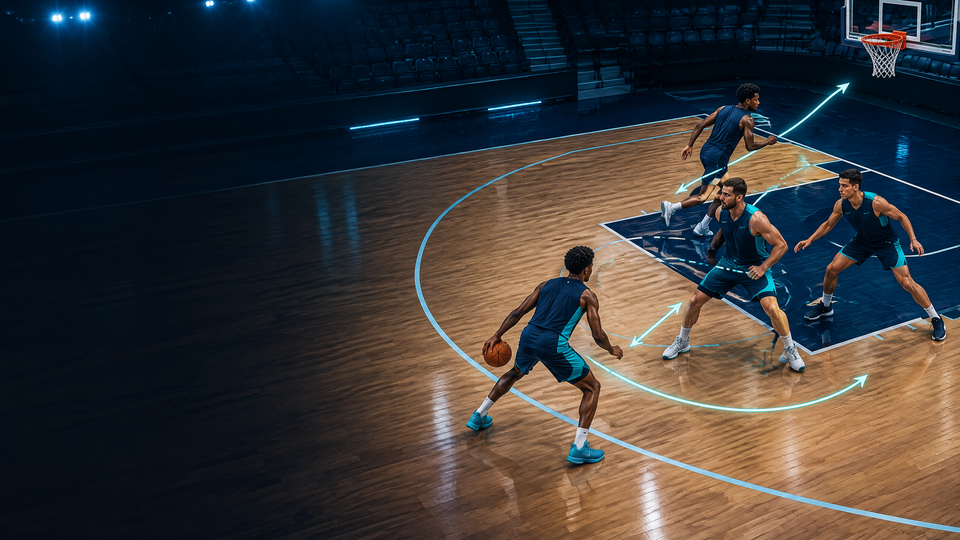
What you need
balls, cones
Overview
This half-court sideline trap is a controlled pressure call, not a gamble. It is designed for a FIBA court (28 m × 15 m) once the ball has crossed the centre line and is moving toward a sideline. The objective is to make the ball-handler stop their dribble inside a defined trap box, remove the middle and retreat passes, then force a high, late release that D3 can read. The first two defenders create the problem; the other three win the possession through rotation.
Use it after a made basket, a dead-ball change, or on a verbal call such as “RED.” It is especially useful against a primary ball-handler who brings the ball up on one side and against teams that space their inbound or early offence too high. The first target is a five-second disruption or timeout; the second is a deflection; the third is a steal. Do not sell out for the steal at the cost of the rim.
Setup
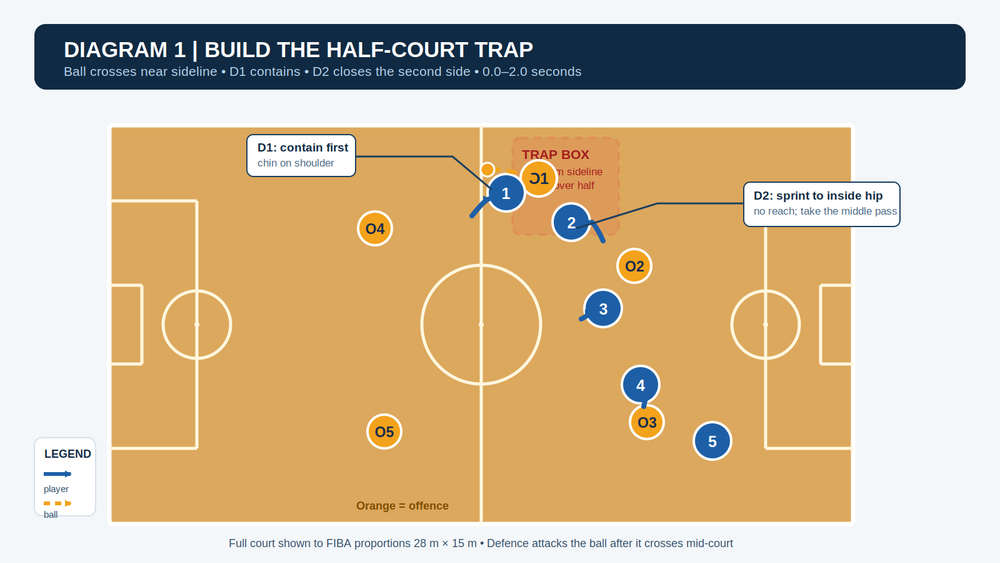
Start in a compact 1-2-2 half-court shell as the offence advances. D1, normally the lead guard defender, meets O1 one stride inside the frontcourt and shades the ball to the chosen sideline. D2 is the strong-side wing, one pass away and slightly above the ball. D3 sits at the nail, chest facing the ball, with feet ready to take away the middle outlet. D4 guards the weak-side elbow and diagonal pass. D5 is the deepest safety, one step above the restricted area, responsible for the rim and any long release behind the trap.
Mark a trap box with cones: 1 m inside either sideline and 2–4 m over half-court. The ball must enter that box before D2 commits. If O1 stays in the middle third, the defence remains in the shell; do not chase the trap across the floor. The call side should be pre-agreed: “RED right” sends the ball to the offence’s right sideline, “RED left” to the other side.
Step-by-Step Instructions
1. Contain and steer — 0.0–0.5 seconds. The clock starts when O1’s ball and both feet are over half-court. D1 arrives under control, takes away the centre with their inside foot and shows O1 the sideline. D1’s chest is square enough to absorb a drive, with the outside hand low to discourage the crossover and the inside hand high in the passing window. The cue is: “No middle, no foul.” D1 does not reach.
2. Trigger D2 — 0.5–1.2 seconds. When O1 takes the first dribble toward the sideline or turns their shoulders parallel to it, D1 calls “GO.” D2 sprints to the ball-handler’s inside hip, arriving on a short choppy close-out rather than a lunge. D2’s body angle removes the middle outlet; D1’s angle removes the baseline/sideline escape. Their feet form a tight V around O1, leaving no gap wider than a basketball.
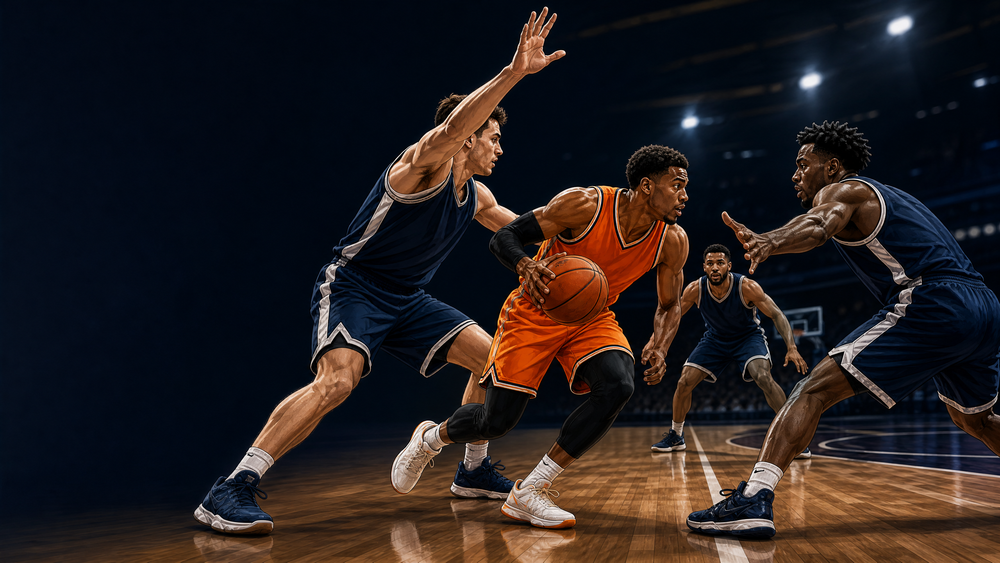
3. Lock the trap — 1.2–2.0 seconds. Both trappers raise active hands without swinging down. D1 takes vision away from the sideline return; D2 takes vision away from the middle. Their chests stay outside the vertical cylinder and their feet remain on the floor. The target is a held dribble, a pivot toward the backcourt, or a pass released above shoulder height. Call “LOCK” only when the ball is picked up.
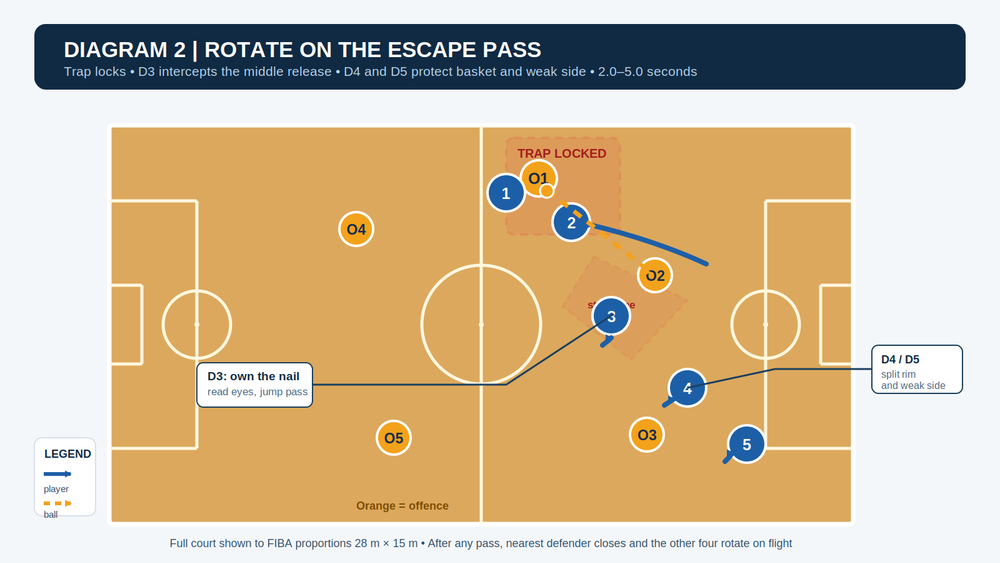
4. Take the first pass — 2.0–3.0 seconds. On “LOCK,” D3 steps from the nail into the ball-handler’s eyes and owns the middle release. D3 reads the passer’s sternum and top hand, not the ball’s first fake. D4 shrinks toward the weak-side elbow, splitting O4 and O5 and protecting the diagonal. D5 stays between the ball and basket, one step inside the deepest offensive receiver. If O1 throws the middle escape, D3 attacks it with two hands; if it goes diagonal, D4 closes on flight while D5 stays home.
5. Recover after the release — 3.0–5.0 seconds. The nearest defender takes the catch; the other trapper peels out to the next dangerous pass. Everyone else rotates one spot toward the ball. If the pass beats the first line, the call is “MATCH”: sprint back into normal man or matchup assignments, protect the paint first, then locate shooters. A trap that causes one extra pass has succeeded; do not compound it by giving up a lay-up.
Key Coaching Points
The trap is won by angle, arrival time, and restraint. D1 must arrive early enough to steer but not so early that O1 crosses back into the middle. D2 must sprint on the trigger and brake before contact; a late D2 simply creates a driving lane. Coach both trappers to keep a palm-length of legal space, hands high and feet moving, because reaching across the body produces avoidable fouls under FIBA officiating.
D3 is the play’s quarterback. Put your best anticipator there, not necessarily your quickest player. Demand early, loud information: “side,” “GO,” “LOCK,” “middle,” and “MATCH.” The three off-ball defenders must move on the flight of the pass, not after the catch. Finish every successful deflection with a conversion rule: first secure the ball, then one outlet dribble to the middle before looking to score.
Common Mistakes
The most common error is trapping on the first catch anywhere near half-court. That opens the middle because the sideline is not yet a third defender. Wait for the trap box. Another error is D1 overplaying the sideline and allowing a clean crossover middle; D1’s nose should point to O1’s inside shoulder, not the ball. Coaches also see D2 arrive too fast and foul, or D3 stand flat-footed at the nail and react after the pass. Finally, D5 often chases a wing pass and vacates the rim. In this call, the basket is never negotiable.
Variations & Progressions
Start with a guided 2v2 in the trap box: O1 dribbles to the side, D1 contains, D2 arrives, and the rep ends at the pickup. Progress to 3v3 by adding D3 and a middle outlet; score D3 for deflections and clean steals. Then play 5v5 from a coach-led advance, awarding the defence two points for a five-second call, deflection, or turnover and subtracting a point for a foul or paint touch.
For a more aggressive look, run “RED X”: D3 denies the middle outlet completely and D4 gambles on the diagonal. Use it only with D5 positioned early and a clear recovery rule. For a safer version, call “RED CONTAIN”: D2 shows a trap but remains half a step off, inviting the retreat pass while D3 and D4 take away the next receiver.
Age Adaptations
For Under 10, teach the picture without trapping hard: D1 steers, D2 arrives with hands visible, and everyone freezes at “LOCK.” Use a wider 2 m trap box and forbid steals from the rear. For Under 12, add D3’s middle interception and require two controlled slides before the trap; reward communication and legal distance more than turnovers. For Under 14, use the full 5v5 rotation but cap each trap at three seconds before “MATCH.” Under 16 and open groups can use the timed, live-ball version, add the RED X variation, and review each rep for whether the rim protector stayed deeper than the ball.
