

Basketball
4v4+2 Passing Accuracy Under Pressure Game
Build game-ready passing precision by forcing players to create angles, read pressure and thread accurate passes through live defensive traffic.
What you need
balls, cones
Overview
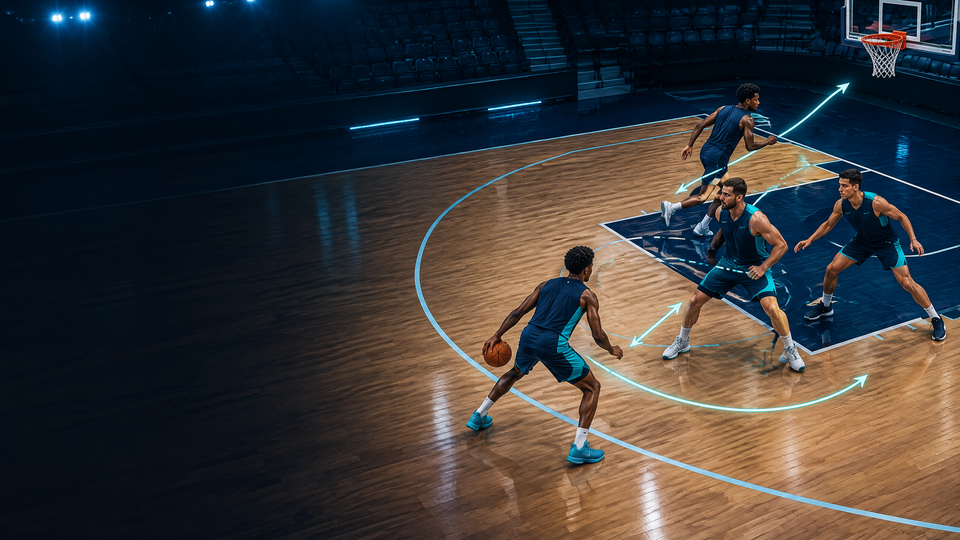
This Passing Accuracy Under Pressure drill teaches players to protect the ball, create a clear passing lane and deliver a catchable pass when a defender is actively taking away space. Every reception happens with a live defender closing, so the ball-handler must see the next picture before the catch. The attack earns a point only after completing four accurate passes inside the central box and then threading a fifth pass through a gate to a target player. It blends decision-making, footwork, communication and defensive effort.
Setup
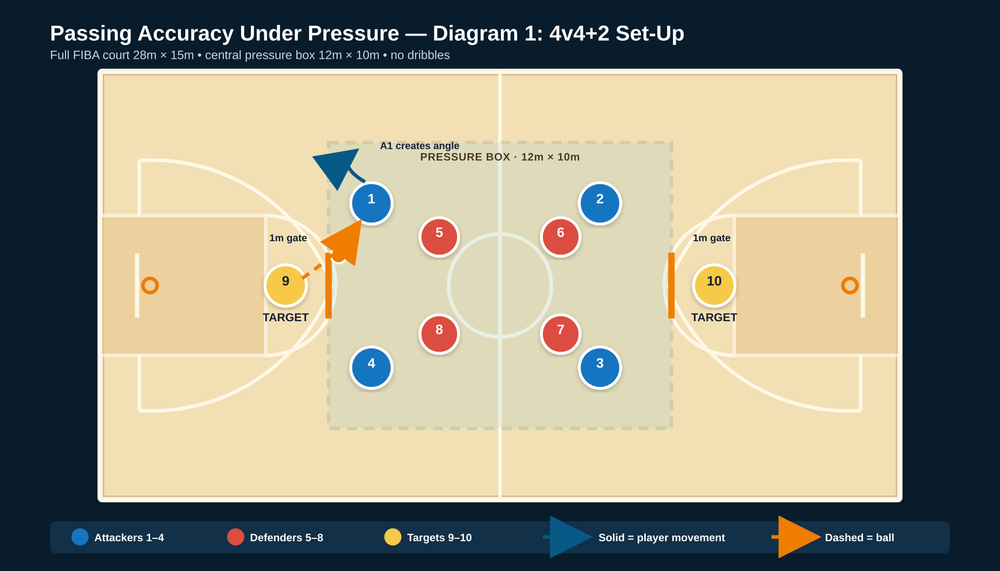
Use the full 28m × 15m FIBA court. Mark a 12m × 10m pressure box around the centre circle with four cones; place a 1m cone gate at each long-side exit of the box. Assign four blue attackers (A1–A4), four red defenders (D5–D8) and two yellow targets (T9 and T10), one beyond each gate. Start A1 with a ball at the left-upper corner of the box. Place A2 opposite at the right-upper corner, A3 at the right-lower corner and A4 at the left-lower corner. Defenders begin inside the box in a compact diamond, each responsible for an immediate close-out and a passing lane.
Use two balls: one live and one spare with the coach. Attackers and defenders remain in the box; targets stay outside their gate and may move laterally along a 3m line. There are no dribbles. A player has a maximum of four seconds from catching to releasing. Coach from the sideline where both gates are visible.
Step-by-Step Instructions
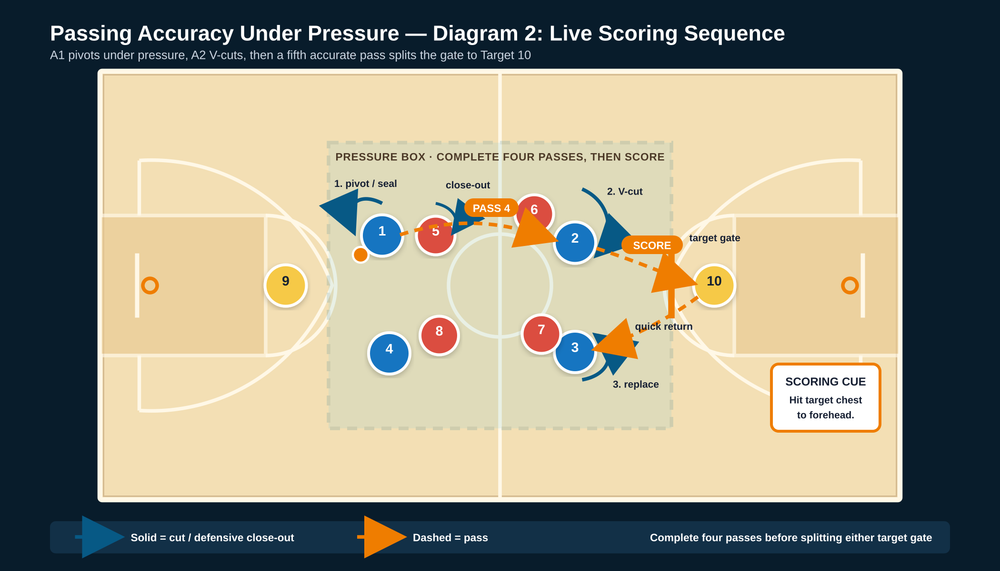
0:00–2:00 | Explain and demonstrate. The first four passes must be caught cleanly inside the box; the fifth must travel through either 1m gate and hit the target’s chest-to-forehead window. A bobble, tip or ball on the floor resets the count. Defenders score for a steal, deflection, five-second violation or ball out.
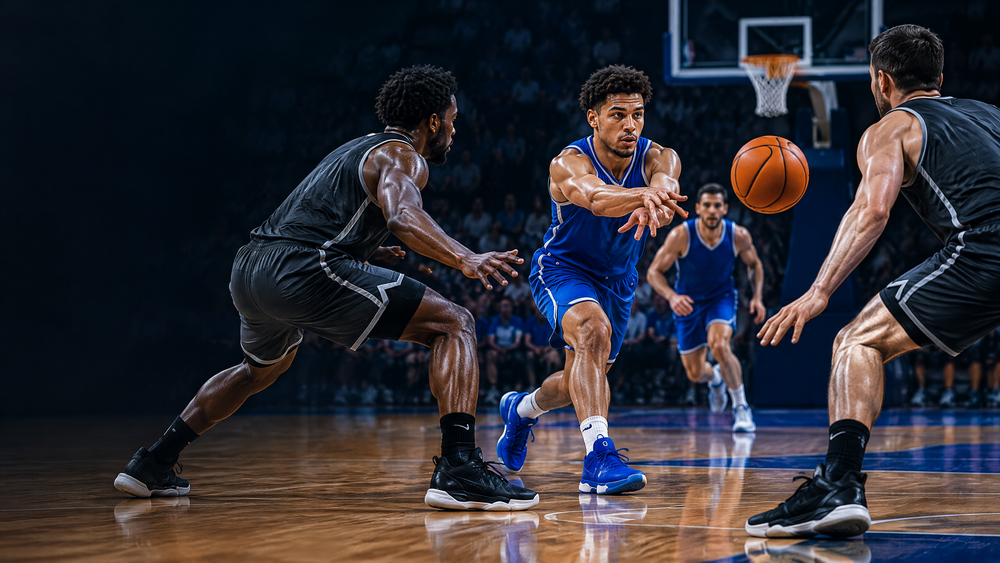
2:00–5:00 | Technical rehearsal. Run the attackers unopposed for 90 seconds. Each player catches on two feet, lands balanced and pivots to see the teammate and gate. For the next 90 seconds, add passive defenders who close out with a hand up. Call “show hands”, “pivot away” and “outside shoulder” on every rep.
5:00–8:00 | Round 1: controlled live pressure. Defenders are now live but must begin one arm’s length from their matchup. On the coach’s whistle, A1 receives from T9 and the four attackers work for four clean internal passes. A1 should seal D5 with the pivot, A2 uses a sharp V-cut to receive away from D6, and the opposite pair replace to maintain diagonal angles. On pass four, the receiver reads the nearer gate and delivers the fifth pass to T9 or T10. The target catches, returns immediately to a different attacker, and the count restarts. Award one attack point per completed sequence and one defence point for a stop.
8:00–9:00 | Reset and rotate. Give one concise piece of feedback. T9 and T10 join the attackers; A3 and A4 move to defence; D7 and D8 become targets. This keeps the 4–4–2 structure intact.
9:00–12:00 | Round 2: deny and recover. Start every defender in denial position, with their chest between their player and the ball. They may jump a passing lane but may not hold, body-check or reach across the passer’s cylinder. The attack must still complete four internal passes, but a receiver now has three seconds to release. Demand a fake only if it creates a new lane; fake-and-hold is a turnover waiting to happen.
12:00–13:00 | Reset and rotate. Repeat the same two-player rotation. Ask attackers which pass was most difficult and have defenders name the cue that allowed them to get a deflection.
13:00–16:00 | Round 3: transition pressure. On each target return, defenders must touch the centre-circle line before re-engaging. Attackers use the brief transition to change their spacing, then defenders sprint back into a live 4v4. This forces the offence to recognise the moment to move the ball quickly without relaxing their accuracy standard.
16:00–18:00 | Pressure challenge. Play first to five points. A scoring pass is worth two if the target catches it without moving their feet. A defensive steal or interception remains worth one. Keep the spare ball ready; after any dead ball, the coach serves within five seconds so work rate and concentration remain high.
18:00–20:00 | Review. State the winning score, then ask for one good passing angle and one poor one. Finish with two clean walkthrough passes at game pace.
Key Coaching Points
Players should arrive before the ball, showing a target with both hands and a wide, balanced base. Catch on two feet whenever possible; the landing gives the player a legal pivot and protects the ball from the first reach. The passer’s eyes should scan the defender’s top hand, the receiver’s outside shoulder and the open gate before the ball arrives. Teach a firm chest pass for a clear lane, a bounce pass only below an extended hand, and a one-hand push pass only when the defender has been beaten by the pivot.
Spacing is the tactical lever. Keep roughly 4–5m between adjacent attackers and do not drift into one straight line. The receiver cuts away from the defender, not simply towards the ball. When the ball moves, the weak-side pair must replace one pass ahead so the next outlet is already visible. Defenders should close short under control, lead with active hands and recover to the ball-side shoulder; reckless lunges produce fouls rather than game-useful pressure.
Common Mistakes
The most common error is passing at a teammate rather than to a usable target, usually at their knees or into the defender’s near hand. Correct it by demanding chest-to-forehead catches and pausing a rep immediately after a poor flight path. Players also catch square and stare at the same defender. Require a catch, chin and pivot sequence before every pass. Finally, attackers often stand after passing. Make the non-passer replace or V-cut on every release; static spacing makes the defence’s job easy.
Variations & Progressions
For a progression, reduce each gate from 1m to 75cm and require the scoring pass to be delivered with the non-dominant hand. For an advanced variation, allow one controlled dribble per possession but score a defensive point if the dribble does not create a passing angle within two seconds. Alternatively, run the drill in half-court 3v3+2 and make the first successful gate pass trigger a fast break to the far basket.
Age Adaptations
For under-12 players, enlarge the box to 14m × 10m, use 1.5m gates, allow five seconds to pass and begin with passive defence. Keep the score at three internal passes plus a target pass. For under-14 players, retain the full set-up but allow four seconds and use a defender hand-up rule for the first round. For under-16 and open players, use the three-second release limit, live denial and the two-point no-foot-movement target catch. The standard should always be a catchable, purposeful pass—not simply getting rid of the ball.
