Football
4v4 Football Transition Game: Win It, Secure It, Attack It
A coach-ready 4v4 transition game that develops immediate counter-pressing, composed first actions after regains and decisive attacks inside an eight-second scoring window.

What you need
10–12 footballs, 20 flat cones, 8 bibs in two colours, 2 end-zone scoring gates (5 x 2 m), Stopwatch, Spare cones for a 2 m run-off area
4v4 Transition Game: Win It, Secure It, Attack It
Overview
This is a high-repetition 4v4 small-sided game designed to coach the two seconds that decide whether a turnover becomes a counter-attack or a counter-press. The practice asks each team to recognise gain or loss, recover its shape at speed and make the first action purposeful. Use it in the main block of a session around transition, pressing, counter-attacking or game intelligence.
The activity uses a 36 x 26 m area, a compact central corridor on an adult 105 x 68 m pitch. This is within the 100–110 m by 64–75 m reference range requested for the full pitch. The width creates pressure while retaining a meaningful first forward pass; use the reduced area only as a training environment.[1]
| Session element | Coach specification |
|---|---|
| Players | 8 outfield players: Blue #2 RB, #4 CB, #6 DM, #9 CF; Orange #2 RB, #4 CB, #6 DM, #9 CF |
| Area | 36 x 26 m rectangle; divide it visually into three 12 m vertical lanes |
| Equipment | 10–12 balls, 20 cones, 8 bibs, stopwatch, two 5 x 2 m end-zone goals, spare cones |
| Work-to-rest | 4 x 4-minute blocks, 90 seconds coaching/recovery between blocks |
| Primary outcomes | Counter-pressing, first forward pass, support angles, compact recovery shape, transition finishing |
Setup
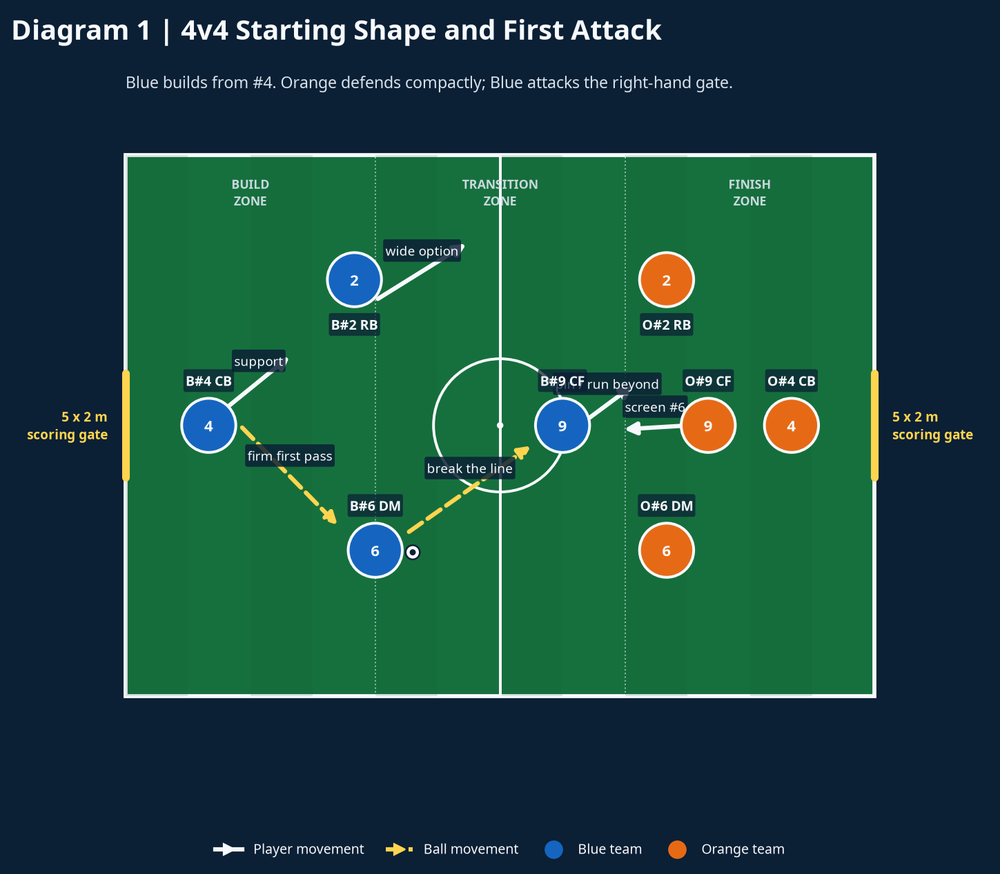
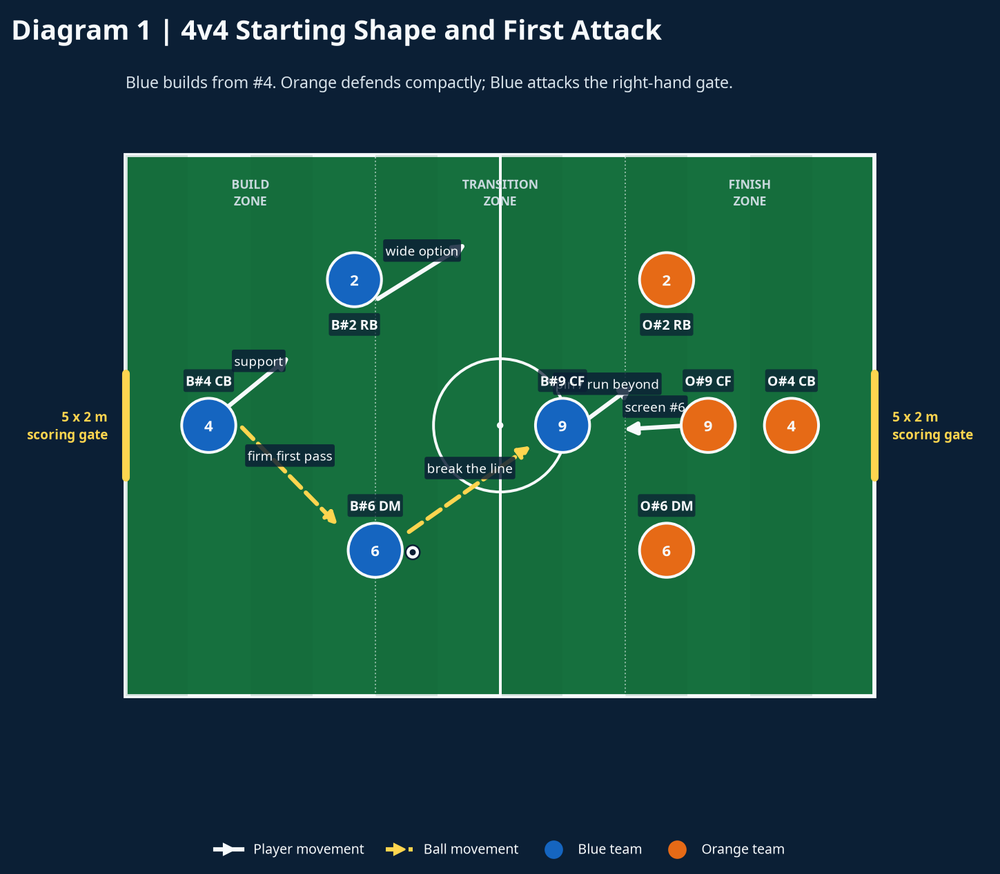
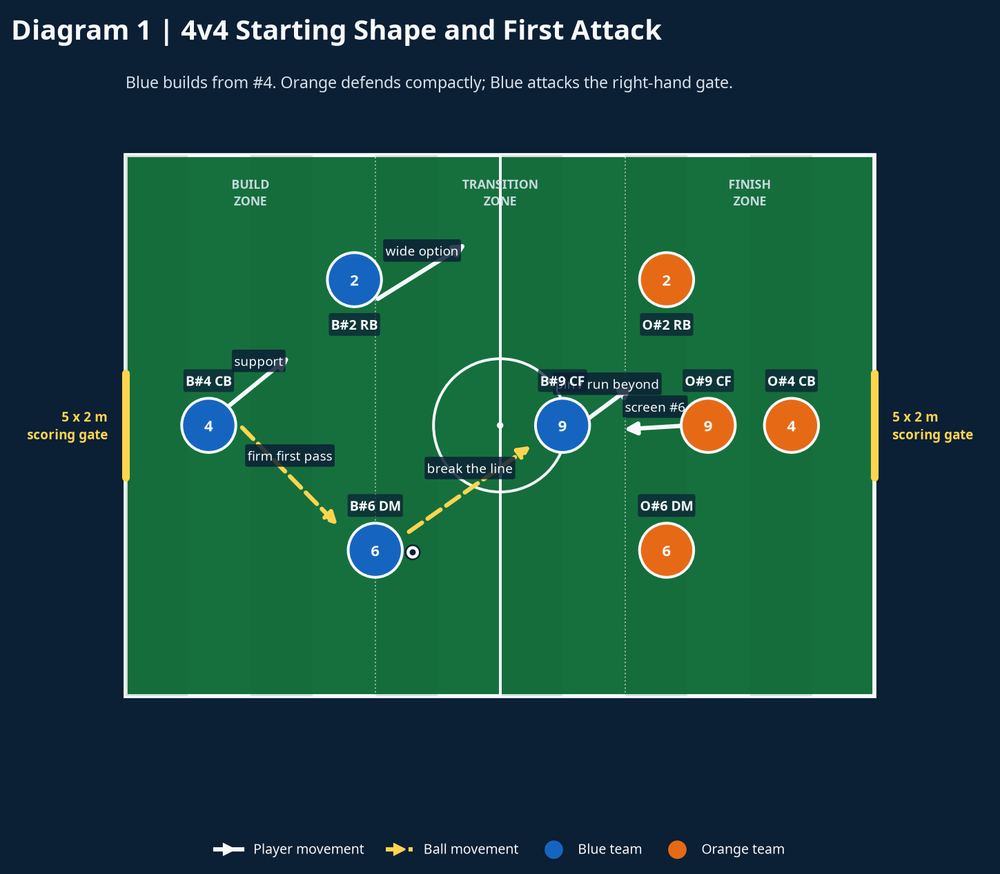
Mark out the 36 x 26 m pitch with flat cones and place a 5 x 2 m scoring gate centrally on each 26 m end line. Use two coloured bib teams. Position each team in a compact diamond: #4 starts deepest, #6 operates underneath the ball, #2 holds the wide support lane and #9 plays highest. Treat them as role references, not fixed stations. Begin Blue in possession from its #4 and have Orange set in a compact mid-block, with #9 screening the direct line into Blue #6.
Leave a 2 m run-off beyond every boundary. Keep all spare balls with the coach at the halfway line so that a new ball can be served immediately after a score or an escape. Before the first block, walk players through the scoring rule: a normal goal through either gate is worth one point, while a goal scored within eight seconds of winning the ball is worth three. This creates a visible reward for a clean transition without asking players to abandon game-realistic decisions.

Step-by-Step Instructions
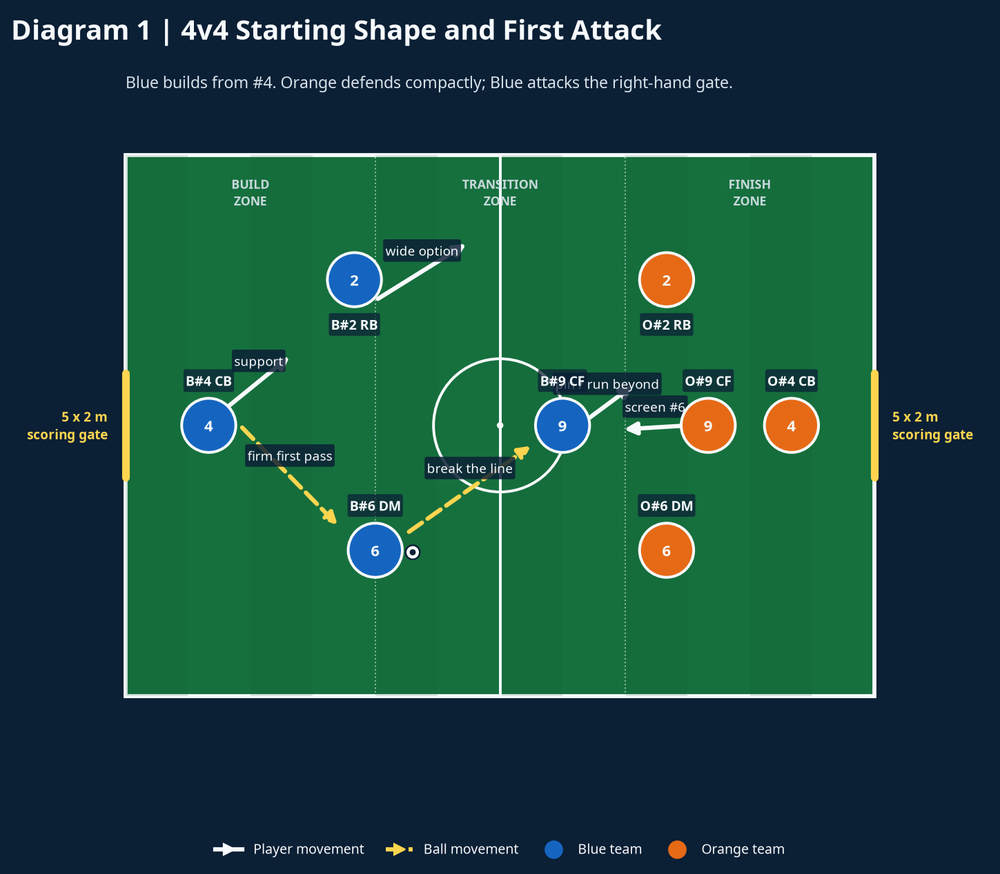
Start every repetition with Blue #4 playing a firm pass to a team-mate. Both teams are live from the first touch. Blue attacks the Orange end gate; Orange attacks the Blue end gate. Demand an immediate picture from the receiving player: scan, protect or play forward.
Play unrestricted for the opening 60 seconds so players understand the space and gates. Restart only after the ball leaves, a goal is scored or play stalls for three seconds. Serve to the team that did not score, so it must immediately manage the next transition.
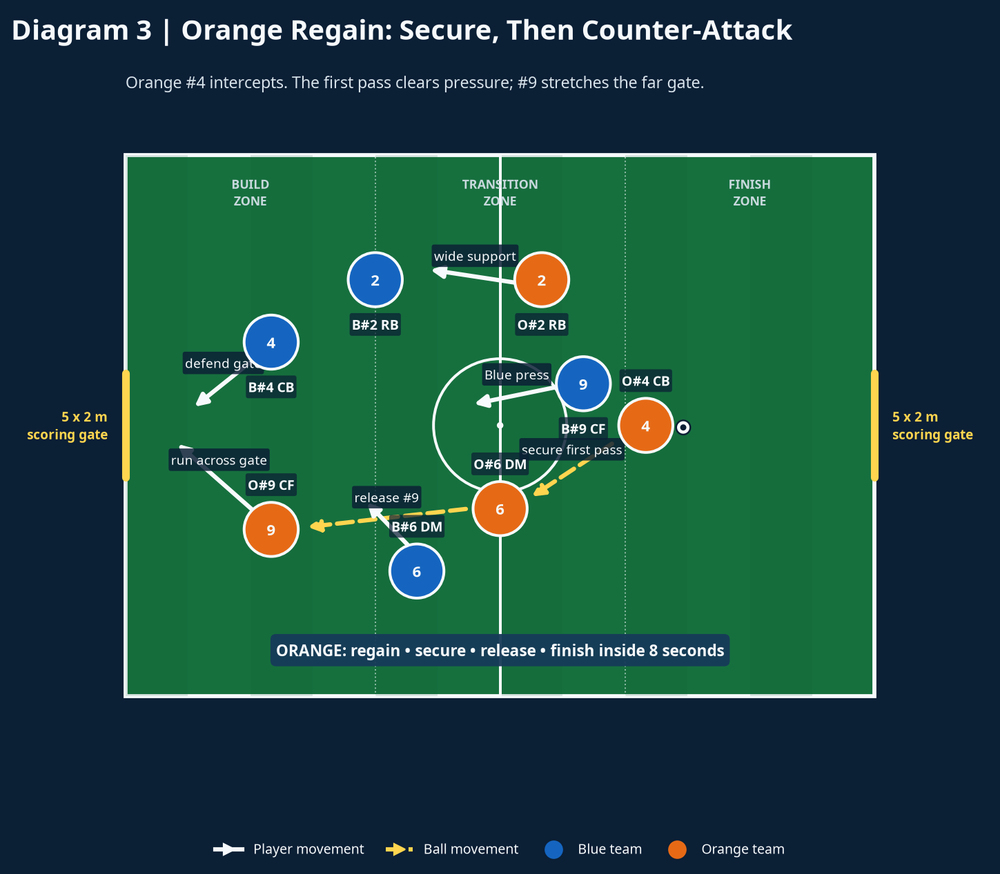
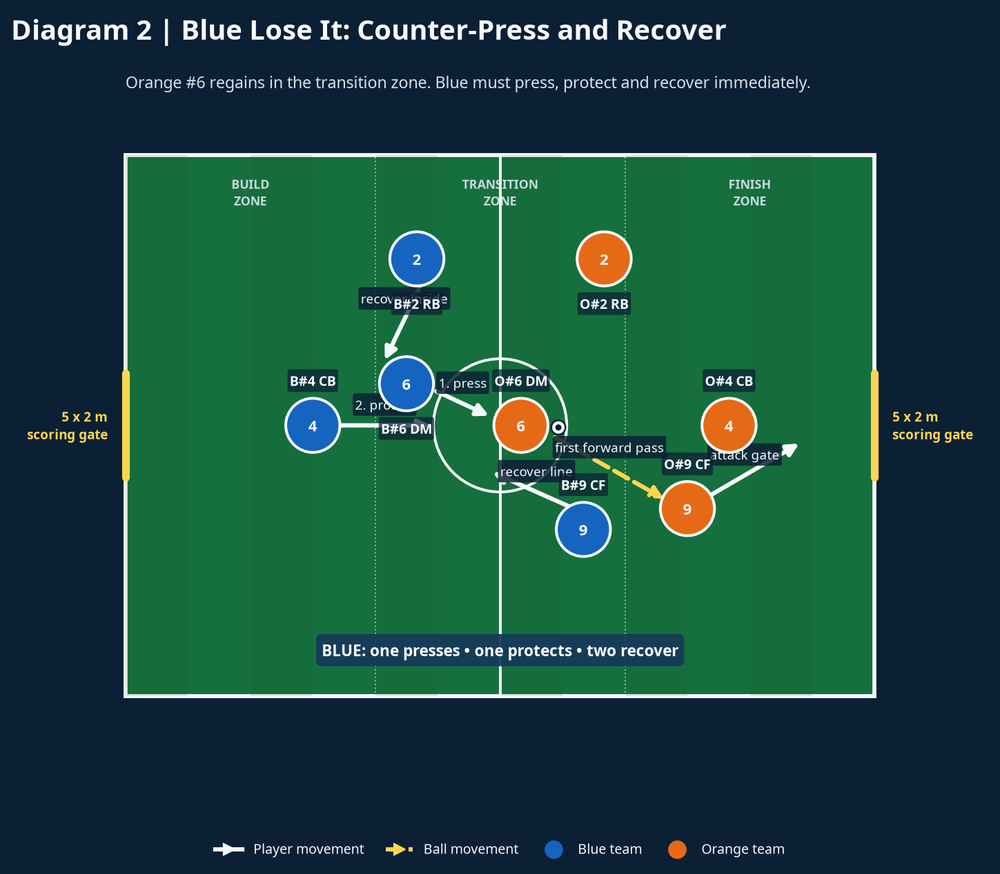
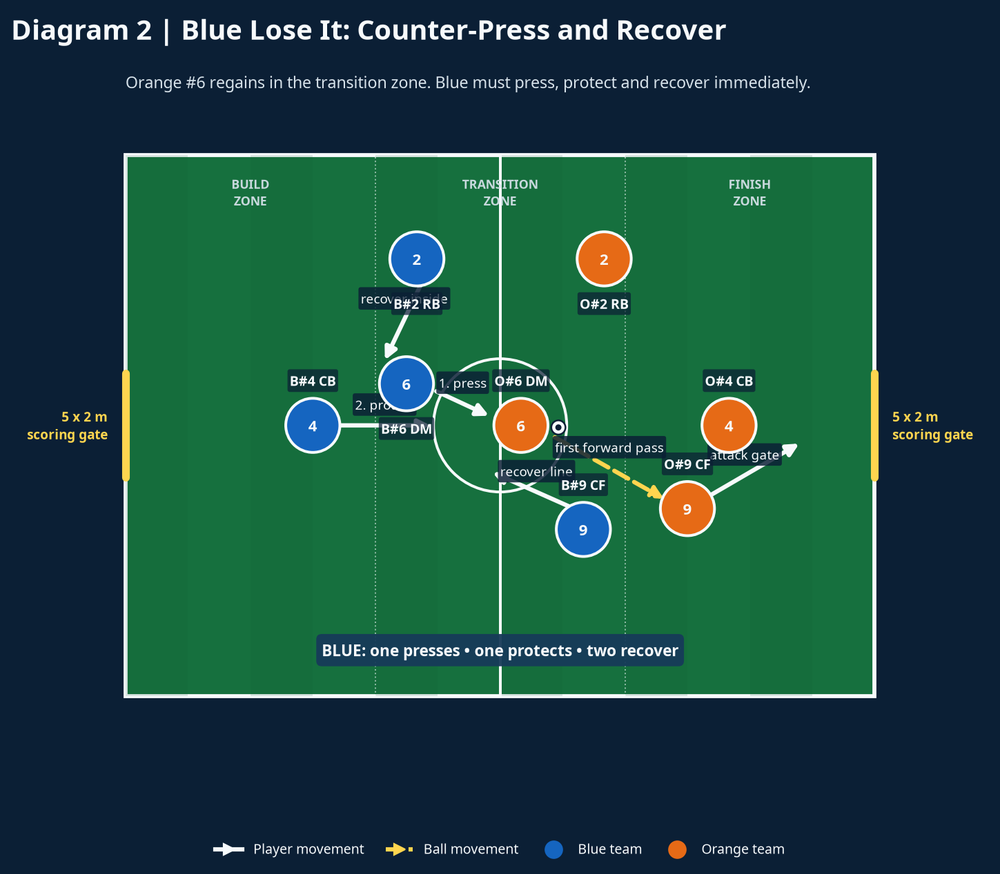
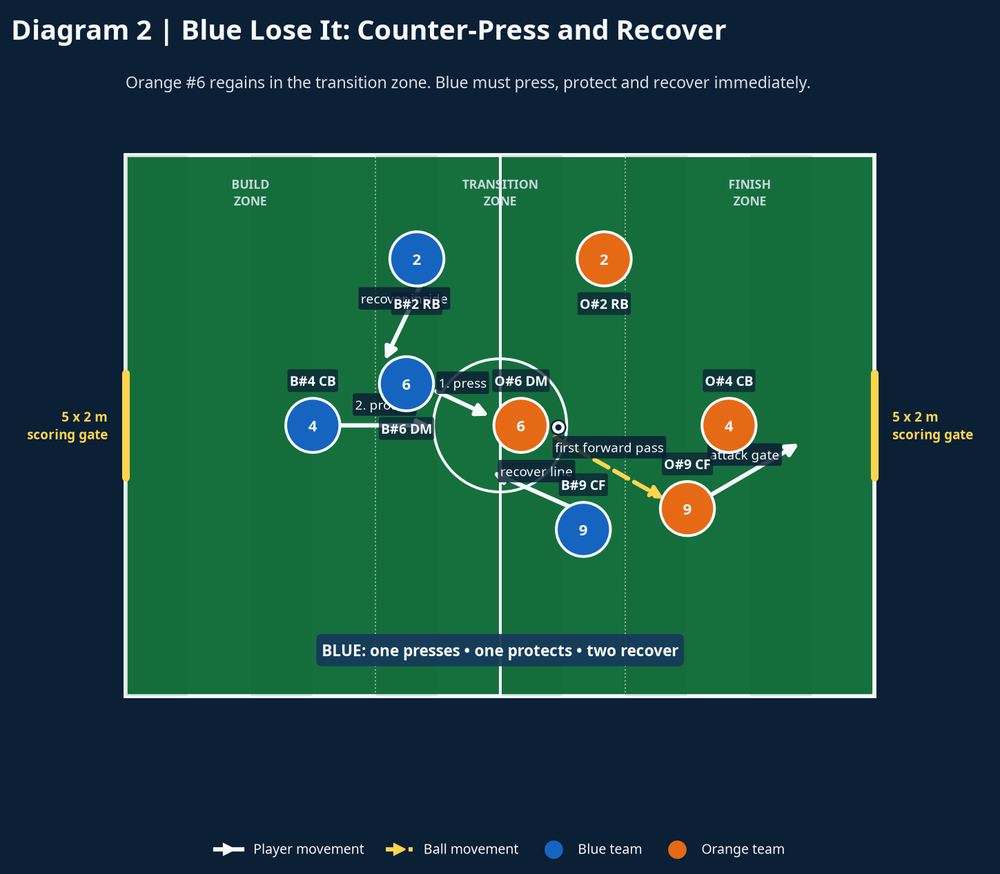
When a team loses the ball, give it a clear transition trigger: the nearest player closes the new ball carrier, the second player blocks the next forward pass and the two furthest players sprint back inside the ball-to-goal line. Use the phrase “one presses, one protects, two recover.” The losing team has two seconds to win, delay or force the new attack away from the central lane.
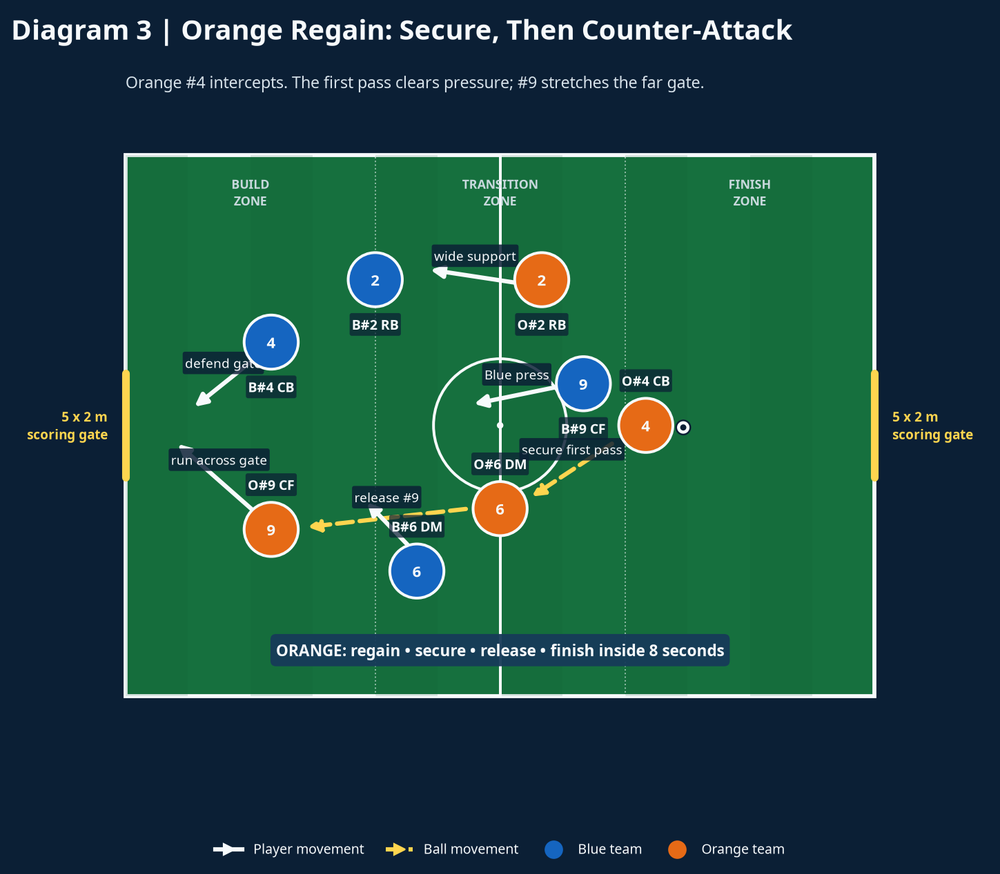
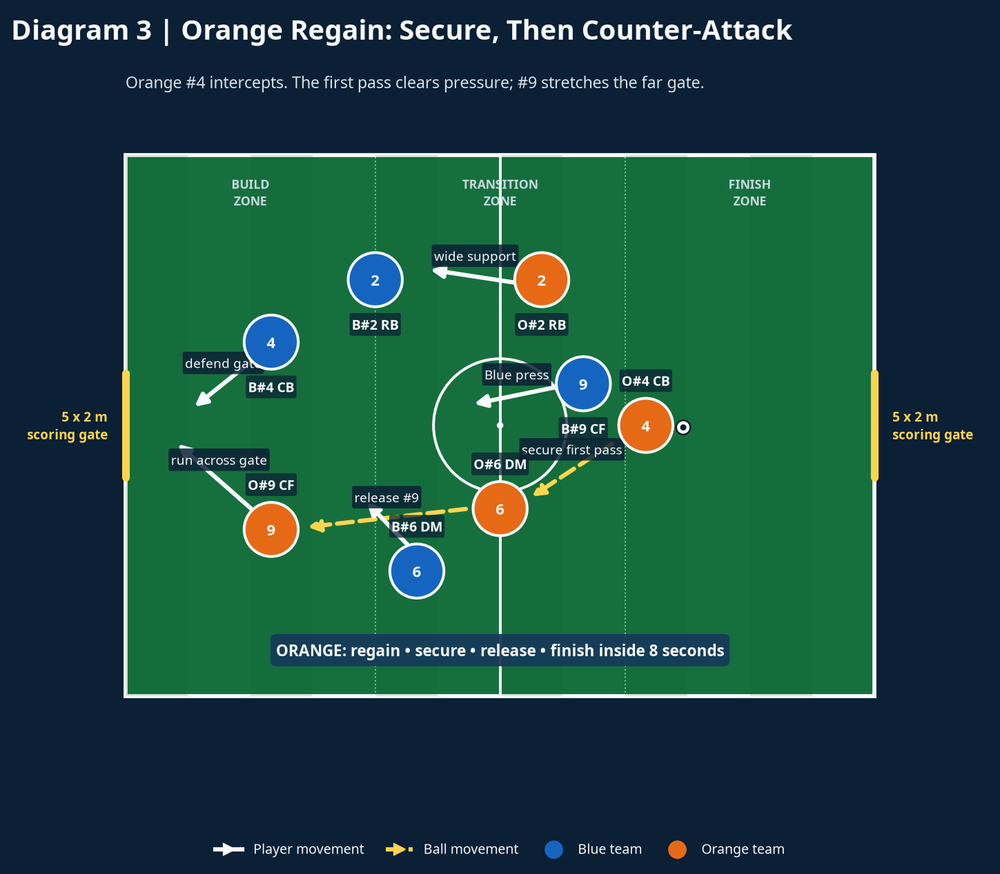
When a team wins the ball, its first priority is to secure the next action. If #6 wins it, coach #9 to stretch the far side of the pitch and #2 to create a diagonal passing lane. The first pass may be forward, sideways or back, but it must remove the first pressure and create the next attack. Do not reward a rushed forward ball that simply returns possession.
Award three points when the winning team scores through a gate within eight seconds. Count the transition window aloud only for the first two blocks; then let the players own the tempo. If the attacking team does not score, it may keep possession and build for a normal one-point goal. This distinction teaches players to recognise whether the counter is on rather than forcing every regain into a sprint.
Complete four four-minute blocks. During the 90-second breaks, ask one question, correct one detail and rehearse one restart. Suggested prompts are: “Where is the next pass before you win it?” and “Which player protects the middle when the ball is lost?” Finish with two minutes of player-managed free play.
Key Coaching Points
| Moment | Coach the behaviour | Practical cue |
|---|---|---|
| Ball loss | The nearest player attacks the ball carrier under control; do not dive in and open a lane. | “Arrive fast, defend slow.” |
| Ball loss | The second defender protects the inside lane and screens the pass into the opponent’s #9. | “Close the door, not just the player.” |
| Ball gain | The ball winner takes the first touch away from pressure and scans before the second touch. | “Win it with your eyes up.” |
| Attack | #9 pins or runs beyond the deepest defender while #2 offers a visible diagonal support line. | “Length first, then width.” |
| Team shape | The two players away from the turnover recover inside the ball-to-goal line before chasing wide. | “Get goal-side, then get tight.” |
| Decision-making | Counter only when the forward route is clean; otherwise secure and rebuild. | “Fast is not rushed.” |
Common Mistakes
The first common error is four players chasing the ball after possession is lost. Freeze the picture and show how one presser, one protector and two recoverers can both regain and defend the gate. The second is a blind first pass forward; insist that the ball winner recognises pressure with the first touch and uses the free support if the direct route is blocked.
A third error is #9 standing on the ball line, shortening the pitch. Ask the highest player to work on #4’s blind side or arc across the gate. Finally, insist that players furthest from the turnover recover inside the ball-to-goal line within three seconds.
Variations & Progressions
Start with a three-second transition protection rule for developing groups: after a regain, the winning side cannot be tackled for three seconds but must make at least one pass. This reduces chaos and gives players a clear picture of supporting angles. To increase the challenge, remove that protection and require the first attacking pass to break into a different 12 m lane before a team can score.
For a more advanced progression, make #6 the designated transition connector. A team earns its three-point transition goal only if #6 touches the ball during the eight-second attack. This develops the habit of finding the midfielder under pressure while still allowing the game to remain fluid. Finally, introduce a five-second counter-press bonus: if the losing side regains possession in five seconds and then scores, it also earns three points. Keep the language simple: win it, use it, hurt them.
Age Adaptations
| Age group | Adaptation | Coaching emphasis |
|---|---|---|
| Under-8 / Under-10 | Use 24 x 18 m, 3v3 or 4v4, wider 6 m gates and no timed bonus in the first round. | Recognition of gain/loss and safe first touches. |
| Under-12 | Use 30 x 22 m, retain the diamond roles and use a six-second bonus window. | Passing angle, spacing and immediate support. |
| Under-14 / Under-16 | Use the full 36 x 26 m, eight-second bonus and the counter-press scoring rule. | Compactness, pressing roles and choice of counter versus control. |
| Open / adult | Expand to 40 x 30 m or add neutral #10s, then constrain scoring to transition patterns relevant to the next opponent. | Unit connections and match-specific transition detail. |
Coach’s Delivery Note
Keep interventions short: the value is in repeated, game-real transition moments. If intensity falls, reduce the pitch by 2 m in each direction or shorten the block rather than adding running. If players panic, enlarge the width by 2–4 m and ask: who gives the ball winner their next picture? Success is players organising before the coach’s cue and explaining why a regain may need securing.
References