

Football
Pressing Trigger & Four-Second Recovery Drill
Teach players to recognise a square-pass pressing trigger, hunt as a unit, and recover into a compact defensive shape when the first press is beaten.
What you need
balls, cones, bibs, 2 mini goals, stopwatch
Overview
This is a high-tempo 10-player pressing and recovery practice for an Under-16 or senior development group. It develops the moment that separates a good press from a reckless one: players must identify a clear trigger, attack the ball together, and react immediately if the opponent escapes. The trigger in this version is a slow or square pass into the opposition’s pivot. The pressing team has six seconds to force a regain or an error. If the possession team breaks the first wave, the defending side has four seconds to recover goal-side, protect the middle and rebuild its compact shape.
The drill is deliberately structured around realistic roles. The blue team works with a 9, two wide forwards, an 8 and a centre-back stepping in behind. The red team builds through a goalkeeper, two centre-backs, a full-back and a number 6. Rotate roles every four-minute block so that every player experiences the physical and tactical demands of pressing, delaying and recovering.
Setup
Use a standard 105 x 68m pitch and mark a 58 x 44m active area around the centre circle, with a five-metre recovery runway beyond each side. Use 24 cones, two sets of bibs, a supply of balls and two mini goals or end zones. Split the players into two teams of five.
The red possession team starts with the goalkeeper and uses a 1-2-1-1 shape: goalkeeper, two centre-backs, a supporting full-back and a pivot. The blue team starts in a narrow 1-3-1 pressing shape: number 9 highest, 11 and 7 as wide forwards, 8 underneath and 5 providing depth. The coach serves a ball to the red goalkeeper or centre-back to begin every repetition.
Run the practice for 20 minutes: three minutes for organisation and walkthrough; three four-minute work blocks; three minutes for the final progression; and two minutes for debrief. Within each four-minute block, play six repetitions of 25 seconds with 15 seconds to reset. Demand full intensity on the press and a quick, quiet reset between repetitions.
Step-by-Step Instructions
Organisation rehearsal — 3 minutes. Walk both teams through their reference positions without opposition. Red players circulate the ball between goalkeeper, centre-backs and pivot. Blue players hold a compact starting shape, with the 9 positioned to screen one centre-back and show play towards the intended trigger.
Build-up phase. On the coach’s whistle, red has up to 10 seconds to make two or three passes. Blue stays patient; this is not the moment to sprint individually. The blue 9 angles the approach to take away the return pass to the far centre-back. The two wide forwards remain connected, roughly 8–10m inside the touchline, ready to lock the next pass outside.
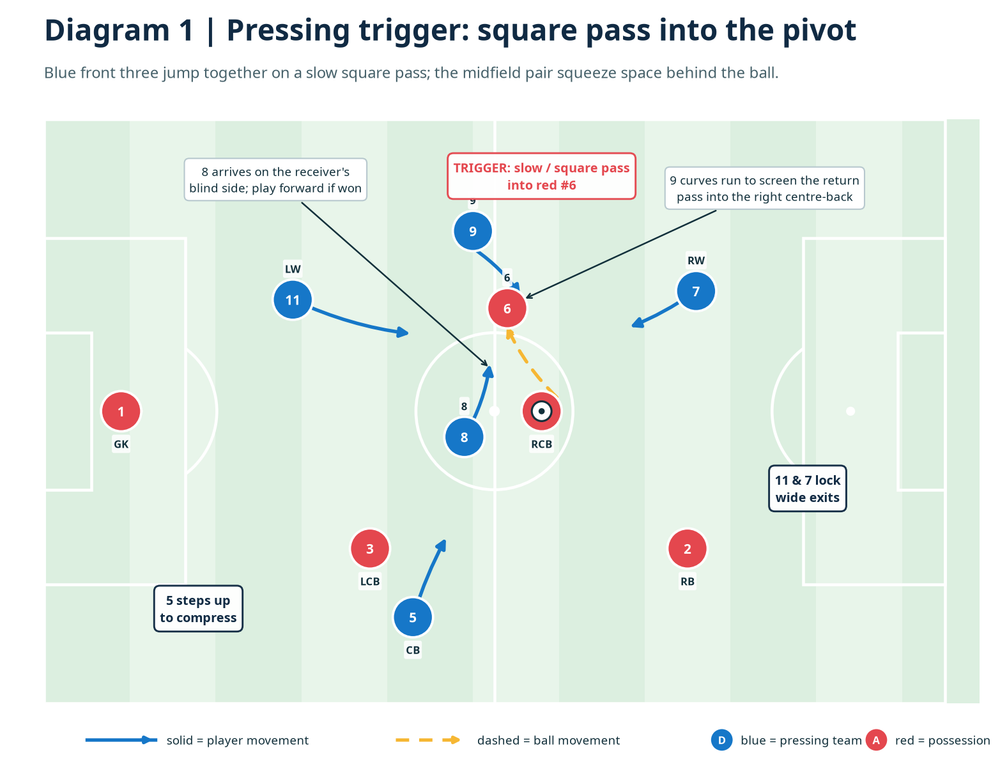
Recognise the trigger. The moment red plays a slow, square or backward pass into red #6, the coach calls the live action. Blue #9 presses the receiving pivot on a curved line, arriving under control and screening the easiest return pass. Blue #8 attacks the receiver’s blind side to challenge the next touch. Blue #11 and #7 pinch in to close passing lanes to the full-back and opposite centre-back. Blue #5 steps up behind them to compress the space, but remains ready to protect the ball over the top.

Pressing outcome — maximum 6 seconds. Blue scores one point for a regain, forced clearance or pass intercepted inside the active area. If blue wins the ball cleanly, it has six seconds to play into either mini goal or carry through the nearest end zone for a bonus point. This gives the press a purpose: do not simply tackle; win it and attack with the opponent disorganised.
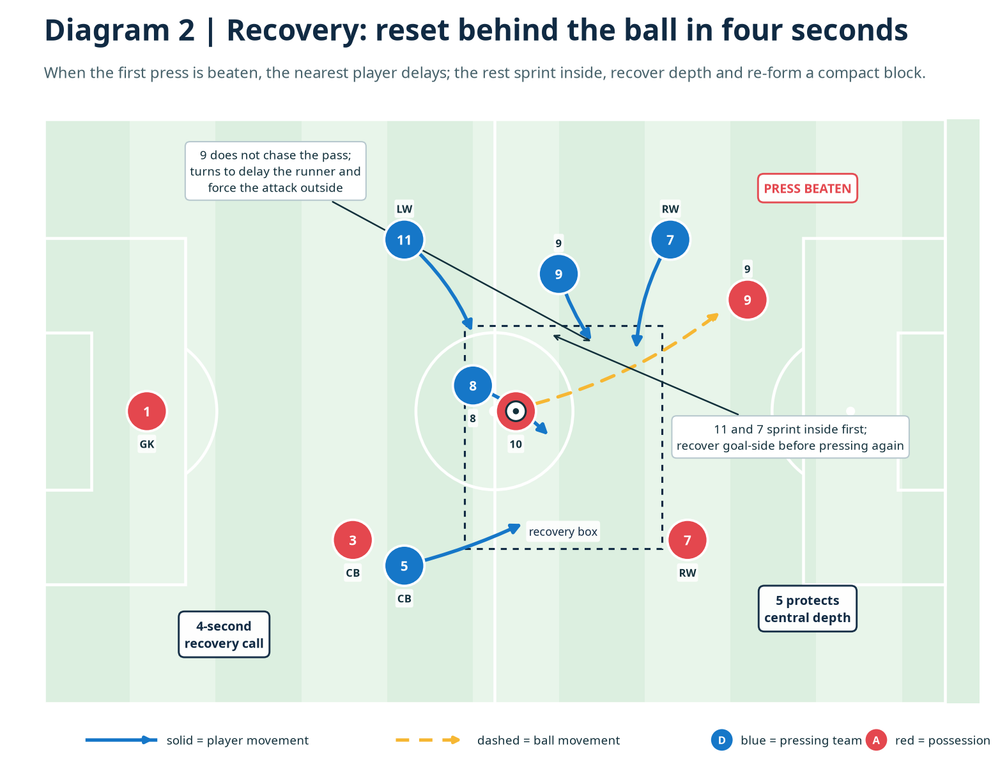
When the press is beaten. If red plays through, around or over the first pressing wave, the coach shouts recover. Blue #9 becomes the nearest delaying player. Rather than chasing the ball from behind, #9 turns, drops onto a side-on body shape and directs the ball carrier away from the centre. The other four blue players immediately sprint inside and goal-side first. Their first job is not to steal; it is to remove the direct route to goal.
Four-second recovery rule. Blue has four seconds to get two players between the ball and the central goal line, with the remaining players compact enough to cover the next pass. Blue #5 protects central depth and communicates the line. Blue #8 tracks the runner nearest the ball. The wide forwards recover inside before they re-engage. Once the group is compact, the nearest player can press again while the others provide cover and balance.
- End and reset. Award red one point if it breaks the press and plays or dribbles through the far end zone before blue reforms. Stop only for clear coaching moments: an excellent curved press, a poor distance between players, or an outstanding recovery sprint. Keep feedback to 20 seconds, then restart with a fresh ball.
Key Coaching Points
- Press on the pass, not after the touch. The ball travels faster than players, so the first presser must move as the pass is played. A late press allows the pivot to receive open and face forward.
- Curve the approach. The 9 should arrive side-on, close at speed, then decelerate over the final two metres. Show the receiver into the area where teammates are waiting; do not open the central lane.
- Lock, squeeze and cover. The three nearest players hunt the ball, but the 8 and 5 must close the space behind the press. Aim for 6–8m between connected players around the ball.
- Recover inside first. When beaten, players must sprint towards the centre and their own goal before thinking about the next tackle. Use clear calls: square, jump, lock, inside and drop.
Common Mistakes
- The 9 runs straight at the ball and leaves the return pass open. Correct this by marking the screening line with cones and rehearsing the curved route.
- Wide players chase the full-back too early, creating a large gap inside. Demand that 11 and 7 stay connected to the 8 until the trigger is confirmed.
- Players turn and chase the ball after the press is broken. Insist that the nearest player delays while the rest recover goal-side and rebuild the defensive box.
Variations & Progressions
Begin with red limited to two touches, which makes the trigger obvious and gives blue repeated success. Then allow unlimited touches and require red to look for a split pass or switch after drawing the press. For the final three-minute progression, give red a bonus point for reaching an end zone through a forward pass; this forces blue to protect depth rather than over-commit around the ball.
To increase the challenge, allow blue to score only after a regain followed by a forward pass. Alternatively, nominate a different trigger each block: a bad first touch, a back pass to the goalkeeper, a pass into a full-back facing their own goal, or a bouncing aerial ball. Keep the recovery rule unchanged so players learn that the team response matters more than the original trigger.
Age Adaptations
For Under-12 players, use a 40 x 30m area, make the recovery window six seconds and coach only two priorities: press together and run back inside. For Under-14 players, retain the four-second recovery rule but allow a neutral server to improve ball flow. For stronger Under-16 or open-age groups, remove touch limits, add offside lines and require the recovering team to communicate the new marking assignments before it can press again.



