

Football
High-Intensity Counter-Attack Transition: From Regain to Finish
Train your team to exploit defensive disorganization with lightning-fast transitions, focusing on forward passing, purposeful runs, and clinical finishing.
What you need
Full-size goal, 10-12 cones or markers, Supply of footballs, Bibs in two contrasting colours
Overview
In modern football, the moments immediately following a turnover are often the most lucrative opportunities to score. When the opposition loses possession, they are inherently disorganized and out of their defensive shape. This High-Intensity Counter-Attack Transition Drill is designed to train your players to recognize these moments, secure the ball, and execute a rapid, vertical attack before the defense can recover.
This drill emphasizes the critical "first pass" out of pressure, the coordinated forward runs of attackers, and the ruthless efficiency required in the final third. By simulating game-realistic transition moments, coaches can develop a team that is lethal on the break.
Setup

To ensure this drill replicates match conditions, setting up the pitch accurately is vital.
Pitch Dimensions: Use a standard 100m x 68m pitch, or adapt slightly for younger age groups. The drill primarily utilizes two-thirds of the pitch, from the defensive penalty area to the opposite goal.
Player Positions:
- Attacking Team (Blue): 1 Goalkeeper (1), 2 Center Backs (4, 5), 2 Central Midfielders (6, 8), 1 Striker (9), and 2 Wingers (7, 11).
- Defending/Pressing Team (Red): 3 Pressing players (10, 7, 11) starting high up the pitch, and 2 recovering defenders (2, 3) starting near the halfway line.
Equipment Needed: Full-size goal, 10–12 cones or markers for starting positions, a supply of footballs near the coach, and bibs in two contrasting colours.
Step-by-Step Instructions

Phase 1: Regain & Trigger
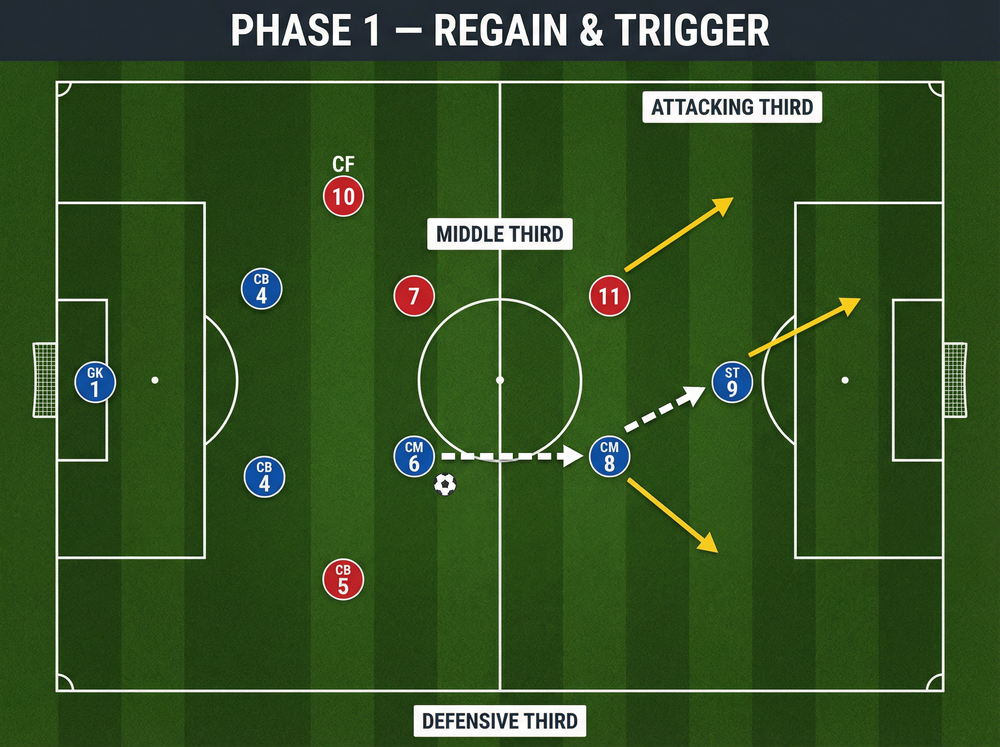
- The Trigger: The coach initiates the drill by playing a ball into the defensive third, simulating a turnover or a loose ball won under pressure.
- Securing Possession: The Blue Central Midfielder (6) or a Center Back must immediately secure the ball under pressure from the Red pressing players.
- The First Pass: The player on the ball must look up immediately and execute a forward, penetrating pass. The primary target is the advanced Central Midfielder (8) or the Striker (9) dropping deep to link play.
- Forward Movement: As the ball is secured, the Wingers (7, 11) and the Striker (9) must make explosive, coordinated runs to stretch the recovering Red defense.
Phase 2: Counter-Attack Execution
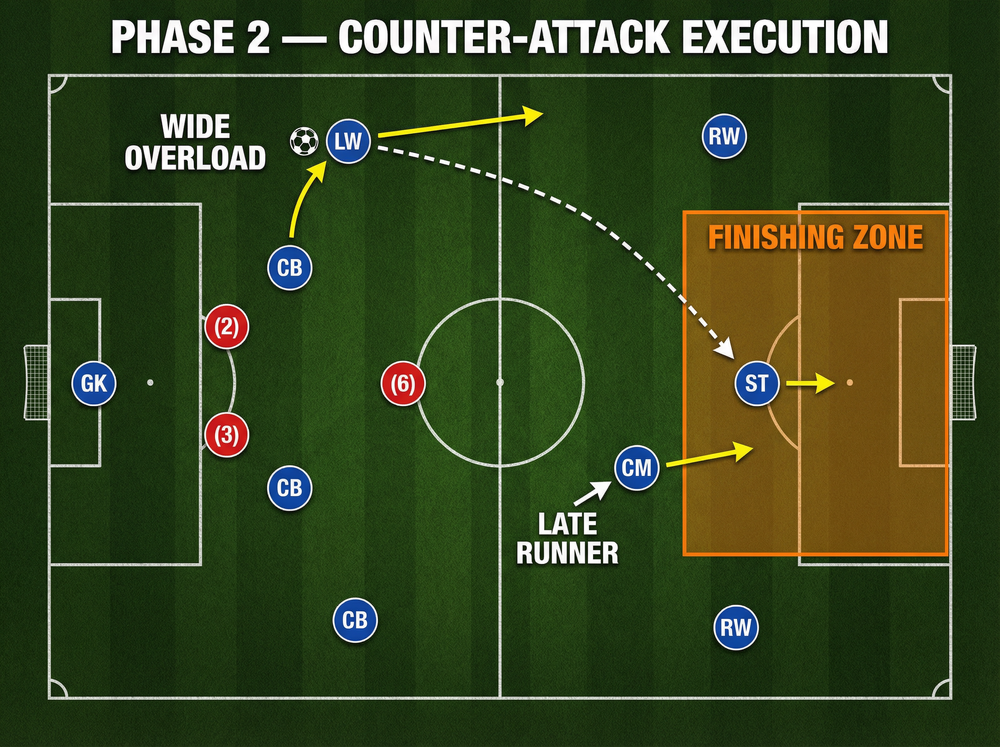
- Exploiting the Space: Once the first pass breaks the initial press, the attacking team must drive forward at pace. The player receiving the ball (CM 8) should look to play a through ball into the path of the wingers or striker.
- Creating the Overload: The Wingers should look to isolate the recovering Red defenders (2, 3), creating a 3v2 or 4v2 overload in the attacking third.
- The Finish: The attack must culminate in a shot on goal within 8–10 seconds of regaining possession. Players must attack the cross or through ball with intent, focusing on the Finishing Zone inside the penalty area.
- Reset: Once a goal is scored, the ball goes out of bounds, or the Red team wins possession, the drill resets to starting positions.
Key Coaching Points

- Speed of Thought and Action: The transition must be instantaneous. Players cannot dwell on the ball; the first thought upon regaining possession must be "forward."
- Quality of the First Pass: A poor first pass kills the counter-attack. It must be firm, accurate, and ideally break the first line of pressure.
- Purposeful Runs: Attackers must make runs that not only offer a passing option but also drag defenders out of position. Diagonal runs across the defense are particularly effective.
- Ruthless Finishing: The final action must be clinical. Encourage players to hit the target and follow in for rebounds.
- Defensive Balance: Even while attacking, the deeper players (Center Backs) must maintain a defensive structure to prevent a counter-counter-attack if the ball is lost.
Common Mistakes

- Playing Backwards: The most common error is playing a safe, backward pass after winning the ball, allowing the defense time to reset. Demand a forward option is always sought first.
- Lack of Width: Attackers running in straight lines make it easy for defenders to narrow the pitch. Wingers must stay wide initially to stretch the play before cutting inside.
- Over-Dribbling: Players taking too many touches slow down the attack. Emphasize passing over dribbling unless driving into open space.
- Ignoring the Late Runner: Often, the most dangerous player is the midfielder arriving late into the box. Ensure the player on the ball scans for this option before crossing or shooting.
Variations & Progressions
- Time Limit: Introduce a strict 8-second shot clock from the moment possession is regained to increase urgency and sharpen decision-making.
- Add Defenders: Increase the difficulty by adding a recovering defensive midfielder to make it a 4v3 or 5v4 scenario in the final third.
- Set-Piece Trigger: Instead of a coach feeding the ball, start the drill from a defended corner kick or wide free-kick that the Blue team wins and then counters from.
Age Adaptations
| Age Group | Pitch Adjustment | Key Focus | Defensive Pressure |
|---|---|---|---|
| Under-10 to Under-12 | Reduce to 60m x 40m | Quality of first pass, basic forward runs | Light — 1 passive presser |
| Under-14 to Under-16 | 80m x 55m | Decision-making in final third, overloads | Moderate — 2 active pressers |
| Open / Senior | Full 100m x 68m | Tactical precision, rapid execution, clinical finishing | Full intensity — 3 active pressers |
