

Netball
The Lightning Strike: Centre Pass to Quick Goal
Master a high-tempo centre pass set play designed to bypass the midcourt defence and secure a scoring opportunity in three passes or less.
What you need
1 Netball, Positional bibs, Training cones (optional)
1. Overview
The "Lightning Strike" is a high-intensity, direct centre pass set play designed to rapidly transition the ball from the centre circle to the shooting zone. This play aims to catch the defensive team off guard by bypassing congested midcourt areas and delivering the ball to the shooters before the opposition can set up their defensive structures. It is particularly effective against teams that employ a strong, structured zone defence in the centre third, as the speed of the play forces defenders into one-on-one situations where attacking leads can exploit open space.
2. Setup
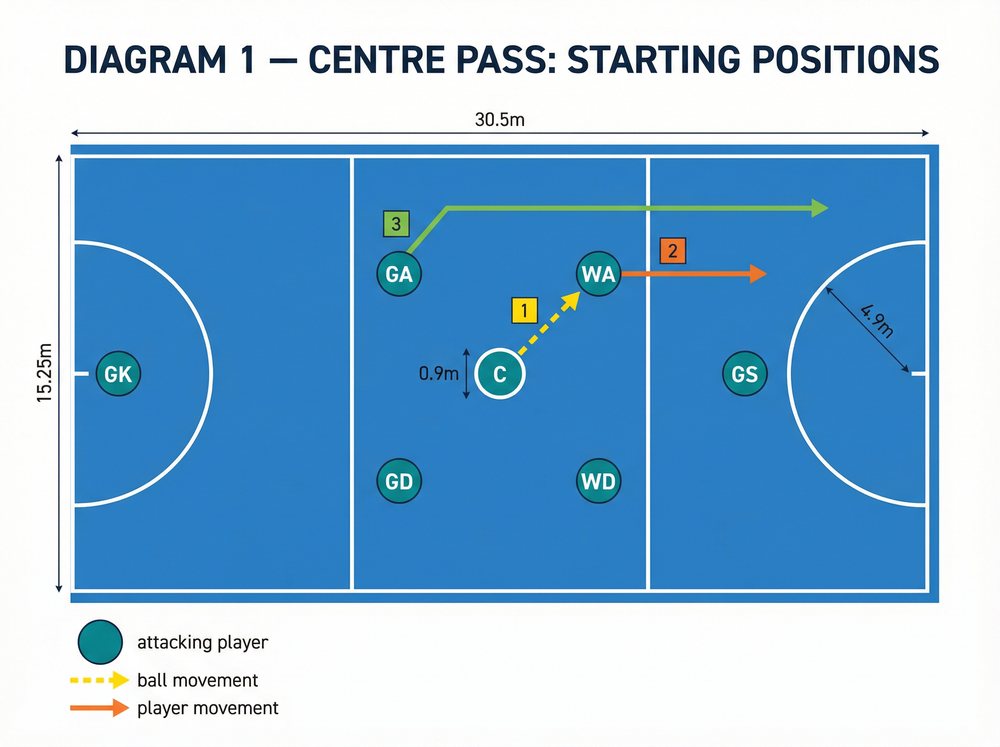
Equipment Needed: 1 Netball, full set of positional bibs, training cones (optional for marking target areas).
Court Setup: Full standard netball court (30.5m x 15.25m).
Starting Positions:
- Centre (C): Standing exactly in the centre circle (0.9m radius), ready to deliver the first pass.
- Wing Attack (WA): Positioned in the centre third, slightly right of the centre circle, prepared to make a strong forward lead.
- Goal Attack (GA): Positioned in the centre third on the left side, ready to time a dynamic run into the attacking third.
- Goal Shooter (GS): Positioned in the attacking goal third, near the edge of the goal circle (4.9m radius), holding space and observing the play.
- Wing Defence (WD), Goal Defence (GD), Goal Keeper (GK): Positioned in their respective defensive zones to provide cover and balance.

3. Step-by-Step Instructions
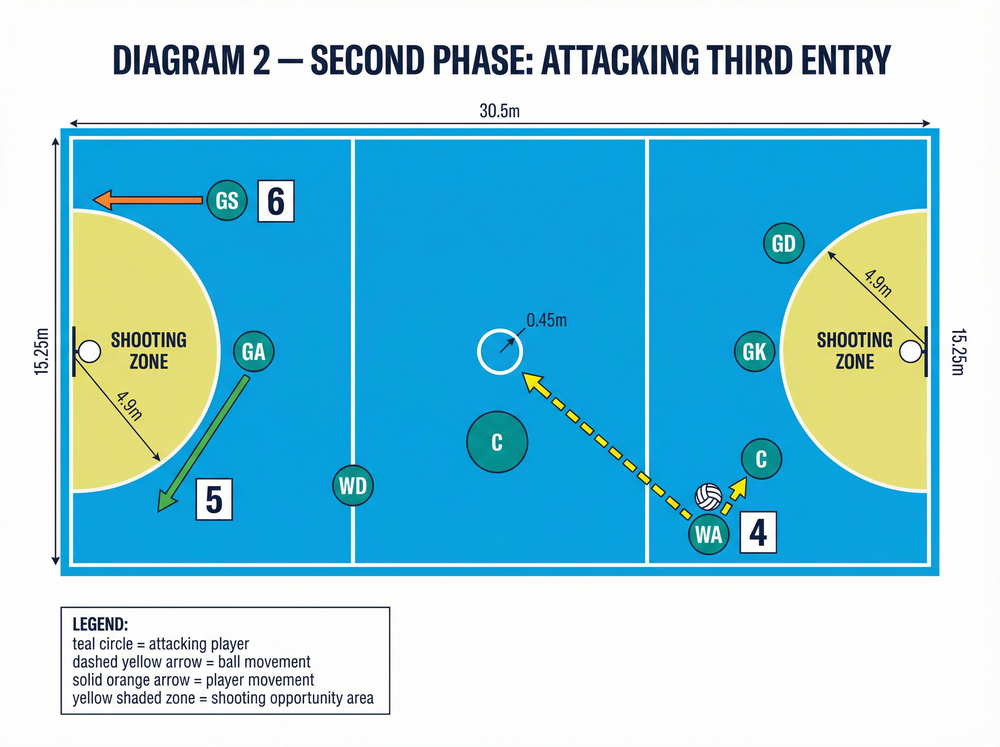
- The Whistle: On the umpire's whistle, the Centre (C) immediately steps and delivers a sharp, flat pass to the Wing Attack (WA).
- The First Lead: Simultaneously, the WA makes a strong, explosive sprint forward into the right channel of the attacking third to receive the pass securely.
- The Second Phase: As the WA receives the ball, the Goal Attack (GA) initiates a sharp, diagonal lead from the left side of the centre third directly into the attacking goal circle.
- Creating Space: The Goal Shooter (GS) must simultaneously move laterally along the top of the goal circle, drawing their defender away and opening up the central channel for the GA's lead.
- The Final Feed: The WA delivers a precise, perfectly timed pass into the space created for the GA, who catches the ball within the goal circle, ready for an immediate shot.
4. Key Coaching Points
- Timing is Everything: The success of this play relies entirely on the synchronized movement of the WA, GA, and GS. The GA must not start their run too early, or they will crowd the space before the WA is ready to pass.
- Pass Quality: The Centre must deliver a flat, hard pass to the WA. Loopy passes give the defence time to recover and intercept.
- Strong Leads: The WA and GA must commit fully to their leads. Half-hearted sprints will be easily defended. They must demand the ball with strong hands and clear verbal communication.
- Spatial Awareness: The GS plays a crucial role without even touching the ball in the initial phases. Their lateral movement is essential for clearing the central channel. If the GS remains static, the GA's lead will be blocked.
- Vision: The WA must have their head up immediately upon receiving the ball from the Centre. They need to spot the GA's lead instantly and execute the final feed without hesitation.
5. Common Mistakes

- Hesitation on the Whistle: The Centre takes too long to deliver the first pass, allowing the defence to set their structure.
- Running Too Early: The GA initiates their lead before the WA has secured the ball, resulting in the GA running out of space or entering the goal circle before the pass can be made.
- Poor Spacing: The GS fails to move laterally, cluttering the top of the goal circle and blocking the GA's path to the post.
- Weak Passing: Delivering slow, lobbed passes that give defenders ample time to intercept, particularly on the crucial feed from the WA to the GA.
6. Variations & Progressions

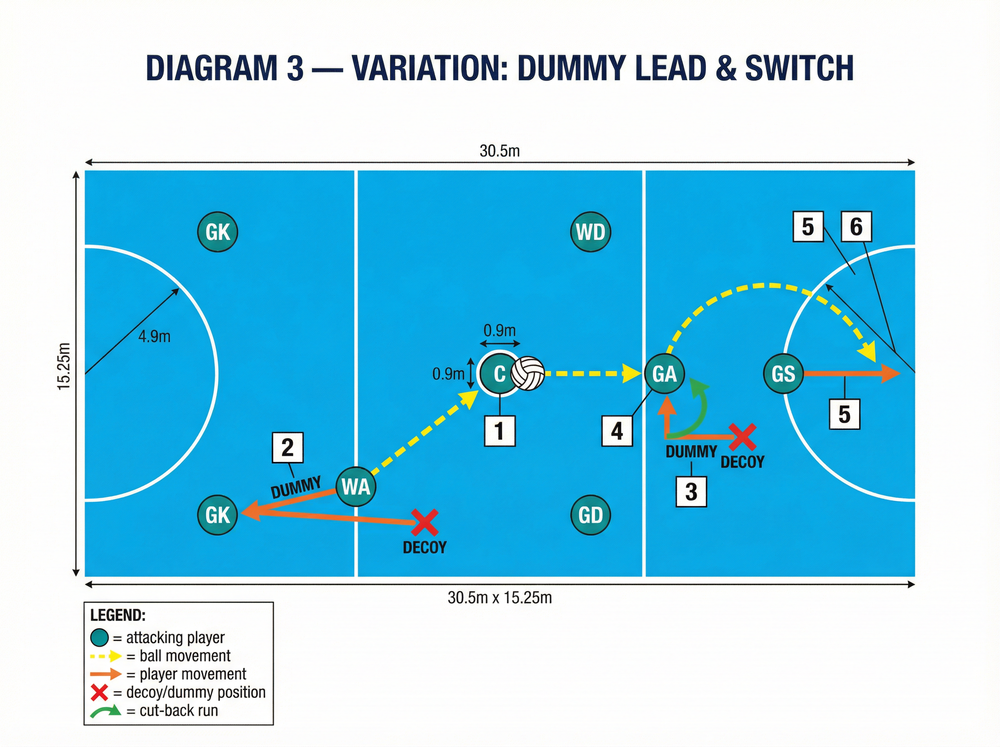
- The Dummy Lead (Diagram 3): If the defence starts anticipating the WA's direct lead, introduce a dummy run. The WA fakes a drive to the left, drawing the defender, while the GA cuts back sharply to receive the first pass from the Centre. The GA then feeds the GS who has driven to the post.
- The GS Screen: Instead of moving laterally, the GS can set a screen on the GA's defender at the top of the goal circle, allowing the GA to roll off the screen and receive the ball in open space closer to the post.
- Adding Defensive Pressure: During training, gradually introduce passive, then active, defenders to simulate match conditions and force the attacking players to execute under pressure.

7. Age Adaptations

- Under 8s / Under 10s: Focus on the basic mechanics of the first pass from Centre to WA. Ensure players understand the concept of running onto the ball rather than standing still. Reduce the distance of the passes.
- Under 12s / Under 14s: Introduce the synchronized timing between the WA and GA. Emphasize the importance of strong, flat passes and clear communication. Begin incorporating the GS's movement to create space.
- Under 16s / Open: Execute the full play at match speed with active defence. Focus on split-second decision-making, precision feeding into the goal circle, and executing variations like the dummy lead when the primary option is covered.
