Basketball
Low Block Mastery: The Drop-Step and Step-Through Counter Drill
Equip your bigs with a decisive baseline drop-step and a lethal up-and-under counter to dominate one-on-one matchups on the low block.
What you need
basketballs, cones, contact pads (optional)
Overview
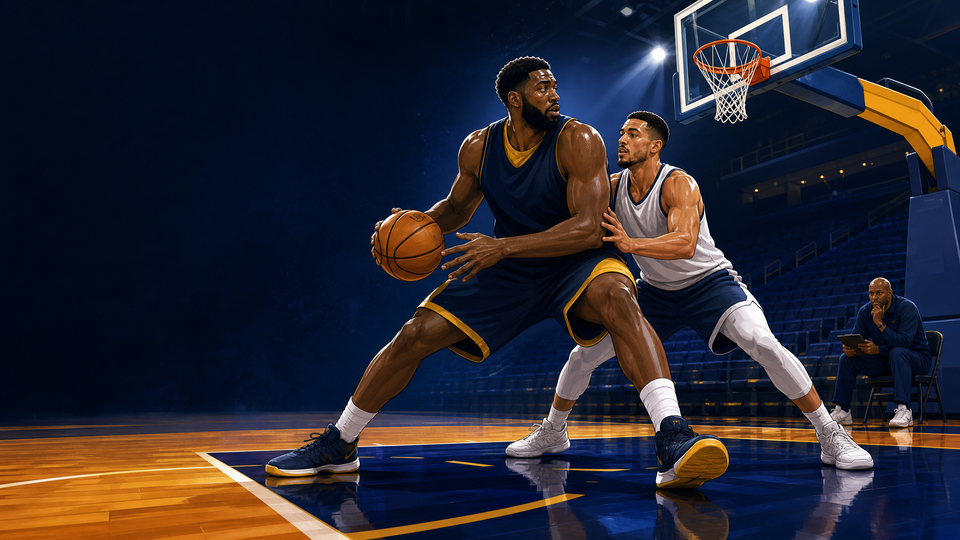
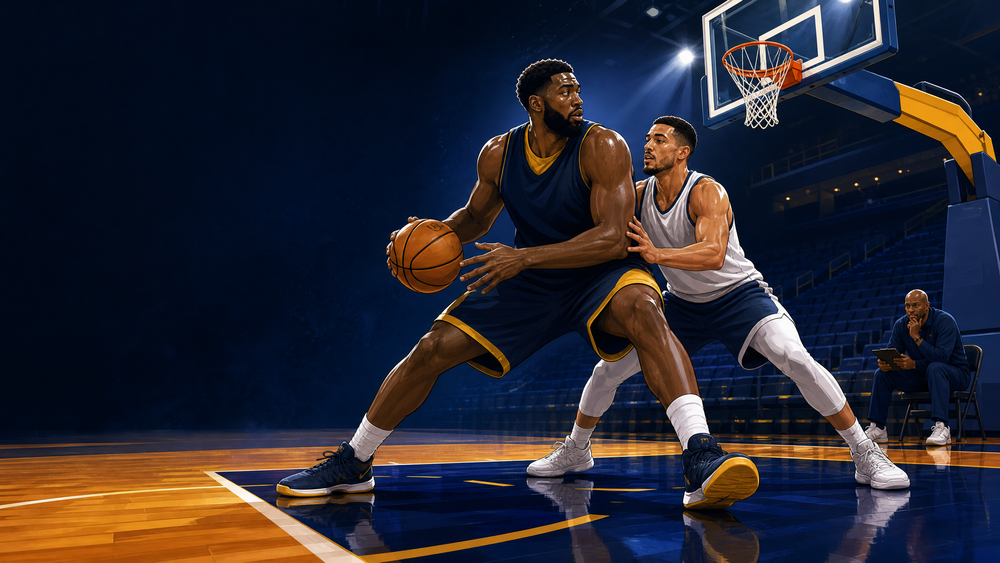
Scoring efficiently from the low block requires more than just size; it demands precise footwork, reading the defender’s leverage, and decisively exploiting the resulting gaps. The Low Block Mastery drill is a progressive, high-repetition sequence designed to teach your centers and power forwards how to establish deep post position, read the defense upon the catch, and execute two foundational moves: the baseline drop-step and the middle step-through counter.
By running this drill regularly, coaches can help players eliminate wasted dribbles, protect the basketball under pressure, and finish through contact at the rim. It is highly effective when introduced during early-season skill development and remains a staple for pre-practice big-man workouts throughout the year.
Setup
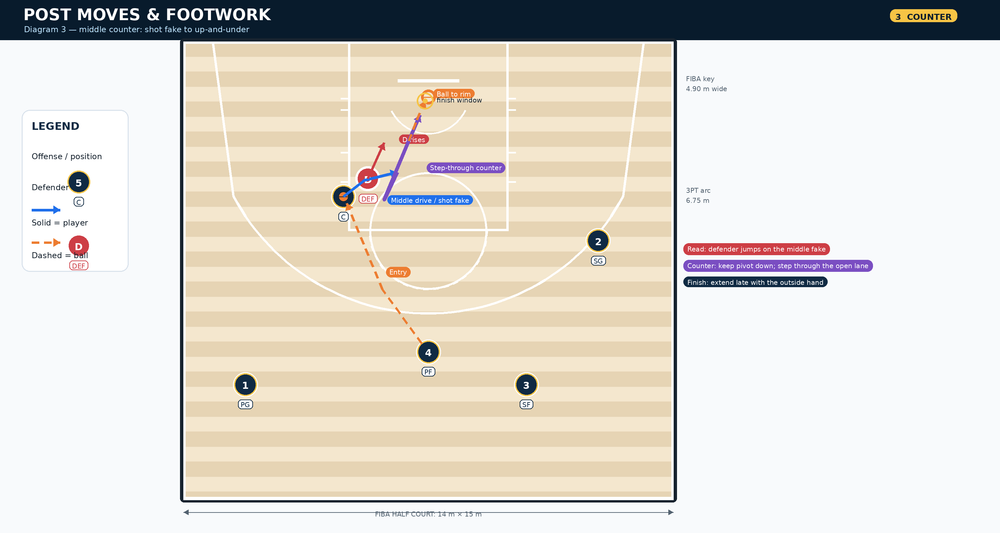
To run this drill efficiently, you will need a standard FIBA half-court (14m x 15m), one basketball per pair, and optional contact pads to simulate game-like physicality. This half-court layout is based on the official 28m x 15m full-court standard. 1
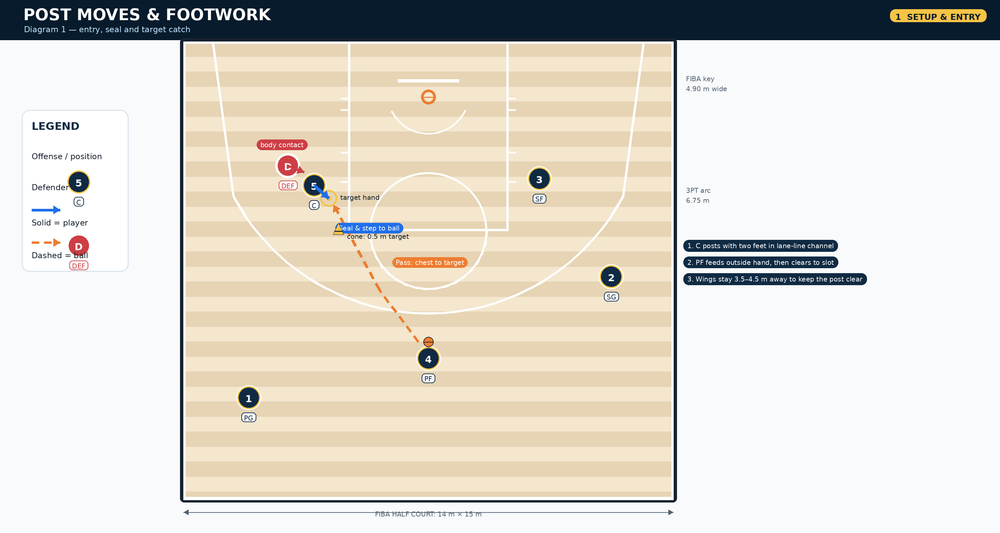
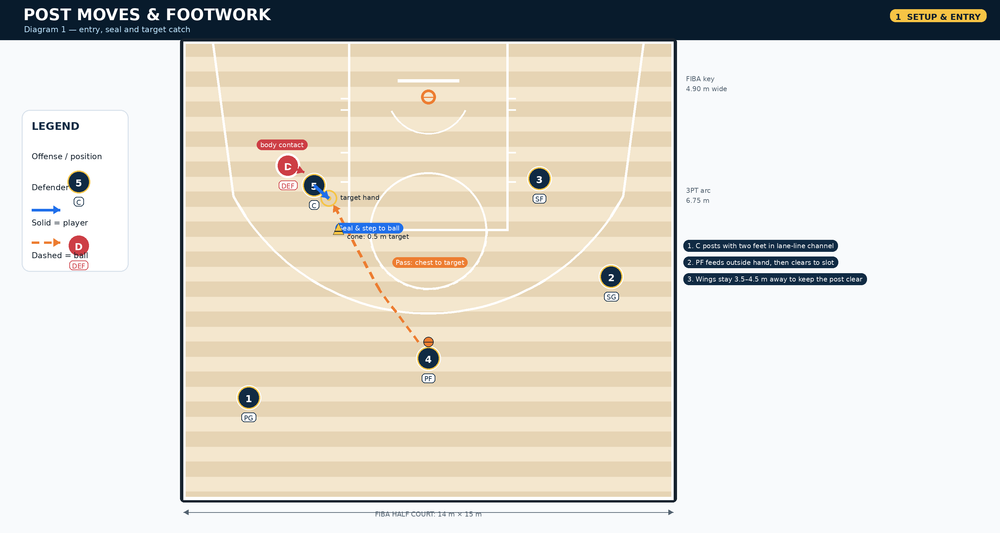
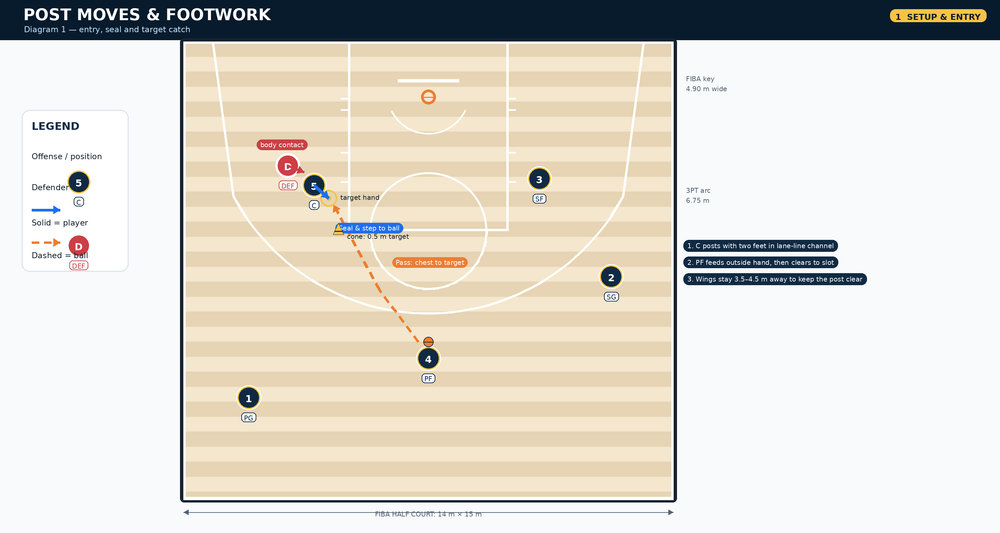
Assign players into pairs—one offensive player (the 5 or 4) and one defender—and place them on the low block. A coach or a perimeter player (the 1, 2, or 3) should start with the basketball on the wing, approximately free-throw line extended, to act as the entry passer. Ensure the rest of the offensive players maintain functional spacing, staying 3.5 to 4.5 meters away to keep the post clear. Place a cone 0.5 meters above the block to give the offensive player a physical target for their seal.
Step-by-Step Instructions
Phase 1: The Entry and Seal
- The offensive post player begins slightly above the low block, reading the defender's position.
- As the wing player readies the entry pass, the post player steps forcefully to the ball, establishing a wide, balanced stance with both feet in the lane-line channel.
- The post player seals the defender on their high (middle) hip, presenting a clear target hand to the passer.
- The wing delivers a crisp chest or bounce pass to the target hand. The post player catches the ball with two hands, immediately chinning it to protect against digging guards.
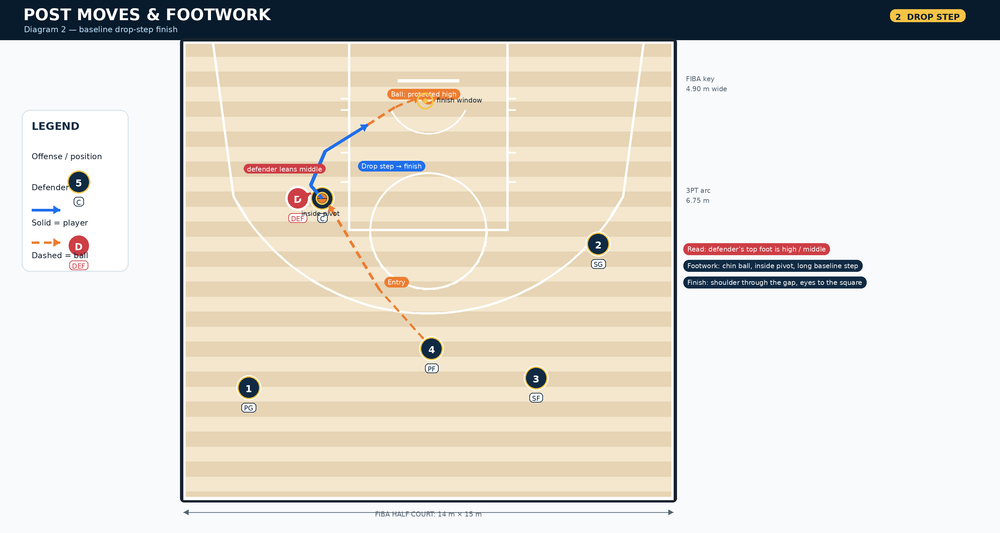
Phase 2: The Baseline Drop-Step
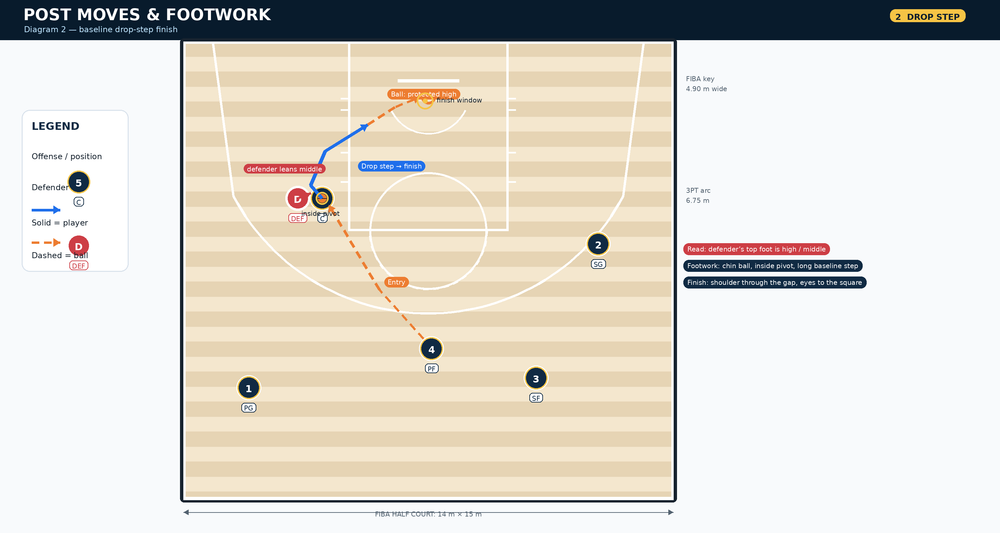
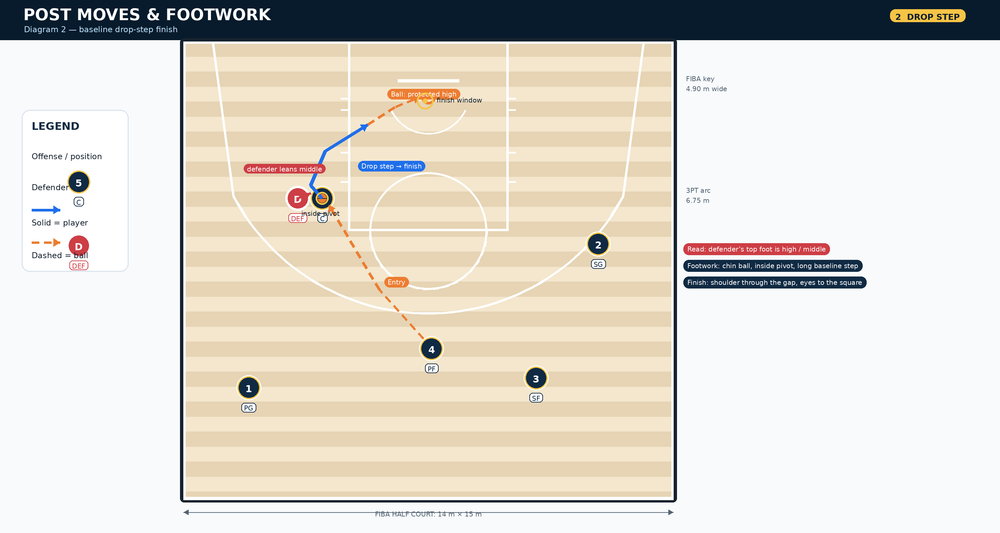
- Upon catching the ball, the offensive player checks their inside shoulder to read the defender. If the defender is leaning middle or playing high on the top foot, the baseline is open.
- The offensive player establishes their inside foot (the foot closest to the middle of the floor) as the pivot foot.
- They execute a long, explosive drop-step with their baseline foot, swinging their outside shoulder past the defender's hip to seal them off.
- Without putting the ball on the floor, the player powers up off two feet, keeping the ball protected high and away from the defender, and finishes strong off the glass.
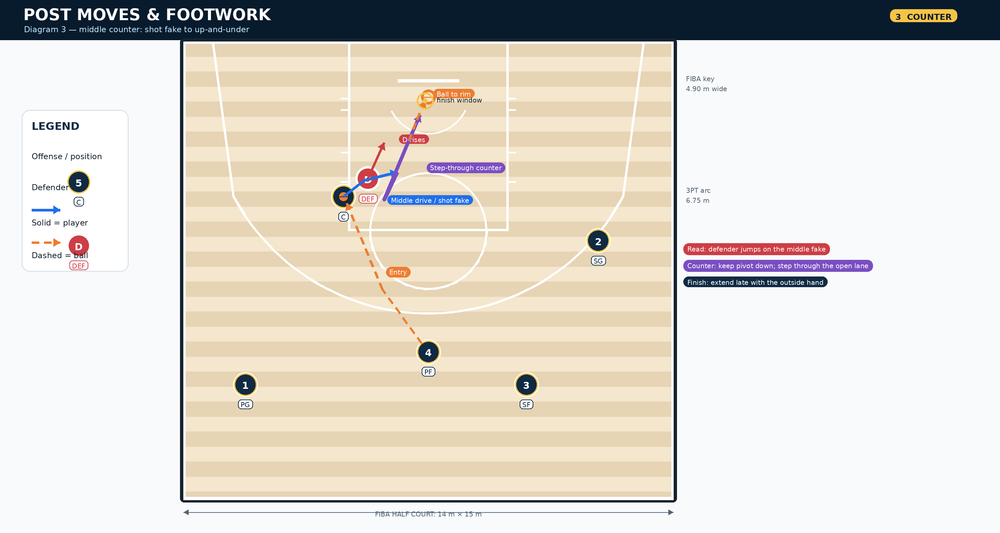
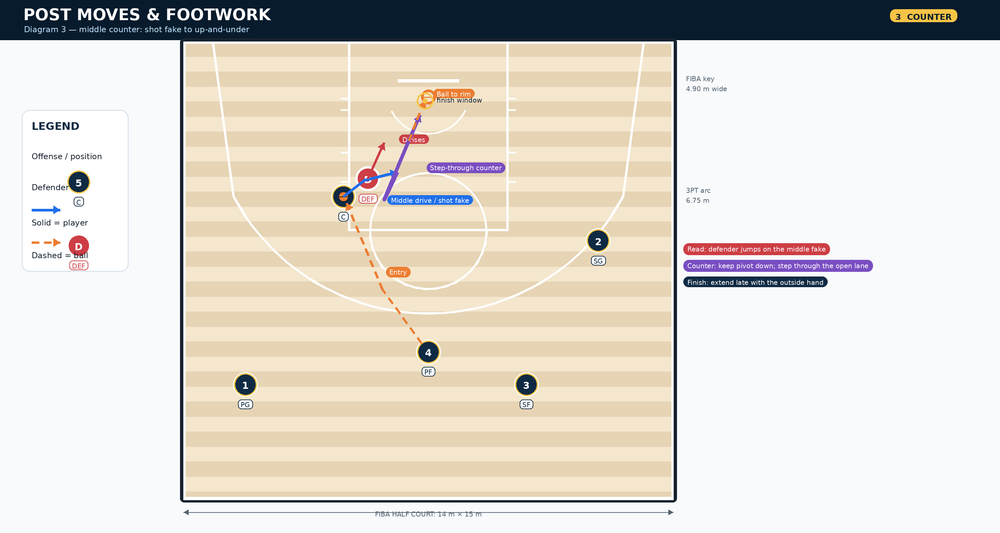
Phase 3: The Middle Step-Through Counter
- The drill resets with the same entry and seal. This time, the defender is instructed to aggressively jump the baseline drop-step or overplay the middle drive.
- The offensive player catches the ball and executes a hard, convincing shoulder and ball fake toward the middle of the floor, selling a jump hook or middle drive.
- As the defender rises or shifts their weight to contest the fake, the offensive player keeps their inside pivot foot planted firmly on the floor.
- They step through the newly created gap on the baseline side with their non-pivot foot, keeping their hips low and driving their shoulder past the recovering defender.
- The player extends late with their outside hand, using the rim for protection, and finishes the reverse layup or power finish.
Key Coaching Points
- Win the space before the catch: The move begins before the ball arrives. Players must fight for position, get wide, and step to the pass rather than waiting for it to reach them.
- Chin the basketball: Immediately upon catching the entry pass, players must bring the ball to their chin with elbows out. This protects the ball from guards swiping down and prevents the defender from tying them up.
- Read the top foot: Teach players to feel the defender's leverage. If the defender's top foot is high, drop-step baseline. If the defender plays flat or jumps the baseline, counter middle.
- Low man wins: On the step-through counter, the offensive player must stay low. Popping up during the fake ruins the leverage needed to explode past the defender's hip.
- Finish through the chest: Encourage players to initiate contact on the finish. Taking the ball directly into the defender's chest neutralizes their shot-blocking ability.
Common Mistakes
- Putting the ball down unnecessarily: Many young post players instinctively dribble immediately upon catching the ball. This allows the defense to recover and invites double-teams. Emphasize that these moves require zero dribbles.
- Narrow base on the catch: Catching the ball with feet close together destroys balance and allows the defender to push the offensive player off the block. Demand a wide, athletic stance.
- Faking with the head only: A shot fake that doesn't move the ball or the shoulders will not lift a disciplined defender. The fake must look exactly like the first motion of an actual shot.
- Exposing the ball on the finish: Swinging the ball out wide during the drop-step or step-through exposes it to the trailing defender. The ball must be kept tight to the body until the final extension at the rim.
Variations & Progressions
- Add a live dribble: Once the footwork is mastered, allow the offensive player one power dribble to get deeper into the paint before executing the drop-step or step-through.
- Introduce a double-team: Have a perimeter defender dig down on the catch. The post player must read the double-team, protect the ball, and either make a quick move before the trap arrives or pass out to the open shooter.
- Contact pads: Coaches can use heavy contact pads to bump the offensive player during the catch, the pivot, and the finish, forcing them to maintain balance and focus through physical play.
Age Adaptations
- Under 10 / Under 12: Focus entirely on the footwork without a defender. Use cones or spots on the floor to dictate where the pivot and drop-step should land. Emphasize catching the ball with two hands and finishing off the glass.
- Under 14 / Under 16: Introduce guided defense where the defender intentionally gives up the baseline or the middle to help the offensive player practice reading leverage. Emphasize chinning the ball and eliminating the unnecessary dribble.
- Open / Advanced: Play live one-on-one from the catch. Allow the defender to fight over the top, front the post, or play physical behind. The offensive player must secure the catch, read the live defense, and score using the appropriate move or counter.
References