Dodge, Lead and Re-offer: A Netball Timing Drill for WA, C and GA
A progressive 22-minute attacking drill that teaches WA, C and GA to create separation, time a lead and re-offer safely against live pressure.
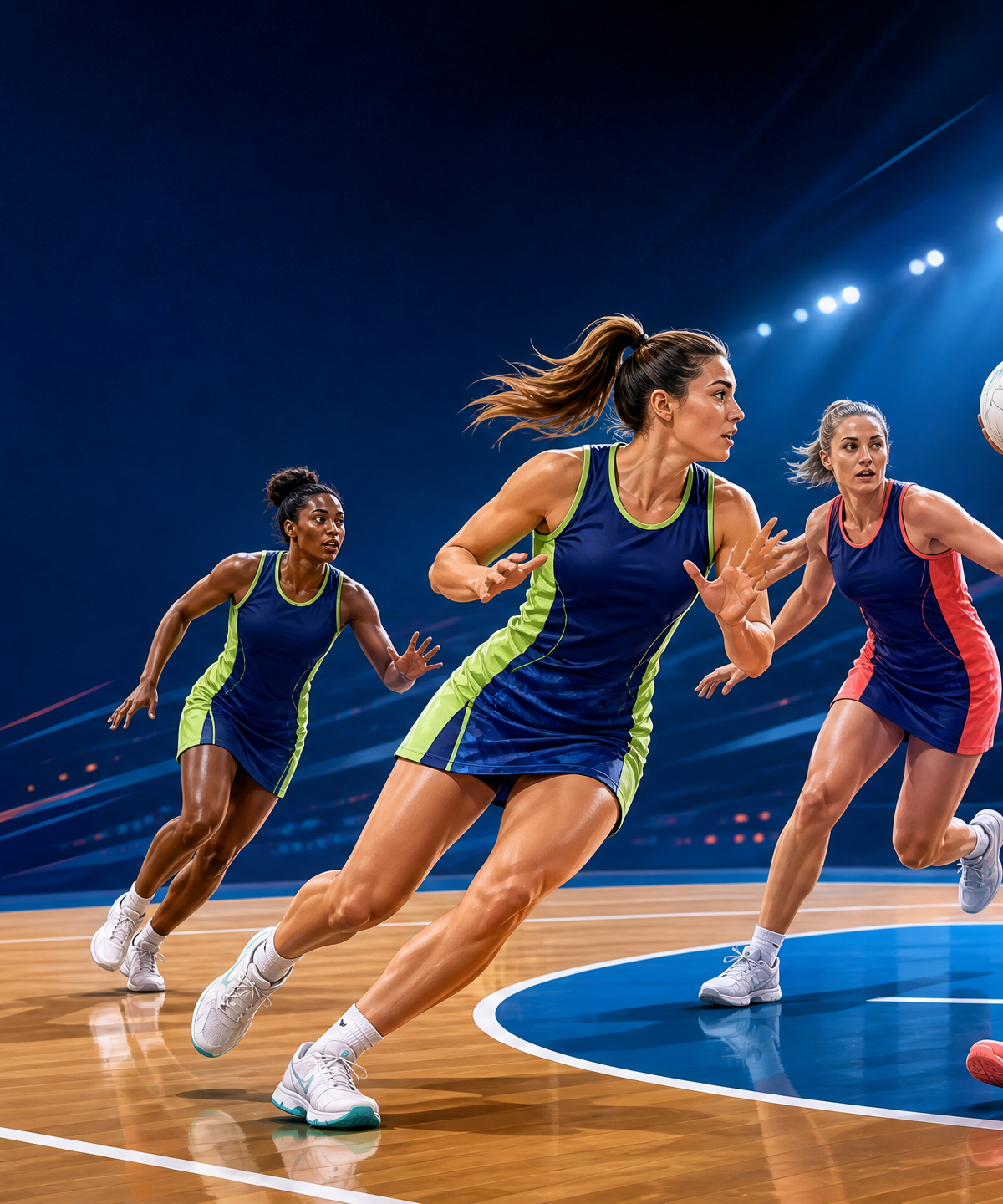
Equipment Needed
Overview
This is a high-repetition attacking pattern drill for teaching players to win a passing lane rather than simply run into space. It develops the sequence every coach wants to see through the midcourt: dodge to move the defender, plant, accelerate into a lead, receive with balance, then re-offer if the first option closes. The core unit is 1 WA, 2 C and 3 GA against 4 WD and 5 GD, with spare players rotating in. Use it early in an attacking block to establish quality footwork and timing, then bring it back later in the season as a decision-making progression.
| Session outcome | What success looks like |
|---|---|
| Create separation | WA moves WD before committing to the lead. |
| Improve pass timing | C releases when WA changes speed, not when WA first moves. |
| Build the re-offer | WA clears after the catch and presents a second safe option. |
| Transfer to match play | GA receives a balanced feed with GD displaced or delayed. |
Setup
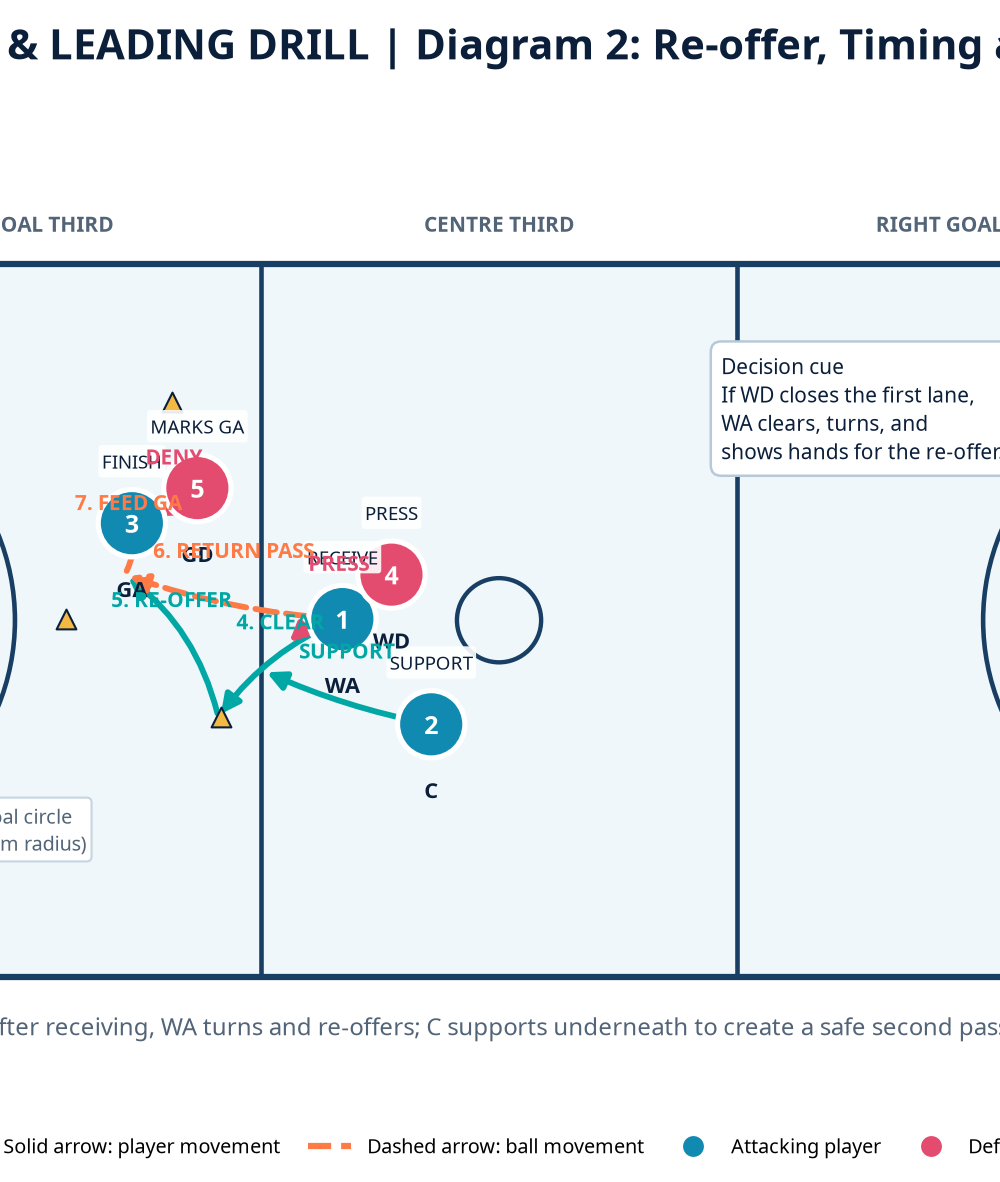
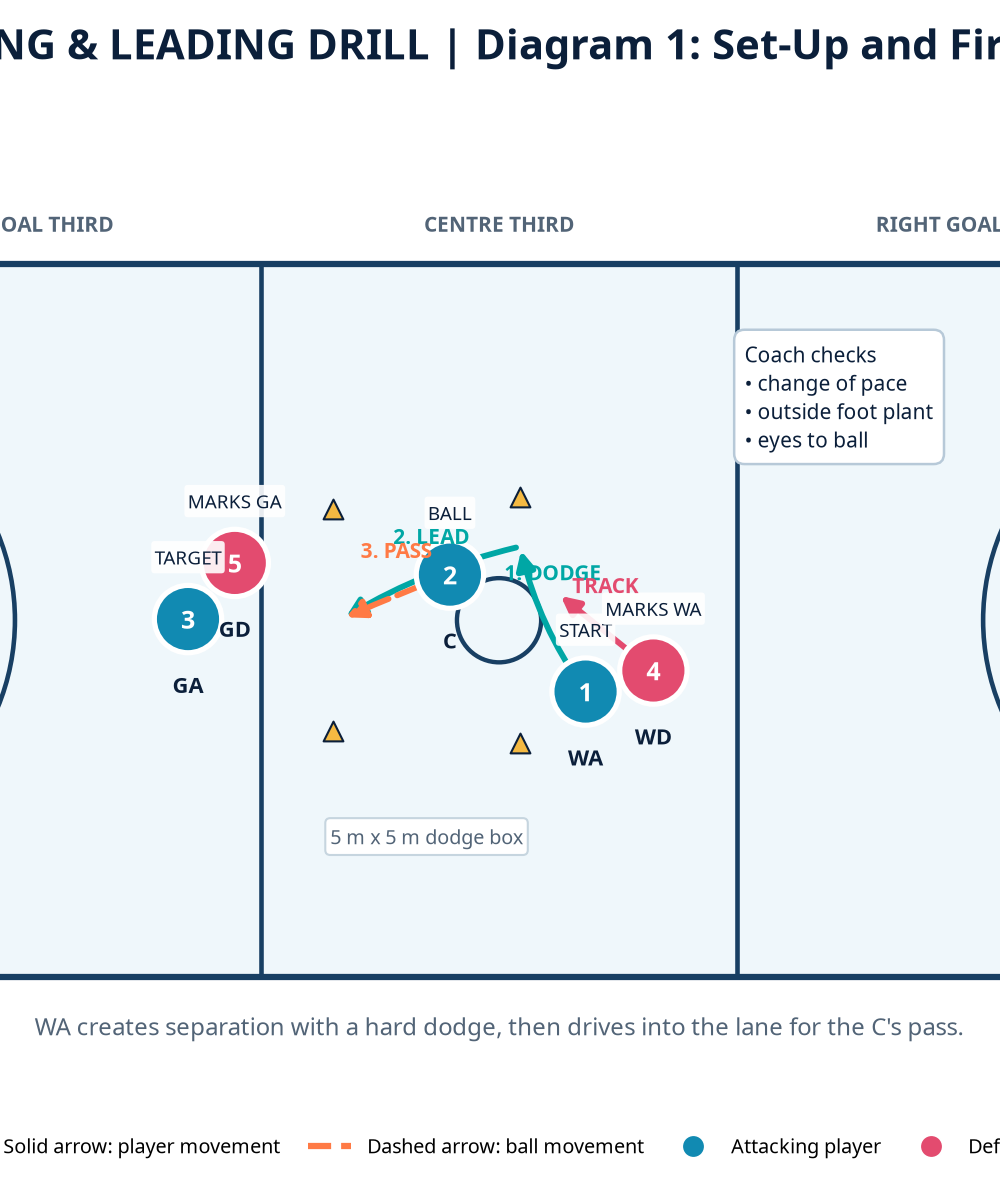
Mark out the full court so players can see the transverse lines, centre circle and goal circles. The working area is the left goal third and left half of the centre third; reverse the pattern on the opposite side after each block. Put four flat cones in a 5 m x 5 m dodge box in the centre third, approximately 1.5 m from the attacking-third transverse line. Place a fifth cone 3 m into the attacking third to indicate WA’s preferred first receiving lane. Place a sixth cone 2 m to the side of that lane as the re-offer cue.
Start 1 WA at the back-right corner of the dodge box, with 4 WD 1.2 m goal-side and slightly inside to deny the direct route. Position 2 C 4 m behind and to the ball-side of WA with the ball. Set 3 GA just outside the goal circle edge, 3 m to the side of the post, with 5 GD in a legal marking position. Use ten players where possible: five are active, three collect loose balls and two queue as immediate replacements. With a smaller squad, work in groups of five and rotate the defenders after every three repetitions.

Coach’s set-up check: The first pass must be short enough to reward a sharp lead, not a hopeful lob. If C can pass without WA moving the defender, narrow the starting gap or bring WD closer.
Step-by-Step Instructions
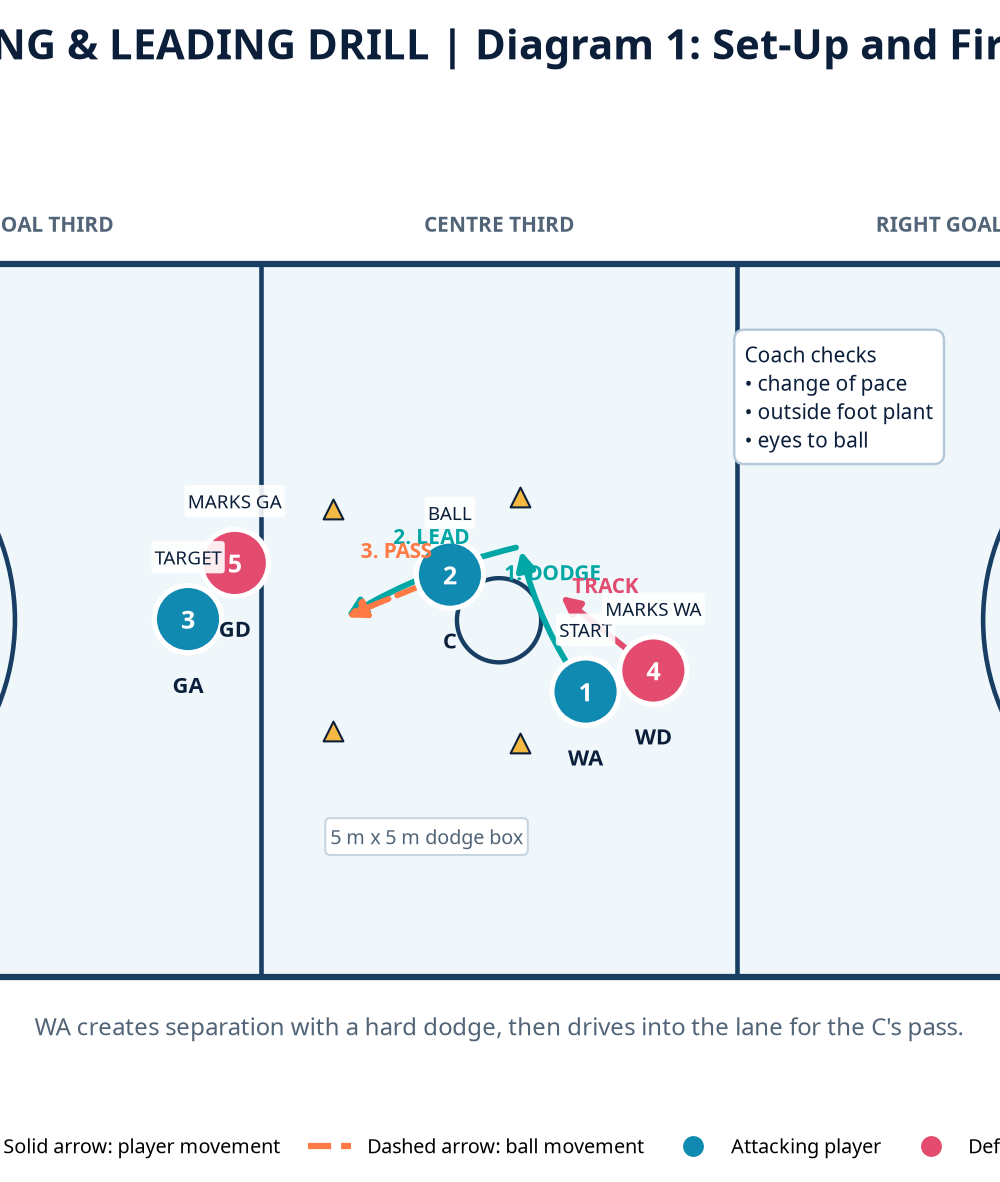
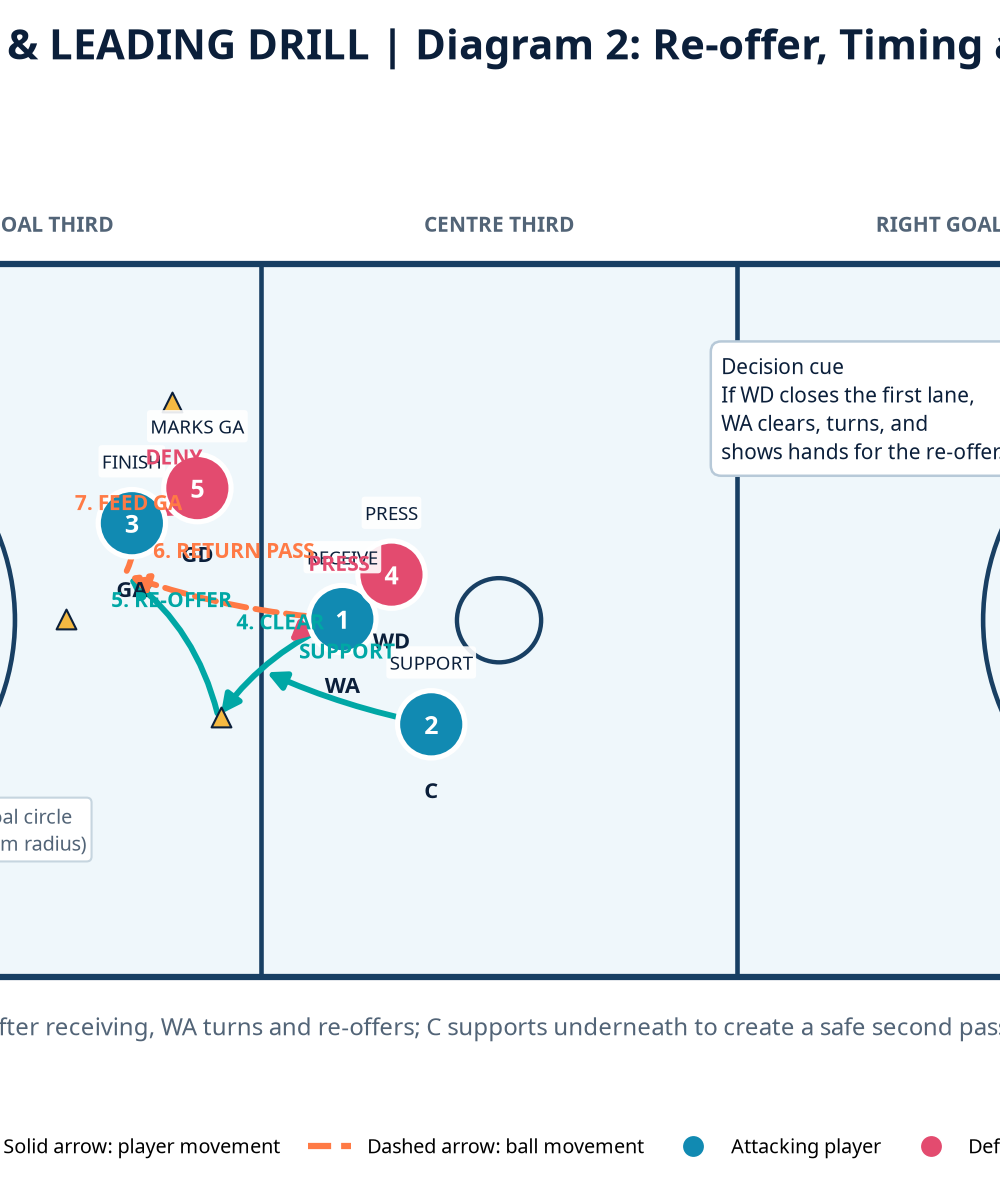
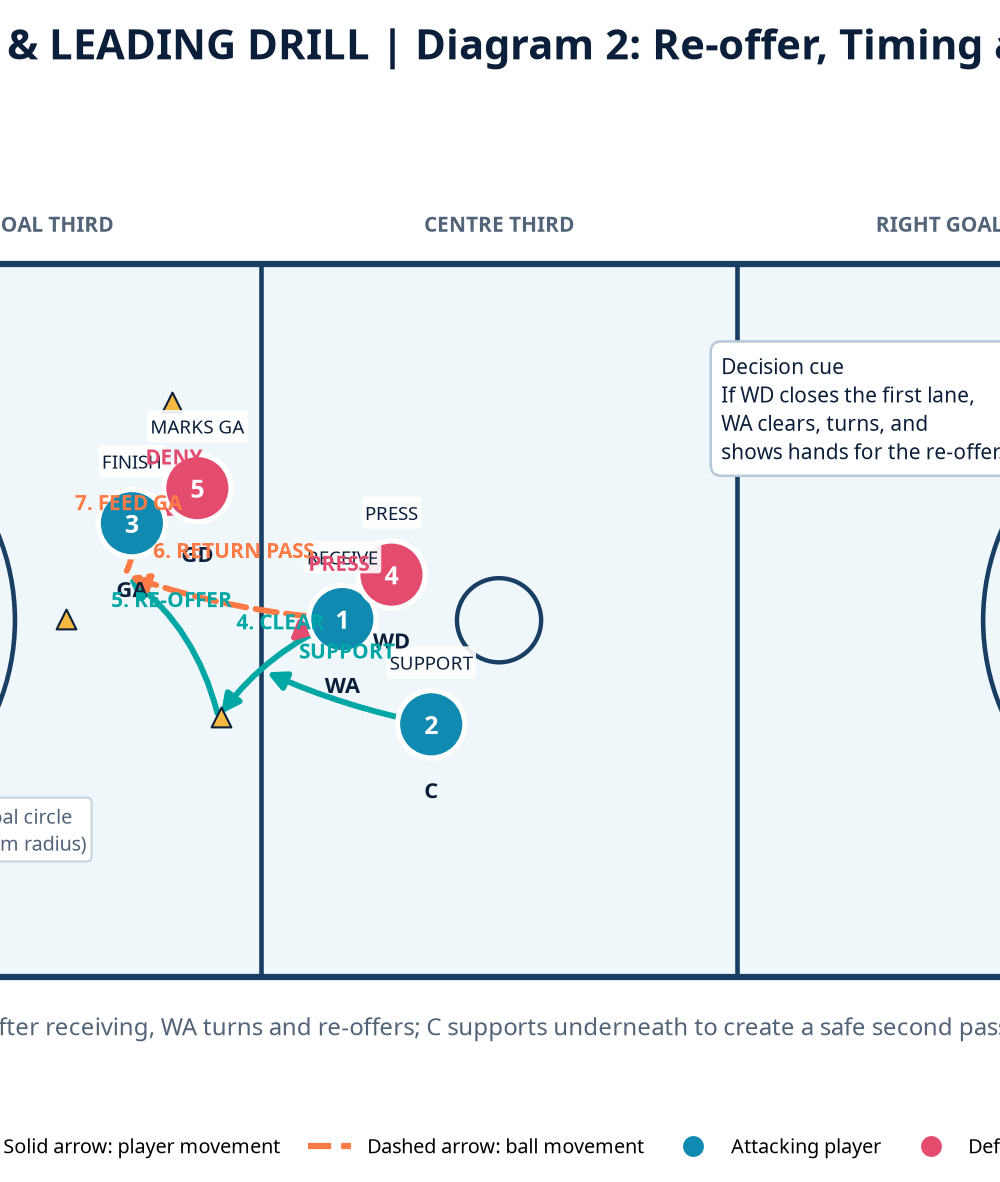
Set the picture. C holds the ball and scans. WA stands tall, watches WD’s hips and gives a clear hand signal only after deciding which way to move. WD begins in a realistic deny position; no passive shadowing. GA stays available but does not drift into WA’s first lane.
Dodge before leading. On C’s call of “go”, WA makes a sharp 1.5–2 m dodge across WD’s front or toward the sideline. The purpose is to shift the defender’s feet, not to receive the ball. WA plants on the outside foot with hips low and eyes returning to C.
Explode into the lead. WA changes pace and drives diagonally through the cone lane toward the attacking third. The lead should be 4–6 m, with hands shown early and fingers pointing to the ball. C adjusts their feet to keep a passing shoulder open and releases a firm chest or shoulder pass into WA’s path, not behind the runner.
Land and protect. WA receives with two hands, lands balanced and turns the body side-on to protect the ball. Count the first second aloud in early repetitions. WD applies hands-over pressure without contact; the aim is to make the catch realistic while preserving safety.
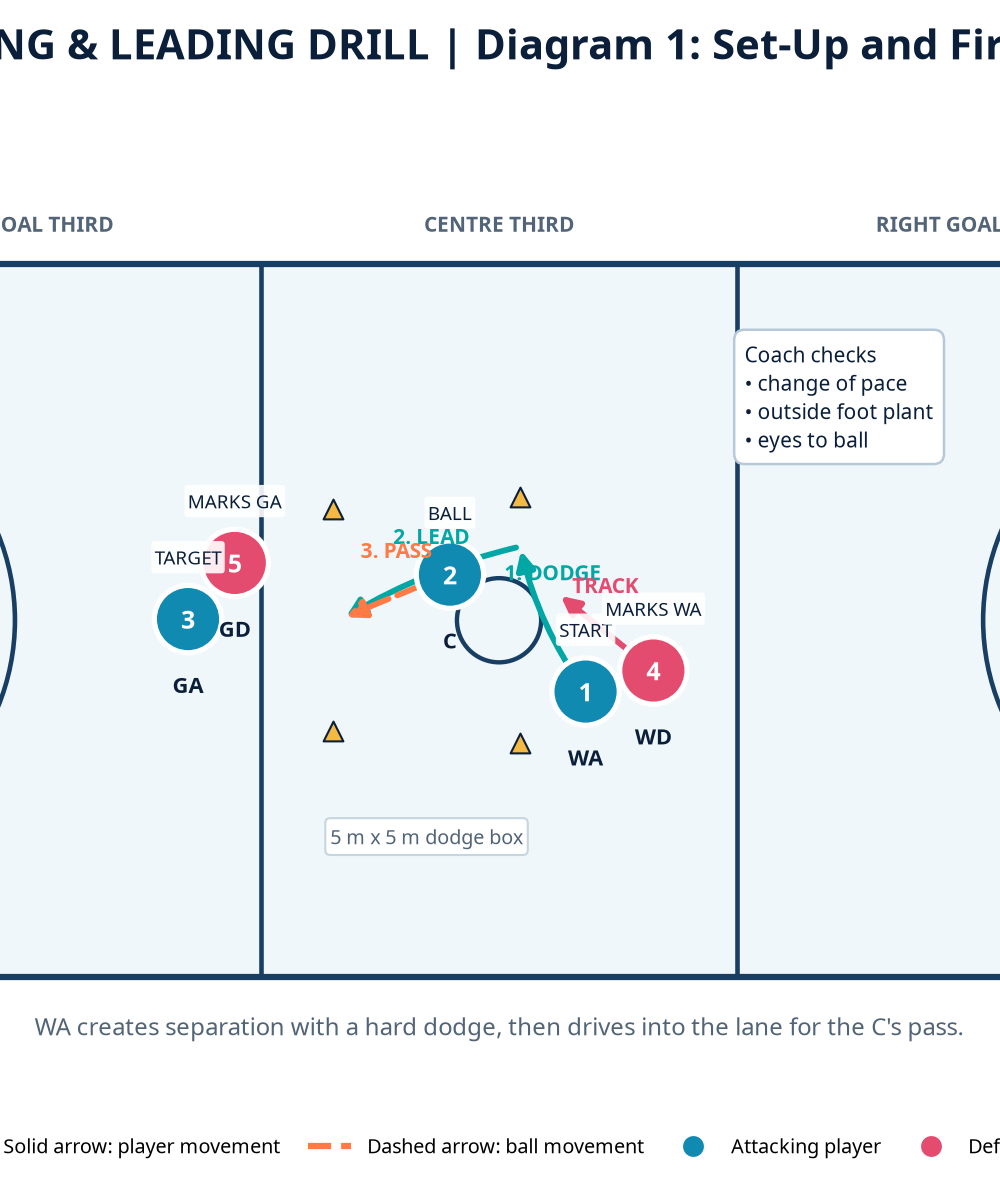
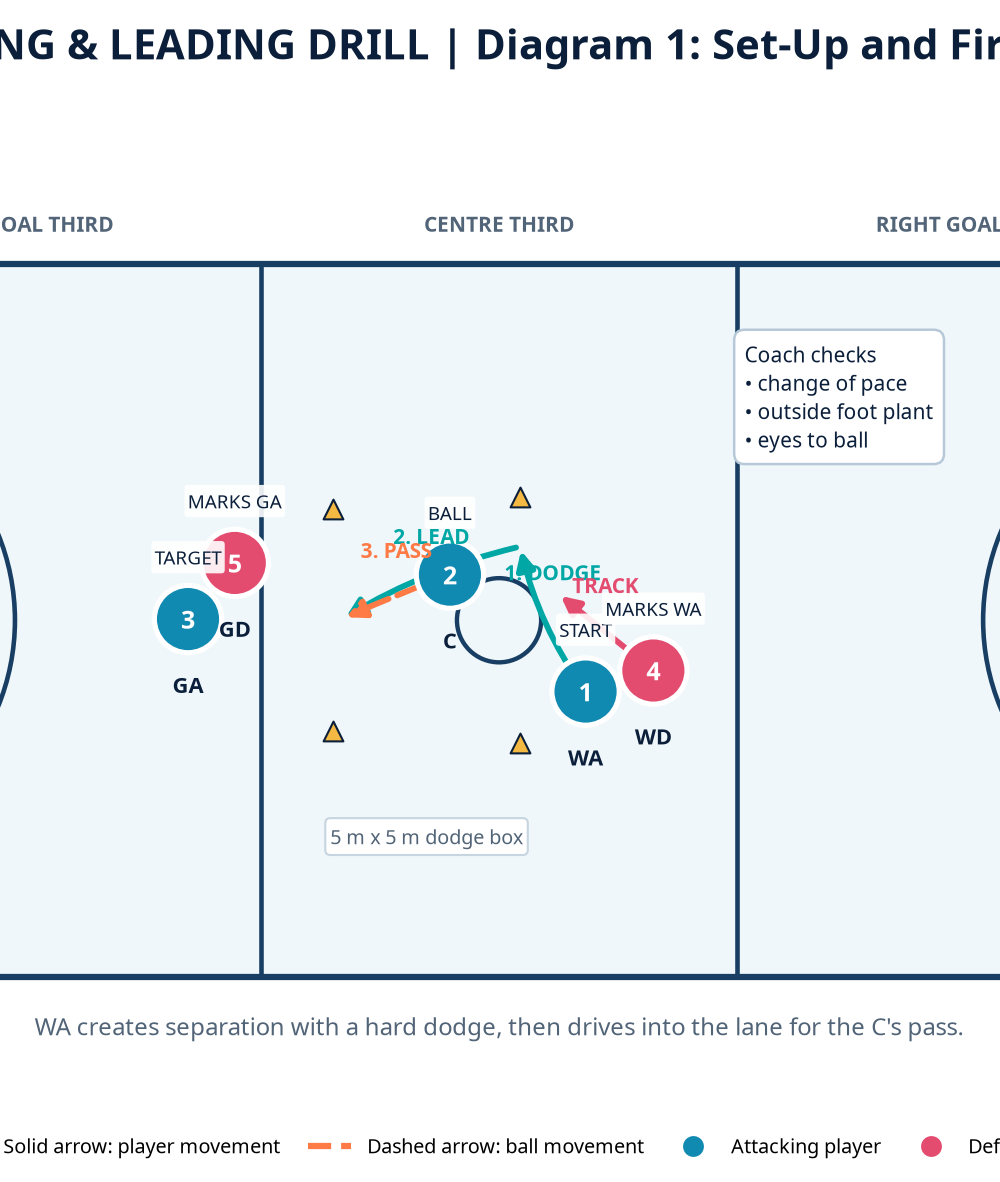
Clear and re-offer. WA does not freeze after the catch. If GA is not immediately free, WA passes back to C, clears 2–3 m away from the ball line, plants and turns back into the re-offer lane. C tracks underneath, creating a short, safe option rather than watching the play.
Return pass and feed. C receives, scans the new angle and returns the ball to WA as WA shows hands. WA then feeds GA only when GA has a lead and GD is not body-to-body in the passing line. If that feed is not on, C restarts the pattern; do not force a speculative ball into the circle.
Reset with purpose. Award one point for a clean WA catch in the first lane, one for a controlled re-offer, and one for a legal GA feed. Rotate WA to C, C to GA, GA to WD and WD to the queue every three balls. Run three 90-second bouts with 45 seconds for coach feedback and water.
Key Coaching Points
| Coaching focus | Head-coach cue | What to watch for |
|---|---|---|
| Sell the dodge | “Move her feet first.” | The dodge is sharp and purposeful, not a slow curve. |
| Win with change of pace | “Slow–plant–go.” | WA has a visible acceleration after the plant. |
| Time the release | “Pass to the second step.” | C waits for WA to break clear before releasing. |
| Present early | “Hands first, then voice.” | WA’s hands are a target before the ball travels. |
| Re-offer with discipline | “Clear, turn, show.” | WA creates a second passing angle instead of crowding C. |
| Protect the landing | “Strong base, soft knees.” | Receiver is balanced and does not step into contact. |
Common Mistakes
| Common error | Why it breaks down | Immediate correction |
|---|---|---|
| WA runs before moving WD. | The defender simply follows the obvious line. | Freeze the picture and require one decisive dodge before every lead. |
| C passes on WA’s first movement. | The ball arrives while WA is still covered. | Have C say “wait” and release only on WA’s acceleration. |
| WA catches square and stationary. | The next pass becomes slow and vulnerable. | Mark a receiving lane and insist on a side-on, balanced landing. |
| C watches after passing. | The re-offer has no short support. | Give C a support-cone target after every release. |
| GA drifts into WA’s lane. | Two attackers bring one defender to the ball. | Keep GA wide of the first lane until the return pass. |
Variations & Progressions
1. Easier: guided defender. Make WD a tracking defender for the first 60 seconds. WA calls the direction of the dodge before the ball starts, giving less experienced players time to rehearse the footwork and timing.
2. Harder: live 5-second decision. Once WA receives the first pass, start a five-second coach count. The unit must either complete the re-offer and GA feed or recycle safely to C. WD and GD are live and may intercept. This demands quicker scanning without encouraging rushed, low-percentage passes.
3. Match-transfer: two-lane choice. Add a second WA receiving cone on the opposite side of the court lane. C calls “inside” or “outside” late, and WA must read WD’s position rather than running a pre-set route. Award a bonus point when the attacking unit chooses the open lane and keeps legal spacing.
Age Adaptations
| Group | Adaptation | Coaching priority |
|---|---|---|
| Under 8–Under 10 | Use a 3 m x 3 m dodge box, no live defence for the first block, and five-metre leads. | Stop safely, show hands and pass accurately. |
| Under 12–Under 14 | Use the full 5 m x 5 m box, live WD after two rehearsals, and a simple re-offer. | Change pace and make the second option available. |
| Under 16–Open | Add live GD, a five-second decision clock and an intercept reward for defenders. | Read defenders, protect possession and choose the highest-value feed. |
Finish with one 3-minute competitive block. Give the attacking group three points for a clean first catch, re-offer and GA feed; give defenders one point for an intercept or forced reset. Stop only for a clear learning moment, then let the players solve the timing under pressure. This is where the drill becomes match-relevant: the goal is not a perfect pattern, but attackers who can move defenders, create a lane and offer again when the first picture changes.