

Netball
Penalty Pass Advantage Play: Inside WA Release to Circle Entry
Coach a repeatable penalty-pass pattern that uses the infringer’s temporary exclusion to free WA inside, create a clean second pass to GA, and feed GS goal-side.
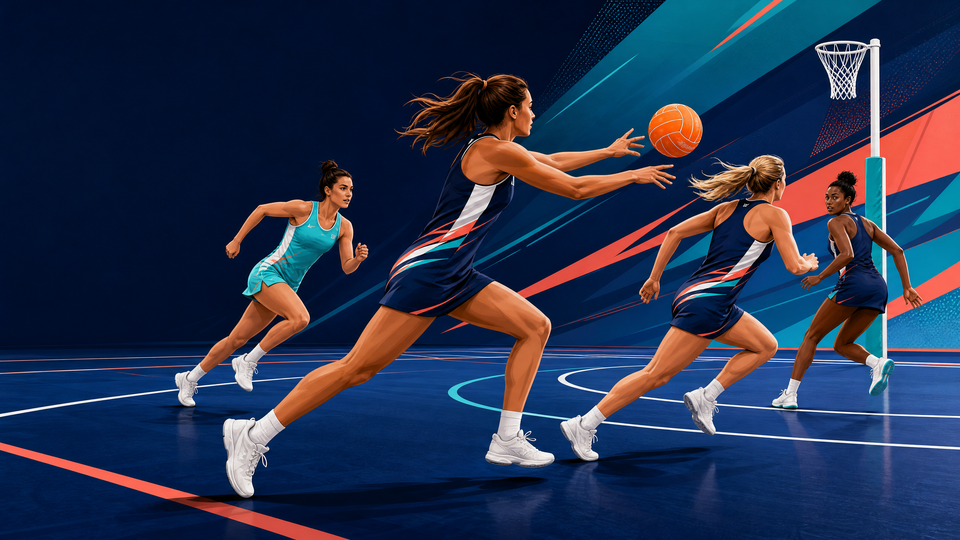
What you need
1 regulation netball, 8 flat marker cones, 2 bib colours, 1 whistle, 1 full netball court or marked attacking third
Overview
This is a designed penalty-pass restart for an attacking unit that has been awarded a penalty pass just inside the attacking goal third, close to the centre-third transverse line. The play turns a stoppage into a short, rehearsed attacking window: C uses the mark, WA wins the inside lane, GA clears GD away from the next passing lane, and GS re-sets goal-side for a high-percentage feed. It is particularly useful after repeated defensive contact or obstruction in transition, when the opposition is still trying to re-match.
Rules anchor: the infringer must stand out of play, remain there, and not take part until the ball has been released. A correctly positioned player may also choose to play a penalty pass immediately. 1
Use this penalty-pass set-up purposefully. Create a 2–3 m inside lead for WA, then play the next pass before the defence recovers. The diagrams use the official 30.5 m × 15.25 m court, three equal thirds, and 4.9 m-radius goal circles. 2
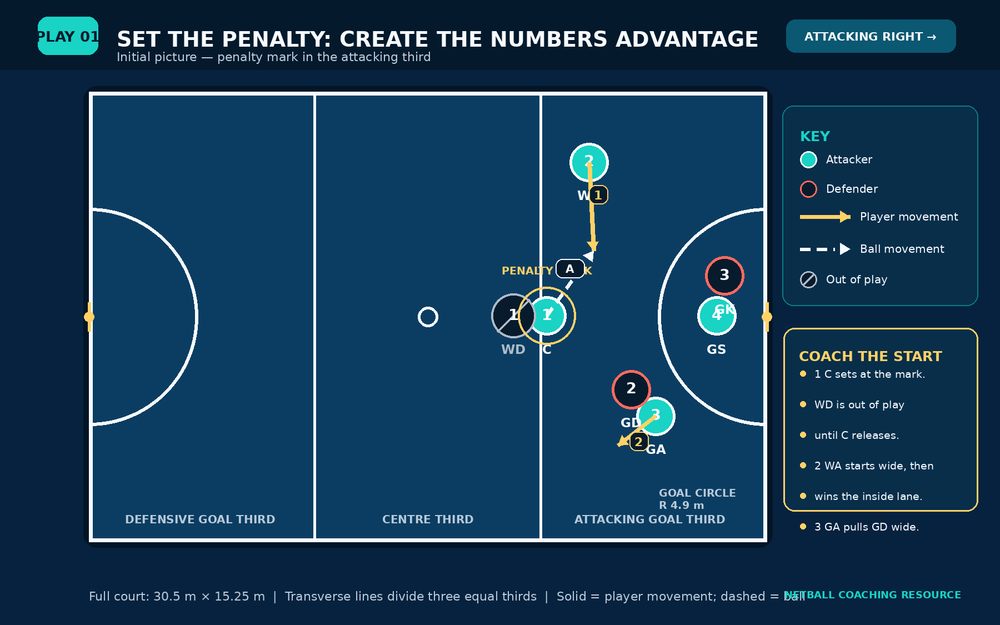
Setup
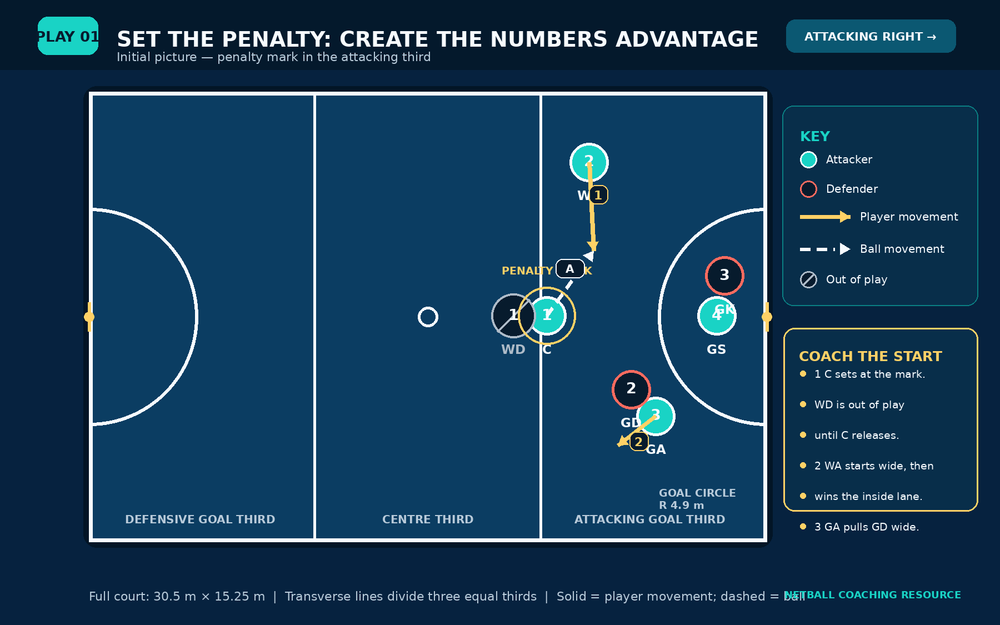
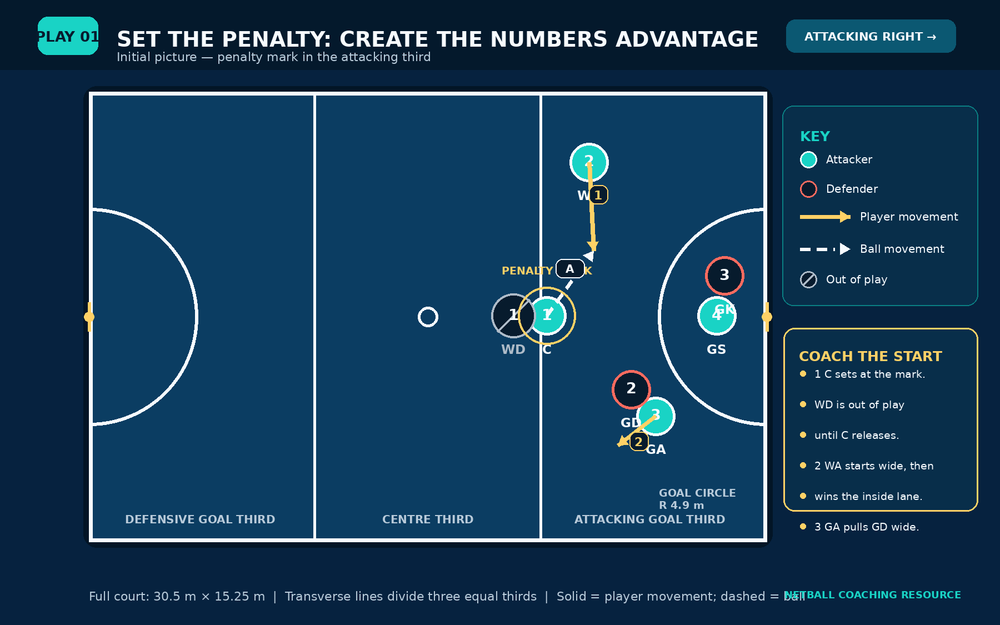
Use the right-hand goal end as the attacking end. Put the penalty mark 0.5 m inside the attacking goal third, on the centre corridor: that is approximately 20.8 m from the left goal line on a 30.5 m court. C (Player 1) takes the penalty. WA (Player 2) begins 2.5 m from the near sideline and 2.2 m inside the attacking third. GA (Player 3) begins about 5.0 m from the far sideline and 4.8 m from the goal line, while GS (Player 4) starts just outside the goal circle on the post side, roughly 2.0 m from the goal line.
Set WD beside but away from C to represent the infringer. Place GD on GA’s shoulder and GK between GS and the post. Mark the WA start, WA catch point, GA receive point, and GS landing zone with four flat cones. This creates a seven-player picture: C, WA, GA, GS, WD, GD and GK. The ball starts with C.
| Role | Starting responsibility | Exact coaching cue |
|---|---|---|
| C / 1 | Set at the penalty mark and scan early. | “Eyes up, feet quiet, release to movement.” |
| WA / 2 | Hold width, then drive across C’s vision. | “Wide first, hard inside second.” |
| GA / 3 | Clear GD into the far channel before presenting. | “Pull, plant, re-offer.” |
| GS / 4 | Stay goal-side, then show a strong target in the circle. | “See ball, hold space, seal.” |
Step-by-Step Instructions
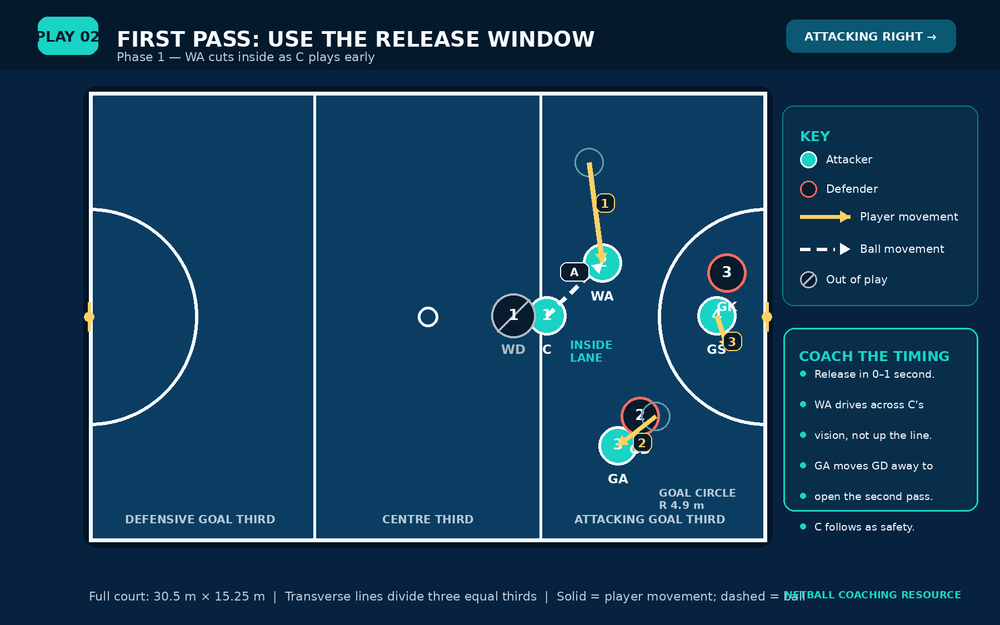
Set the legal picture. C puts the ball at the indicated mark and gets balanced, side-on to WA’s channel. WD moves quickly to the umpire-indicated position beside but away from C and stays out of play until release. C should communicate the trigger with a clear call—“Inside”—rather than a long verbal count.
Create the first advantage. As C is set, WA holds the near-side width for one beat, then drives 3–4 m diagonally inside across C’s eye line. The cut must begin on C’s first shoulder feint, not after C has turned fully. WA catches around 2.5–3.0 m inside the transverse line and lands open to the goal end. C releases within 0–1 second of being set; do not wait for WD to re-engage.
Clear the second-pass lane. Simultaneously, GA makes a purposeful 2 m outward lead toward the far sideline. The goal is not to receive the first ball; it is to draw GD two or three strides away from the middle channel. GS takes one short step to the post side, then re-presents goal-side of GK without crowding GA’s landing space.
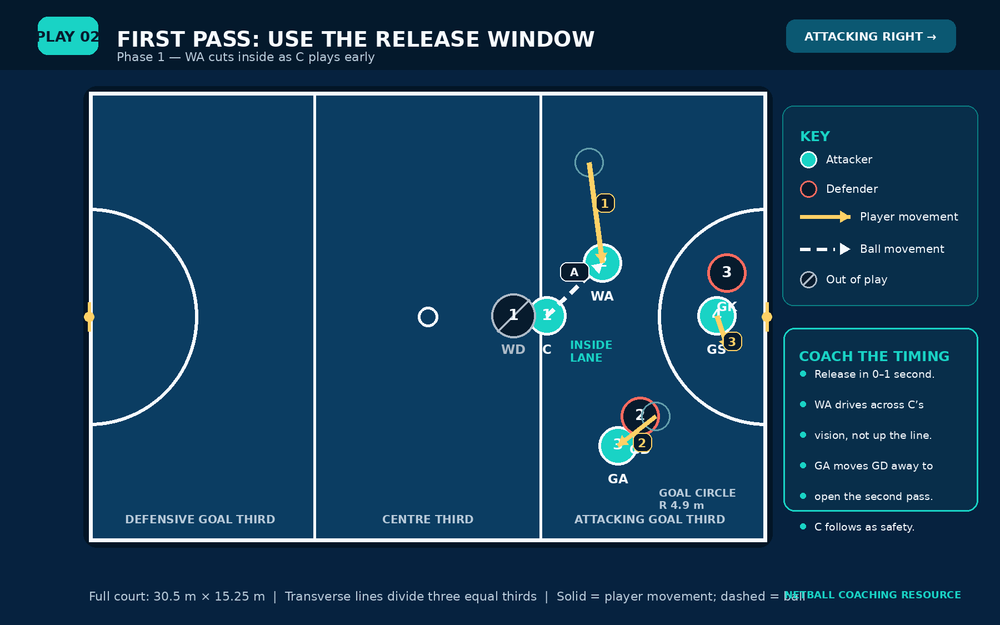
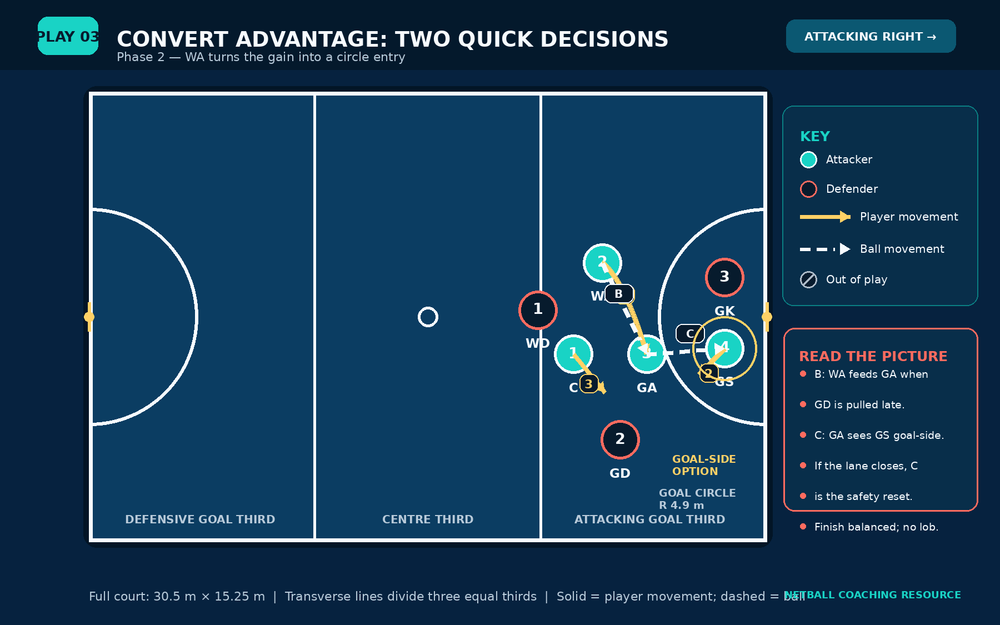
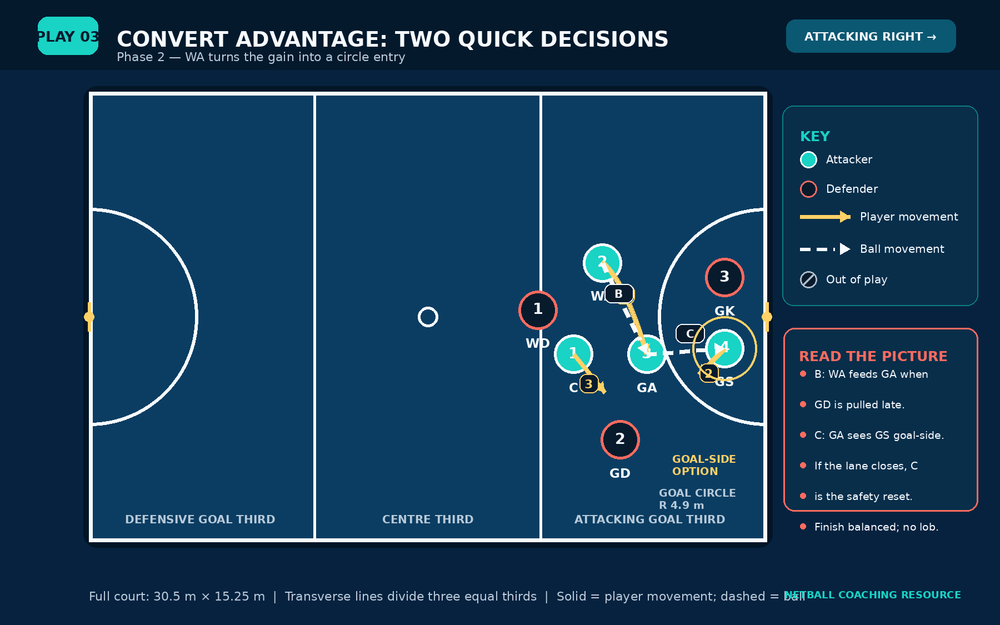
Turn WA’s catch into a decision. WA lands with the outside shoulder already pointed toward GA. Within the three-second possession window, WA reads GD. If GD has followed GA late or is behind the line of ball, WA plays a flat, shoulder-height pass to GA’s re-offer at about 25.0 m down court and 8.5–9.5 m across court. The pass should travel in front of GA’s outside shoulder, away from GD’s reach.
Finish the advantage. GA catches on the move, holds the landing foot, and looks first to GS. GS completes the seal by stepping 1–1.5 m across GK’s front into the goal-side pocket. GA feeds a firm, flat ball to GS’s hands, not a floating lob. If GK has protected the front space or GD has recovered, GA returns the ball to C, who has followed to a 3 m safety pocket outside the circle. The unit then runs normal circle attack rather than forcing the finish.
Key Coaching Points
First, coach the release window, not just the pattern. The value is greatest before the infringer is legally able to participate, so C must recognise the mark and play when set rather than pausing for a perfect picture. Second, WA must change pace: a slow drift is easy to read, whereas a held wide stance followed by one explosive diagonal step makes the inside shoulder available. Third, insist that every receiver lands with the next pass already in sight; C looks at WA’s path, WA opens to GA, and GA sees GS before the ball arrives.
Fourth, protect the space around the circle. GA’s clear lead has purpose only if it moves GD away from the corridor; GA must not drift into GS’s landing lane. Fifth, use flat pass height and early hands. A high ball gives recovering defenders time; a chest-to-shoulder-height pass arrives while the attacking advantage still exists. Finally, use an audible contingency call—“Reset”—so C becomes the automatic safety outlet whenever GA cannot see GS goal-side.
Common Mistakes
| Error | What it looks like | Coach correction |
|---|---|---|
| C waits too long. | WD is ready to defend before the first pass. | Rehearse a 0–1 second release after the set cue. |
| WA cuts straight up court. | WD and GD can see both ball and runner. | Start wide, then cut diagonally across C’s vision. |
| GA chases the first pass. | GD stays in the central lane and blocks WA’s next pass. | Make GA’s first job the clear lead, not the catch. |
| GS crowds the post. | GK can sit between ball and shooter. | Re-present into a 1–1.5 m goal-side pocket with hands early. |
| WA floats the second pass. | GD recovers for an intercept or deflection. | Demand a flat, firm pass to GA’s outside shoulder. |
Variations & Progressions
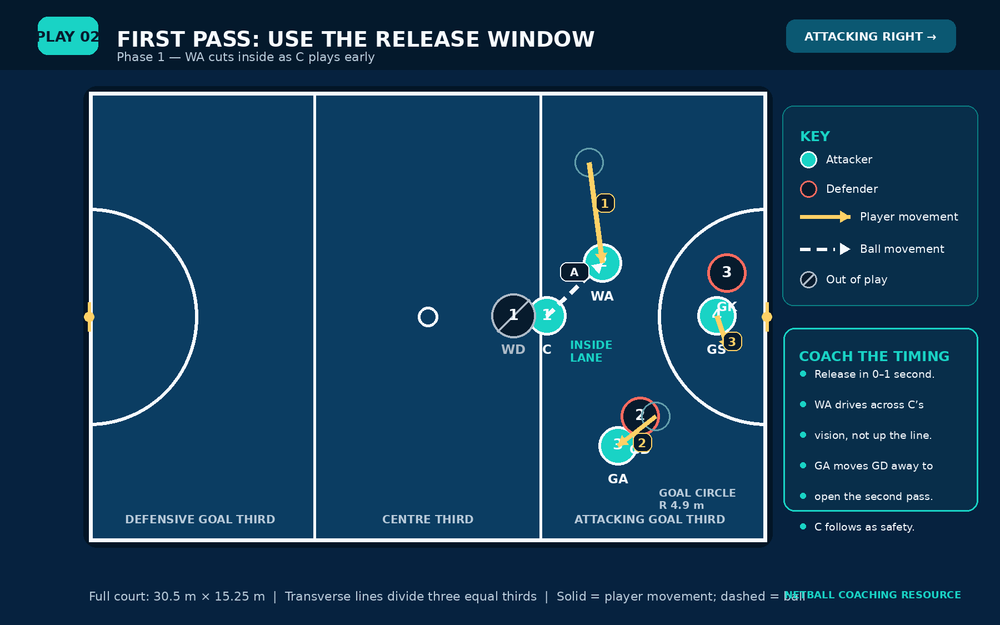
Start with a guided 4 v 0 rehearsal using C, WA, GA and GS. Walk the landmarks, then add a countdown—C must release by “one.” Progress to 4 v 2 by adding passive GD and GK, allowing them to recover only after C’s release. The final game-real version is 4 v 3 with WD, GD and GK live: score one point for a clean GS catch inside the circle and an extra point if the ball reaches GS within three passes.
For a harder tactical variation, move the penalty mark to the near sideline. WA then becomes the safety receiver, while C plays a short inside ball to GA running the middle corridor; GS retains the same goal-side seal. For a defensive-read variation, instruct GD to cheat toward GA. WA must then skip GA and feed GS only if the passing lane is genuinely open; otherwise WA resets to C.
Age Adaptations
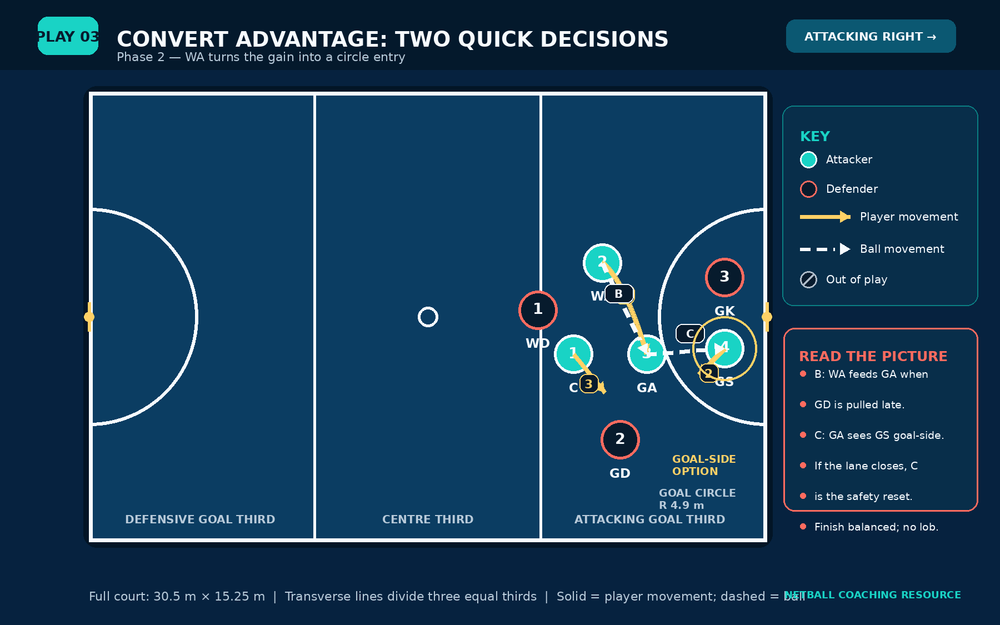
For Under 10, use half-court, remove the live WD, and allow C up to two seconds to identify WA’s run. Use cones to make a 3 m diagonal lane and reward the correct timing more than speed. For Under 12, add passive defenders and require WA to land balanced and face the next pass before playing. For Under 14, use the full seven-player picture and make the 0–1 second release a team standard.
For Under 16 and open athletes, make defenders fully live, vary the location of the penalty mark, and require the attack to call the appropriate branch—GA feed, direct GS feed, or C reset—before the ball reaches WA. Across every age group, keep the teaching language consistent: set quickly, cut inside, clear the lane, play flat, and reset if the goal-side feed is not on.
Session Integration
Run this as an 18-minute block: four minutes to walk the landmarks and legal start, six minutes of escalating opposition, six minutes of live repetitions from varied penalty locations, and two minutes of review. Give the group one measurable target: at least 6 clean circle entries from 10 attempts, with no forced lob and no offside or contact penalty. Confirm local competition rules and umpire interpretation before match use; the pattern depends on taking the penalty legally and promptly.
