

Netball
Shooting Circle Movement: Read, Split, and Finish
A progressive circle-entry drill that teaches GA, GS, WA, and C to create separation, read defenders, and deliver high-percentage feeds under match pressure.
What you need
1 regulation netball, 6 positional bibs: WA, C, GA, GS, GD, GK, 3 flat marker cones, Stopwatch or coaching timer
Overview
This Shooting Circle Movement: Read, Split, and Finish drill develops the coordinated movement that turns an organised attacking third into genuine scoring opportunities. It gives the Goal Attack (GA) and Goal Shooter (GS) a repeatable three-part solution: establish width, split the circle defenders, then give the feeder a clear high, low, or reset decision. The focus is not simply on getting the ball into the circle; it is on making the Goal Defence (GD) and Goal Keeper (GK) defend two threats at once.
Use it after a passing-and-catching warm-up, as a circle-entry block in an attacking session, or before a game against a physical zonal defence. The layout uses the regulation court dimensions: 30.5 m x 15.25 m, divided into three equal 10.17 m thirds, with a 0.9 m-diameter centre circle and 4.9 m-radius goal circles.1
Coaching definition — second lead: The first attacker moves to draw a defender; the second attacker times a different lead into the space that has just been created. The feeder waits for that second lead instead of forcing the first pass.
Setup
| Item | Coach instruction |
|---|---|
| Players | 6: GA (1), GS (2), WA (3), GK (4), GD (5), C (6). Add a WD later for progression. |
| Equipment | 1 netball, six position bibs, and 3 flat cones. |
| Court area | Use the attacking third and 2 m of the centre third. The shooting circle must remain fully marked. |
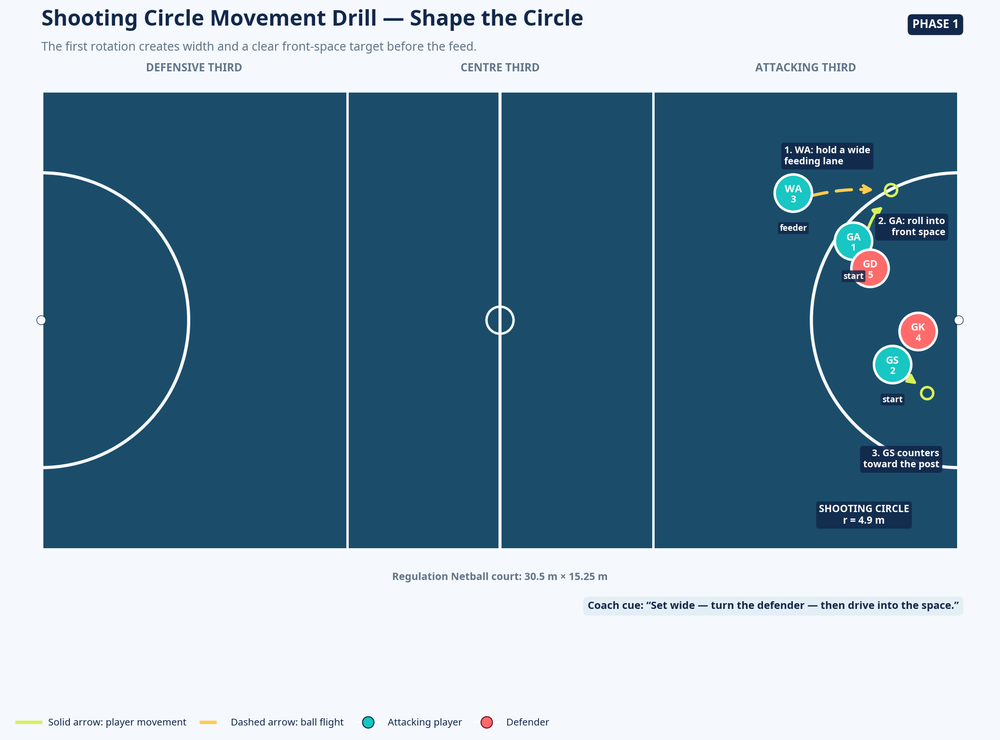
| Starting picture | C starts 2 m behind the attacking transverse line with the ball. WA sets 3 m inside the attacking third and 1.5 m from the sideline. GA begins 1 m inside the top of the circle; GS begins 2 m from the goal post, slightly off-centre. GD marks GA; GK marks GS. |
| Work block | Run each repetition for 10–12 seconds. Complete 4 repetitions from the right, 4 from the left, then rotate the attacking and defensive pairs. |
The C opens every rep with a firm pass to the WA. Once the WA receives, they must establish a balanced landing position and use a pivot to see both sides of the circle; do not coach the ball carrier to run sideways with the ball. Position the defenders initially at 70 percent pressure so the movement pattern can settle before you increase contest intensity.
Step-by-Step Instructions
Phase 1 — Shape the Circle
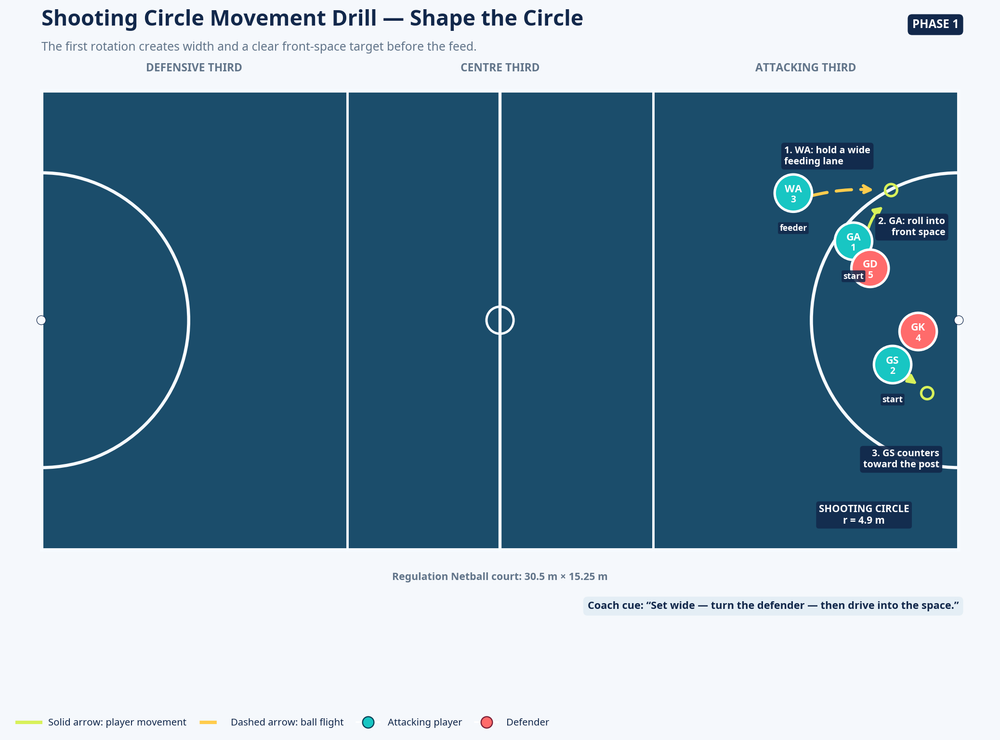
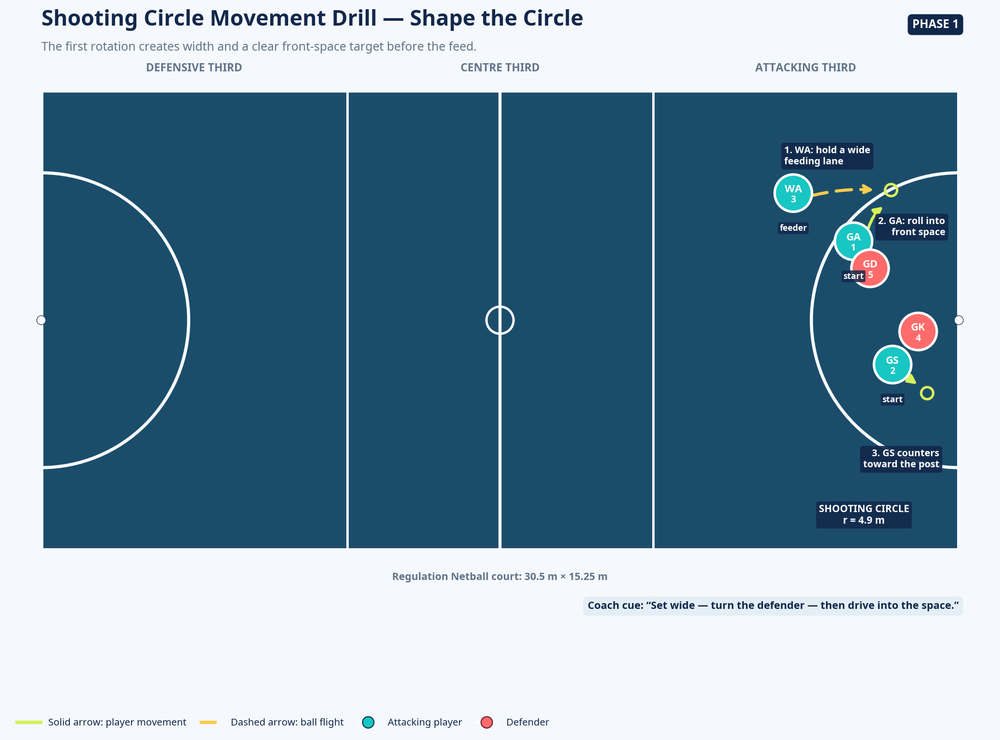
- The C passes to the WA, then holds a reset lane roughly 4–5 m behind and inside the WA. The WA catches, lands balanced, and scans before the shooters move.
- On the WA's call of "set", the GA takes one small holding step toward the GD, plants the outside foot, and rolls into the high-front space. The aim is to place the body between the GD and the expected pass.
- As GA moves high, GS counters low toward the post-side space. This keeps the GK occupied and gives the circle width rather than two attackers working on the same line.
- The WA uses a crisp shoulder or chest pass to GA only if GA has gained body position and can land safely inside the circle. If the GD is level or in front, WA holds the ball and calls "split".
Phase 2 — Baseline Split
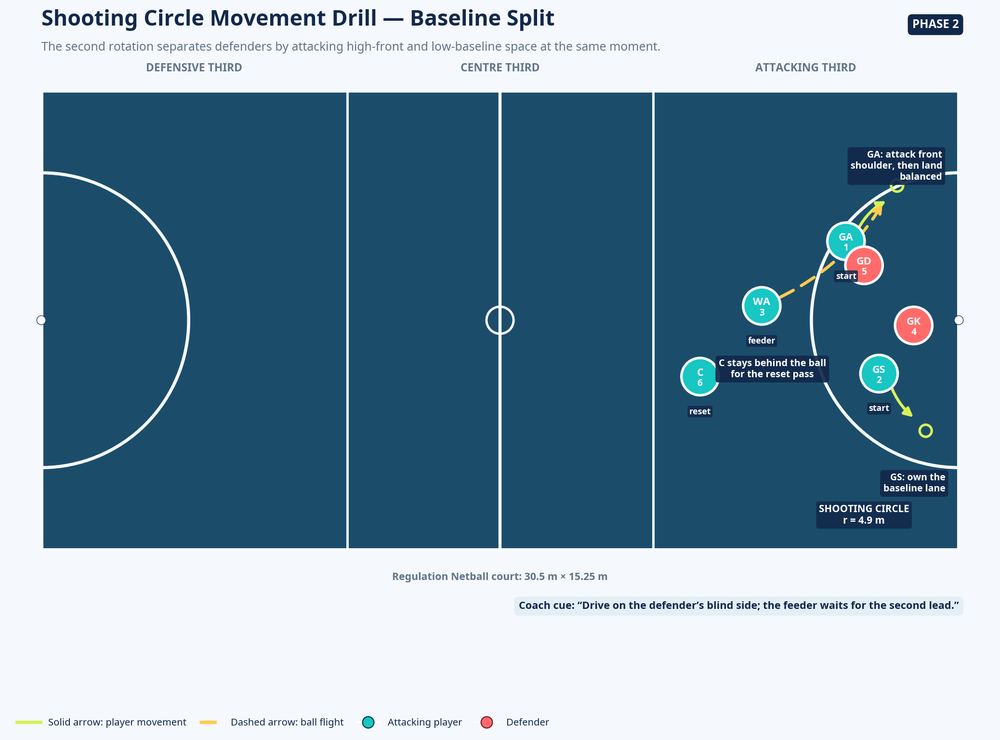
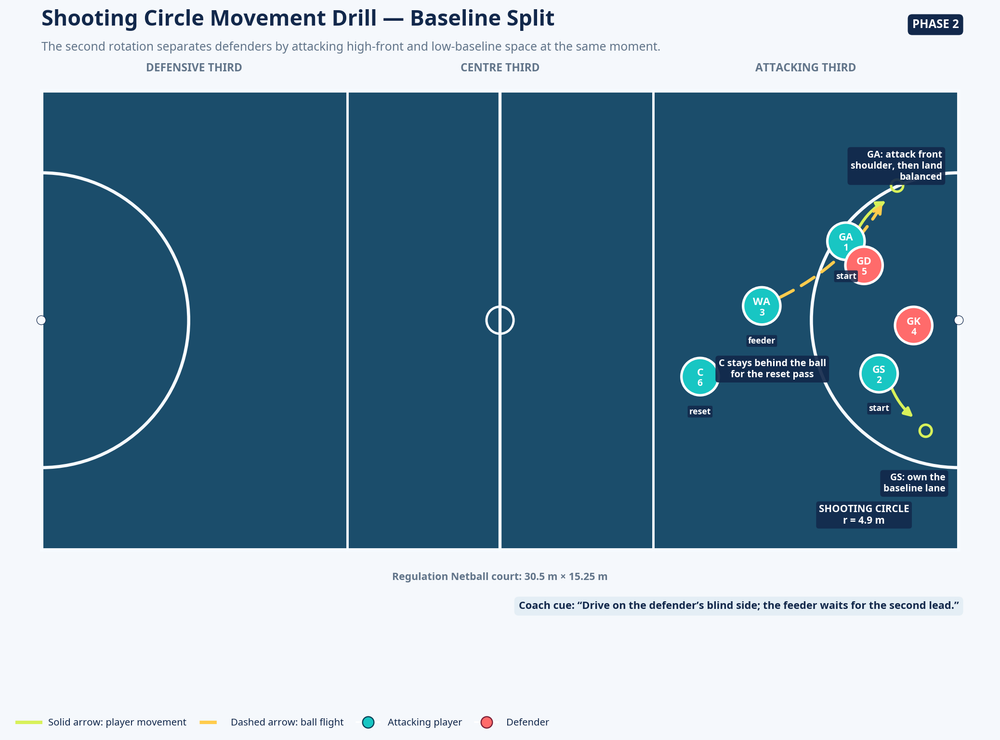
- On "split", GA re-offers by changing pace toward the high-front shoulder of GD, while GS drives along the baseline side of GK. The two leads must be on different angles and approximately 1–1.5 seconds apart.
- WA stays patient on the circle edge. Their job is to keep a wide visual lane, not to drift into the circle or chase the moving attackers.
- C steps diagonally to remain behind the ball, ready to receive a safe reset. C should keep at least 3 m of passing distance from WA rather than standing directly in the same channel.
- The defenders now decide: GD follows GA high, or GK drops to protect GS low. That decision is the cue for the next pass.
Phase 3 — Read, Feed, Finish
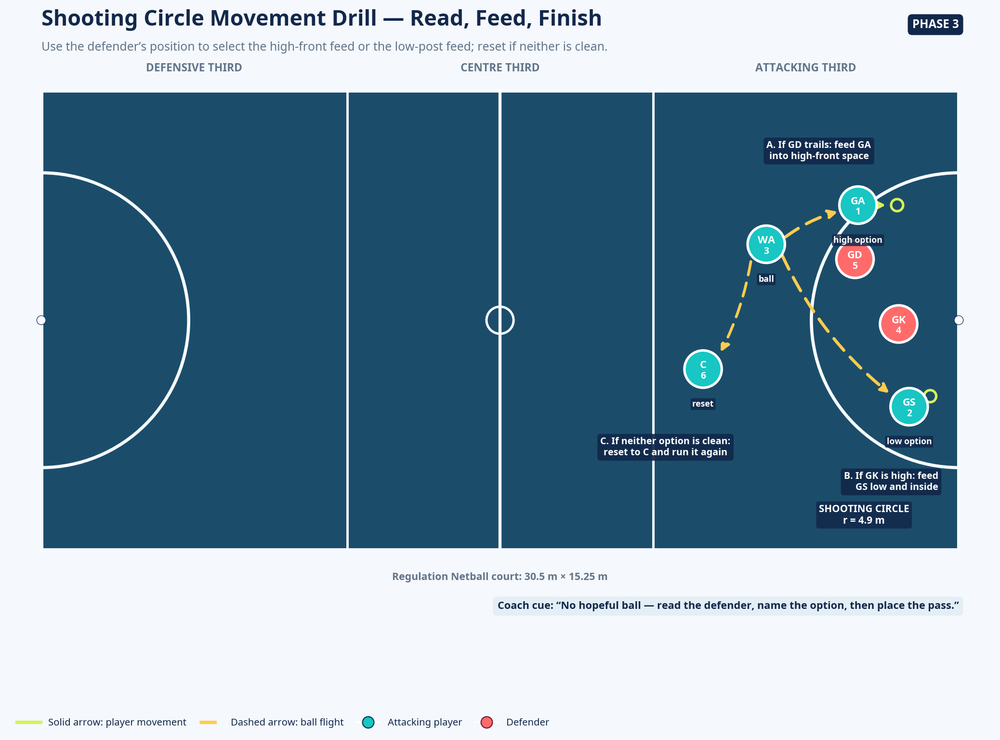
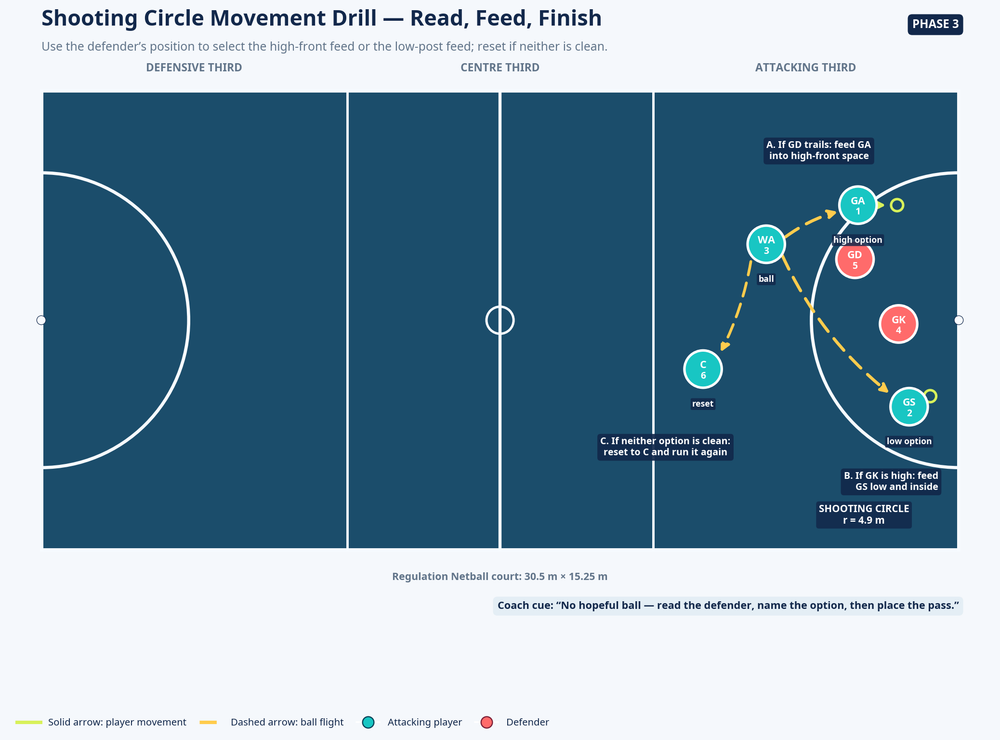
- High-front option: If GD trails GA, WA feeds into the high-front space with a direct pass. GA lands on balance, turns the eyes to the post, and either shoots or moves the ball quickly to GS if GK has overcommitted.
- Low-inside option: If GK steps high to help on GA, WA feeds GS on the baseline side with a controlled bounce pass or a safe short lob into the shooter’s outside hand. GS protects the ball, turns in, and finishes.
- Reset option: If both defenders are goal-side and no attacker has clean body position, WA pivots back to C. C immediately passes to WA’s new side or restarts the pattern; a reset is a deliberate attacking decision, not a failure.
- Finish every live repetition with a shot within 10–12 seconds. After the shot or a clean defensive gain, all players reset briskly so the drill stays game-like.
Key Coaching Points
| Focus | What to coach |
|---|---|
| Timing | GA creates the first picture; GS responds to it. Two simultaneous straight leads make one easy defensive line. |
| Body position | Attackers should arrive side-on or half-turned, with the defender on the back shoulder and hands showing early. |
| Change of pace | Demand a controlled hold, an explosive first three steps, then a balanced landing. Straight-line jogging will not beat a set defender. |
| Feeder discipline | WA looks high, low, then reset. Coach the eyes first, the feet second, and the pass last. |
| Pass quality | Feed to the receiver’s outside hand and away from the defender’s intercepting arm. Flat passes must be genuinely on; otherwise choose the reset. |
| Finishing habit | GA and GS should land with knees soft, chin up, and immediate shot preparation. Do not let a good lead end in a rushed, unbalanced release. |
Common Mistakes and Corrections
| Mistake | Immediate coach correction |
|---|---|
| GA and GS both run to the front | Freeze the picture, return one shooter to the post-side lane, then rehearse the 1–1.5 second stagger. |
| WA throws on the first half-chance | Give WA the verbal sequence: "high, low, reset." Award a point for a safe reset in the scoring system. |
| GS stands beneath the post | Use a cone 1.5 m from the post as a temporary start marker and demand a baseline re-offer after every GA lead. |
| C watches after the first pass | Mark C’s reset corridor with two cones and require C to move diagonally behind the ball. |
| Feed is floated across GK | Rehearse passing to the outside hand at shorter range, then increase distance only when the pass stays sharp. |
Variations and Progressions
- Pattern first: Remove defenders and have the attacking four complete 8 clean rotations each side. Score one point when the second lead arrives on time and two points for a balanced shot. This is ideal when teaching the vocabulary.
- Add pressure: Introduce a WD on WA and let GK/GD defend live. The attacking group earns one point for a goal, one for a safe reset, and loses one for an intercept. This rewards decision quality, not only scoring.
- Transition entry: Start C with the ball in the centre circle and require an entry through WA before the circle pattern. Set a 14-second limit to complete the sequence and finish; this is a demanding senior progression.
Age Adaptations
For Under 8/Under 10, use a reduced area, no defenders, and a 3-second pause after each lead so players can identify high, low, and reset space. Let GA and GS take turns in both shooting roles and keep repetitions to 6–8 seconds. For Under 12, add passive GD and GK, use only chest passes, and coach the stagger before introducing a time limit. For Under 14, use active circle defenders at 70 percent pressure, then increase to full contest when players can reset without panic. For Under 16/Open, add WD pressure, score the decision quality, and video the feeder’s first look to assess whether the chosen feed matched the defensive picture.
