

Netball
WA Feeding Patterns Drill: Create, Re-offer, Feed
A progressive attacking drill that teaches Wing Attacks to create separation, re-offer with purpose and deliver controlled feeds to the circle edge.
What you need
2 regulation netballs, 8 flat cones or floor markers, 7 position bibs: C, WA, GA, GS, WD, GD, GK, 1 whistle, 1 score card or whiteboard
WA Feeding Patterns Drill: Create, Re-offer, Feed
Overview
This intermediate attacking drill trains a Wing Attack (WA) to link the centre third to the goal third with repeatable, intelligent movement. The WA learns to read the Wing Defence (WD), create a first receiving lane, clear it, and re-offer to feed the Goal Attack (GA) at the circle edge. Use it after a passing warm-up and before conditioned match play, when your group needs sharper timing and clearer decisions through attack. The drill uses a full regulation court of 30.5 m by 15.25 m, divided into equal thirds, with a 4.9 m goal circle at each end. 1
The coaching objective is a WA who can choose the next action: under-and-through when WD sits high; re-offer square when the lane is blocked; or sideline drive when GA wins front space. The sequence gives circle feeders a picture before the ball arrives, rather than a late, hopeful ball into traffic.
| Drill profile | Coach decision |
|---|---|
| Duration | 18–22 minutes: 4 minutes set-up, 12 minutes of repetitions, then 4–6 minutes of conditioned play. |
| Numbers | 14 players is ideal for two channels of seven. With 10–12 players, run one channel and rotate every 90 seconds. |
| Unit | 1 C, 2 WA, 3 GA, 4 GS versus 5 WD, 6 GD, 7 GK. Position initials and assigned court areas are standard Netball conventions. 1 |
| Success measure | In each 90-second block, target six WA touches and four controlled feeds to GA or GS without a held-ball or intercept. |
Setup
Use the centre third and attacking goal third. Mark a 3 m entry gate on the centre-third side of the transverse line, 2 m in from the WA sideline. Mark a second 3 m re-offer gate 5 m further downcourt and 3 m inside the same sideline. Place a flat marker at the top of the goal circle, 1 m outside the line, for the preferred GA receiving point.
Give the C a ball in the centre third. Start the WA 4 m ahead of the transverse line, with WD goal-side and slightly inside. Position GA 2 m outside the circle on the pocket side, GD between GA and post, and GK on GS. The coach stands level with the transverse line to judge whether WA creates a genuine lane and whether the ball is released before the circle crowds. Keep a second ball with the next C for an immediate reset.
Step-by-Step Instructions
Set the defensive picture. On the whistle, WD begins tight enough to be relevant but does not intercept the first two repetitions. C holds a balanced landing stance, scans WA first and keeps the ball in two hands. WA calls “under” or “through” before moving; that verbal decision stops a reactive lead.
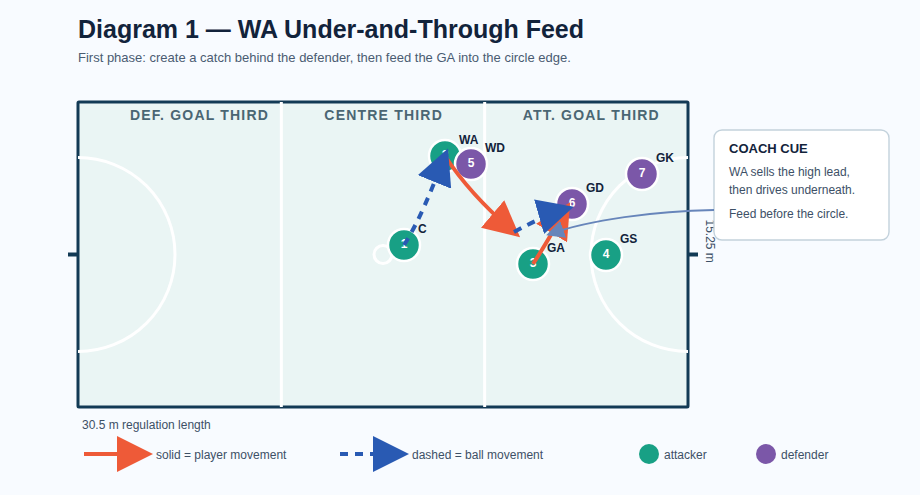
Run the first lead. WA sells a high or sideline lead for two steps, then plants and drives underneath WD through the entry gate. C releases a chest or shoulder pass into WA’s forward space, not to her current feet. WA lands under control, pivots toward the circle and checks WD’s recovery line.
Feed or clear. If GA has won front space on GD, WA feeds GA on the outside-circle marker. GA catches side-on and either feeds GS or shoots if legally placed. If GA is covered, WA returns safely to C and clears wide. Do not force a ball over GD.
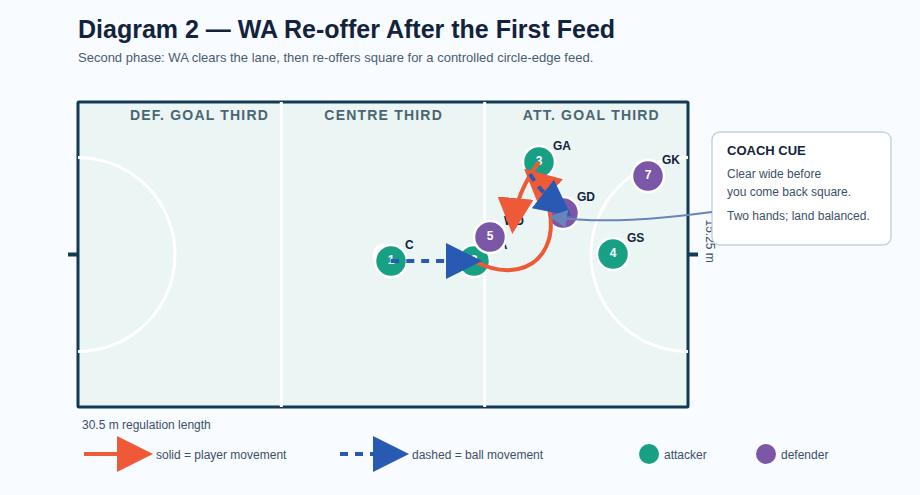
Re-offer with purpose. After passing or returning the ball, WA clears to the sideline for at least 3 m, turns, then re-offers square through the second gate. C times the pass for the moment WA has separated, not while she is beside WD. Require WA to catch, land balanced, and look at GA before GS.
Finish the pattern. GA drives toward the circle edge as WA re-offers. WA feeds GA’s leading shoulder when GD is behind. If GD steps toward the ball, WA carries on her sideline drive, receives a return from C and delivers from a better angle. GS holds a strong high target early in the circle.
Reset and rotate. Complete the pattern even if the final pass drops. Rotate every two repetitions: C to WA, WA to GA, GA to GS, GS to WD, WD to GD, GD to GK, GK to C. Run six walking reps, then three 90-second competitive blocks. Award one point for a gate reception, one for a controlled circle-edge feed and one for a shot attempt created without forcing the pass.
Key Coaching Points
| Coaching focus | What to coach on court |
|---|---|
| Win feet before ball | WA changes speed and direction first. “Make the defender turn their hips” before C passes. |
| Lead into space | The first lead is underneath or away from WD’s shoulder. A lead at GA and GD compresses the next pass. |
| Pass to front shoulder | C and WA pass into the receiver’s next step. A ball behind WA brings her back toward WD. |
| Clear, then re-offer | Demand a visible 3 m clearance. Hovering beside the carrier lets WD guard two attackers. |
| Read GD, not post | WA checks GA’s front space. If it is not on, recycle through C and create a fresh angle. |
| Name the picture | Use concise cues: “under,” “square,” “front,” “reset.” The cue must reflect the defender’s position. |
Common Mistakes
The most common error is a WA who moves only after C has landed. Correct it by starting the WA’s first two steps on C’s landing action, not on the pass. A second error is a flat lead that lets WD remain goal-side; set the entry gate underneath the defender and insist that WA crosses the line before turning out.
Stop repeated high balls to GA when GD has front position. The solution is a deliberate recycle through C and a new WA angle, not a harder pass. Finally, watch the WA catch and immediately turn toward GS. That gaze telegraphs the feed and removes GA as the safer option. Require WA to scan GA first and choose the available player.
Variations & Progressions
Regression: guided defender. WD shadows at 70% effort and cannot intercept the first C-to-WA pass. Newer WAs can feel the under-and-through route and practise a stable landing.
Progression: live denial. Allow WD to deny either gate and GD to hunt the GA feed. The attack scores only if WA identifies the blocked lane and selects the opposite re-offer or recycle within three seconds.
Progression: pressure-score finish. The final shot is worth two points only when WA has made two distinct leads before the feed. After a turnover, defence has five seconds to transition back to the centre-third start cone. This adds the demand of protecting possession after a missed first option.
Age Adaptations
For Under 10, use an unopposed four-player pattern in a 12 m by 15.25 m section and widen both gates to 4 m. Remove the scoring target and reward a clean catch, balanced landing and accurate return pass. Use 45-second blocks and frequent rotation.
For Under 12, add a passive WD and GA’s circle-edge marker. Keep one decision: feed GA if she is in front; otherwise return to C. For Under 14 and Under 16, make WD and GD live, retain 3 m gates and enforce the three-second decision. Ask athletes to state the defender read after a turnover.
For Open players, run two balls through alternate channels, make defence fully live, and score decision quality rather than completion alone. A completed recycle under pressure should be worth as much as a risky feed; that standard transfers to a tight match.
Coach’s Close-Out
Finish with a two-minute 5 v 5 possession game in the centre and attacking thirds. Award a bonus point when WA makes a first lead, clears, and receives again before the attack enters the circle. Review one successful rep and one reset: an elite feed is created by timing, space and a second effort, not by forcing the first ball.
