

Basketball
Post Moves and Footwork: The Baseline Drop-Step and Middle Counter
Equip your post players with the essential footwork to read the defense, seal the low block, and finish through contact using the drop-step and middle counter.

What you need
Basketballs (2 per group), Cones (1 per basket), Contact Pads (optional)
1. Overview
Developing dominant post players requires more than just size; it demands elite footwork, balance, and the ability to read the defense before the catch. This drill focuses on the foundational low-post movements: sprinting to a seal, chinning the basketball, executing a baseline drop-step against high-side pressure, and countering to the middle when the baseline is denied.
Use this drill during the skill-development phase of your practice to build muscle memory and physical conditioning. It is highly effective for bigs (4s and 5s) but is equally valuable for guards (1s, 2s, and 3s) who post up smaller defenders in mismatch situations.
2. Setup
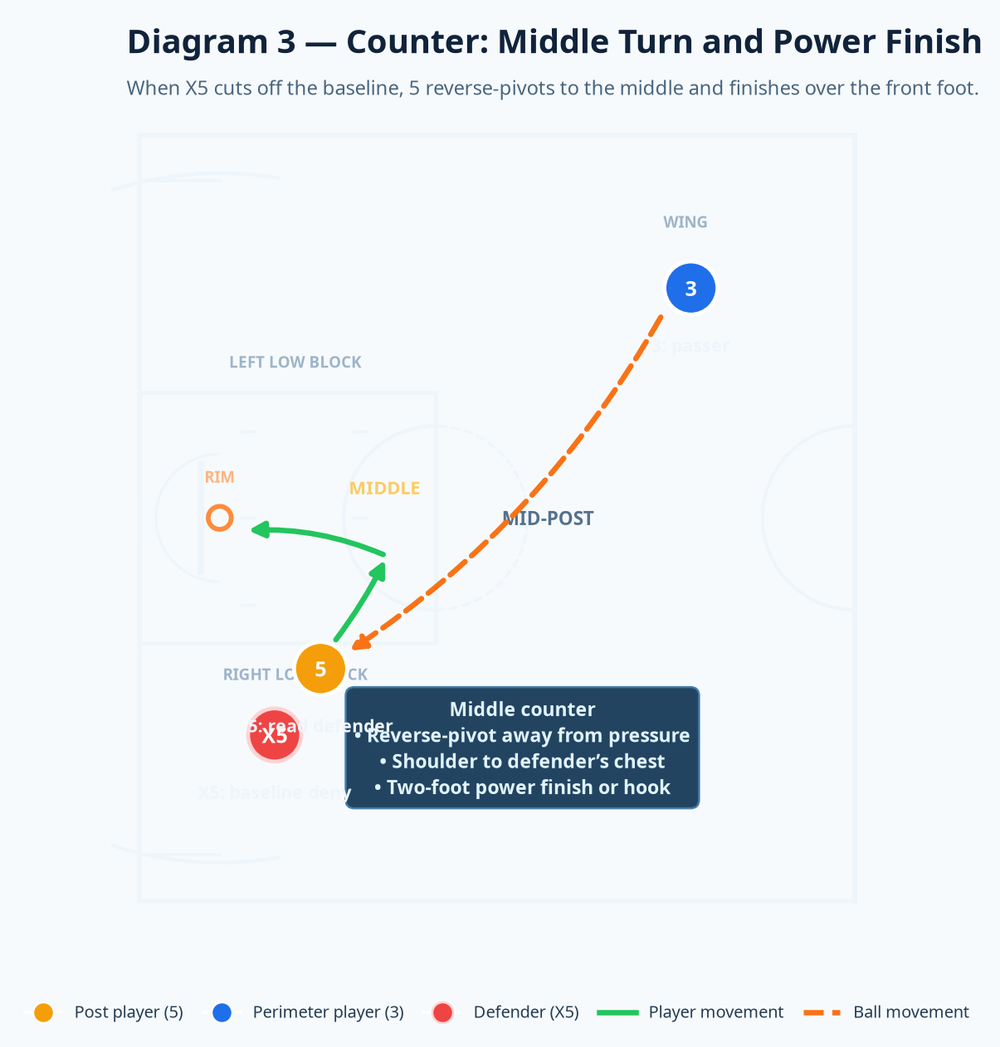
To maximize repetitions, run this drill on both ends of a FIBA court (28m x 15m); each working half-court is 14m x 15m.1 Place the mid-post cone 4.5m from the baseline and approximately 2m outside the lane line. Run three 90-second work blocks per side, with 30 seconds to coach and rotate between blocks. You will need:
- Players: Minimum of 4 players per basket (1 Post, 1 Passer, 1 Defender, 1 Rebounder/Next Passer).
- Equipment: 2 Basketballs per group, 1 Cone (placed at the mid-post/elbow area).
- Positions:
- 5 (Post Player): Starts at the mid-post cone.
- 3 (Passer): Positioned on the wing (free-throw line extended, beyond the three-point arc).
- X5 (Defender): Starts on the low block with a pad or arms up.
- 4 & 1: Waiting at the top of the key to rotate in.

3. Step-by-Step Instructions
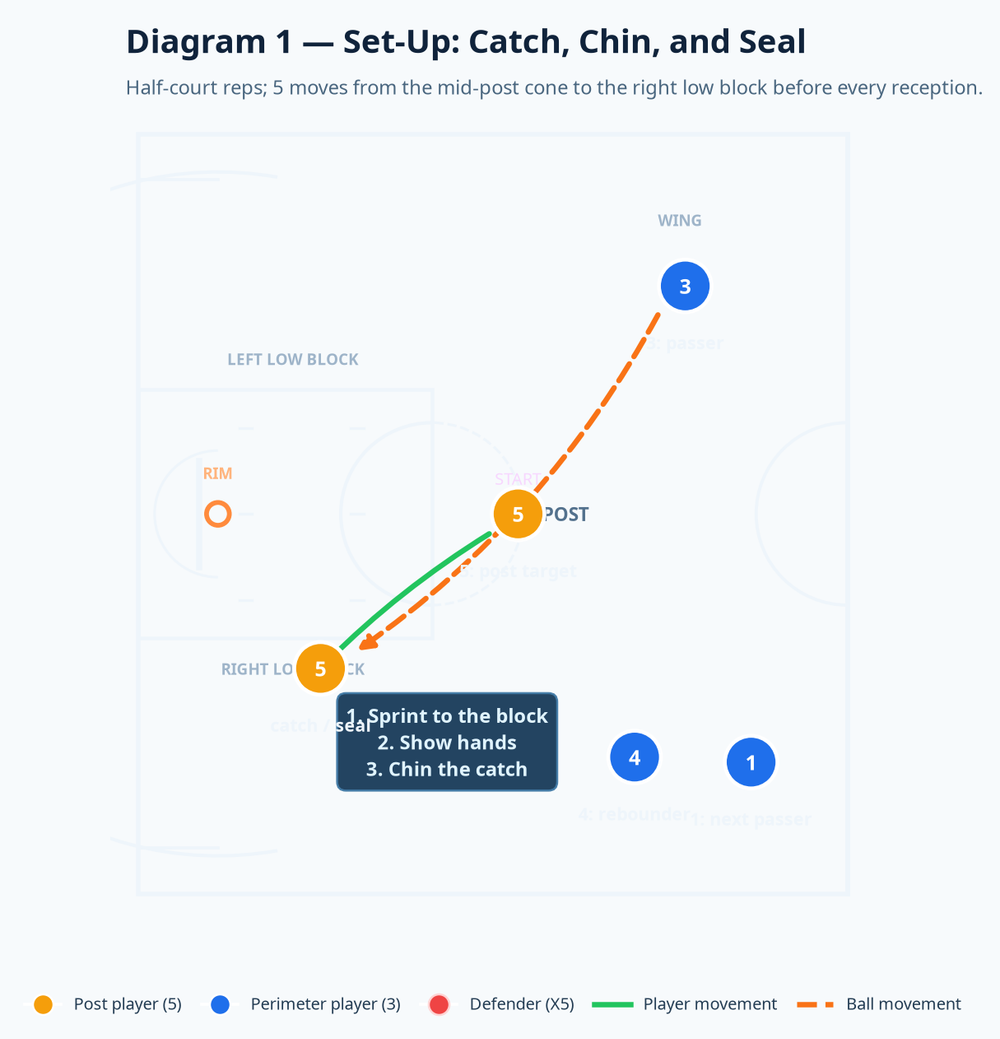
Phase 1: The Catch and Seal
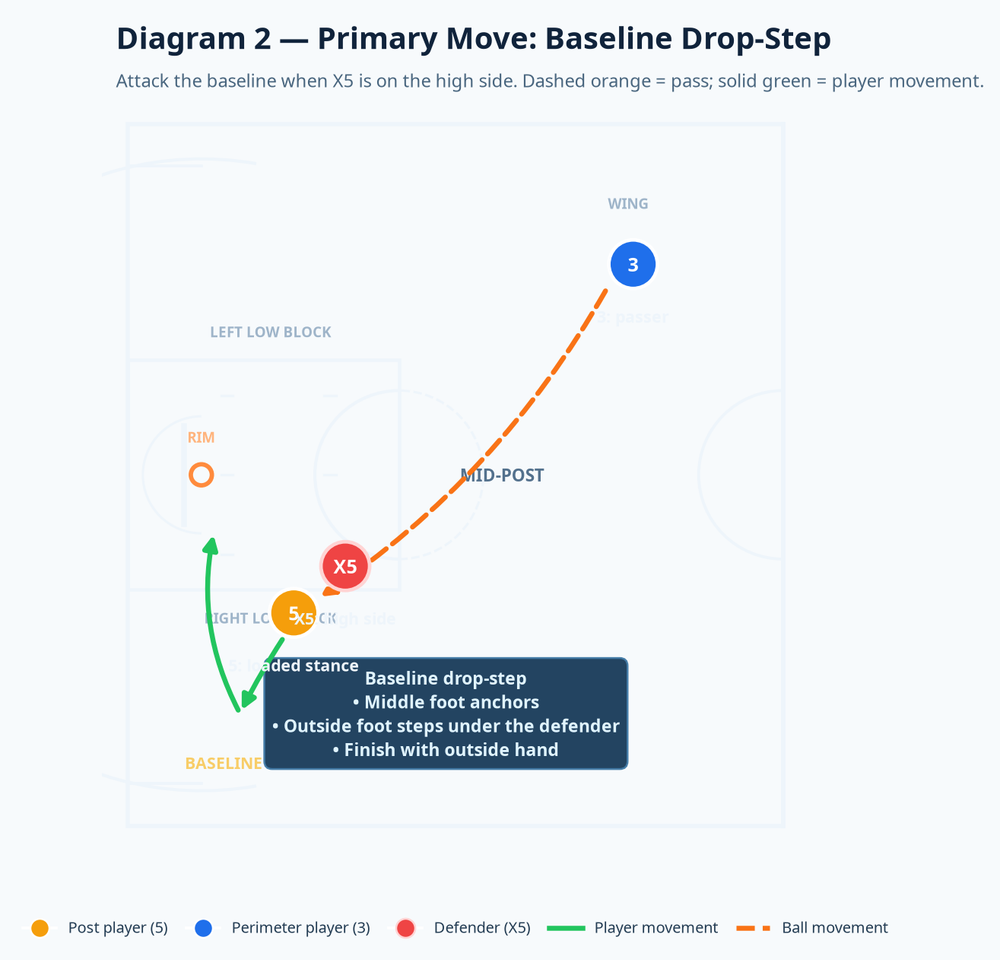
- The Post Player (5) starts at the mid-post cone.
- On the coach's whistle, 5 sprints 3–4m down to the right low block in no more than two seconds, stepping over the defender's top foot to establish a wide, powerful base.
- 5 shows a clear target hand to the Passer (3).
- 3 delivers a crisp entry pass (bounce or air) as 5 shows the target hand for one full second.
- Upon catching, 5 immediately "chins" the ball (secures it tightly under the chin with elbows out) and lands in a two-foot jump stop.
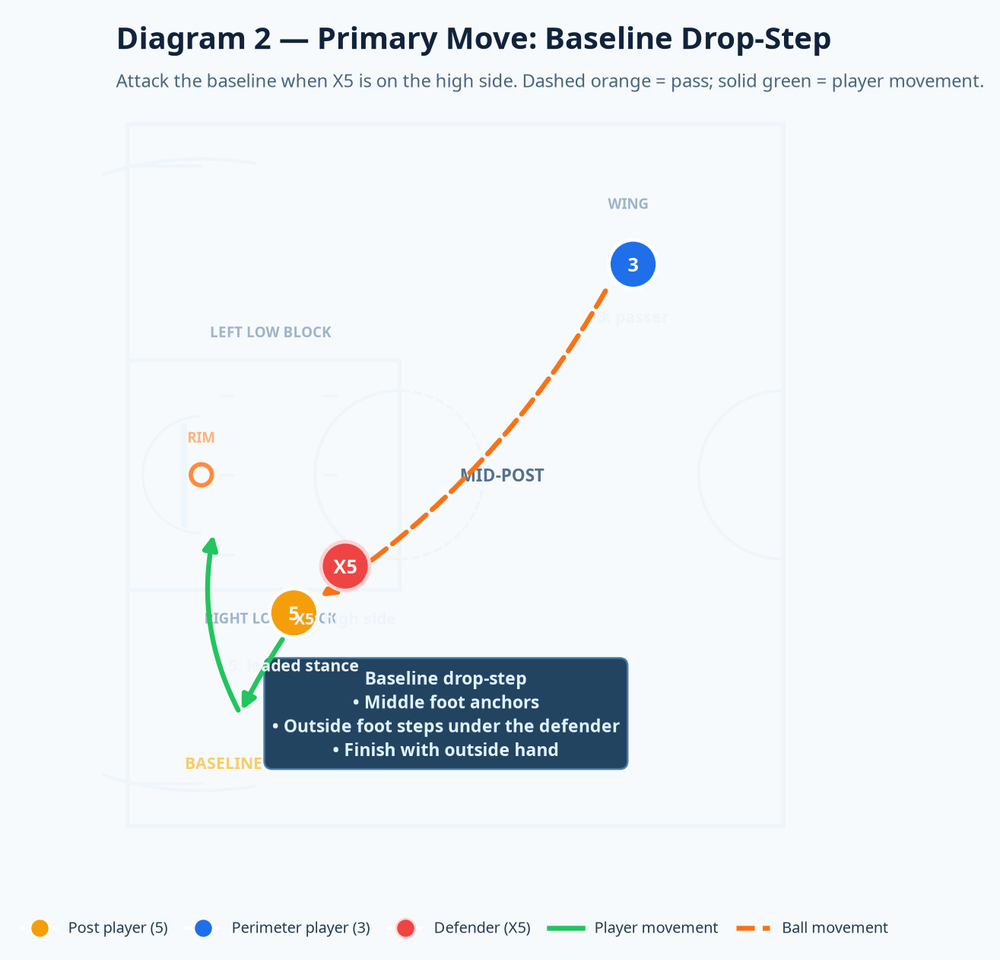
Phase 2: The Baseline Drop-Step (Primary Move)
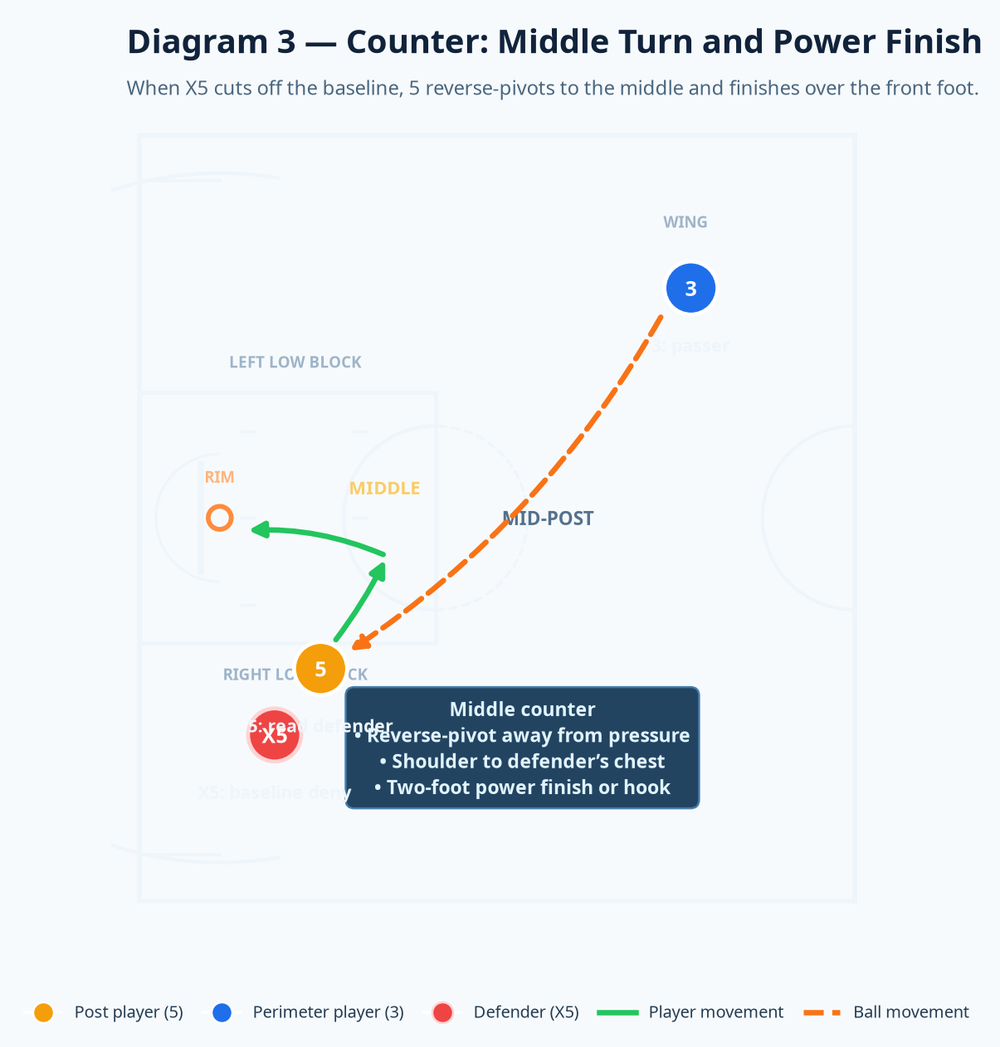
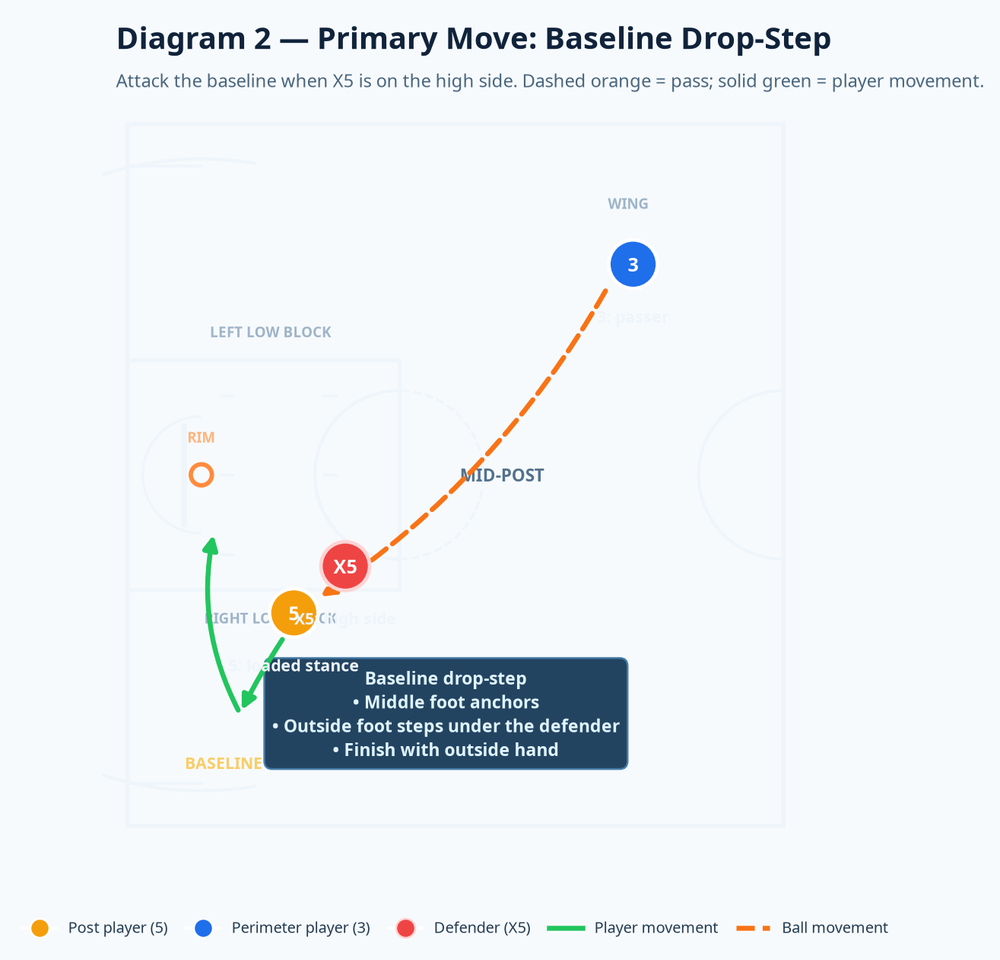
- The Defender (X5) applies pressure on the high side (closer to the free-throw line).
- 5 feels the pressure on their top shoulder and visually checks the middle.
- 5 anchors their middle foot (the foot closest to the foul line) as the pivot foot.
- 5 takes a deep, explosive step backward with their baseline foot, stepping under and past the defender's legs.
- Keeping the ball chinned, 5 power-dribbles once between their legs, squaring their shoulders to the backboard.
- 5 explodes up off two feet, finishing with the outside hand to protect the ball from the defender. Each player makes 5 baseline finishes before rotating.
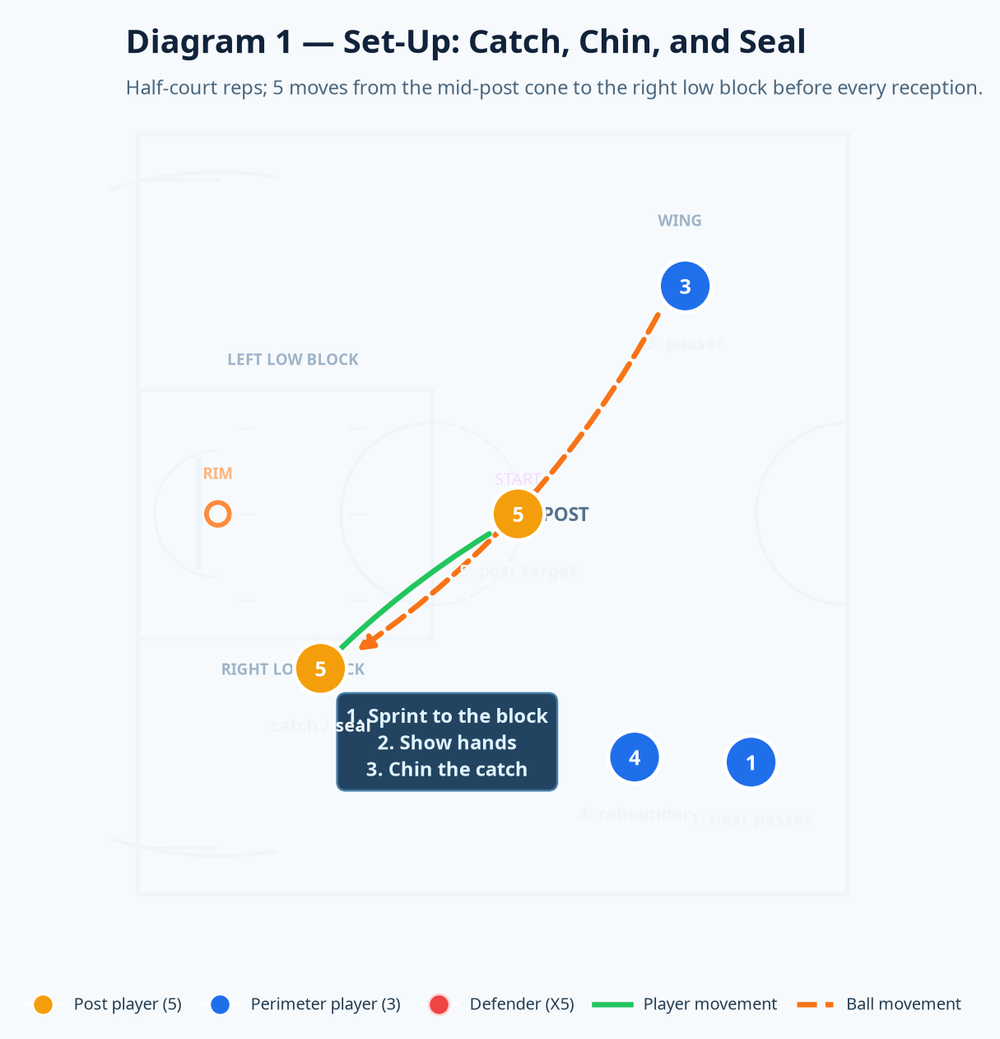
Phase 3: The Middle Counter
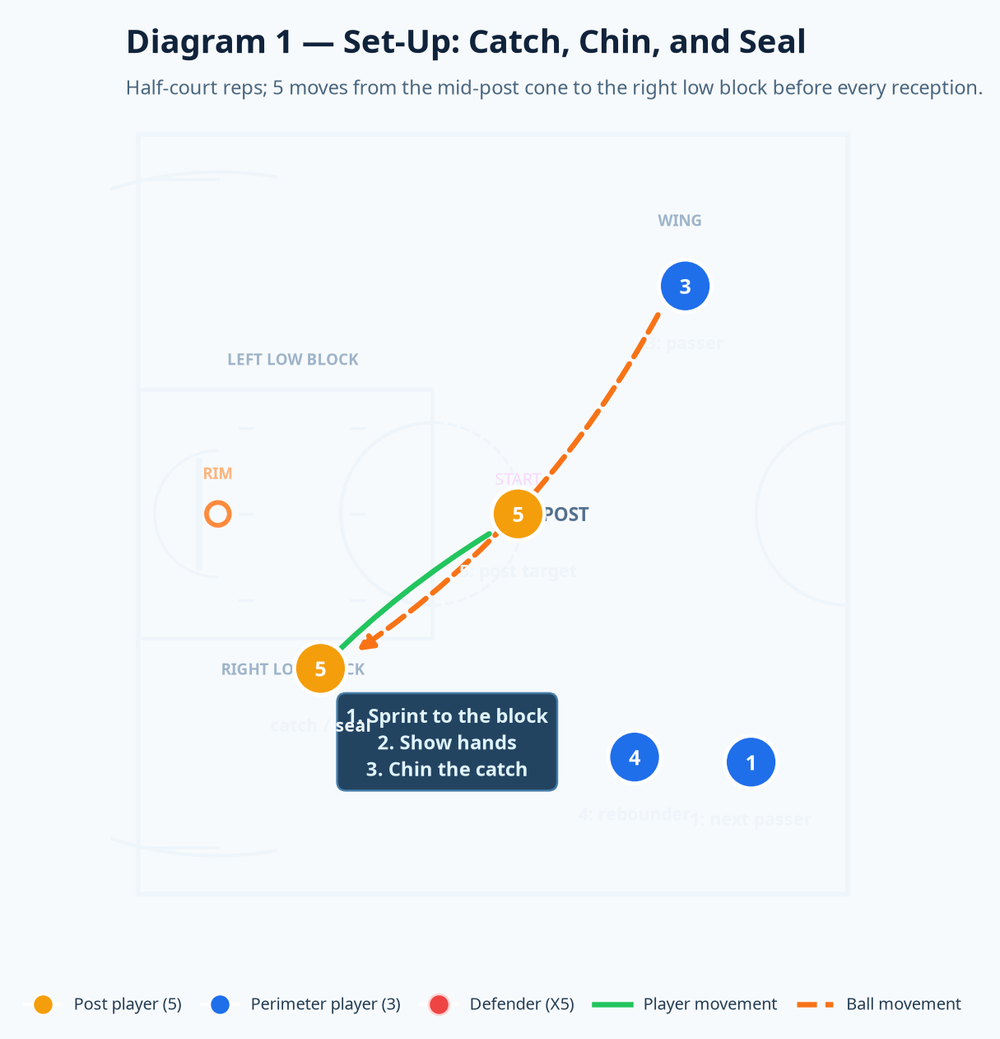
- The setup remains the same, but this time X5 jumps to the baseline side to deny the drop-step.
- 5 catches, chins the ball, and feels the baseline pressure.
- Recognizing the baseline is closed, 5 anchors the baseline foot as the pivot foot.
- 5 executes a reverse pivot, swinging their top leg toward the middle of the paint.
- 5 drops their inside shoulder into the defender's chest to create separation.
- 5 finishes with a two-foot power layup or a running hook shot across the lane. Each player makes 5 middle counters before rotating.
4. Key Coaching Points
- Sprint to the Spot: The post up begins before the catch. Players must sprint from the mid-post to the block to beat the defender to the spot.
- Chin the Ball: Immediately secure the ball under the chin with elbows wide. Bringing the ball down to the waist invites guards to strip it.
- Read the Defense: The post player must "feel" where the defender is leaning. If the defender is high, drop-step baseline. If the defender is low, turn middle.
- Step Under, Not Around: On the drop-step, the stepping foot must go between the defender's legs and the basket to establish a superior angle, sealing the defender behind.
- Two-Foot Finishes: Always finish off two feet in the paint. It provides better balance, allows the player to absorb contact, and prepares them for an offensive rebound.
5. Common Mistakes
- Catching with a Narrow Base: Players who catch standing straight up are easily pushed off the block. Correction: Emphasize dropping the hips and widening the stance before the ball arrives.
- Turning Blind: Offensive players sometimes spin without locating the defense or a double-team. Correction: Teach "chin and check"—glance over the inside shoulder before making a move.
- Fading Away from the Basket: On the middle counter, players often drift away from the rim to avoid contact. Correction: Instruct players to initiate contact by driving their shoulder into the defender's chest.
6. Variations & Progressions
- Live Read (Progression): Instead of telling the defender where to play, allow X5 to choose the high side or baseline side dynamically as the ball is in the air. 5 must react instantly upon the catch.
- Add a Dribble Limit (Progression): Restrict the post player to a maximum of one power dribble. This forces efficiency and prevents over-dribbling in the post.
- Weak-Side Flash (Variation): Add a perimeter player cutting from the weak side. If the post player is double-teamed upon their middle turn, they must pass out to the cutter instead of forcing a shot.
7. Age Adaptations
- Under 10 / Under 12: Remove the live defender. Use a coach with a blocking pad to provide light resistance. Focus entirely on footwork, balance, and the mechanics of the drop-step without a dribble.
- Under 14 / Under 16: Introduce the live defender and the "Live Read" progression. Emphasize absorbing contact and protecting the ball with the outside hand on finishes.
- Open / Advanced: Incorporate double-teams and require the post player to read the weak-side rotation. Introduce advanced finishes like up-and-unders or jump hooks.
