

Netball
Quick Hands Passing Circuit: Pass, Call & Follow
Build sharp, catchable passing and instant re-offers with a full-court circuit that progresses from rhythm to live defensive pressure.

What you need
balls, cones
Overview
Quick Hands Passing Circuit is a high-repetition, full-court passing block that teaches players to receive early, move the ball before defensive pressure lands and immediately re-offer. It is not a conditioning run disguised as a skill drill: the quality target is clean, catchable passes at match tempo while players keep a balanced landing and a live next action. Ten players work in two mirrored groups of five, so every athlete handles, calls and moves continually. Use it early in a session to sharpen hands, or after a warm-up when you want to expose lazy footwork and slow decision-making.
Setup
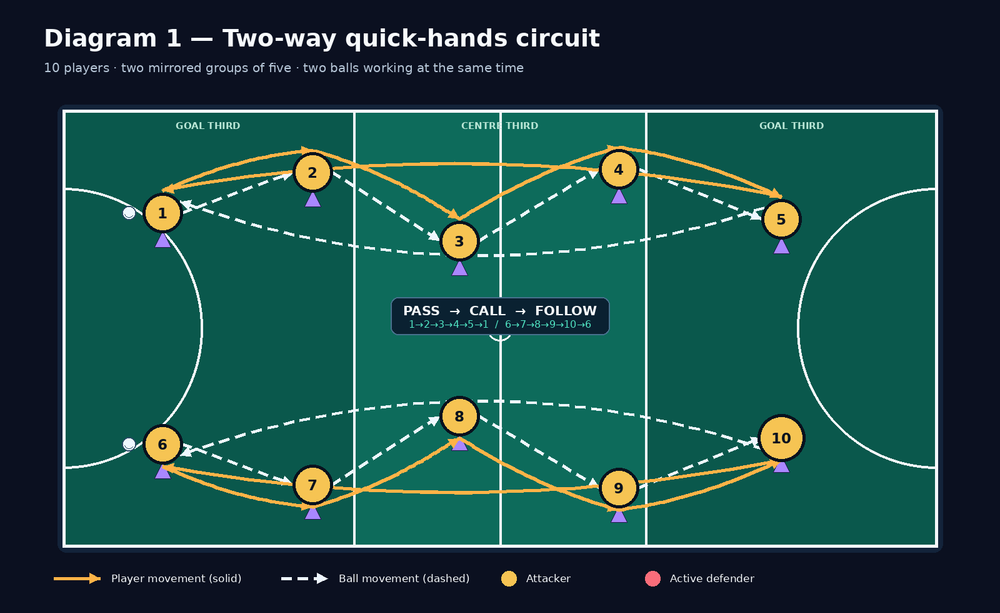
Use the full 30.5 m x 15.25 m netball court. Set out two mirrored five-cone circuits: Group A uses the upper half of the court and Group B the lower half, as shown below. Each circuit is a stretched five-point shape running from one goal third, through the centre third and into the opposite goal third. Leave 5–7 m between adjacent cones.
Number Group A 1–5 and Group B 6–10. Players 1 and 6 start with a ball; position 3 and 8 carry the second ball when the two-ball phase begins. Rotate every athlete through C release, WA outlet, GA receiver, support and return feeder. Have two spare balls beside the centre circle. The exact 20-minute plan is: 3 minutes demonstration, 4 minutes one-ball pattern, 4 minutes two-ball tempo, 5 minutes defender pressure, 3 minutes scoring challenge and 1 minute review.

Step-by-Step Instructions
0:00–3:00 | Walk-through and landing shape. Put each group on its numbered cones. Demonstrate 1–2–3–4–5–1: pass, call the receiver’s name, then follow the ball to fill the next cone. Insist that every receiver is side-on, sees the next pass before the ball arrives and lands with knees soft. Rehearse the return pass from 5 to 1 so the circuit never stalls.
3:00–7:00 | One-ball rhythm. Group A starts at 1 and Group B at 6. The ball travels clockwise through the numbered circuit. Players use a chest pass or short shoulder pass, release within 1.5 seconds of landing and move immediately after release. A dropped, looping or behind-the-body pass resets the group’s count to zero. Change the direction at 5:00 so players pass off both shoulders and pivot both ways.
7:00–11:00 | Add the second ball. Start balls at 1 and 3 in Group A, and 6 and 8 in Group B. Release the second ball 1.5 seconds after the first. The rule is “eyes up before hands”: scan the incoming and outgoing line before catching. If two players arrive at one cone, the late player peels wide, calls “out” and re-enters at the next pass rather than standing still.
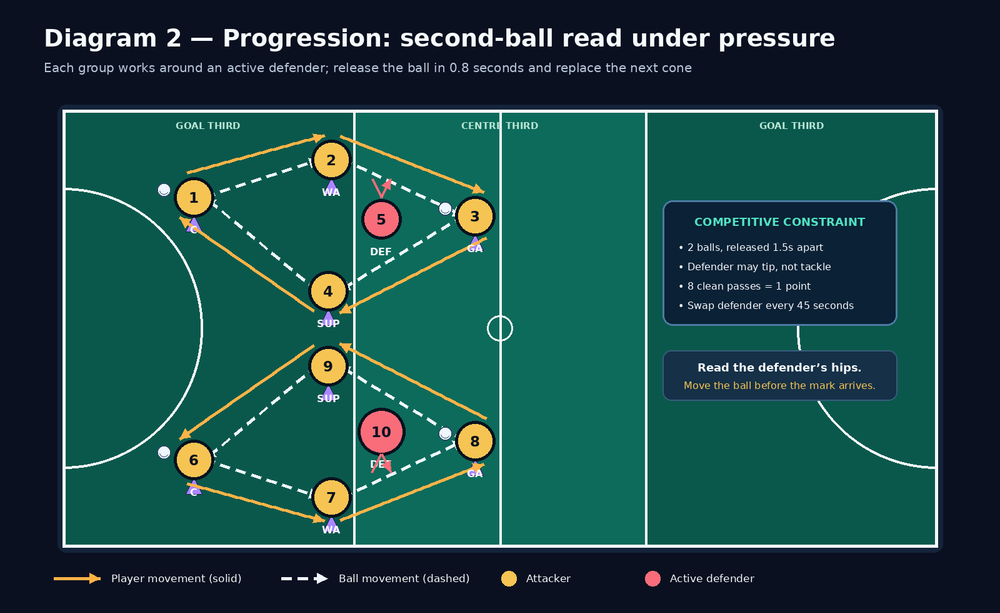
11:00–16:00 | Build pressure. Move player 5 and player 10 into the middle as active defenders, as in Diagram 2. They may track, obstruct and tip, but no contact or reckless lunges. The attackers still pass and follow through four outside stations; defender and attackers swap every 45 seconds. Tighten the release target to 0.8 seconds once the catch is secure. A defender who tips the ball earns one point; attackers earn one point for eight uninterrupted passes.
16:00–19:00 | Competitive finish. Keep the two balls live. Run three 45-second rounds with 15 seconds to reset and coach between rounds. Win with the most eight-pass sequences, not the fastest sprinting. Award a bonus point only when the receiver calls early, catches cleanly and delivers the next pass without a recovery step.
19:00–20:00 | Review. Ask one player to name the cue that made the circuit flow: early call, strong front foot, fast release or re-offer. Finish with one controlled sequence in each direction.
Key Coaching Points
- Arrive before the ball. Hunt the ball on a slight angle, show both hands early and use a strong landing. The first foot down becomes the pivot foot; do not allow a catch, pause and frantic search for an option.
- Pass to space. The feeder leads the receiver’s outside shoulder so the ball travels into the next action. Flat, firm passes are preferable to floated passes, provided the receiver can take them safely.
- Call early and specifically. Use the feeder’s name, then a clear cue—“here”, “turn” or “one more”. Communication happens before the previous player releases the ball.
- Follow with purpose. Passing is only half the rep. The passer drives to the next cone, checks their timing and offers a fresh angle. Do not jog behind play.
- Read the defender’s hips. When the defender opens one shoulder, shift the next pass to the opposite side. The ball should beat the defender, not travel through their hands.
Common Mistakes
- Players wait flat-footed behind a cone. This creates a static catch and a late release. Start their movement one pass earlier and make the cone a guide, not a parking spot.
- The ball floats or drifts behind the receiver. Slow the circuit for two repetitions, fix hand position and step through the pass. Speed only counts when the next player can catch in front of their body.
- Players follow too closely and collide at the next station. Set a “one player, one cone” rule. The receiver owns the cone; the passer curves wide and arrives after the ball has gone.
Variations & Progressions
Variation 1 — Direction-call circuit. The coach calls “left” or “right” as the ball arrives at the support cone. Groups reverse the next two passes, forcing a pivot and a new passing shoulder.
Variation 2 — Long-short contrast. Move the WA outlet cone 2 m wider and the support cone 2 m tighter. Players judge whether to drive a short give-and-go or punch a longer shoulder pass.
Progression 1 — One interceptor per group. Use player 5 or 10 as a live interceptor, swapping every 45 seconds. Award defenders for a clean tip and attackers for moving the ball away from the defender’s front shoulder.
Progression 2 — Transition finish. After four clean passes, the return feeder drives to the goal-circle edge and receives a final pass under passive pressure. This transfers quick hands into a realistic C–WA–GA transition.
Age Adaptations
For Under 8, reduce to four cones per group, use one ball, shorten gaps to 3–4 m and allow two seconds to release. For Under 10, keep five cones but remove defenders; use 60-second rounds and allow bounce passes. For Under 12, introduce the second ball only after three clean one-ball sequences and keep defenders on shadow pressure. For Under 14, run the full drill exactly as shown, including 0.8-second releases and 45-second defender rotations. For Under 16 and Open, narrow passing lanes by 1 m, allow live intercepts and require the final receiver to reset, feed into the circle edge or split the defender with a shoulder pass.
