

Rugby
Tackle Technique & Body Height: Track–Connect–Finish Channel Drill
A progressive, low-to-live-contact channel drill that gives coaches a repeatable method for developing low, accurate and legally safe Rugby tackles.
What you need
12–16 cones, 2 Rugby balls, 1 tackle shield or hit pad, coloured bibs, whistle, first-aid plan
Overview
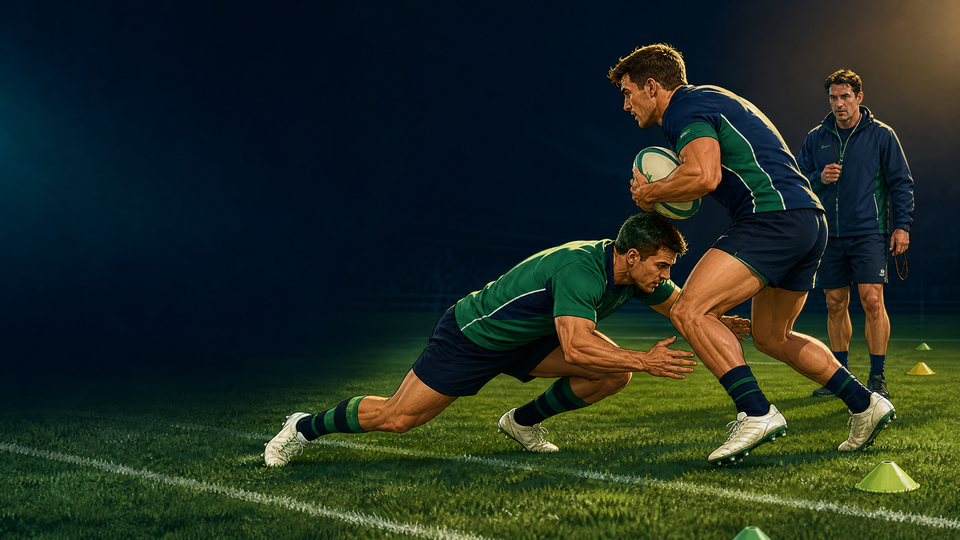
This is a 28-minute defensive skill block for teaching a repeatable tackle picture: track the ball carrier, arrive in a low and balanced power position, connect with the shoulder and arms, then finish, release and reload. It works particularly well in the first half of a defensive session, after movement preparation and before conditioned defence. The coaching intent is not to make players collide harder; it is to make them arrive earlier, lower and more accurate. World Rugby’s tackle guidance identifies eyes up, feet close, a strong low body position, head to the side or behind the ball carrier, arm wrap, release and return to feet as core actions. 1
Use this drill when your line is missing tackles because defenders are upright, reaching from too far away, or failing to regain the line after contact. Keep the carrier’s speed controlled at first; the quality standard is a stable, legal tackle picture, not a dramatic finish. Apply your Union’s current age-grade laws and tackle-height directives throughout.
Setup
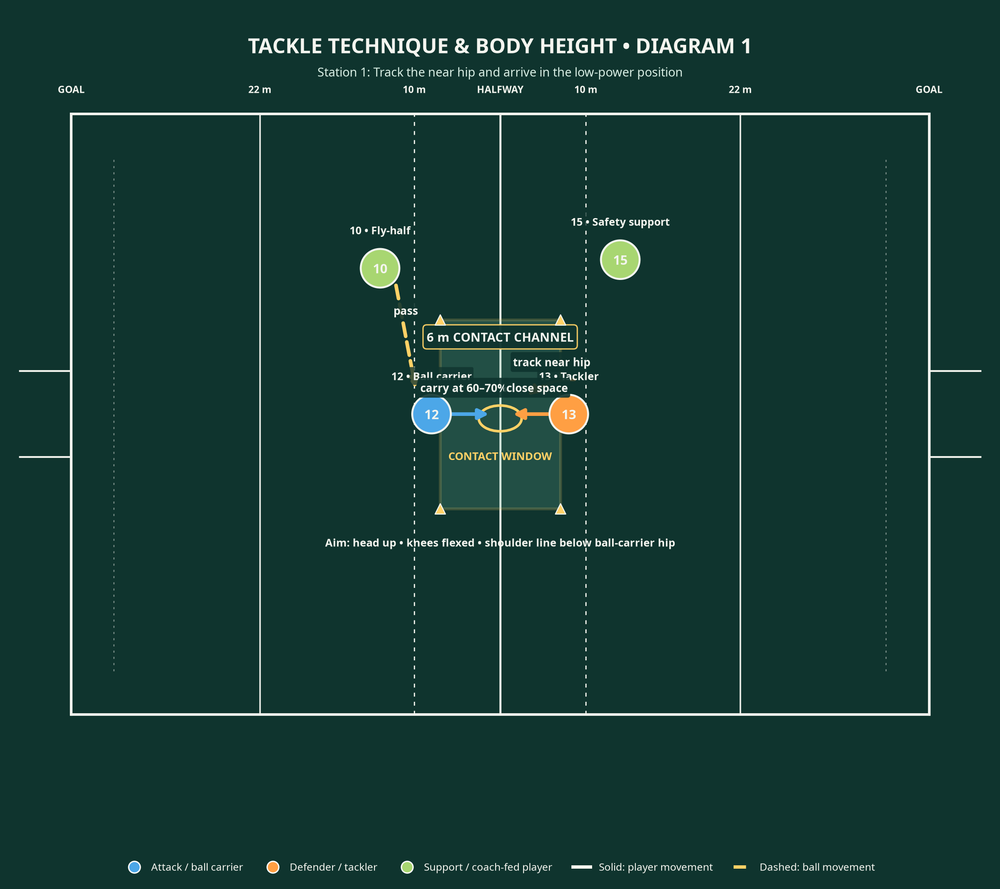
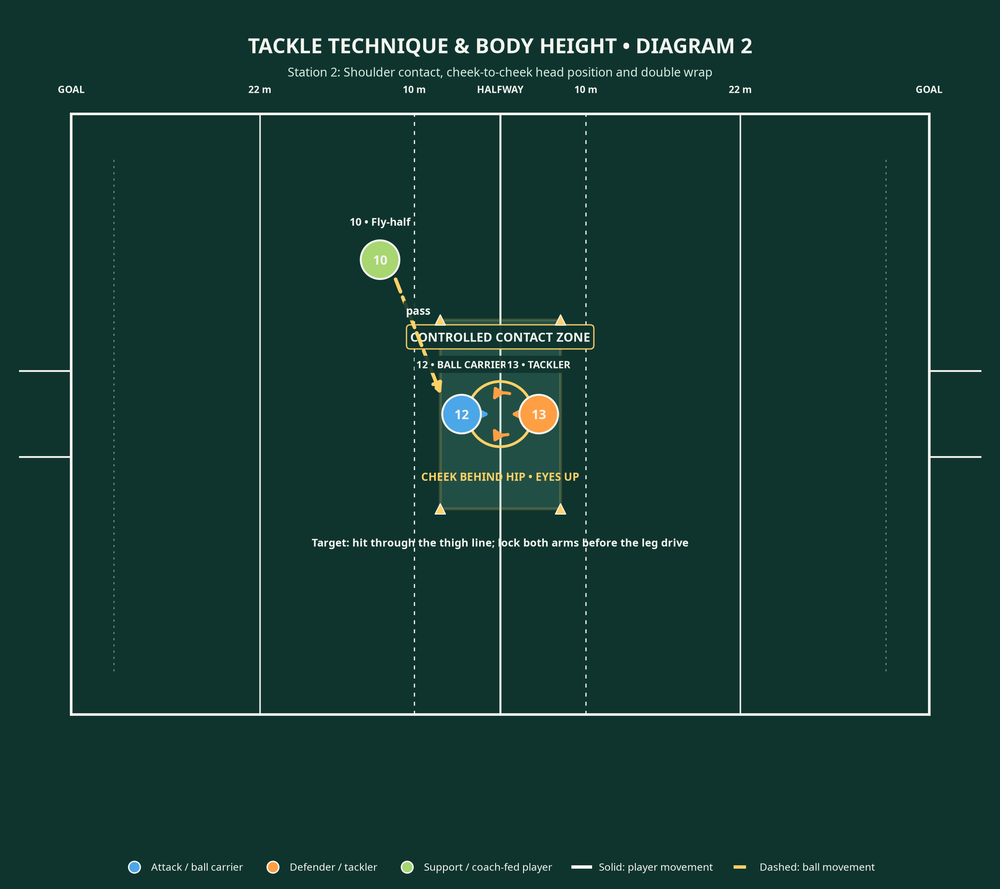
Mark the main activity around the halfway line of a full 100 m × 70 m Rugby pitch so players can understand the wider defensive context, but run the skill in one 16 m long × 12 m wide rectangle. Inside it, cone a 6 m contact channel that is 4 m wide. Use two or three identical channels if numbers allow. Each rep lasts 6–8 seconds, followed by a brisk walk-back; change roles every four reps.
| Item | Detail |
|---|---|
| Players | 8–12 per channel: 10 (fly-half feeder), 12 (inside-centre ball carrier), 13 (outside-centre tackler), 7 (openside support), 9 (scrum-half/reload feeder), plus a coach. |
| Equipment | 12–16 cones, 2 balls, 1 tackle shield or hit pad, coloured bibs, whistle and a clear first-aid plan. |
| Starting picture | Put 10 five metres behind and left of the channel. Place 12 on the left entry cone and 13 on the right entry cone, four metres apart. Put 7 just outside the tackle zone and 9 five metres behind the expected finish. |
| Coach position | Stand five metres side-on to the contact window, where you can see head placement, shoulder height and both players’ feet. Stop the drill immediately for unsafe body positions. |
Step-by-Step Instructions
Prime the shape. In pairs, rehearse the tackling stance without contact for two 20-second bouts. Tackler 13 uses a shoulder-width base, soft knees, hips back, chest proud and eyes on 12’s near hip. The coaching call is: “Eyes up, knees bent, close the space.”
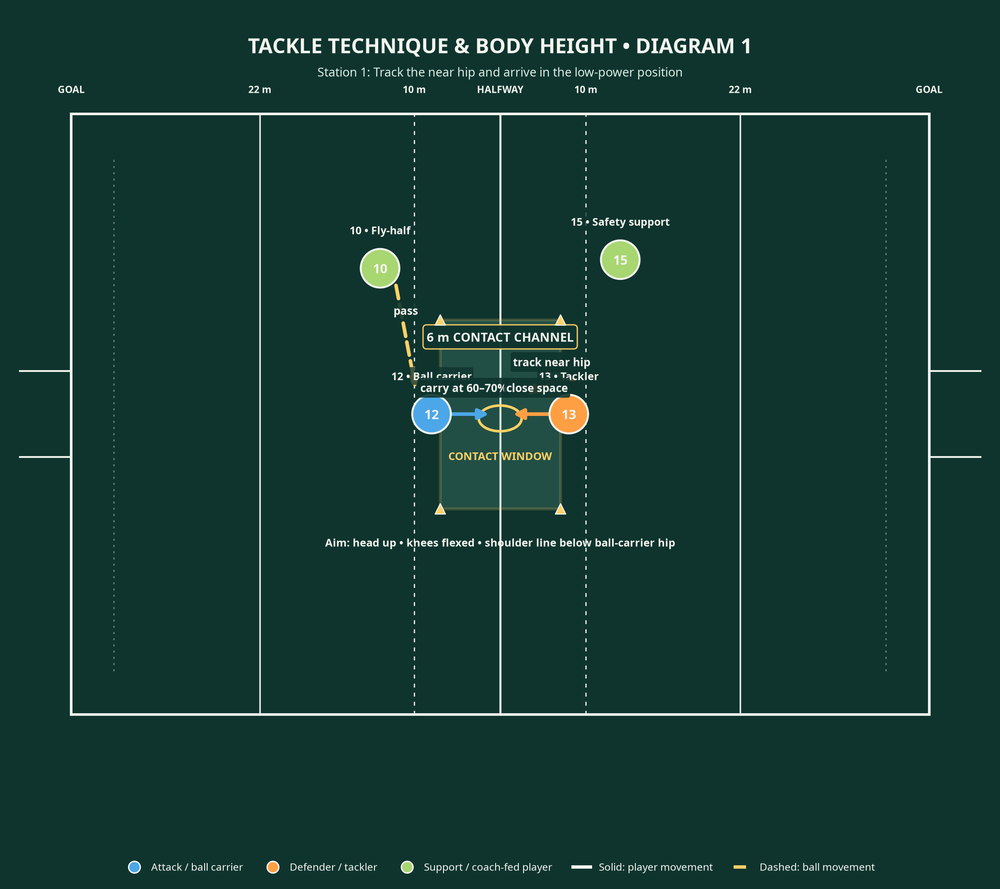
Walk and track. 10 passes to 12, who walks straight through the six-metre channel carrying in two hands. 13 shuffles, then takes short closing steps to keep their shoulder square to the near hip. There is no tackle yet: freeze 13 one metre away and check that the head is not in front of the carrier.
Add the low-power arrival. Run the same action at 50% pace. As 12 approaches the centre cone, 13 plants the lead foot close enough to connect, bends at hips and knees, and puts the shoulder target below the carrier’s hip line. Do not allow 13 to dive, reach or fold at the waist.
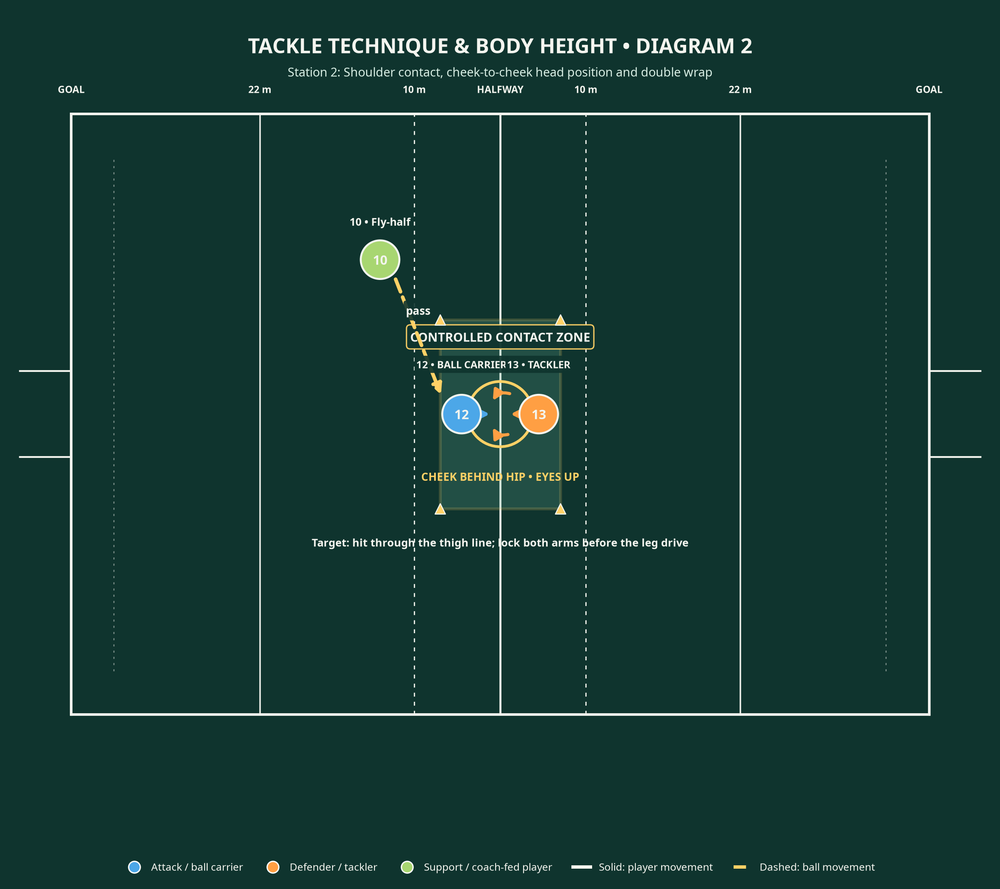
Connect to the thigh line. On the coach’s call, 13 makes controlled shoulder contact on 12’s thigh area, with the head safely behind or to the side of the carrier. 13 wraps both arms, squeezes and takes two short leg-drive steps. 12 cooperates by holding a stable running line and yielding safely to ground only when the coach has approved live completion.
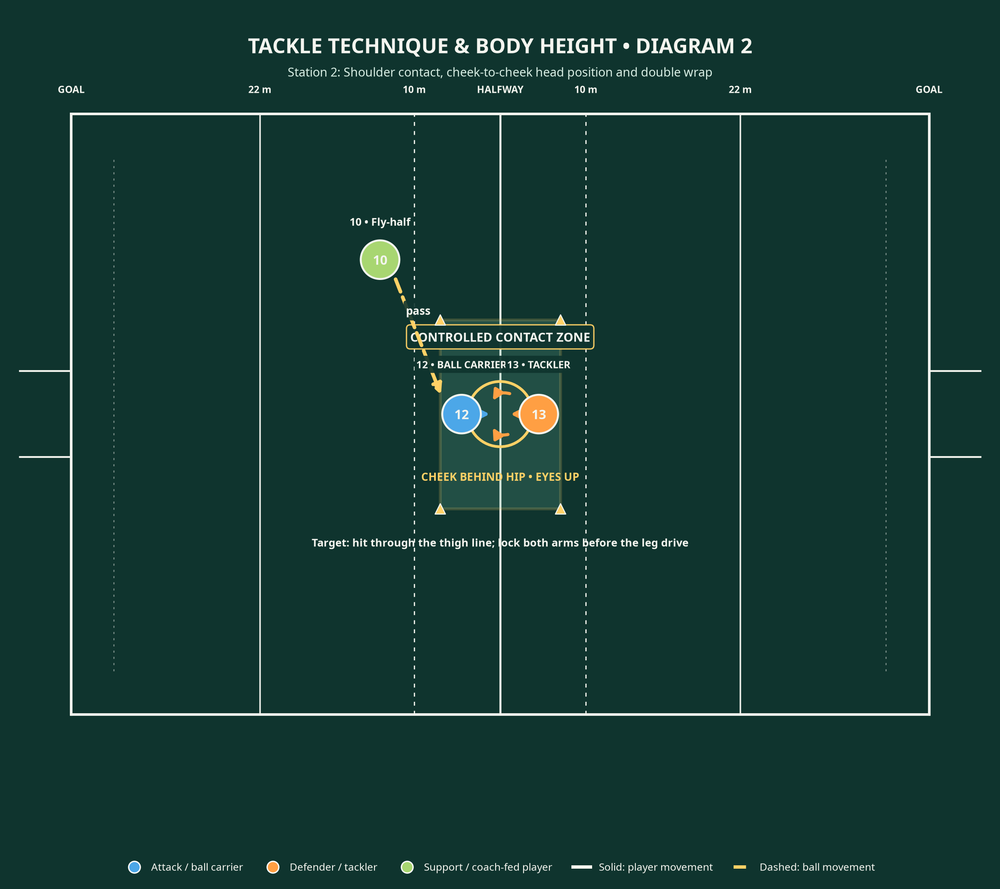
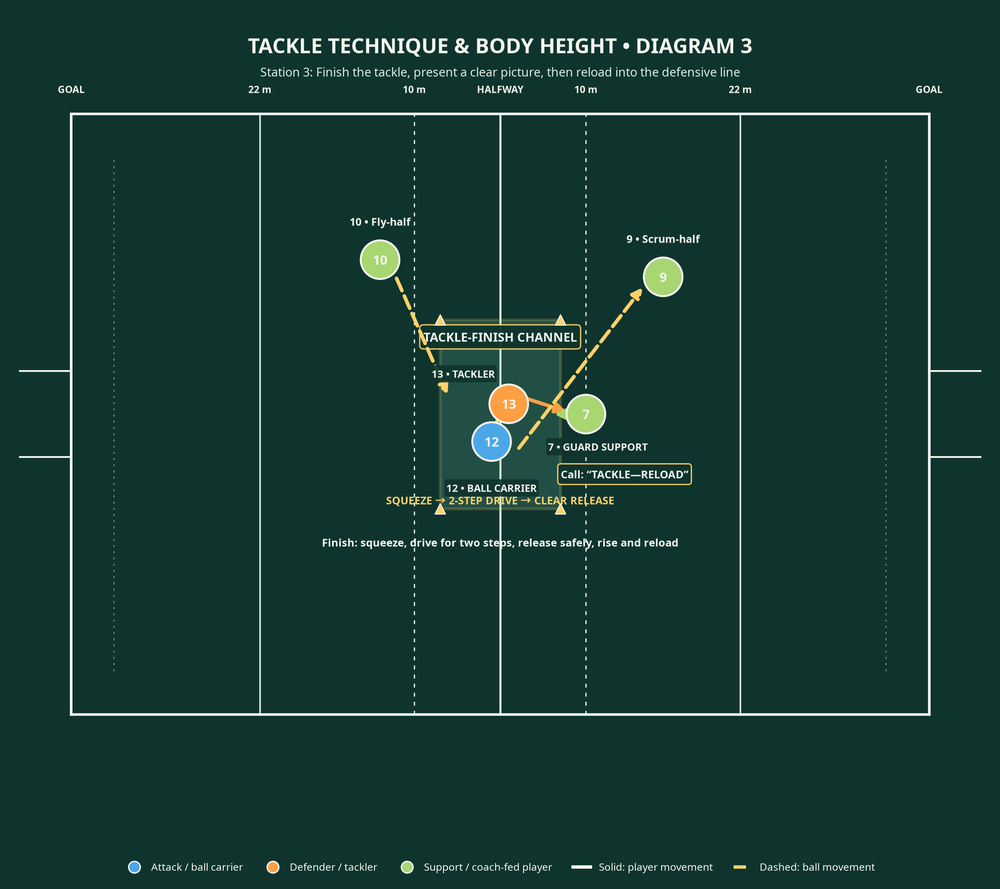
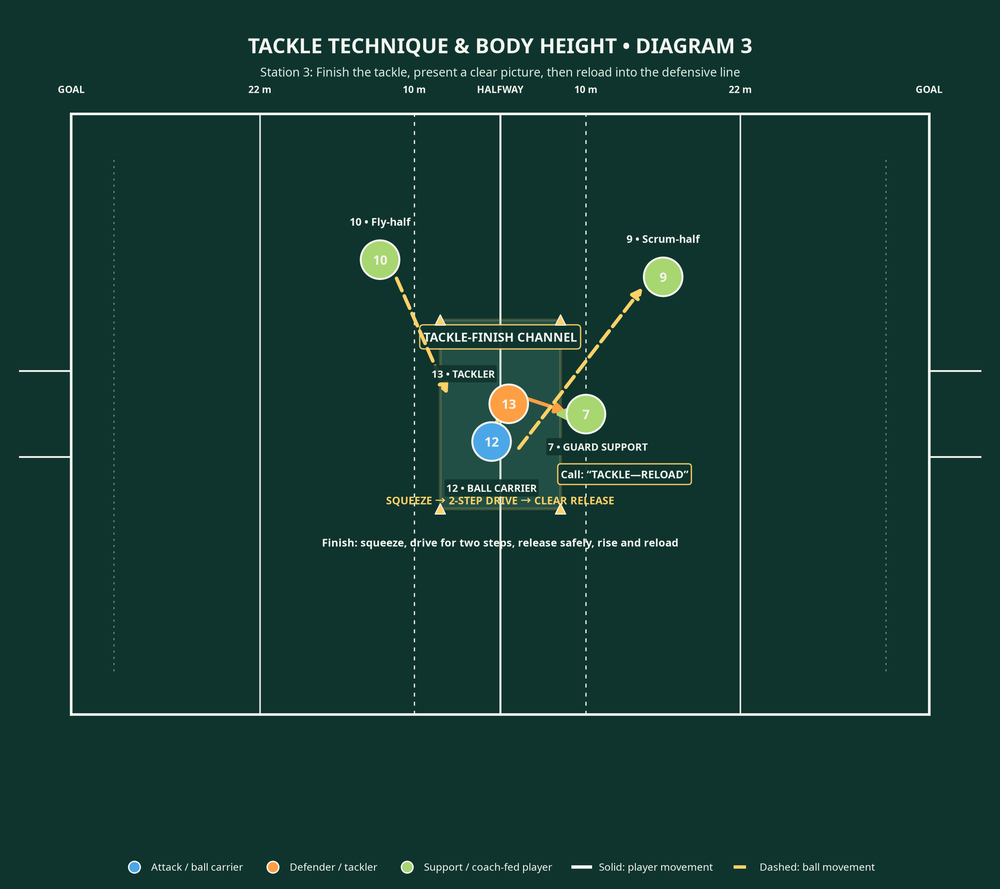
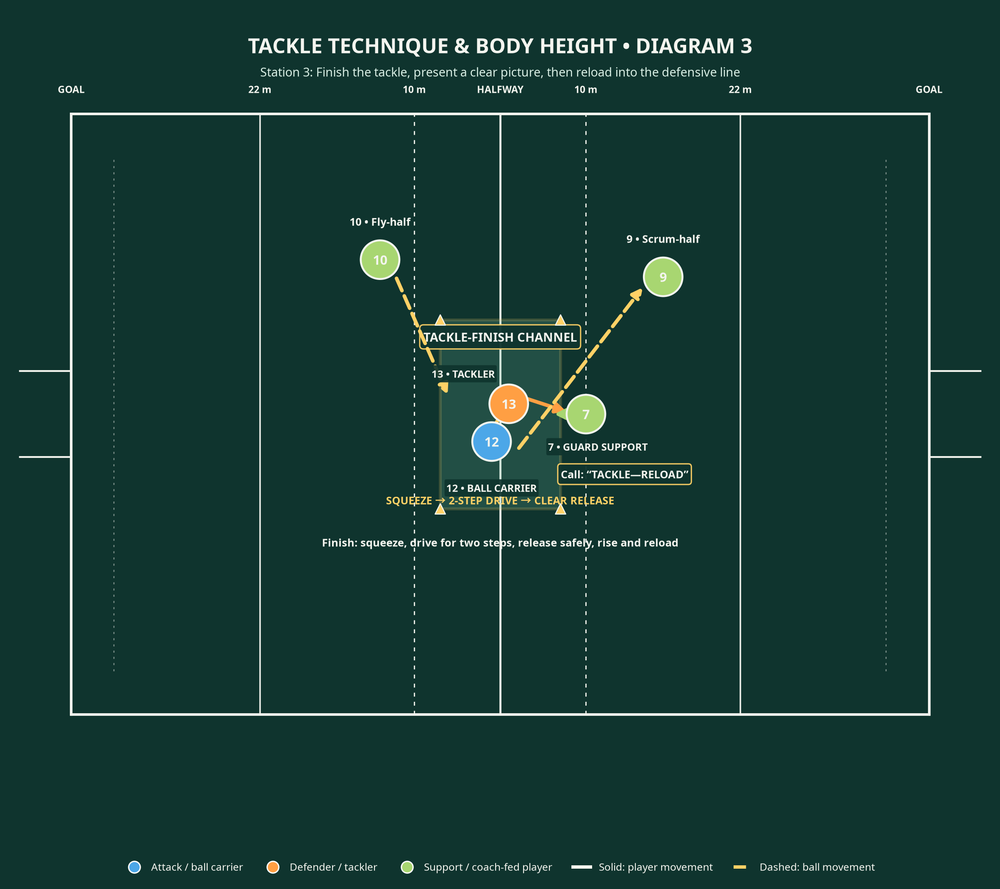
Finish legally. After the two-step drive, 13 releases 12, shows clear daylight with the hands, rises through a stable base and calls “reload.” The ball carrier turns and presents the ball towards their own team. Keep this phase slow until both players can finish without falling on top of ankles or knees.
Build the reload. Now 7 folds inside from the far cone while 9 receives a coach-fed recycled ball. As soon as 13 has released and regained feet, 13 moves to the next defensive position. The aim is to connect the individual tackle to the next decision rather than admire the contact.
Rotate and coach one variable. After four repetitions, rotate 10 → 12 → 13 → 7/9. Give one correction only—body height, foot proximity, head position, wrap, or release—then let the player immediately repeat it. This progressive sequence reflects the recognised track, prepare, connect, accelerate and finish coaching framework. 2
Condition the final block. Run a 90-second continuous block: 12 can carry straight, show a late outside step, or present a short pass from 10. 13 must call the target side before contact. Award one point for a technically clean tackle plus a full reload; no points for a dominant collision with poor technique.
Key Coaching Points
| Coaching cue | What the coach should see |
|---|---|
| Track the near hip | 13’s feet keep moving and the shoulders stay square; the player closes the space rather than launches from it. |
| Win body height early | 13 bends through hips and knees before the final step, with a strong flat back—not a head-down fold. |
| Eyes up; head safe | The tackler sees the target and keeps the head behind or to the side of 12, never directly in front. 1 |
| Shoulder then double wrap | The shoulder meets the thigh-line target and both arms clamp before leg drive. A shoulder-only hit is stopped and re-coached. |
| Squeeze, step, release | Two short drive steps create control; 13 then releases, returns to feet and reconnects to the line. |
| Coach the picture, not the collision | Praise the correct approach, body height and legal finish even when the carrier stays up. |
Common Mistakes
The usual error is an upright chase, where 13 watches the ball and arrives with straight legs. Reduce the carrier speed, use a freeze one metre out, and insist that the last two steps are short. A second error is a reaching tackle; move the entry cones closer and demand that the lead foot gets near the carrier before the shoulder moves. Third, watch for the head in front of 12. Stop immediately, reset the angle and rehearse cheek-to-hip positioning on a stationary shield. Finally, correct the player who remains on the ground after contact: make the release-and-reload call non-negotiable and withhold the point until feet are regained.
Variations & Progressions
Start with a shield progression for confidence: 13 tracks a coach-held shield at walking pace, hits the marked thigh-height target and returns to feet. Next, use the two-choice carrier: 12 may stay square or take one late step, forcing 13 to adjust feet while keeping the same safe head position. For advanced players, run tackle-to-next-job: after a legal finish, 9 passes to a second carrier and 13 must reload with 7 to make the next defensive decision within three seconds. Do not increase speed, angle or contact volume until the prior layer is consistently safe.
Age Adaptations
| Group | Adaptation | Coaching priority |
|---|---|---|
| Under 8–Under 10 | Use non-contact tracking, tag or a shield; make the lane 3 m wide and carrier pace walking only. | Tracking, bend, eyes up and safe space awareness. |
| Under 12 | Use a kneeling-to-standing or shield-to-walk progression, with short, supervised contact if permitted locally. | Head position, shoulder target and double wrap. |
| Under 14–Under 16 | Use the full walk–jog–controlled-run progression; add a late step only after clean legal finishes. | Footwork before contact, thigh-line target, release and reload. |
| Open age | Add decision pressure, line speed and a second defensive task, but cap repeat volume and rotate frequently. | Accurate tackle under fatigue, communication and defensive connection. |
Finish with a 60-second review: ask players to name the five calls—track, low, eyes up, wrap, reload—then nominate one player who demonstrated each. This leaves the group with a shared language that you can carry directly into your next small-sided defensive game.
