

Netball
Three-Stage Attacking Play from Defence: The Full Court Transition
Master the art of transitioning the ball from your defensive circle to a shooting opportunity with this structured, high-percentage three-stage set play.
What you need
1 netball, Full set of positional bibs, Flat markers (optional)
1. Overview
Transitioning the ball smoothly from the defensive third into a high-percentage shooting opportunity is one of the most challenging aspects of netball. This Three-Stage Attacking Play provides a structured, reliable method for moving the ball down the court (30.5m x 15.25m) against a set defence.
By breaking the court into three distinct stages—Defensive Clearance, Centre Third Transition, and Attacking Third Entry—coaches can teach players to execute specific roles and timings. This play is highly effective for teams that struggle with unstructured transition and frequently turn the ball over in the middle of the court. It relies on sharp angles, decisive leads, and using the full width of the court to stretch the opposition.
2. Setup
- Equipment Needed: 1 netball, full set of positional bibs, flat markers (optional, to mark specific drive channels during early learning).
- Court Setup: Full standard netball court.
- Player Positions: All 7 players (GK, GD, WD, C, WA, GA, GS) are involved in this full-court transition.
3. Step-by-Step Instructions
Stage 1: Defensive Clearance
This stage focuses on safely exiting the defensive third without getting trapped on the baseline.
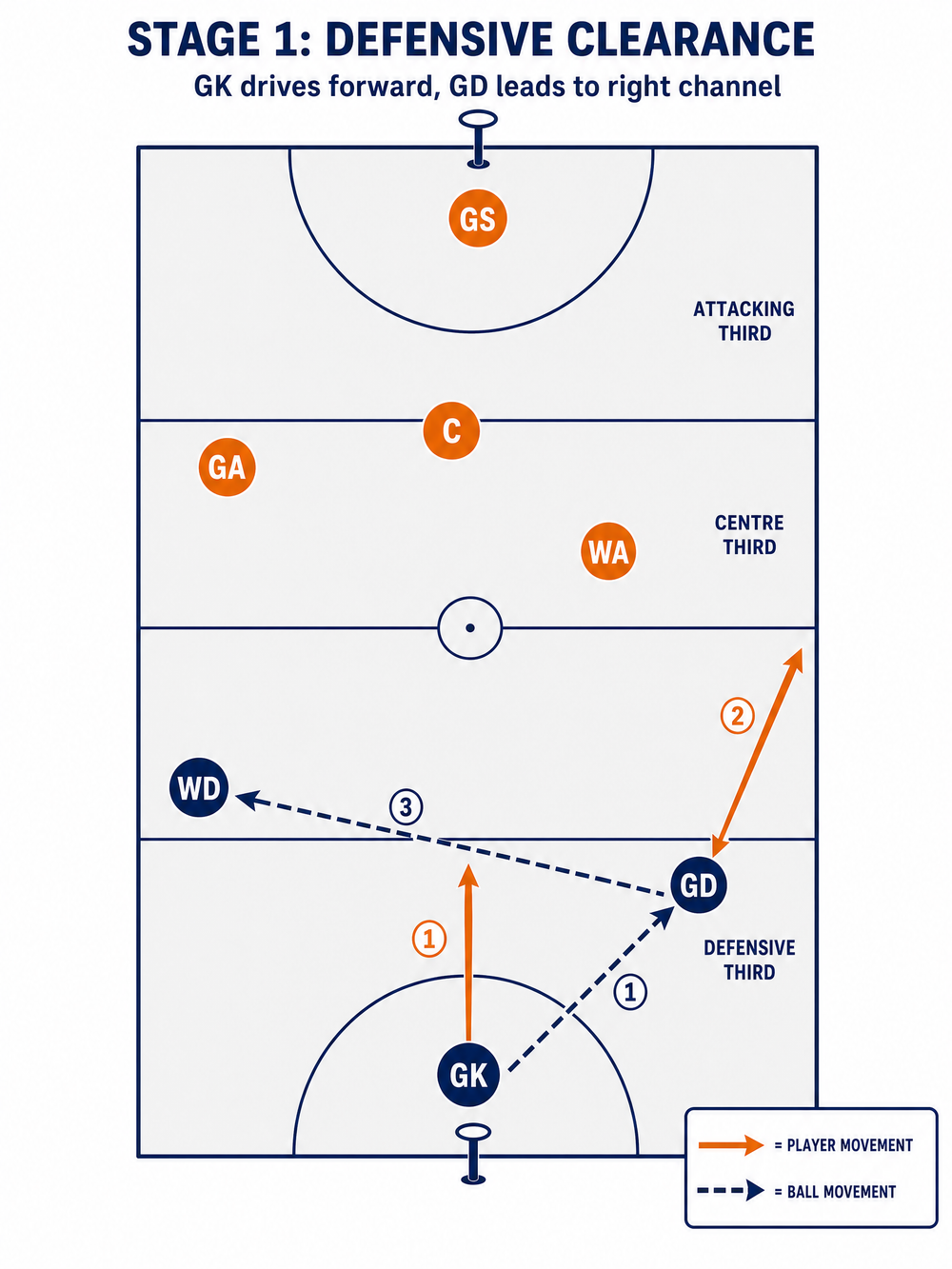
- The Setup: The GK has possession of the ball in the defensive goal circle, perhaps following a rebound or a turnover.
- The First Lead: The GD makes a strong, angled drive toward the right sideline (the right channel) to clear space and offer a safe, wide option.
- The Pass: The GK steps forward and delivers a firm chest pass to the GD.
- The Reset (if needed): The WD drops back slightly on the left side of the transverse line, offering a safe reset option if the GD is heavily contested upon receiving the ball.
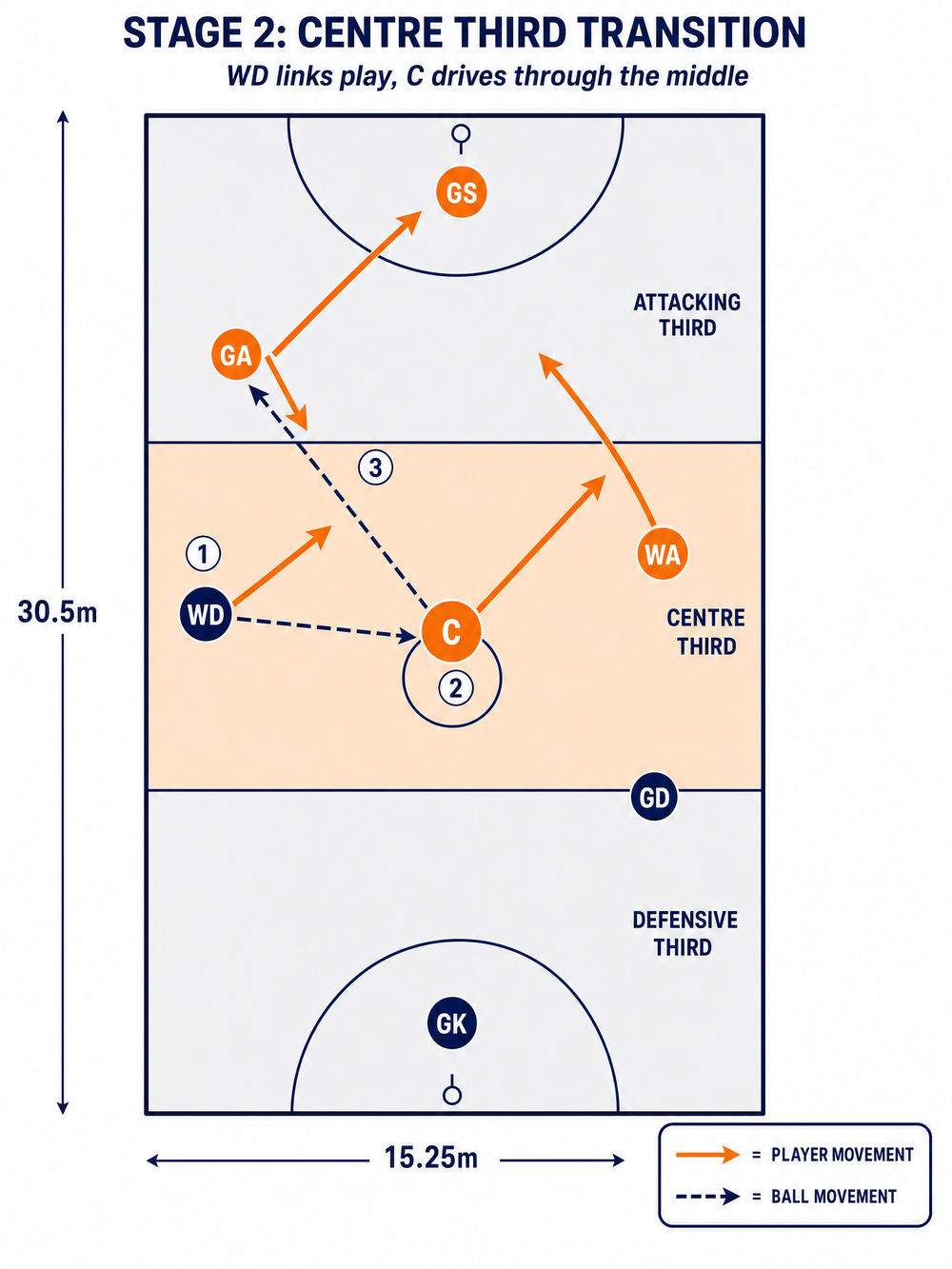
Stage 2: Centre Third Transition
This stage is about speed through the middle and linking the defensive players with the attackers.
- The Link: The WD, having held their wide position, receives the ball from the GD (or directly from the GK if the GD was covered). The WD immediately turns to face down the court.
- The Drive: The C makes a powerful, explosive diagonal drive from the centre of the court toward the right channel of the attacking third. This run is crucial as it commits the opposing WD and opens up the middle.
- The Penetration: The WD delivers a strong pass into the space ahead of the driving C.
- The Decoy: Simultaneously, the WA makes a wide lead toward the left channel, drawing their defender away from the central corridor.
Stage 3: Attacking Third Entry
This final stage focuses on entering the goal circle and creating a high-percentage shot.
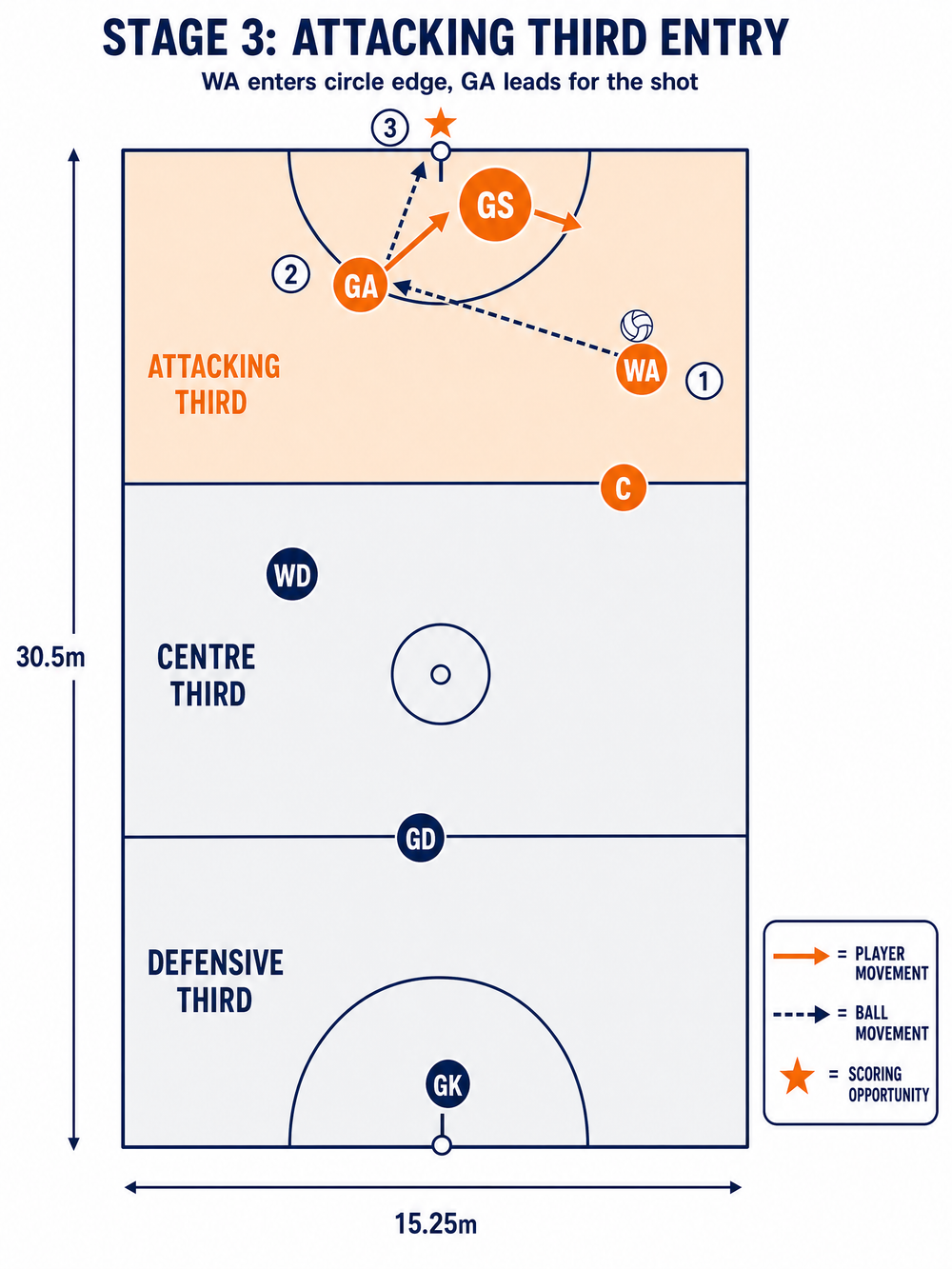
- The Circle Edge: The C, now in possession near the attacking transverse line, looks immediately to the circle edge. The WA, having completed their decoy run, cuts sharply back toward the right edge of the goal circle to receive the next pass.
- The Shooter Rotation: Inside the circle, the GS makes a strong hold near the post, then pops out toward the right side to create space underneath.
- The Final Cut: The GA, starting wide on the left, uses the space created by the GS to make a sharp, aggressive V-cut directly into the heart of the goal circle.
- The Finish: The WA delivers a precise pass to the cutting GA, who is now in prime position for a high-percentage shot on goal.
4. Key Coaching Points
- Timing is Everything: Players must not lead too early. The C must wait for the WD to secure the ball and turn before making their explosive drive.
- Angle of the Drives: Emphasise sharp, 45-degree angles rather than flat, lateral runs. Diagonal runs cut through the defence and open up passing lanes.
- Vision Down Court: The player with the ball (especially the WD and C) must get their eyes up immediately upon receiving the ball to spot the next phase of the play.
- Strong Holds: In Stage 3, the GS must demonstrate a strong, physical hold to occupy the GK and create the necessary space for the GA's cut.
- Use the Channels: Remind players to use the full 15.25m width of the court. Driving into the wide channels stretches the defence and prevents congestion in the middle.
5. Common Mistakes
- Crowding the Ball: Players running toward the ball carrier rather than driving into space, resulting in a congested mid-court and easy interceptions.
- Flat Passing: Throwing looping, slow passes rather than sharp, direct chest passes, giving the defence time to recover and contest.
- Looking Away: The receiver taking their eyes off the ball carrier before the pass is released, leading to fumbles and dropped balls.
- Ignoring the Reset: Forcing the ball forward into heavy traffic instead of using the WD or a trailing player as a safe reset option.
6. Variations & Progressions
- Progression 1: Add Defenders: Start with passive defenders (shadowing only) to allow the attacking team to learn the timing. Progress to full, contested defence.
- Progression 2: Time Limits: Introduce a 3-second rule for the entire transition (e.g., the ball must reach the attacking third within 9 seconds of the GK's first pass) to encourage speed and urgency.
- Variation 1: The Switch: If the C is heavily tagged, the WA and C can switch roles in Stage 2, with the WA making the central drive and the C taking the wide channel.
7. Age Adaptations
- Under 10s / Under 12s: Simplify the play to two stages. Focus heavily on the basic chest pass and ensuring players stop fully before passing. Use markers on the court to show exactly where players should run.
- Under 14s / Under 16s: Introduce the concept of the 'decoy run' (the WA in Stage 2) and emphasize the importance of peripheral vision.
- Open / Advanced: Focus on the speed of transition and the precision of the final pass into the circle. Introduce complex defensive scenarios and require the team to adapt the play on the fly.
