

Netball
The V-Cut Masterclass: Dodging and Leading Drill
Master the explosive V-cut dodge to shake defenders, create space, and improve midcourt transition timing in this essential attacking netball drill.
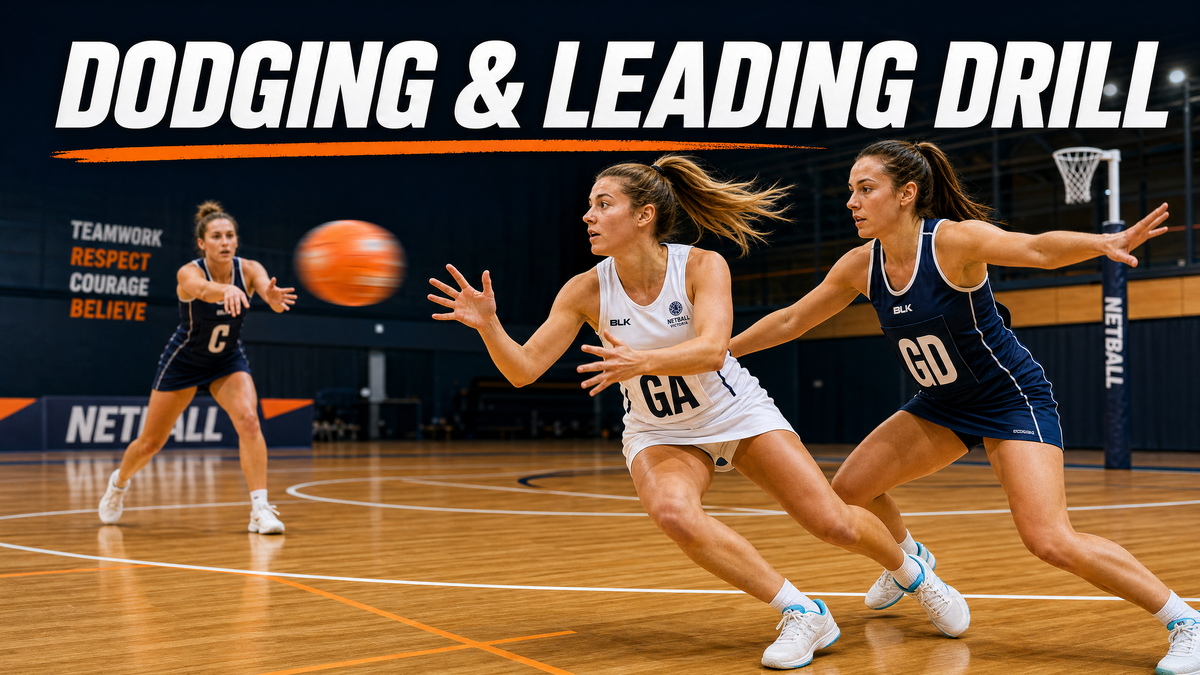
What you need
2-3 Netballs, Bibs (two colours), 4 Cones
The V-Cut Masterclass: Dodging and Leading Drill
1. Overview
The ability to lose a defender and create space is fundamental to attacking netball. This drill focuses on the "V-Cut" dodge—a sharp, explosive movement designed to unbalance the defender before driving hard into open space to receive the ball. It transitions players from basic unopposed footwork into game-like scenarios with defensive pressure. Use this drill during the main body of your session to sharpen attacking timing, improve explosive speed off the mark, and develop the feeder’s ability to read the lead.
2. Setup
- Equipment: 2-3 Netballs, bibs (at least two contrasting colours), 4 cones (optional, for marking starting positions).
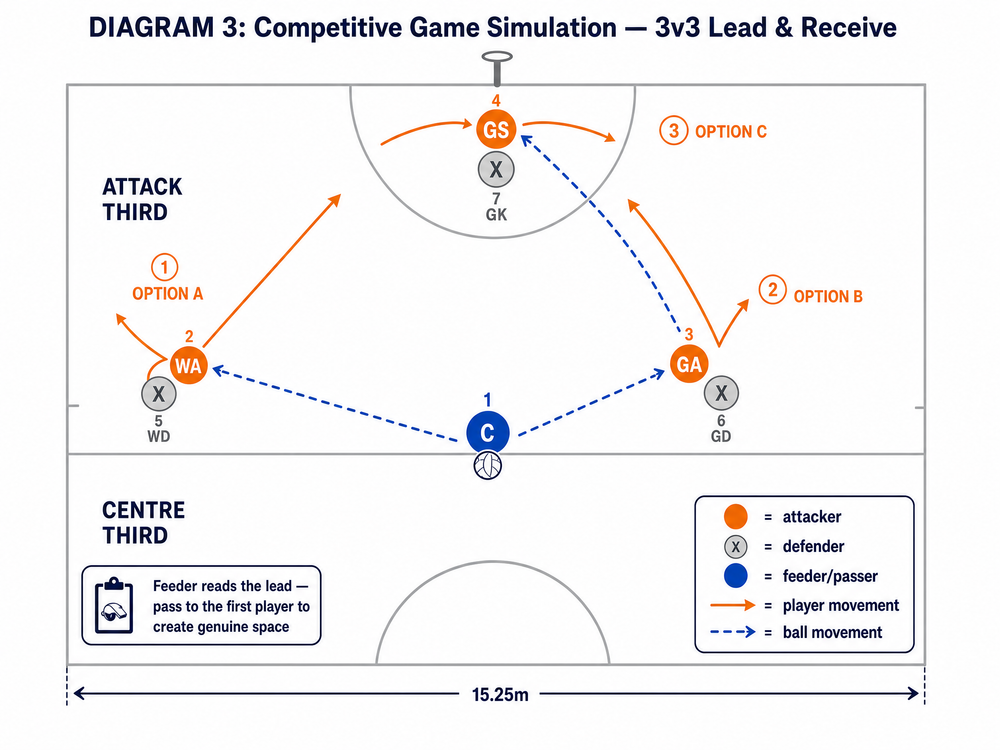
- Court Area: Centre third and one Goal third.
- Players: 6-10 players.
- Positions:
- 1-2 Feeders (C)
- 2-3 Attackers (WA, GA)
- 2-3 Defenders (WD, GD)
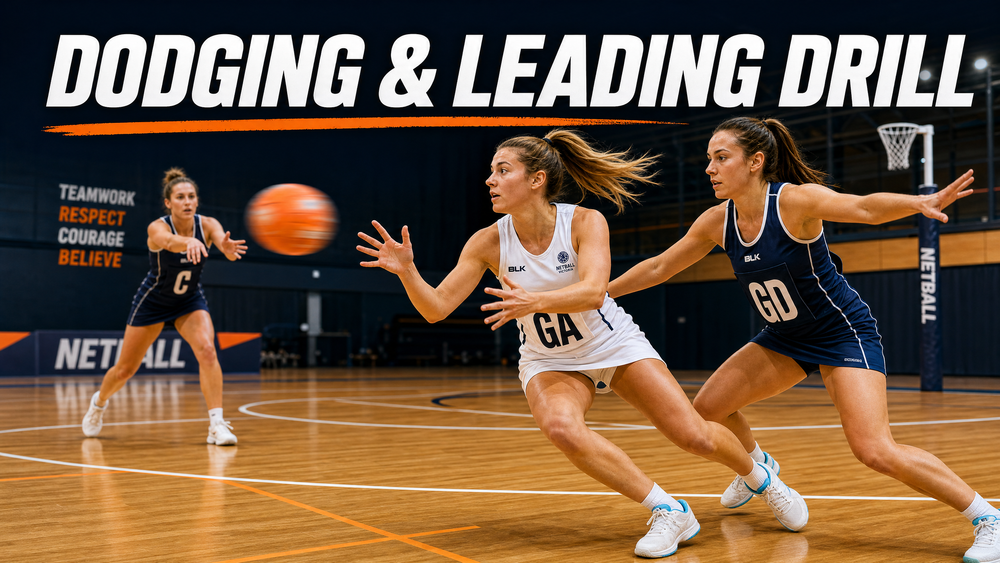
3. Step-by-Step Instructions
Phase 1: The Basic Pattern (Unopposed)
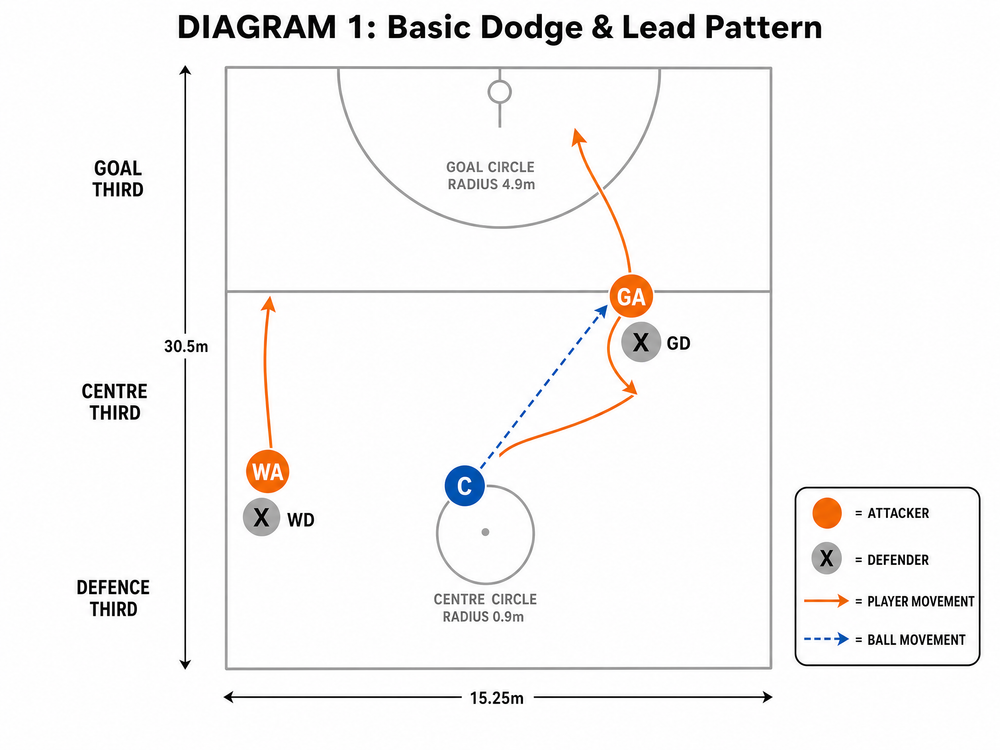
- Position a Feeder (C) with the ball in the centre circle.
- An Attacker (GA) starts near the transverse line in the goal third.
- The Attacker drives hard towards the centre (the first leg of the 'V'), taking 2-3 strong steps to commit the imaginary defender.
- The Attacker plants their outside foot, pushes off explosively, and changes direction sharply to lead out into the open space (the second leg of the 'V').
- The Feeder delivers a firm chest pass out in front of the Attacker so they can run onto the ball.
- The Attacker lands, balances, and passes back to the Feeder. Repeat 5 times, then swap roles.
Phase 2: Adding the Defender (Opposed)
- Introduce a Defender (GD) to mark the Attacker.
- The Defender dictates the starting position (e.g., inside or outside shoulder).
- The Attacker must use the V-cut dodge to shake the Defender. The first drive must be convincing enough to make the Defender shift their weight.
- The Feeder must wait for the Attacker to clear the Defender before releasing the pass. If the Attacker is covered, they must reset and dodge again.
Phase 3: The Double Lead Sequence
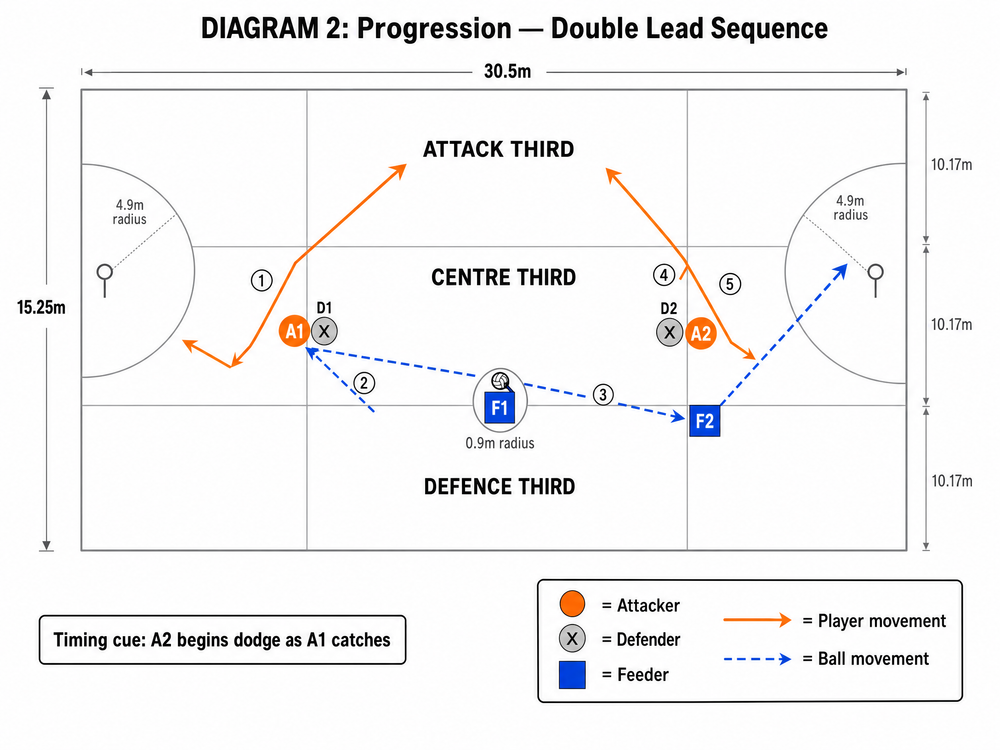
- Set up two Attackers (WA and GA) and two Defenders (WD and GD).
- The Feeder (C) holds the ball in the centre.
- WA initiates a dodge and lead to receive the first pass.
- Timing Cue: As WA catches the ball, GA must immediately initiate their dodge and lead to receive the second pass from WA.
- This simulates the rapid transition of the ball through the midcourt to the goal circle edge.
4. Key Coaching Points
- Sell the Fake: The initial movement of the dodge must be a genuine, hard drive. If the attacker just jogs a few steps, the defender won't react. Drop the shoulder and commit to the fake direction.
- Explosive Push-Off: The change of direction must be sharp. Players need to plant their outside foot firmly, bend their knees, and push off powerfully to create separation.
- Angle of the Lead: The lead should be at a 45-degree angle to the feeder, not flat across the court. This makes it easier to run onto the ball and harder for the defender to intercept.
- Eyes on the Prize: The attacker must turn their head to look for the ball immediately after pushing off for the lead.
- Feeder Timing: The feeder must release the ball as the attacker is driving into the space, not after they have arrived and stopped. Pass to the space, not the player.
5. Common Mistakes
- Rounding the Corner: Instead of a sharp V-cut, attackers run in a curved 'U' shape. This is slow and allows the defender to easily stay with them. Correction: Enforce a hard plant and push-off.
- Leading Too Early: The attacker completes their dodge before the feeder is ready to pass, resulting in them waiting for the ball and allowing the defender to recover. Correction: Emphasise eye contact and timing with the feeder.
- Passing Behind the Player: The feeder throws the ball directly at the attacker rather than out in front of them. Correction: Tell feeders to aim for the attacker's outstretched hands in the space they are running into.
- Taking Eyes Off the Ball: The attacker looks away during the catch to see where they are going next, resulting in a fumble. Correction: "Watch the ball into your hands."
6. Variations & Progressions
- Progression 1 (Continuous Flow): After receiving the pass, the attacker immediately becomes the next feeder, the defender becomes the attacker, and the feeder joins the defensive line. This keeps the drill moving quickly with high intensity.
- Progression 2 (The Reset): If the defender successfully covers the first lead, the attacker must immediately execute a second dodge (e.g., a roll or a sprint back) to get free. The feeder must learn to hold the ball and wait for the second option.
- Variation (Confined Space): Set up a 5m x 5m box with cones. The attacker must get free and receive three consecutive passes within the box against a defender. This develops agility in tight areas.
7. Age Adaptations
- Under 8 / Under 10: Remove the defenders entirely. Focus purely on the footwork of the V-cut—planting the foot and pushing off. Use cones to mark exactly where they should run. Use softer, larger balls if necessary.
- Under 12 / Under 14: Introduce passive defence (the defender follows but doesn't try to intercept) before moving to active defence. Focus heavily on the timing between the feeder and the attacker.
- Under 16 / Open: Run the drill at match intensity with full defensive pressure. Introduce complex scenarios like double-teaming or switching defenders, requiring the attackers to communicate and read the play to create space.
