Basketball
4-Up Flash Full-Court Press Break Drill
Teach players to beat full-court pressure with purposeful inbound cuts, a late middle flash, and an immediate advantage attack.
What you need
1 basketball, full FIBA court, two sets of bibs, 4 flat cones
1. Overview
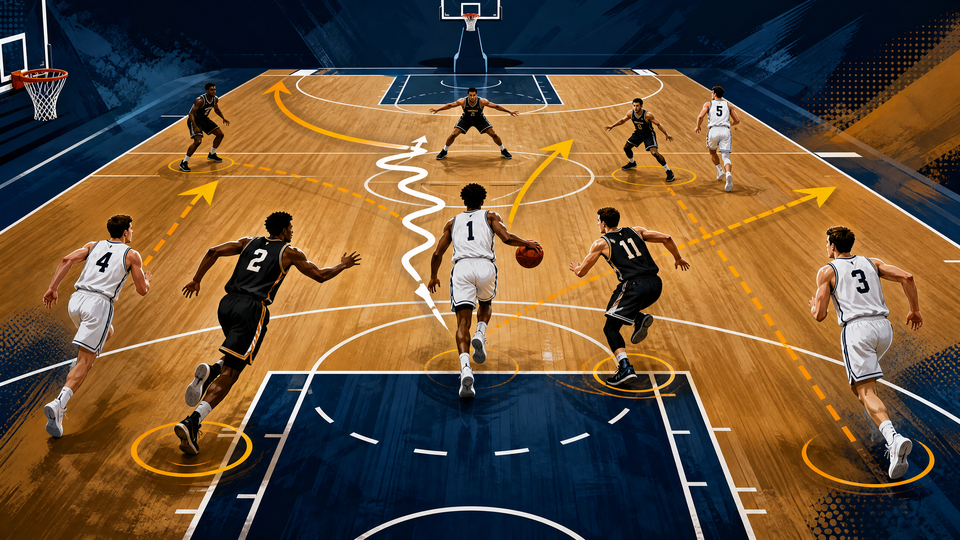
The 4-Up Flash Full-Court Press Break gives a coach a repeatable teaching progression for beating full-court man pressure, 1-2-1-1 diamond pressure, and 2-2-1 zone pressure without asking a young guard to dribble through two defenders. The objective is simple: secure the inbound, create a safe first catch, reverse through the middle, and turn the broken press into a numbers advantage at the far basket. The drill should feel like an attacking transition drill, not a survival exercise.
Run it early in the week before an opponent that extends pressure, then revisit it in short six-to-eight-minute blocks during the season. Lay it out on a full FIBA court: 28 m x 15 m. The inbounder must also work with urgency because FIBA allows only five seconds to release a throw-in.1
| Session item | Coach standard |
|---|---|
| Group | 10 players; 5 offense vs. 5 defense |
| Time | 18 minutes: 6 teach, 8 live, 4 review |
| Goal | Cross half court with control, then create a rim attempt within 6 seconds |
| Reset | New offensive five after each score, turnover, or defensive stop |
2. Setup
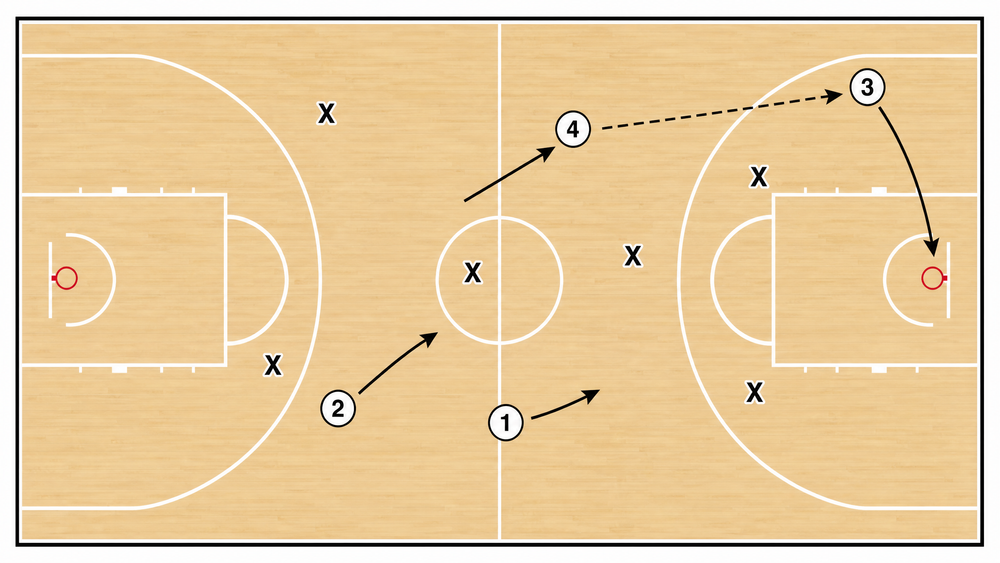
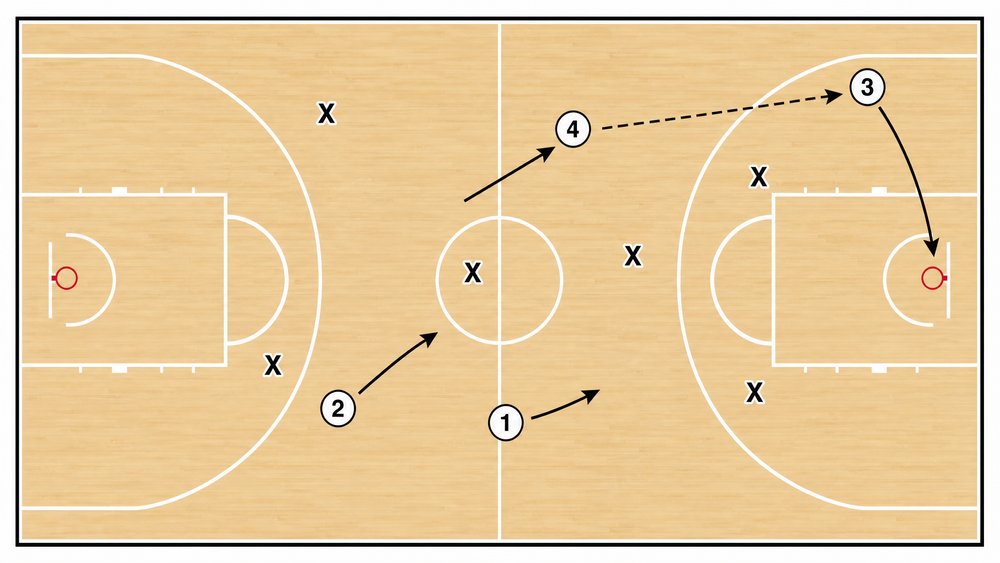
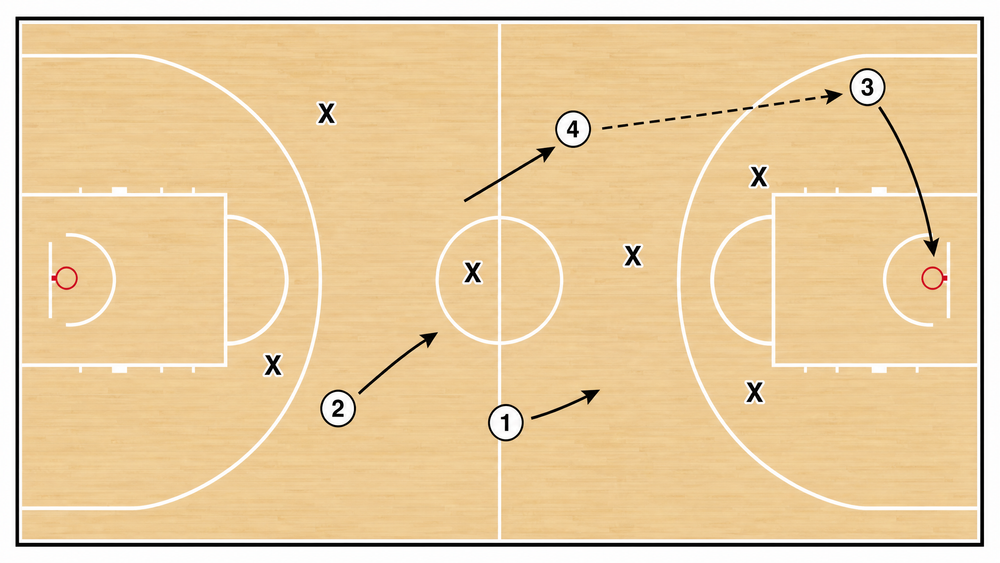
Use one ball, two contrasting bib colours, and four flat cones. Place a cone on each sideline at the free-throw-line extended in the backcourt; these are the release landmarks for 2 (shooting guard) and 3 (small forward). Set another cone in the centre of the middle circle for 4 (power forward), and one on the far rim line for 5 (centre). The coach stands on the inbound sideline with the remaining balls.
Start 1 (point guard) out of bounds on the baseline with the ball. Player 2 begins wide right and player 3 wide left, each roughly 3 m above the backcourt free-throw-line extended. Player 4 begins just behind half court and stays central. Player 5 starts deep at the opposite rim, ready to run behind the press and occupy the last defender. The defense matches five players in the press alignment you want to train against. First install the pattern with defenders shadowing, then move directly to live pressure.
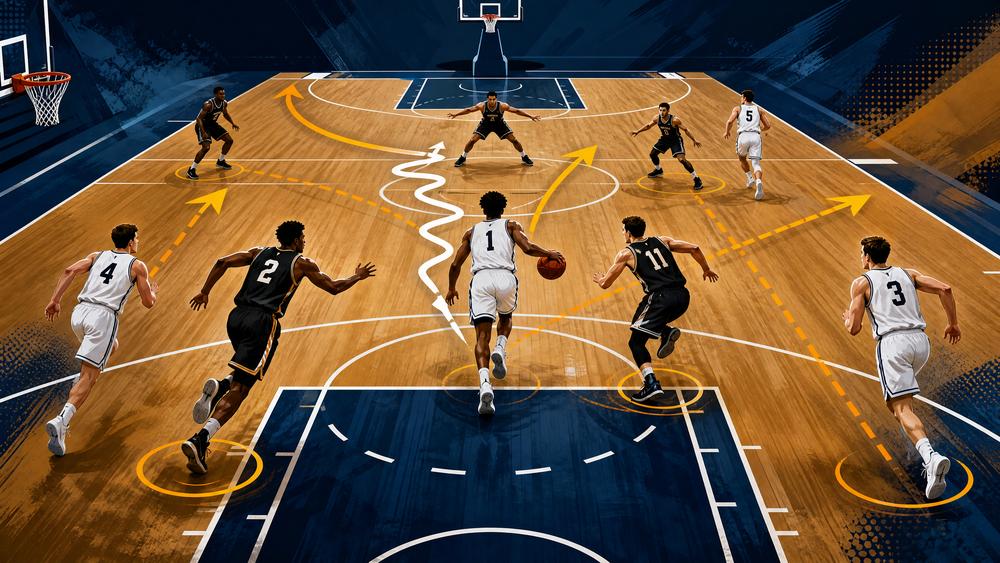
Diagram 1 — starting alignment and release cuts. Solid arrows show player movement; the broken line represents the inbound pass.
3. Step-by-Step Instructions
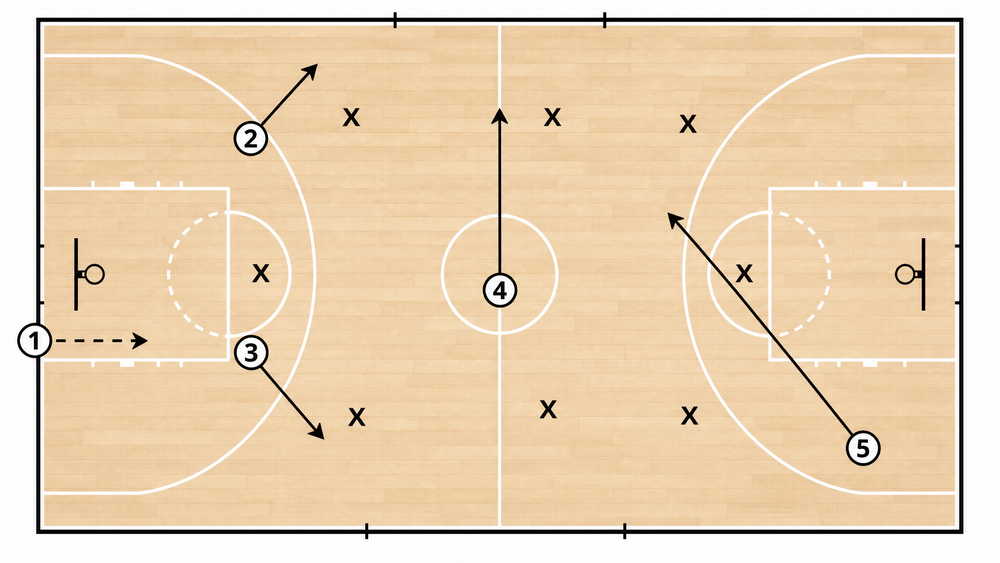
Call the release and trigger the action. The coach calls “right” or “left” so the group knows the intended first receiver. Player 1 pivots to see the whole floor, slaps the ball once, and uses a convincing pass fake to move the nearest defender. Player 2 and player 3 begin with a hard V-cut: first step toward the basket to lose the defender, then explode back to the ball-side release cone. The non-ball-side wing holds width; do not allow both wings to cut into the same lane.
Secure a forward-facing first catch. Player 1 throws a chest pass or overhead pass to the receiver's outside shoulder. The receiver meets the pass with two hands, lands balanced, and immediately pivots to face the middle of the court. This first catch is a decision point, not a dribble cue. Player 2 has a two-second scan: can they pass forward up the sideline to 3 or 5; can they reverse; or is the middle flash now available?
Use the sideline only as an escape route. If the defender is late and the sideline is clear, player 2 may take one controlled dribble forward to improve the passing angle. The second a trap arrives, the ball must leave. Tell the ballhandler: “Sideline is a runway, not a prison.” The nearest outlet stays 4–5 m behind and inside the ball; the far wing sprints to keep a passing lane across the court.
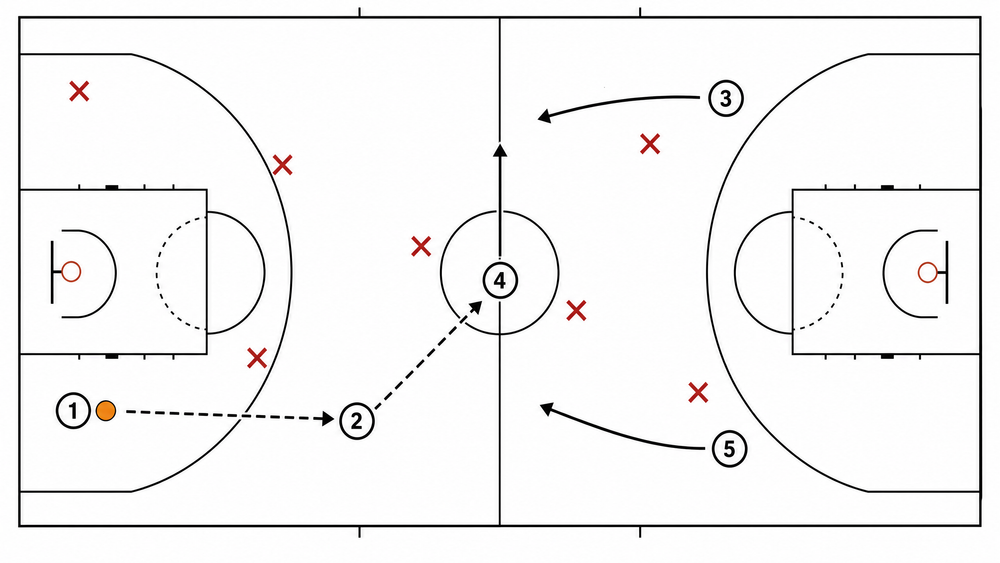
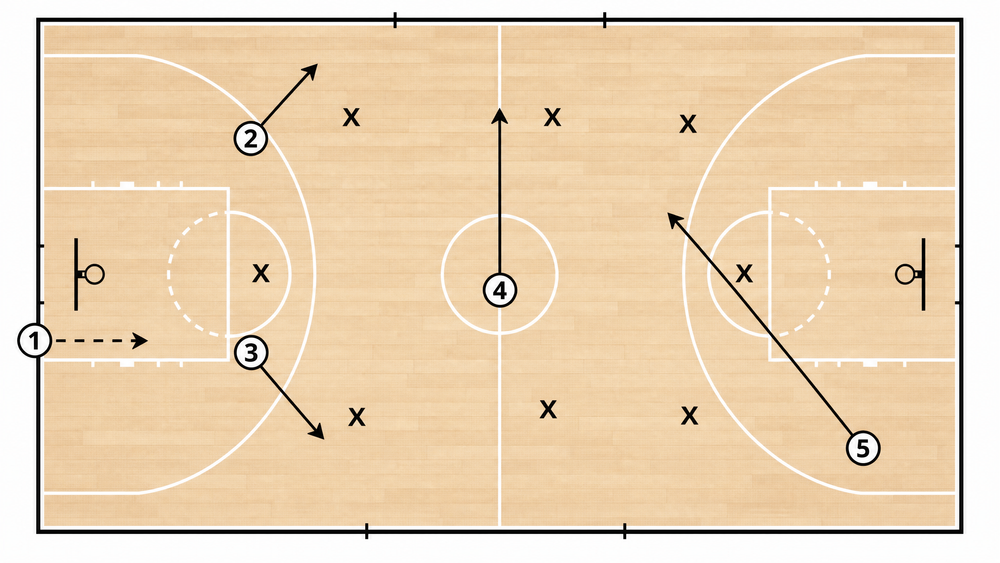
Flash 4 to the middle on the catch. Player 4 waits until the first receiver has possession, then sprints into the centre circle with hands high and feet ready to stop. The timing matters: flashing too early lets a top defender sit on the pass; flashing late turns the trap into a turnover. Player 4 must arrive in the middle with a clear passing window, approximately 5 m away from the trap, never directly behind it. Player 2 delivers a firm pass to 4's front hand.
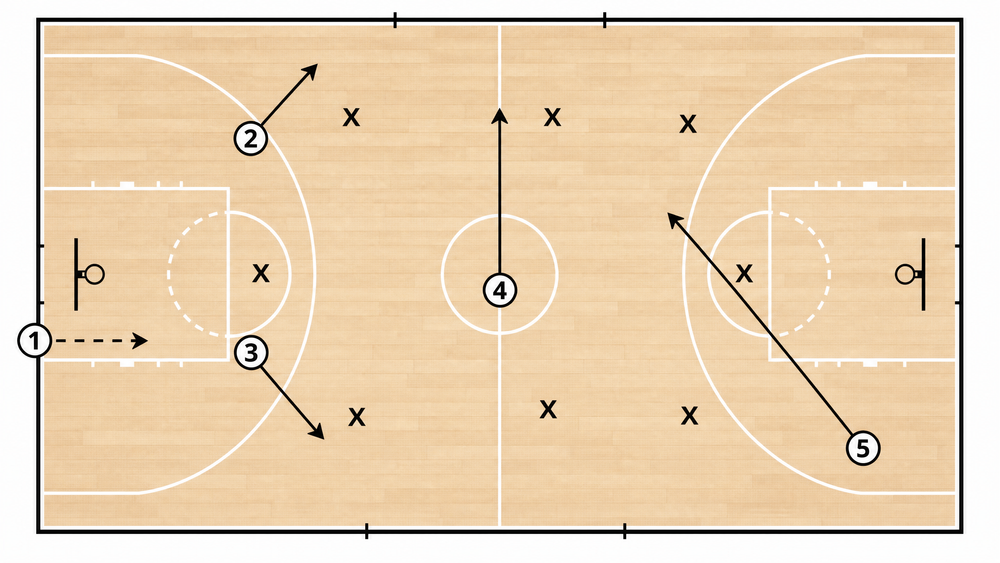
Diagram 2 — middle flash and reversal. The ball reverses from 2 to the flashing 4 while the wings stretch the press.
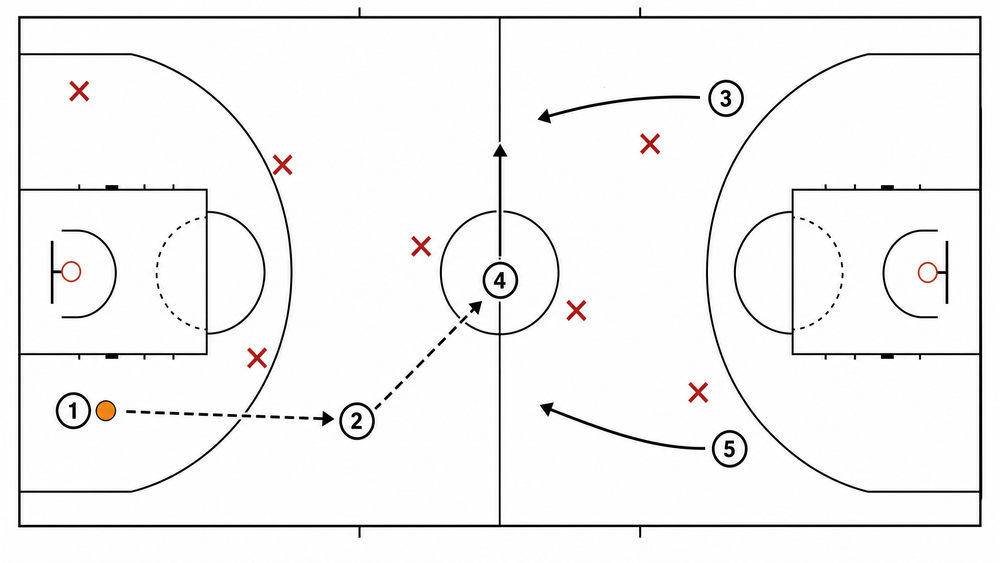
Turn the middle catch into an attack. Once Player 4 catches inside the centre circle, they chin the ball, pivot forward, and read the lowest defender. Player 3 now sprints the weak-side lane, outside the three-point line until the last pass. Player 2 trails up the middle as a safety valve. Player 5 runs rim-to-rim, sealing the deepest defender or presenting a target at the front of the rim. Player 4 should make a decision within one second: advance pass, attack the open lane, or hit the trailing outlet.
Finish with spacing and a game consequence. The preferred finish is a pass ahead from 4 to 3 for a lay-up or paint touch. Player 3 must catch moving downhill and finish through contact; player 5 rebounds every miss; player 2 fills behind the ball for a kick-out; and player 1 becomes the safety behind the play. Award the offense one point for crossing half court under control and two points for a score. Award the defense two points for a live-ball turnover or a stop. Play first to 10, then switch the pressing group.
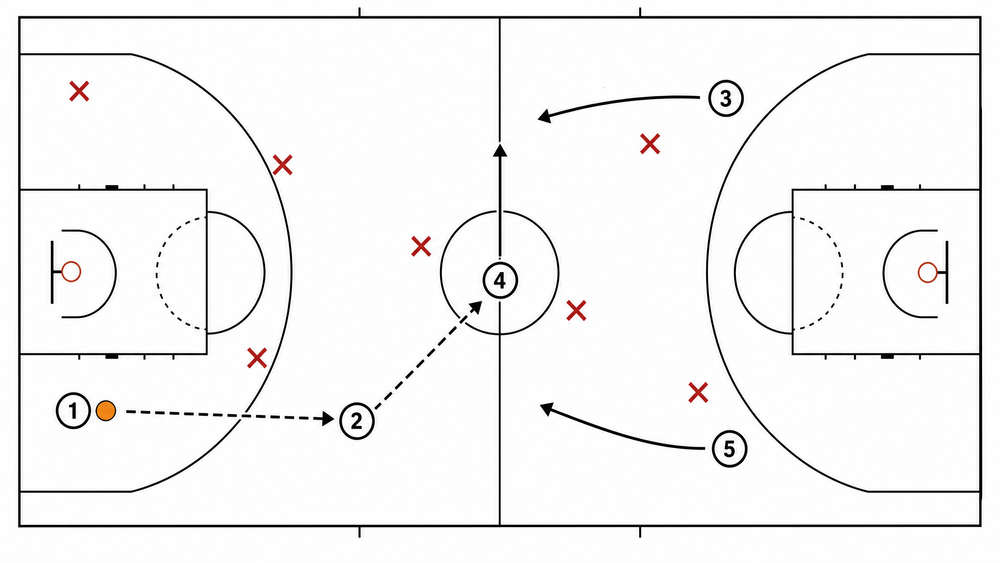
Diagram 3 — attack and finish. Player 4 advances the ball and releases 3 down the open side for the finish.
4. Key Coaching Points
- Meet every pass. A receiver who waits becomes stationary prey. Demand two hard steps to the ball and a two-hand catch.
- Pass before dribble. The ball moves faster than any player. The first receiver looks forward, then middle, before putting the ball down.
- Keep 15 m of width. Wings are valuable when they stay near the sideline; crowded players make a trap easier.
- Flash late, catch square. Player 4's job is to arrive behind the first line of pressure, with shoulders facing the far basket and hands showing a target.
- Punish the press. A middle catch means advantage. Demand a paint touch or quality shot rather than merely dribbling over half court.
5. Common Mistakes and Corrections
| Mistake | What the coach should say |
|---|---|
| Inbounder rushes a covered pass | “Use your fake; make the defender move first.” |
| First receiver dribbles into the corner | “Face middle—one dribble is plenty.” |
| Both wings drift toward the ball | “Hold width; make the defense cover the full floor.” |
| Player 4 flashes too soon | “Wait for the catch, then sprint through the window.” |
| Far players admire the break | “Sprint to score or sprint to rebound—no spectators.” |
6. Variations & Progressions
Begin with 5-on-0: walk through spacing and pass sequence for two minutes, then run it at game speed. Progress to 5-on-4, removing the deepest defender so players can recognise the middle catch and finish. Finally, play 5-on-5 live with a declared 1-2-1-1 or 2-2-1 press. Add a no-dribble rule in the backcourt to force passing and pivoting, then permit only one dribble before half court. For advanced groups, tell the defense to deny the middle flash; the offense must then reverse through the opposite wing and re-flash 4 behind the next line of pressure.
7. Age Adaptations
For Under-10 and Under-12, shorten the court to three-quarter length, remove one defender, and allow the first receiver two protective dribbles. Coach the V-cut, jump stop, pivot, and chest pass before introducing a live trap. At Under-14 and Under-16, use the full 28 m court, make the defense trap the first catch, and score every decision. For open-age and senior teams, use scouting-specific press alignments, add a six-second score clock after the middle catch, and insist on role clarity: 1 is safety, 2 and 3 are wide outlets, 4 is the central decision-maker, and 5 is the rim runner.
References