Basketball
Box Flash Flare: End-of-Game Buzzer-Beater Baseline Play
Install a timed baseline out-of-bounds action that frees a primary shooter for a buzzer-beating flare three while preserving a built-in rim-slip counter.
What you need
1 regulation basketball, 1 regulation basket, 5 offensive pinnies, 5 defensive pinnies for live reps, visible countdown clock or coach timer, 4 floor markers or cones
Box Flash Flare: End-of-Game Buzzer-Beater Baseline Play
Overview
Box Flash Flare is a baseline out-of-bounds set that frees a perimeter scorer for a catch-and-shoot three while preserving a rim counter. Use it with roughly 4.5–7.0 seconds left when you need three points after a timeout, foul, or dead ball. The action creates a safe inbound, then a cross-screen and pin-down flare.
This resource uses a FIBA half-court: 15 m × 14 m from baseline to centre line, within the full 28 m × 15 m court. The shooting window is beyond the FIBA 6.75 m three-point arc.1 The set works only when the first action forces the defense to react before the flare begins.
Coach’s call: “Box Flash — 2 is the shot, 5 is the slip, 3 owns the clock.”
Setup
Run this on the right side as shown and mirror it for a left-wing shooter. Use one ball, a regulation basket, a visible timer, pinnies, and five offensive players; add five defenders once the route and screen angles are clean.
| Player | Starting spot and distance | Job in the play |
|---|---|---|
| 1 — Point Guard / Inbounder | On the baseline, 0.5 m to the ball-side of the rim line | Delivers the first pass, then clears to the ball-side corner. |
| 2 — Shooting Guard / Primary Shooter | Weak-side low block, about 3.25 m from the baseline and 3.5 m left of the rim | Sells the first cut, then uses both screens to flare beyond the arc. |
| 3 — Small Forward / Safety | Ball-side elbow, 5.8 m from the baseline | Lifts into the safety window, catches the inbound, reads, and delivers the second pass. |
| 4 — Power Forward / Cross-screener | Weak-side elbow | Cross-screens first, then seals weak-side help. |
| 5 — Centre / Flare-screener | Ball-side low block | Pins the chaser for 2; slips straight to the rim if the defense top-locks or switches. |
Step-by-Step Instructions
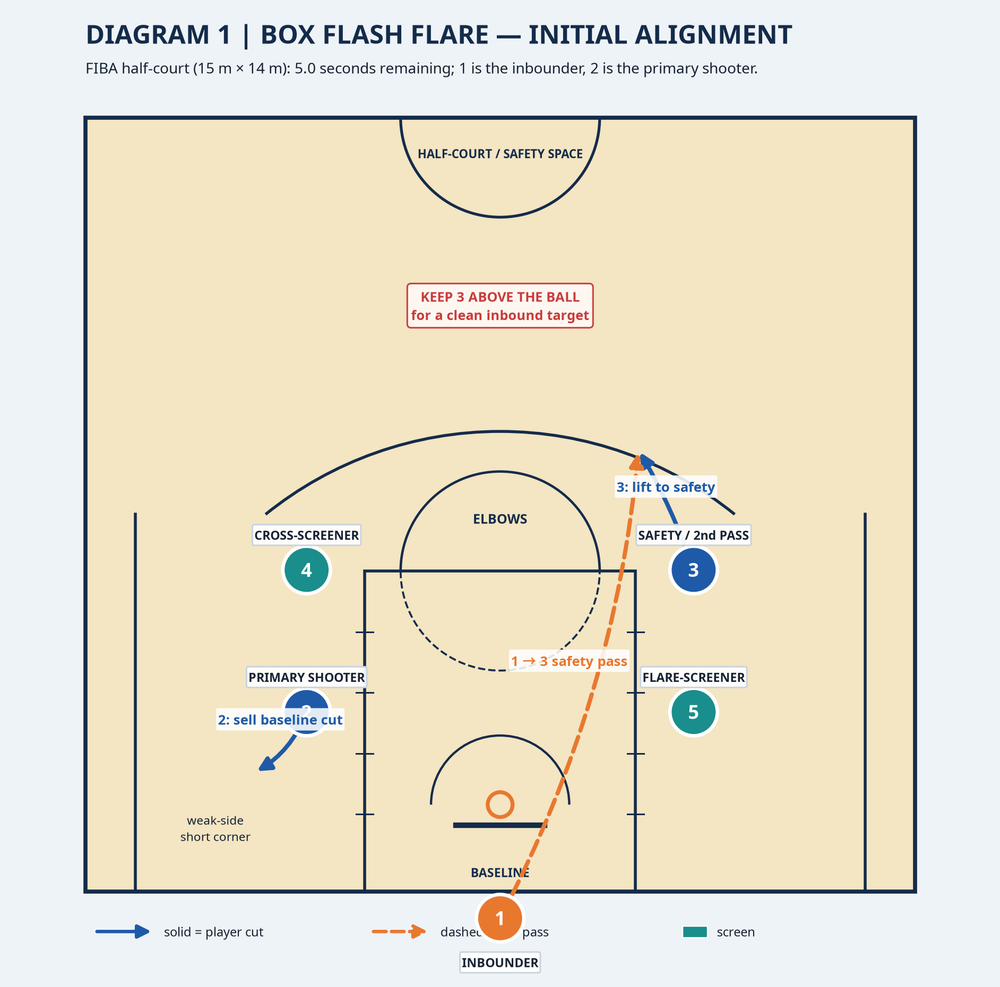
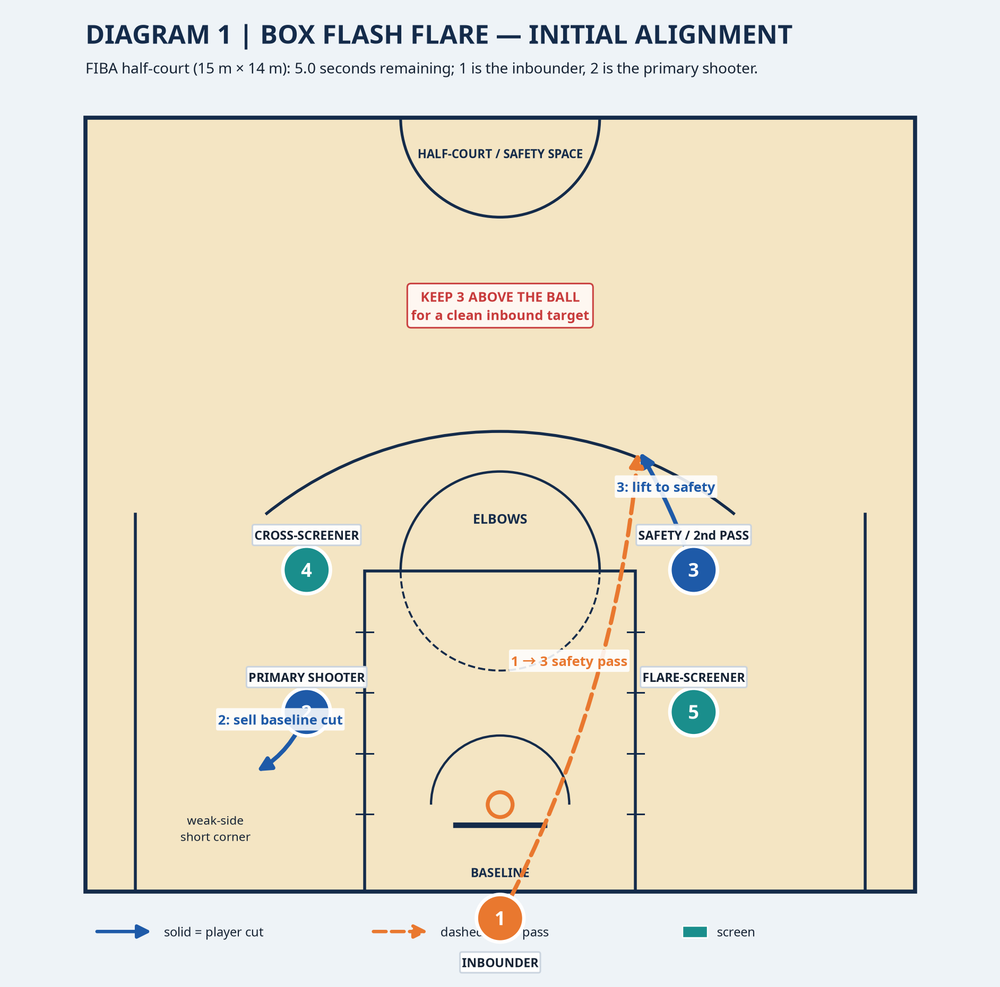
Name the timing before you place the players. Start the teaching rep with 5.0 seconds on the clock. Tell the unit that the first pass must be complete by 0.8 seconds, the flare pass by 3.0 seconds, and the shot out of 2’s hands by 4.0 seconds. That leaves a real finishing margin instead of a rushed heave.
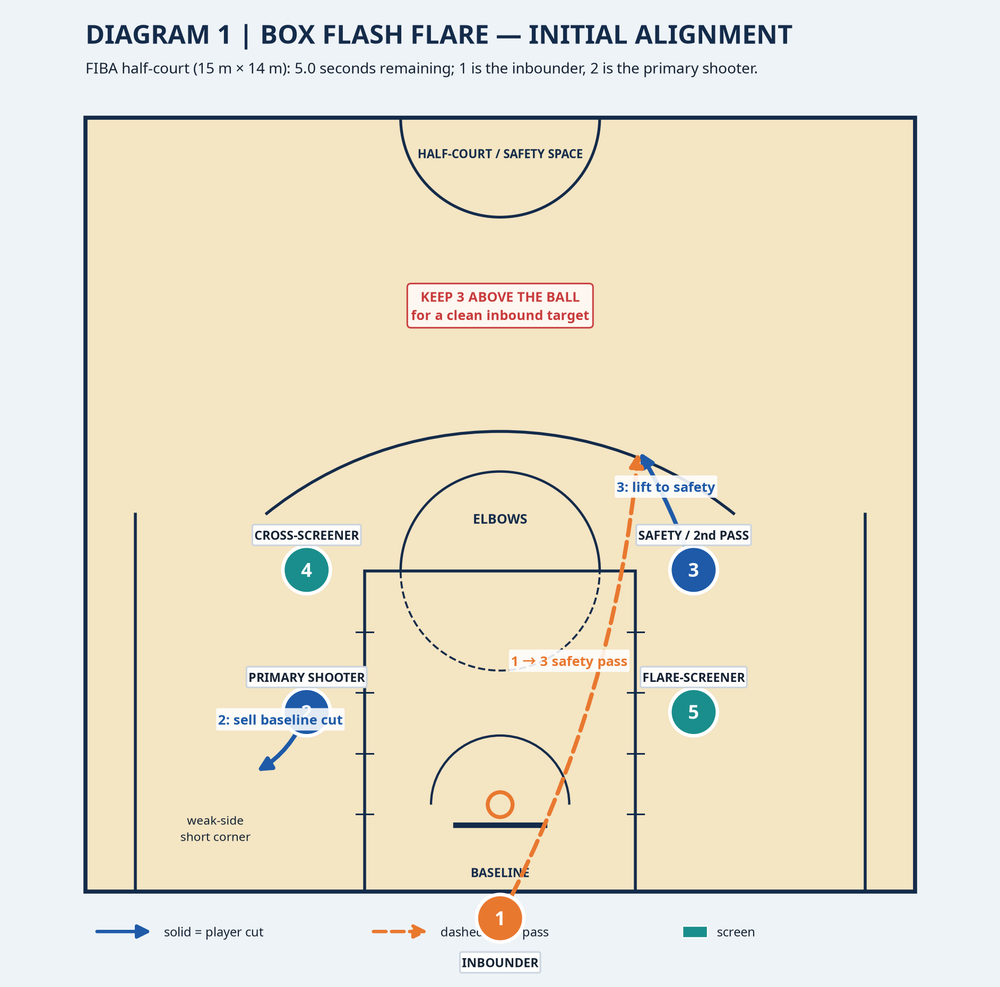
Set the box without tipping the shot. Place 2 and 5 on the low blocks and 4 and 3 on the elbows. 1 stands out of bounds on the baseline. Make the starting picture look like a normal box entry, not a three-point play. 2 begins in a low, coiled stance with eyes on 1; 3 shows a relaxed hand until the ball becomes live.
Create the safety pass. On the trigger word, 2 takes one hard step toward the weak-side short corner to sell the baseline cut. At the same moment, 3 lifts two metres above the elbow into the 8 m safety window. 1 throws to 3’s outside hand and steps inbounds immediately. If the catch is not clean, 3 protects the ball and resets rather than forcing the next action.
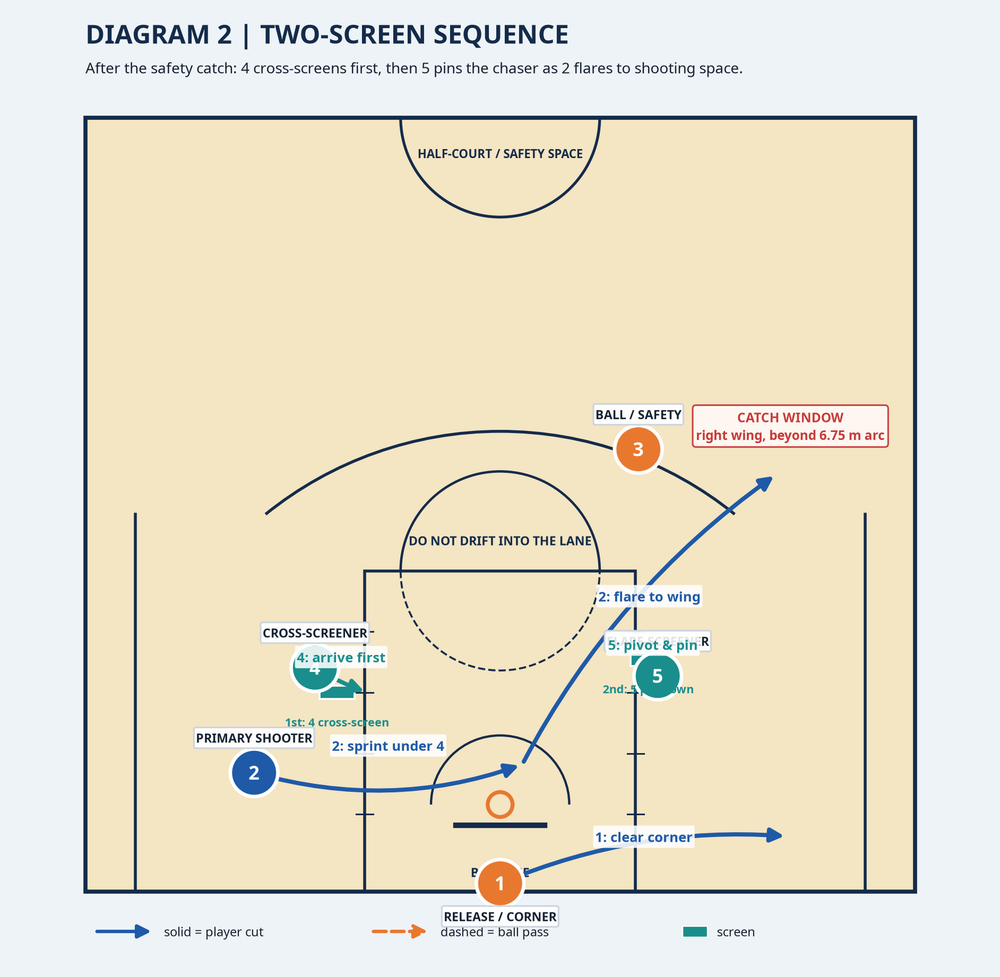
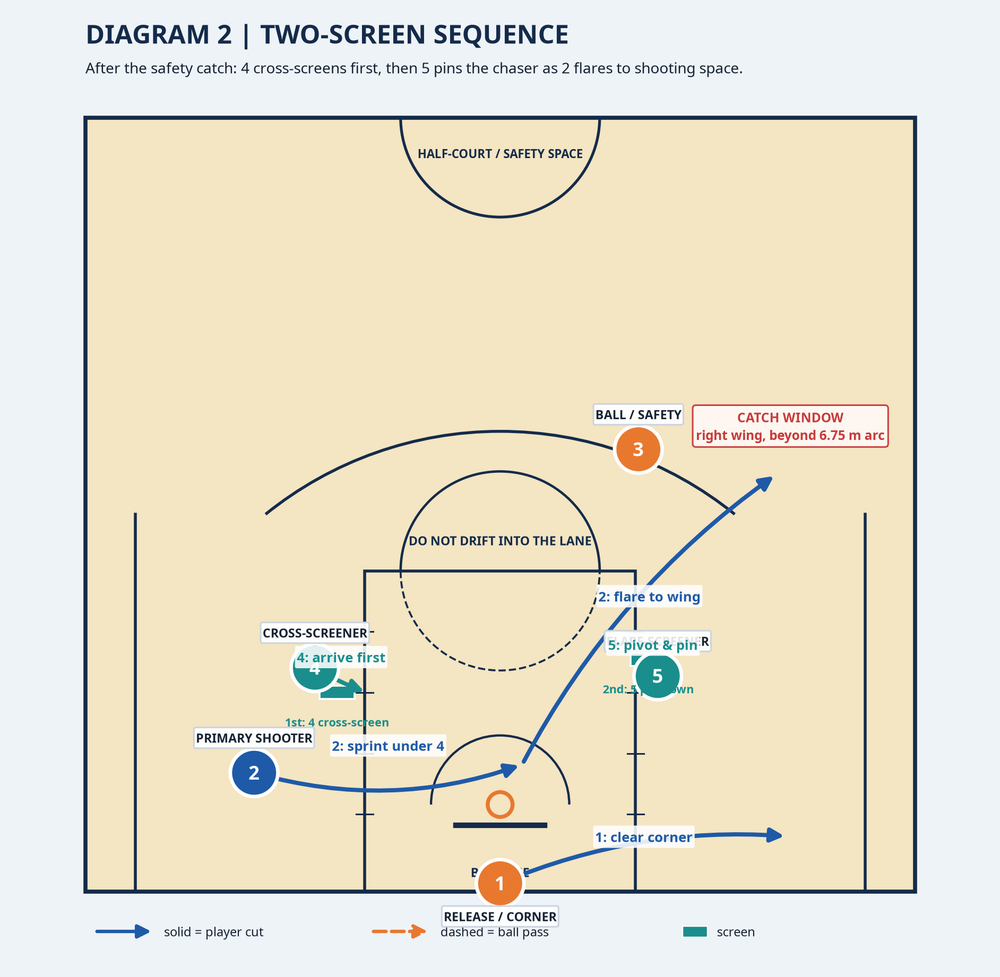
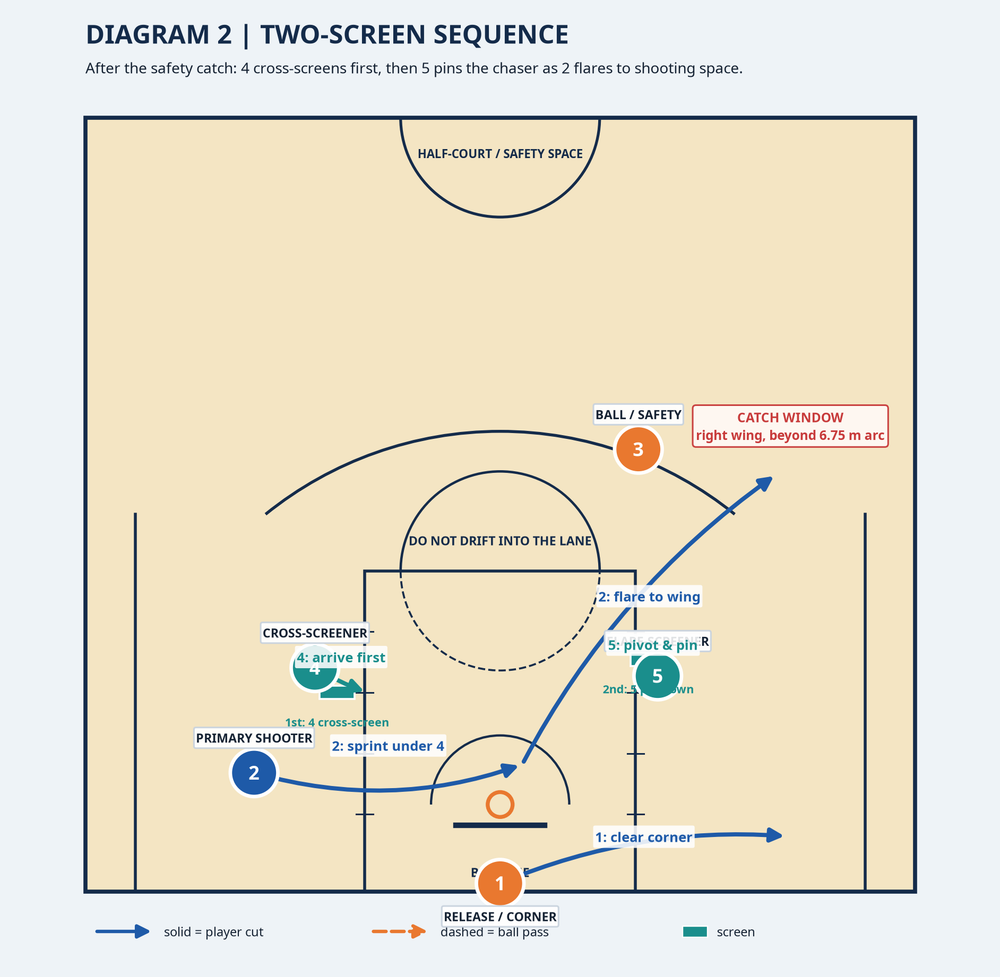
Make 4 arrive early and stationary. As 3 receives the ball, 4 crosses the lane and sets a legal chest-to-shoulder screen just inside the weak-side lane line. 4’s feet must be down before 2 reaches the screen. The purpose is not to crush the defender; it is to make 2’s defender trail over the first line of traffic and to keep the rim protector’s eyes busy.
Send 2 under the first screen and into the flare. 2 runs tight to 4’s hip, sprints across the front of the rim, and continues to the ball-side wing. Do not let 2 round the cut or drift through the lane. The catch spot is 0.5–1.0 m beyond the 6.75 m arc, about one metre inside the sideline for a balanced landing.
Turn 5 into the second screen. While 2 is crossing, 5 pivots from the ball-side low block and pins 2’s trailing defender with a compact, legal pin-down angle. Coach 5 to locate the defender with the inside shoulder, arrive one beat before 2, and keep both feet set. 1 clears to the ball-side corner, pulling the low defender down and preserving a passing lane for 3.
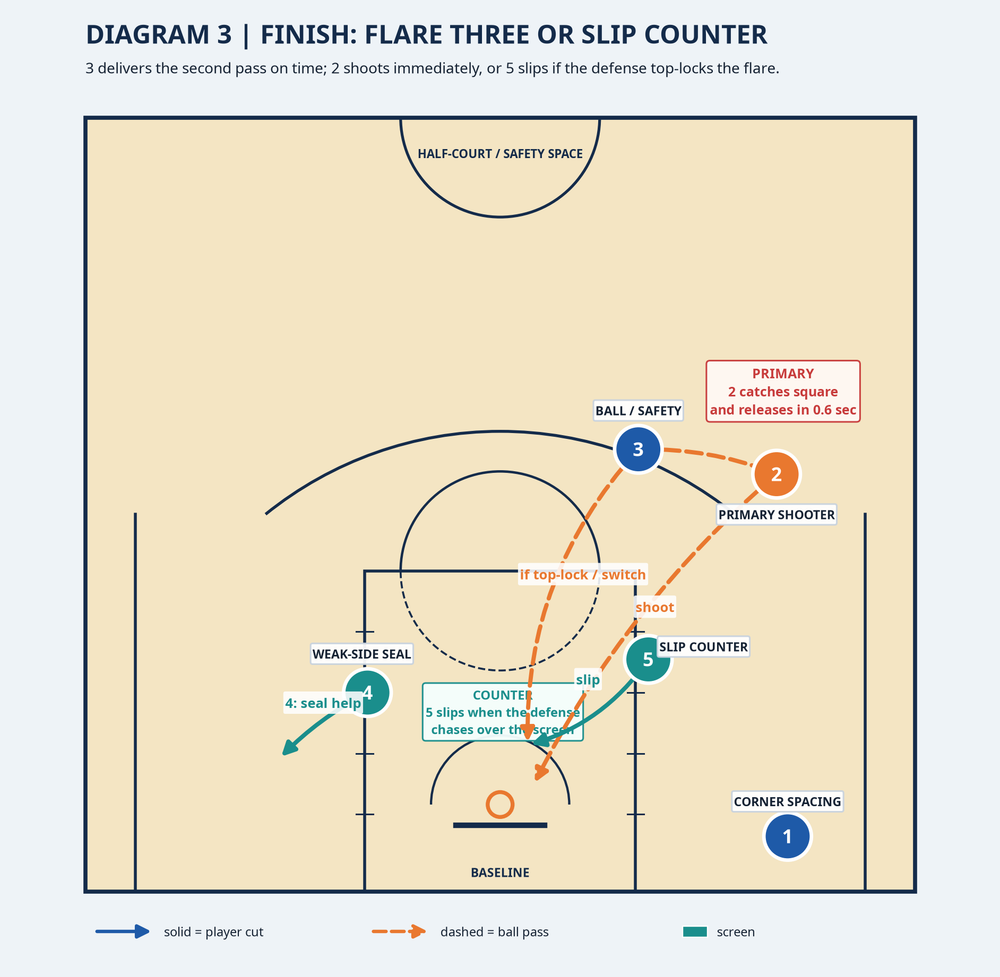
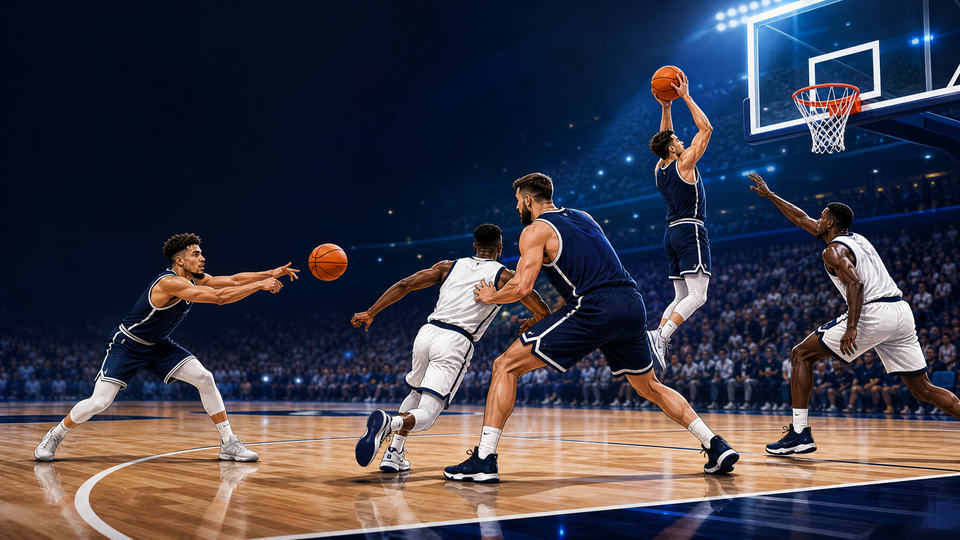
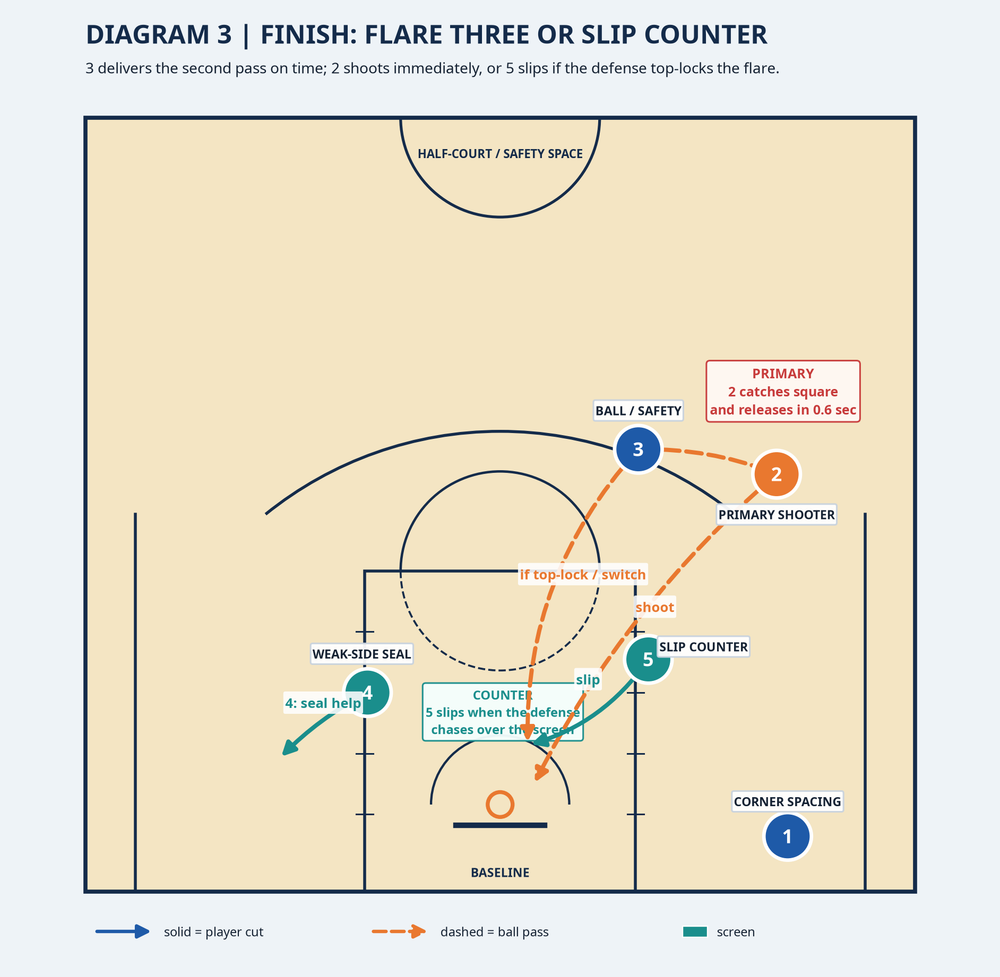
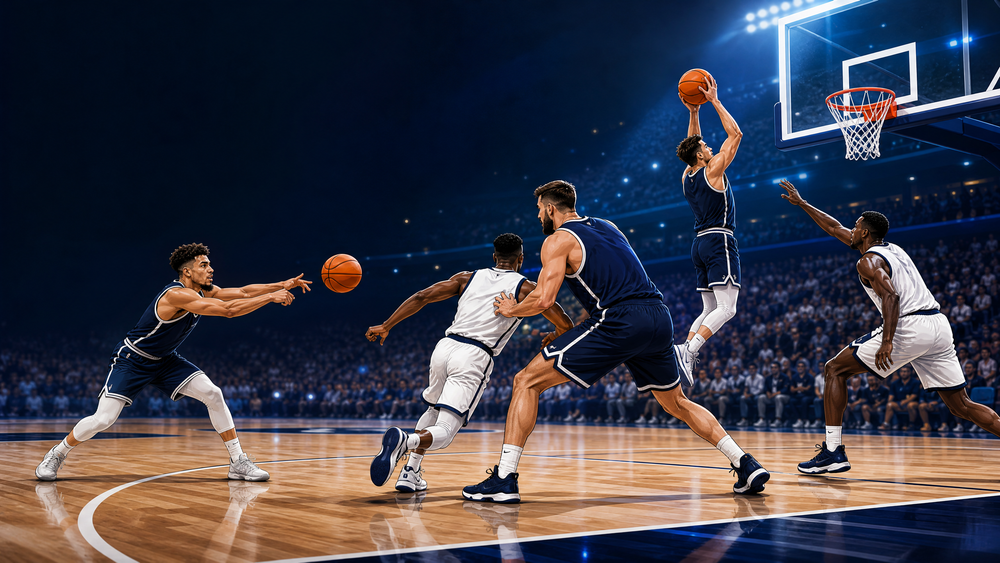
Deliver the shot pass on the shooter’s numbers. 3 must see 2’s chest, not 2’s back. Use a firm chest or hook pass to the shooting pocket; do not loop the ball. 2 catches square and releases within 0.6 seconds. The cue is: “feet, hands, ball.” No extra dribble in the primary option.
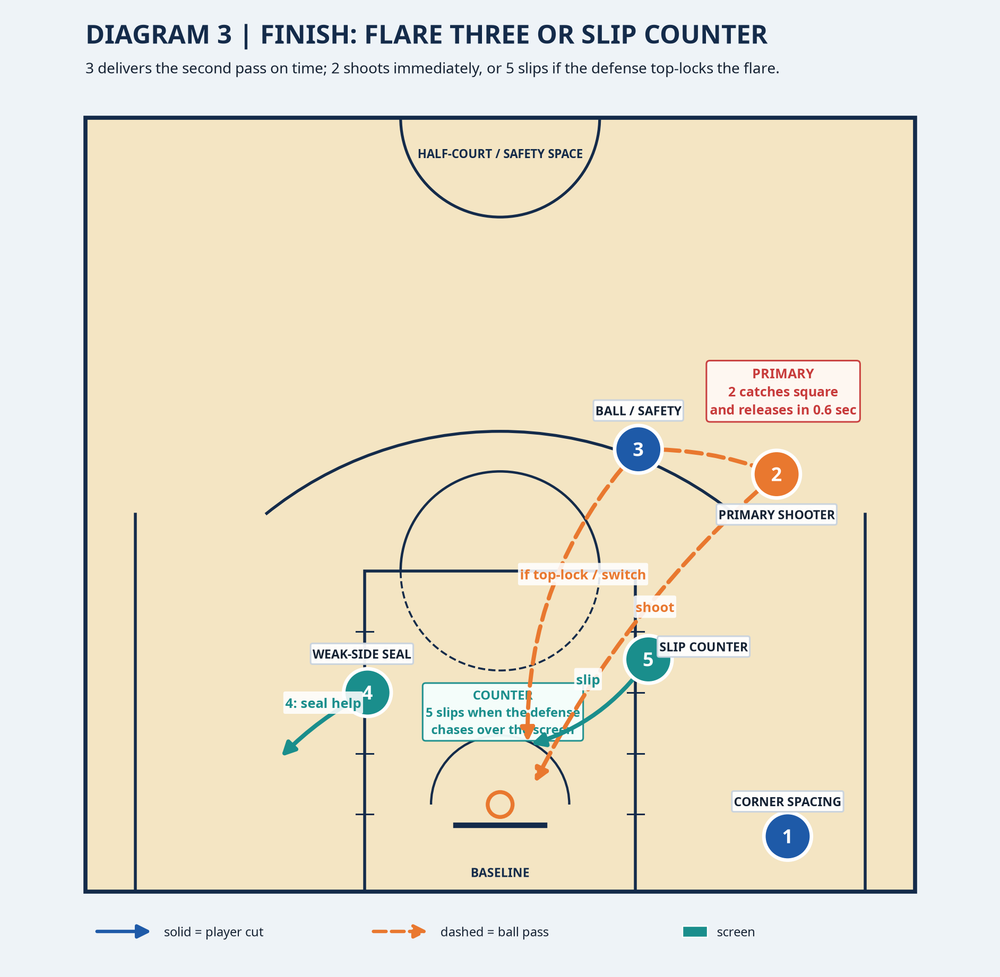
Read the counter instead of forcing the flare. If 2’s defender top-locks the screen, or if the defense switches and takes away the wing, 5 immediately slips down the inside lane line to the rim. 3 takes one dribble only if it improves the passing angle, then feeds 5 between 2.2 and 2.8 seconds. 4 seals the weak-side helper, and 1 remains ready in the corner as the emergency release.
Key Coaching Points
| Teaching point | What to coach on the floor |
|---|---|
| Screen timing beats screen size. | 4 and 5 must be set before the cutter arrives. A late screen becomes either a moving-screen foul or no separation. |
| Change pace, then sprint. | 2 sells the first cut at 70 percent speed, then explodes shoulder-to-hip off each screener. Straight-line speed without deception is easy to trail. |
| Keep the safety above the ball. | 3 cannot flatten toward the baseline. The safety catch must create a passing angle over the top of the action, not through bodies. |
| Pass to a target, not an area. | 3 delivers to 2’s shooting pocket, chest high and slightly ahead. A soft or looping pass steals time from the shot. |
| Teach the slip as a read. | 5 slips only when the defender chases over, switches, or top-locks. If the defender trails, 5 stays solid and protects the flare. |
| Rehearse the clock aloud. | Assign an assistant or player to call “five, four, three” during every live rep. Players must feel the speed of the set, not merely memorize its path. |
Common Mistakes
| Error to catch | Immediate correction |
|---|---|
| 3 stays at the elbow and 1 has no safe inbound. | Move 3 to the 8 m safety window and demand both hands as a target. |
| 4 or 5 is still moving on contact. | Stop the rep, reset the screener’s feet, and rehearse the screen without a cutter before adding speed. |
| 2 drifts wide or turns the route into a loop. | Put a cone at the desired wing catch point and require shoulder-to-hip contact with both screens. |
| 3 watches the action and holds the ball. | Give 3 a verbal rhythm: “catch, eyes, pass.” The second pass should leave within one second of the safety catch. |
| Players force the flare against a switch. | Freeze the switch and have 5 point to the rim. The counter must be an automatic shared read. |
Variations & Progressions
Begin with a walk-through: rehearse the safety pass, cross-screen, and flare with no defense or clock. Add a passive chaser, then five defenders with a five-second inbound count.
For a two-point variation, have 2 curl to the ball-side elbow after 4’s screen. 3 hits 2 for a one-dribble pull-up or drive when a high-percentage finish is needed.
For a quick-hit variation with 2.5 seconds or fewer, remove the safety pass. 4 cross-screens, 5 pins, and 1 inbounds directly to 2; keep 3 high as a safety valve.
Age Adaptations
| Group | Adaptation that keeps the teaching honest |
|---|---|
| Under 8–10 | Use three players, no live screens, and a catch at the elbow. Teach spacing, a clean pivot, and a pass to the shooting hand before running a buzzer-beater scenario. |
| Under 12 | Use the five-player alignment but only one stationary screen. Move the catch 1–2 m inside the arc and let 3 hold the ball for a controlled count of one. |
| Under 14 | Run the full primary route against guided defense. Keep the primary option predetermined, then introduce 5’s slip only after screens are legal and the clock is understood. |
| Under 16 and Open | Use the complete read package: denial on 3, top-lock on 2, switch on 5, and live five-second inbound pressure. Track shot quality, not just makes. |
Finish with three live possessions: one primary flare, one forced switch, and one random defensive call. Judge the rep on shot quality, timing, and the group’s response when the defense takes away the first option.
References