

Football
Build From the Back: Create the Free Player and Break the Press
Teach your players to draw a high press, identify the free player and play through the first two pressure lines with purpose.
What you need
balls, cones
Overview
This build-up from the back play gives a 10-player unit a repeatable way to start possession under a coordinated high press. The aim is not simply to pass short; it is to make the first line of pressure commit, create the free player, then break the next line with a purposeful forward action. Use it from a goal kick, a goalkeeper restart or any settled regain inside the penalty area. The pattern is based on a 1-4-3-2 attacking shape: goalkeeper, two centre-backs, two full-backs, a number 6, two advanced midfielders, two wide players and a central striker. It can be taught in a 20-minute block and then transferred into conditioned games.
The key picture is simple: the goalkeeper stays calm, the centre-backs split early, the full-backs offer width, and the 6 gives a clear central reference without standing on the same line as the ball. The pressing side is encouraged to press properly. If the press does not arrive, the ball carrier drives forward; if it does, the free player must be recognised within two touches.
Setup
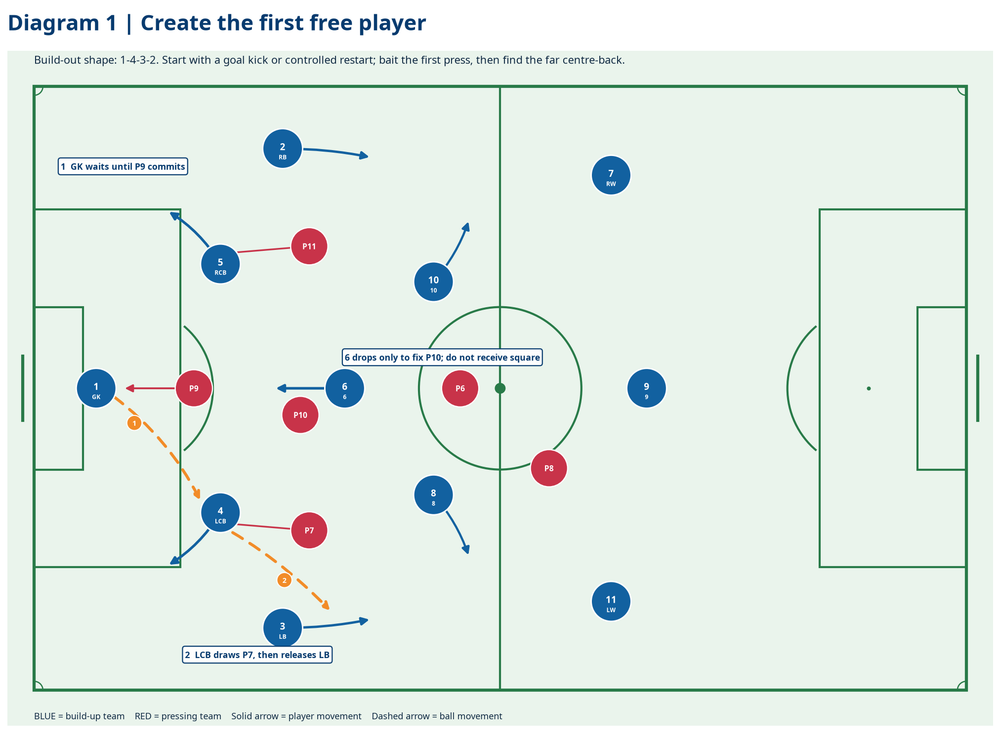
Mark a 70 x 52 m working area from one goal towards the halfway line, using the full penalty area and one central channel. Use 10 attacking players and six pressing players; rotate the pressing unit every 90 seconds. Start every repetition with a ball at the goalkeeper. Place the two centre-backs 16–20 m apart, initially level with the outer edge of the penalty area. Full-backs begin 6–8 m outside each centre-back and 5 m higher. The 6 starts 8–10 m ahead of the centre-backs, while the 8 and 10 occupy staggered pockets beyond the first press.
Give the attacking team 8 seconds to move the ball into the middle third under control. Award one point for crossing the halfway line with possession and a second point if the next pass finds a forward player. The pressing side scores by winning the ball and finishing within 6 seconds. This creates consequence without making players rush the first pass.
Step-by-Step Instructions
Set the picture — 0:00–0:02. On the goalkeeper’s trigger, both centre-backs split immediately and show on a half-turn. The near full-back steps wide and slightly higher; the far full-back holds width to stretch the press. The 6 checks away for one step, then drops into the central lane only if the striker is screening the direct route.
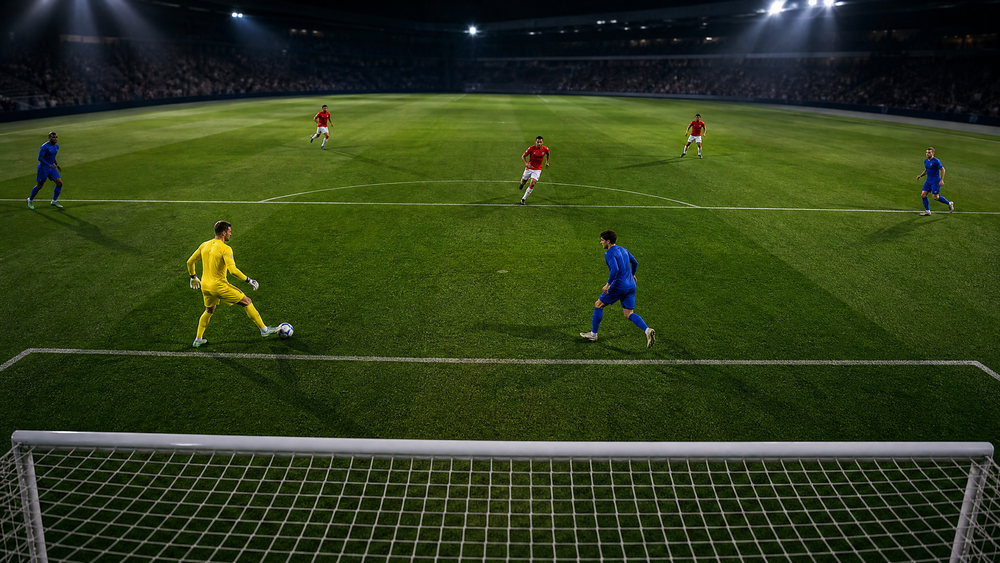
Invite the first press — 0:02–0:04. The goalkeeper takes a settling touch, scans both shoulders and delays the release until the opposition’s first presser has travelled. Play to the centre-back who has the clearest forward-facing first touch. The receiving centre-back should receive across the body, with the back foot, so the next action is forward or out wide rather than back towards goal.
Fix, then release — 0:04–0:06. The centre-back carries 3–5 m to attract the wide presser. Do not force the next pass before that presser commits. Once the press jumps, play firmly to the free full-back or into the 6’s front foot. The opposite centre-back stays connected at 12–15 m as the safety pass, not in the same passing lane.
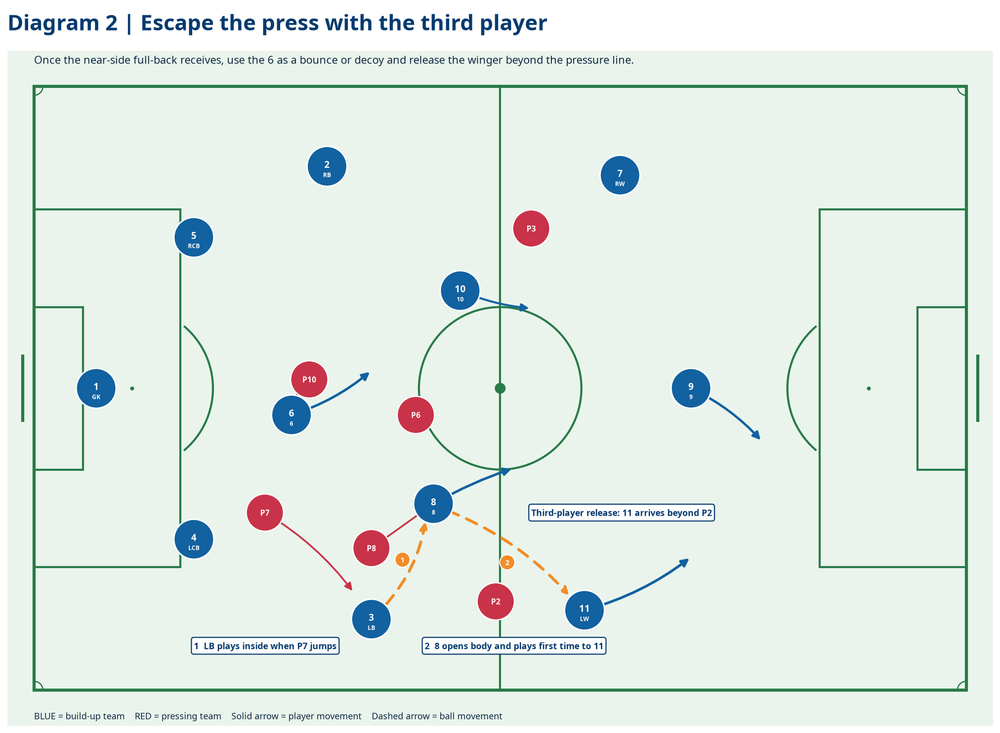
Find the third player — 0:06–0:08. If the full-back is pressed from outside-in, play inside to the 8 or 10, who has moved away from the opponent’s cover shadow. Their first touch faces the far side. The winger times a run beyond the next defender, receiving on the move rather than waiting flat on the touchline. Diagram 2 shows the desired three-player release: full-back to advanced midfielder to winger.
Play forward or secure — 0:08–0:10. Once the winger or striker receives beyond the first two pressure lines, attack immediately with the next action: drive, combine or play into the 9. If the forward pass is not clean, recycle through the free centre-back and reset the picture. The rule is: progress when the receiver can turn; retain when they cannot.
Key Coaching Points
- Goalkeeper’s body shape: stand side-on, see both centre-backs and scan before the ball arrives. A two-touch goalkeeper is fine if the first touch creates a better angle.
- Spacing creates time: centre-backs need 16–20 m separation; full-backs need enough width to pull the winger presser out of the central lane.
- Pass to the correct foot: play into the back foot of centre-backs and midfielders. This keeps the ball away from the press and makes the next pass visible earlier.
- Use the 6 intelligently: the 6 is a reference point, not a magnet. Drop only to unbalance the first line; otherwise stay high enough to receive between lines.
- Demand a forward cue: “set”, “turn” or “man on” must arrive before the ball arrives. The receiving player should know whether to play first time, turn, or protect.
Common Mistakes
The most common problem is both centre-backs dropping too deep, which leaves the goalkeeper with short, straight passing lines and invites a trap. Correct it by asking the goalkeeper to start high enough to see both defenders and by fixing the centre-backs at the edge of the box before the restart.
A second error is the 6 standing square behind the opposition striker. That creates a risky pass with no exit. Coach a curved checking movement: move away first, then arrive at an angle that opens the far-side shoulder. Finally, full-backs often receive with the touchline as a second defender. They should receive on the inside shoulder whenever possible, with the winger already creating the next option.
Variations & Progressions
For a simpler variation, remove one presser and allow the goalkeeper unlimited touches. This lets players rehearse distances and receiving angles before pressure increases. For an opposite-side variation, begin on the right and require the team to switch through the goalkeeper or far centre-back before playing forward.
Progress the practice by adding a seventh presser and limiting the goalkeeper and centre-backs to two touches. Then award three points for reaching the winger or striker with a forward-facing reception within 10 seconds. In the final progression, allow the pressing team to lock one full-back; the build-up team must recognise the overload and use the far side rather than forcing the marked route.
Age Adaptations
For Under-10s, use a 50 x 40 m area, four pressers and no time limit. Teach one clear message: “make the pitch big, receive side-on, pass to the free player.” Let the goalkeeper roll or pass from the ground.
For Under-12s, retain the 1-4-3-2 picture but use five pressers and an 8-second target. Introduce the words “pressing line”, “cover shadow” and “third player” through demonstrations, not long talks.
For Under-14s and above, use the full constraints, rotate pressers every 90 seconds and review whether the first forward pass genuinely breaks a line. Challenge the 6 and advanced midfielders to solve the press with their position before demanding a technically difficult pass.
