

Football
4v4 Transition Game: Win It, Break It, Protect It
A high-tempo 4v4 directional game that teaches players to counterpress on loss, attack decisively on regain, and maintain compact support around every transition.

What you need
4 x 2 m mini-goals, 20 flat cones, 8 footballs, blue and orange bibs, whistle, stopwatch or visible timer
Overview
This directional 4v4 transition game makes the five-to-six seconds after a turnover non-negotiable. In a 32 x 24 m area, each team attacks two 2 m mini-goals and defends the pair behind them. On regain, players play forward if the target is open or secure the first pass before breaking. On loss, they press the ball, block forward exits and protect the centre.
Use it in the middle or later part of a session for competition, repeated acceleration and decisions under pressure. It is a strong follow-on from a passing practice because it applies receiving detail, body shape and passing weight against live opponents. The reduced area creates frequent, purposeful transitions rather than long, low-repetition runs.
Setup
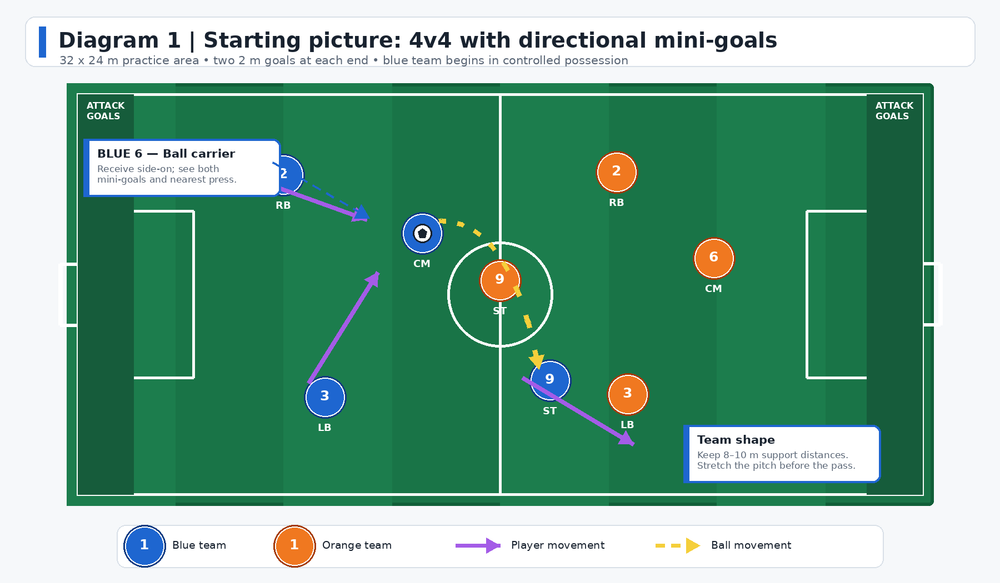
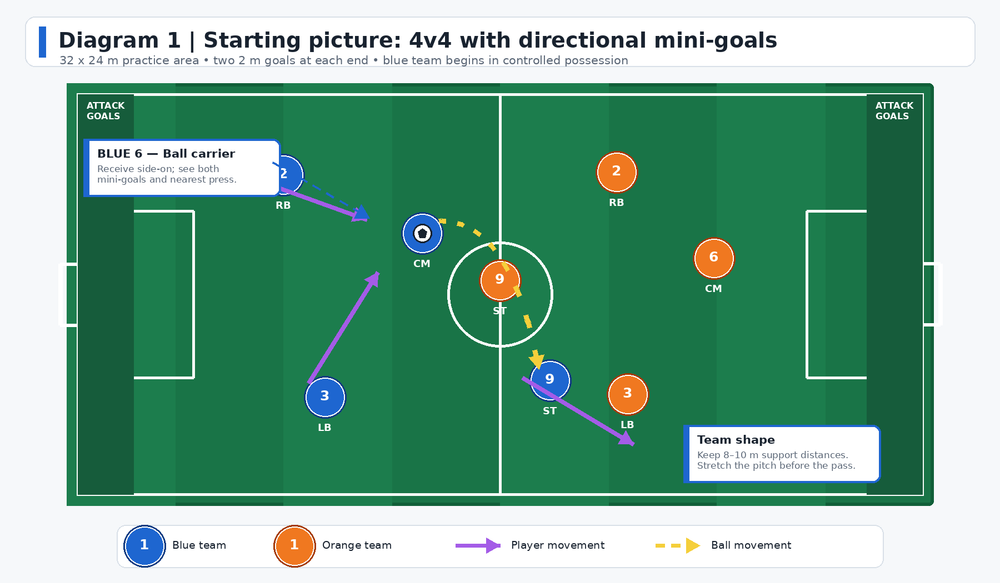
Mark a 32 x 24 m rectangle, with the longer side running goal to goal. Place two 2 m mini-goals, 3 m apart, on each end line. Use blue bibs for one team and orange bibs for the other. Each team starts with a 2, 3, 6 and 9: the 2 and 3 operate as wide supporting defenders, the 6 is the central connector and the 9 is the highest player. These are functional roles rather than fixed positions; coach the players to rotate naturally once the game begins.
You need eight outfield players, four mini-goals, 20 flat cones, two colours of bibs and a supply of balls with the coach on a side line. For 10–12 players, create a second identical area or rotate two players in every 90-second block. Run four 3-minute bouts with 90 seconds of coached recovery. Score one point for a normal goal; award two points if a team scores within six seconds of regaining the ball.

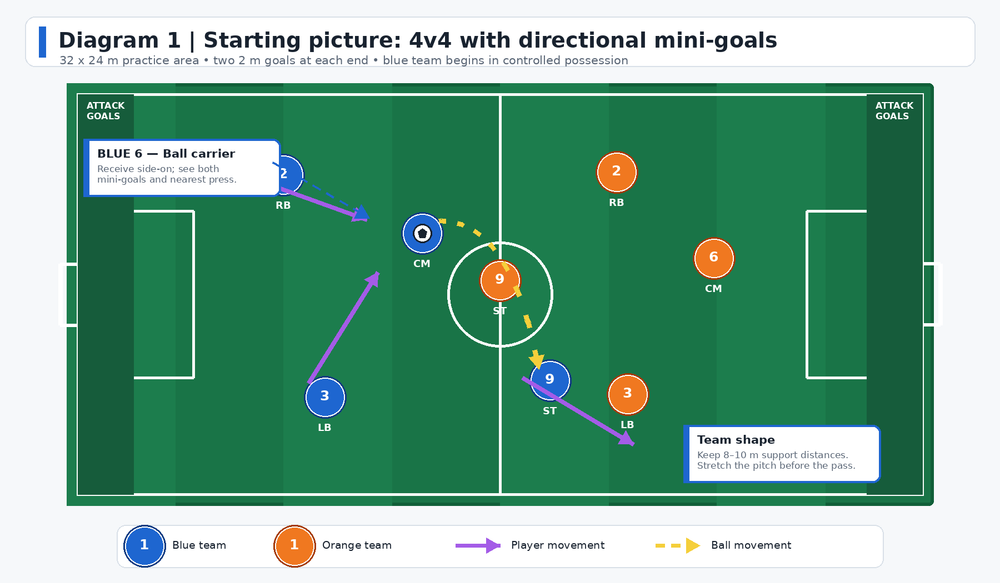
Coach’s starting picture: Blue 6 receives side-on in the central lane. Blue 2, 3 and 9 create three clear passing pictures at roughly 8–10 m distances. Orange are close enough to press but not so close that the first action is predetermined.
Step-by-Step Instructions
Start with the blue team in possession from the coach, who serves to Blue 6. Blue attacks the orange-end mini-goals; orange presses and attacks the opposite pair when they regain possession. The ball is live immediately.
Allow the first two minutes to run with only direction, scoring and the transition bonus explained. Observe the players’ natural response to turnovers, then restart quickly whenever the ball leaves the area.
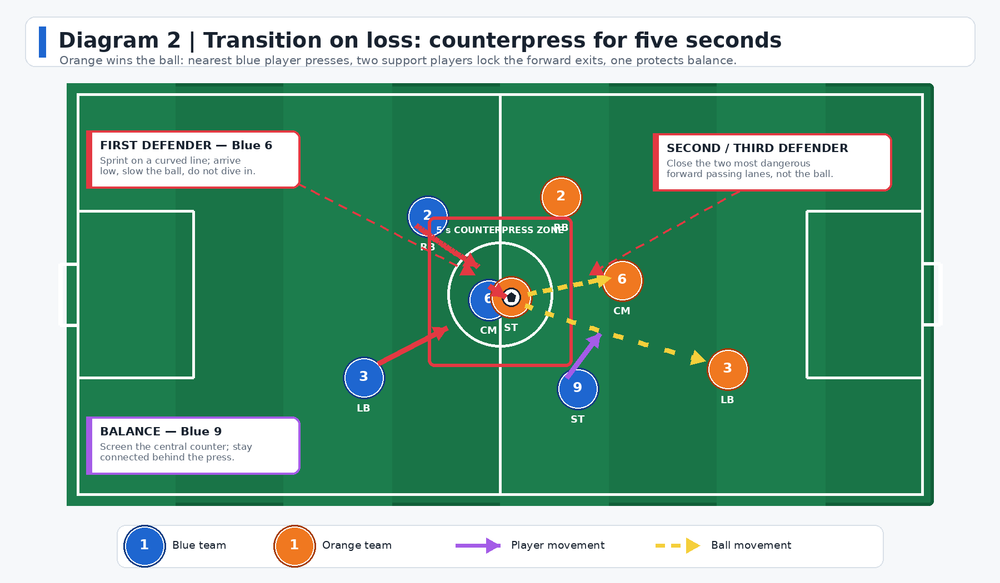
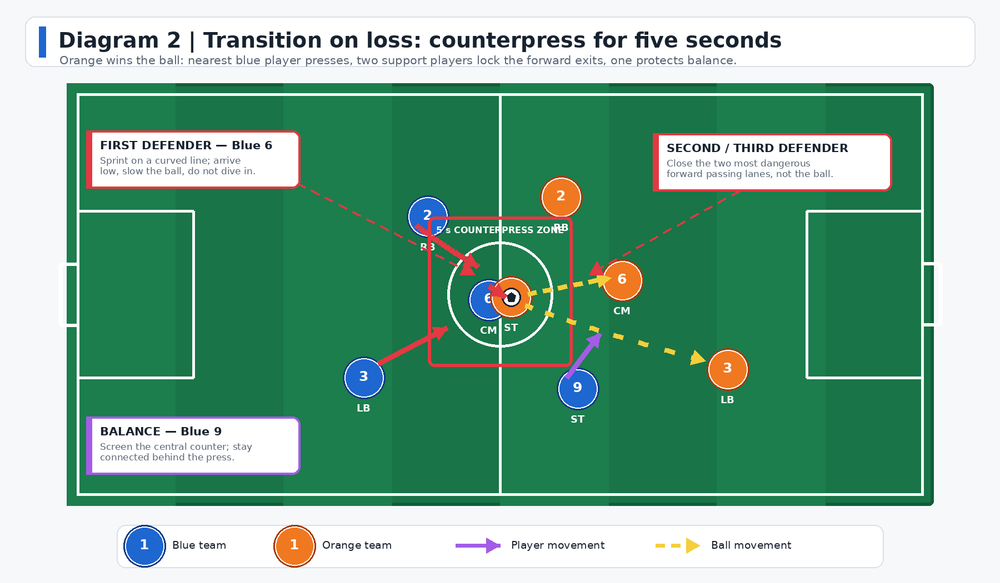
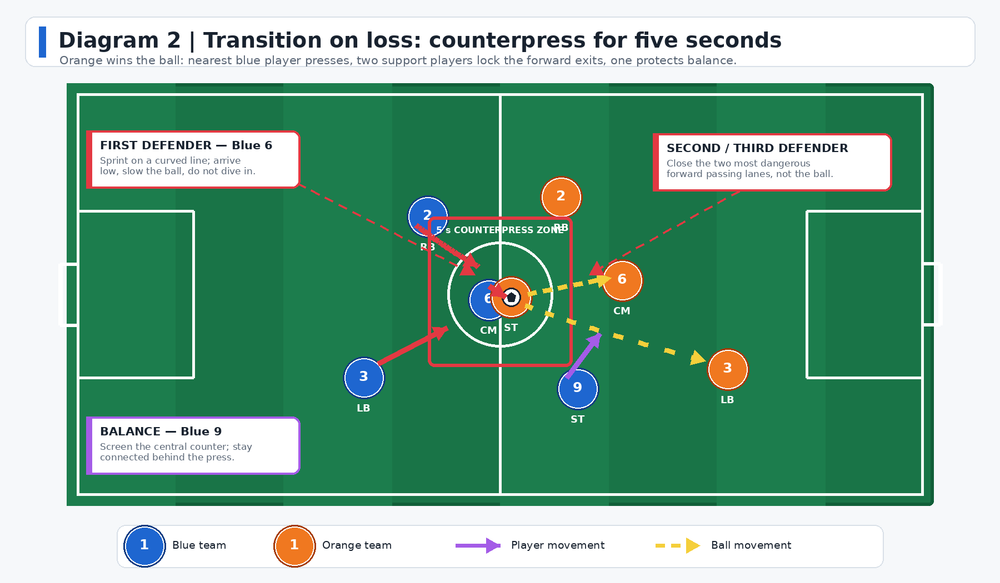
On every loss of possession, call the first transition trigger: “Loss — lock it!” The player nearest the ball becomes the first defender. Their job is not necessarily to win it instantly; it is to arrive under control, deny the forward dribble and show the new ball carrier into pressure.
The second and third nearest defenders take away the closest forward pass and the closest goal. The fourth player, usually the former 9 or far-side player, drops into a balancing position that protects the central counter. Demand a team response within five seconds.
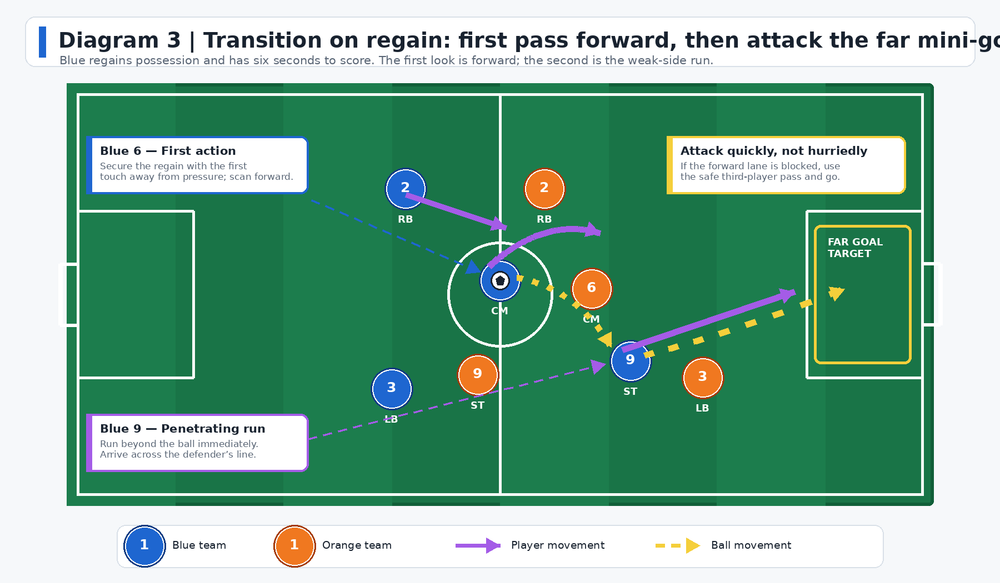
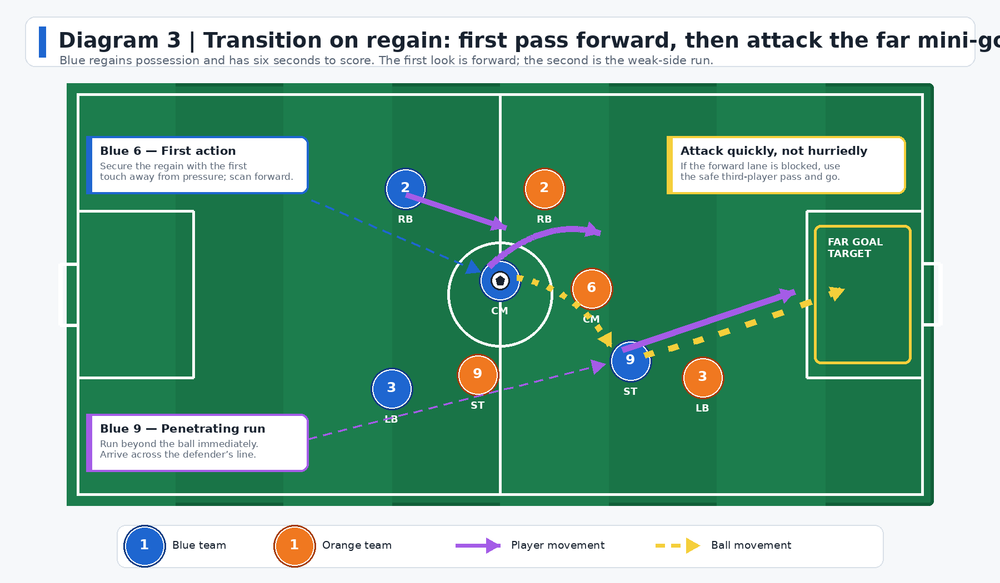
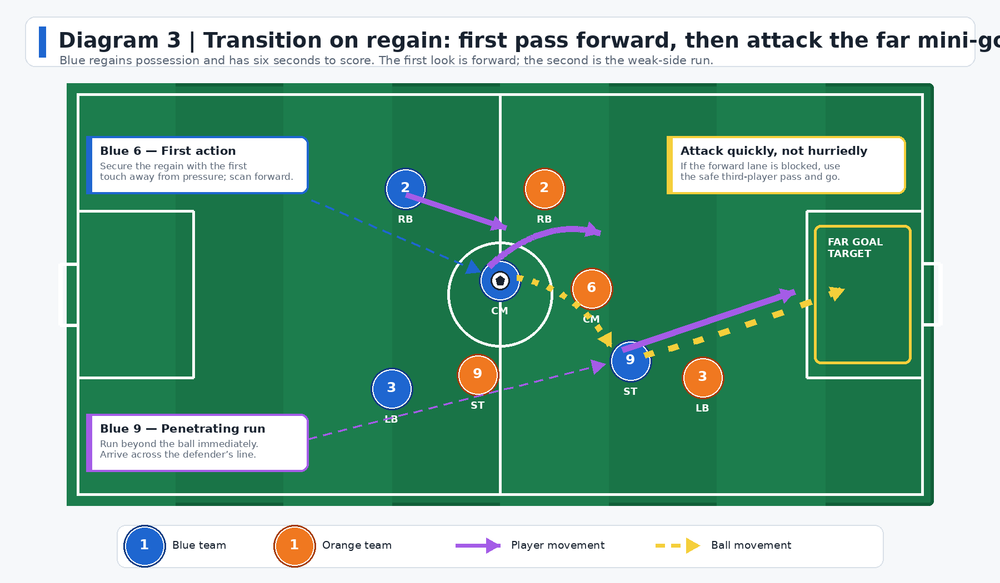
When a team regains possession, call the second transition trigger: “Win — look forward!” The ball winner takes the first touch away from the previous pressure and scans for a pass, dribble or run toward the far mini-goals. The nearest teammate offers a secure angle; the furthest player makes a penetrating run across the defender’s line.
Give the recovering team six seconds to score after a regain. If the forward lane is closed, they may keep the ball, but the bonus is gone. This prevents blind forward passes while still rewarding decisive attacking transition.
Between bouts, freeze only one clear picture. Recreate the turnover, physically move the players into the correct roles and ask two questions: “Who is first defender?” and “Where is the forward pass?” Keep the intervention under 35 seconds; then restart at match speed.
Key Coaching Points
1. React before you complain. The player who loses the ball must immediately sprint into a defensive action. Train the emotional response: no hands out, no appeal, no pause. Their first three steps should be forward and aggressive.
2. Press with a curved approach. The first defender approaches from a line that blocks the easiest forward pass, arrives low through the hips, shortens the final steps and keeps the ball in a crowded zone. A straight, reckless sprint often allows the opponent to play through with one touch.
3. Make the press a three-player action. The first defender affects the ball, but the regain comes from the players behind them. Coach the second defender to remove the nearest forward option and the third to squeeze space around the next pass. Avoid three players chasing from the same line.
4. Maintain usable attacking distances. In possession, players should be separated enough to stretch defenders but connected enough to counterpress. As a guide, keep the nearest support 6–8 m away and the far support no more than 12–14 m from the ball. Adjust these distances for the age and technical level of your group.
5. First touch sets the transition. On regain, the first touch should travel away from pressure and open the body toward the opposition goals. Encourage players to scan before the ball arrives, not after it settles beneath them.
6. Run beyond the ball after regain. The 9 and weak-side player must react as runners, not spectators. A sharp run into the far-goal channel gives the ball winner a clear forward picture and stretches the opponent before they can reorganise.
Common Mistakes
| Error to spot | Why it hurts the game | Direct correction |
| --- | --- |
| Everyone chases the ball after loss. | The opposition has an easy pass through or around the crowd. | Assign first, second, third and balance roles in the freeze. |
| The first defender dives in. | One touch eliminates the press and exposes two mini-goals. | Rehearse a curved run, deceleration and side-on body shape. |
| Players stay spread after losing it. | Distances are too large to counterpress within five seconds. | Ask the team to squeeze 3–4 m toward the ball as it travels. |
| Regaining team forces a blocked pass. | Possession is handed back before the transition develops. | Coach the cue: forward if free, secure if screened. |
| The far player watches the regain. | There is no depth run and no way to exploit the far goal. | Give that player a rule: move as the ball is won, not after the pass. |
Variations & Progressions
Easier: add two neutral outside players. Position one neutral on each long touchline. They play with the team in possession but may use only two touches. This creates clearer passing angles, helps younger players retain the ball and makes the counterpressing team decide whether to lock inside or jump outside.
Harder: limit the first two actions after regain. For older or advanced players, require the first two actions after regain to be one touch where possible. Keep the six-second bonus. This raises the quality of scanning, supporting angle and pass weight; use it only when players can play accurately at speed.
Harder: introduce an end-zone release. Add a 2 m scoring end zone before each pair of mini-goals. A team may score only after a player has entered the end zone with the ball or received there. This encourages a true penetrating action rather than long shooting.
Age Adaptations
For Under-8, use a 26 x 20 m area, one large target gate at each end and no numerical transition countdown. Use simple language: “win it, go forward” and “lose it, get close.” Let the ball roll longer and praise the first positive reaction.
For Under-10 and Under-12, use 28–30 x 22 m, retain four mini-goals and use a seven-second bonus. Name the roles nearest, help and cover before formal defensive labels.
For Under-14 and Under-16, use the full 32 x 24 m area, five seconds to counterpress and six seconds to score. Demand that the 6 communicates the press, the 9 protects or attacks the centre and the wide players identify the weak-side run.
For an open or senior group, reduce the area to 30 x 22 m for a pressing emphasis or expand to 36 x 26 m for more repeated sprint and forward-running demand. Keep the work-to-rest ratio honest: high intensity needs short, sharp blocks and clear recovery coaching.
Coach’s Finish
End with a two-minute free game, remove the coached countdown calls and let the players own the triggers. Your final observation is simple: after ten turnovers, how often did the team produce an immediate collective reaction? If the answer is inconsistent, return to the first-defender role and the supporting distances. In this practice, the quality of the transition is not an add-on; it is the game’s main habit.
