

Football
Penalty-Box Movement Play for Crosses: Near-Post Decoy, Late Arrival and Far-Post Finish
Teach your forwards to create three distinct finishing lanes from a wide cross through disciplined timing, decoy movement and a secure second-phase structure.
What you need
1 full-size goal, 1 goalkeeper, 10 footballs, 16 flat markers, 12 cones, 8 bibs in two colours, 2 mini-goals or counter gates, whistle
Overview
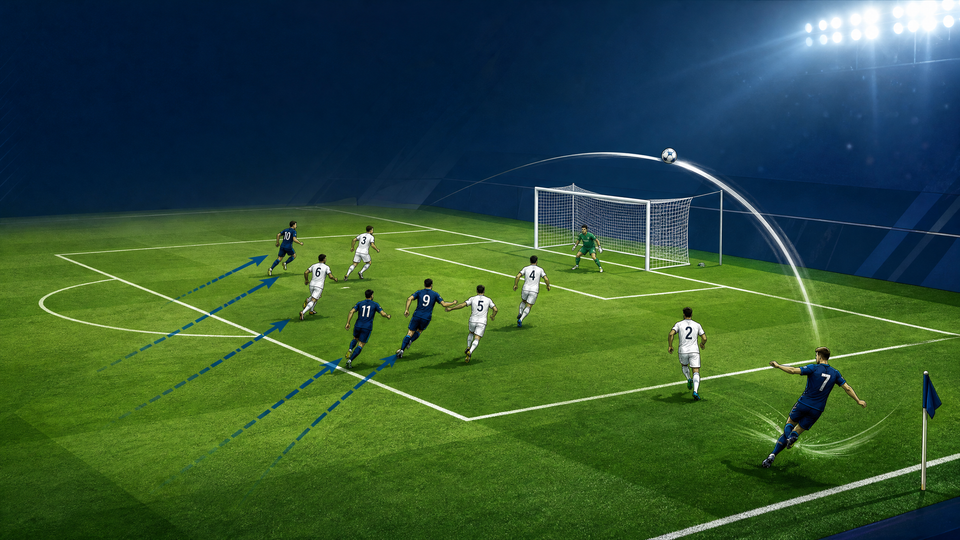
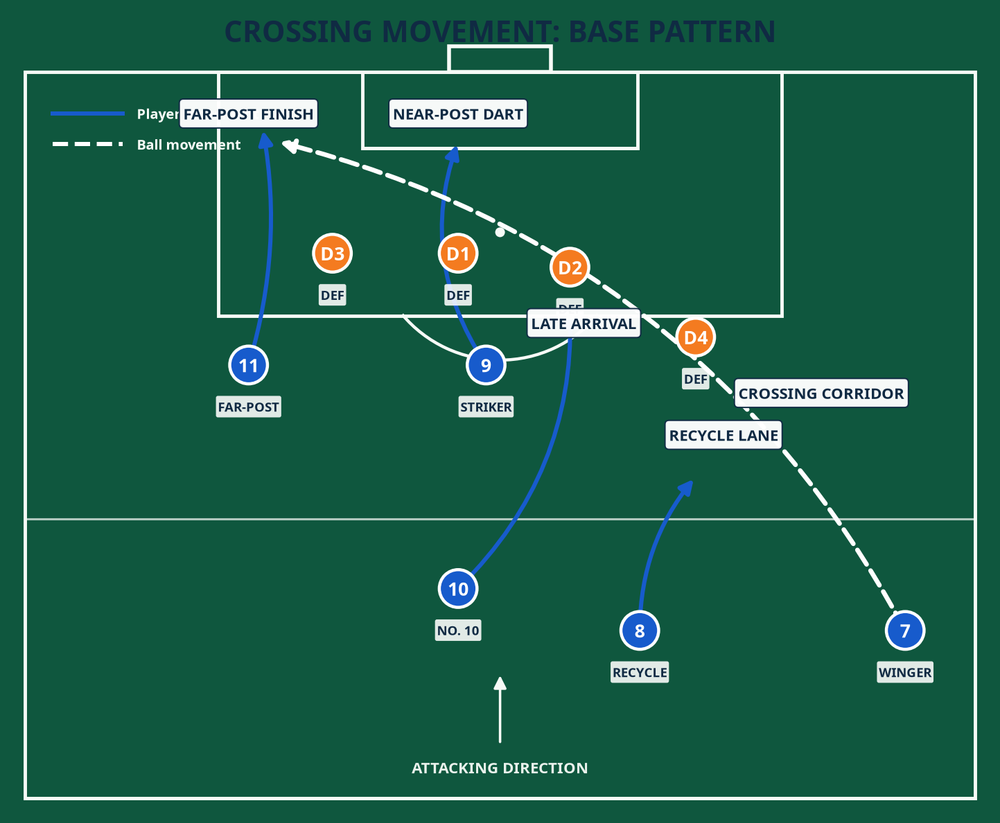
This is a repeatable right-sided crossing pattern that gives the delivery player three clear pictures: the near-post dart, the late penalty-spot arrival and the far-post finish. It is not a drill about simply putting the ball into the box. The objective is to move the defending line first, then attack the space they leave. Use it when your team has a stable wide overload, when the No. 7 can receive facing forward, or after a switch has pulled the opposition's block toward the far side.
The pattern is designed for an 11v11 context on a full pitch of approximately 100-110m x 64-75m, but the live practice takes place in a 44m x 40m final-third area. That size preserves the real distances from the wide channel to goal while creating enough repetition for players to learn the timing. The practice references the international-match dimensions defined in Law 1.1
Setup
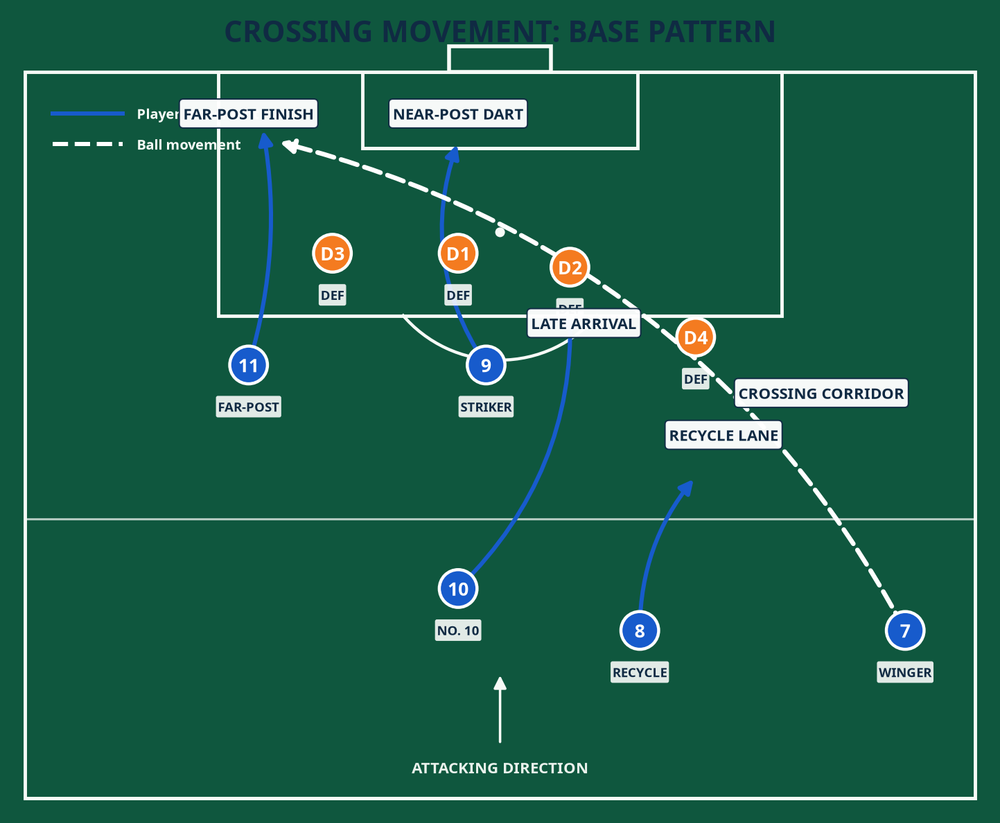
Mark a 44m long by 40m wide area, using the penalty area and the right touchline. If you do not have a full goal, mark a 7.32m goal with poles and retain a 5.5m goal area. Place a flat marker 5m outside the penalty area for the No. 8's recycle position, and a second marker just inside the right channel, 4m from the touchline, for the No. 7's delivery point. The working picture is 5 attackers versus 4 defenders plus a goalkeeper; two spare players act as servers and rotate in every four repetitions.
| Role | Starting reference | Job on the cross |
|---|---|---|
| No. 7, right winger | 4m inside the touchline, level with the box | Receive wide, travel forward and deliver with the correct height or cut-back weight. |
| No. 9, centre forward | 2m behind the penalty spot | Threaten near post to pull the first defender and goalkeeper. |
| No. 10, attacking midfielder | 3m outside the box, central | Delay, scan and arrive in the released penalty-spot lane. |
| No. 11, left winger | At the far side of the box, initially screened | Stay blindside, then attack the far-post corridor. |
| No. 8, central midfielder | 5m outside the box | Protect the second ball and recycle any clearance. |
Step-by-Step Instructions
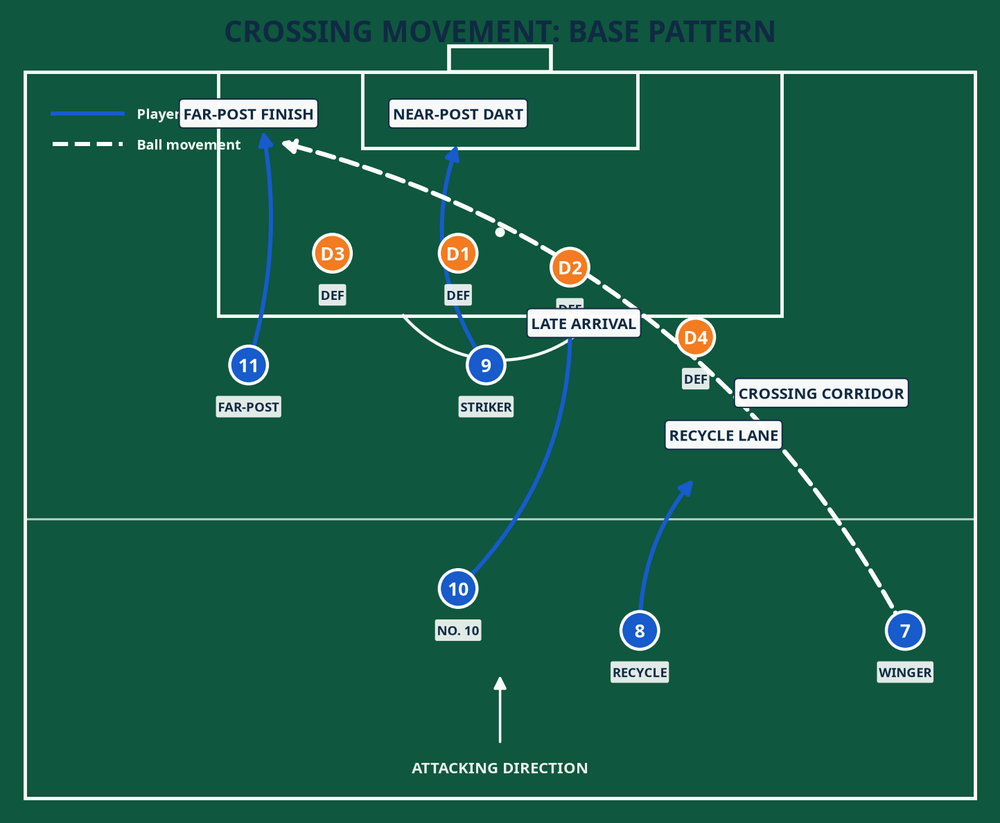
Start with a realistic trigger. A server plays into No. 7's feet in the right channel. No. 7 takes the first touch forward and opens the body to see the goal, the penalty spot and the far post. The other runners remain still until that first touch; this is where you coach patience.
Create the first movement. As No. 7's second touch prepares the cross, No. 9 curves across the nearest centre back and attacks the near-post lane. The run must start from behind the defender's shoulder, then accelerate for 3-4m. No. 9 is a genuine target, but is also the decoy that creates space behind the run.
Arrive, do not wait. No. 10 holds outside the congestion for one extra beat. When No. 7's kicking foot comes through the ball, No. 10 attacks the penalty spot on a diagonal line, aiming to meet the ball 9-11m from goal. A stationary No. 10 is easy to mark; a late runner arriving through the gap is difficult to track.
Attack the far post on the blind side. No. 11 begins 2-3m outside the far-post lane, out of the full-back's eyeline. Once the ball leaves No. 7's foot, No. 11 drives toward the back post and finishes any cross that travels beyond the central contest. Coach No. 11 to stay onside until the delivery, then arrive with a forward body shape.
Secure the next action. No. 8 slides to a position 5-7m outside the penalty area, slightly inside the ball line. If the defence clears, No. 8 receives side-on, has one touch to set, and either re-delivers, finds No. 7 again or changes the point of attack. Do not allow all five attackers to enter the six-yard area.
Finish the repetition properly. Play continues for six seconds after the first contact or defensive clearance. If the defending team wins cleanly, they score by dribbling over the halfway marker; that consequence demands honest rest-defence from No. 8 and realistic recovery from the runners. Rotate No. 7, No. 9 and No. 10 frequently so every player learns both the delivery and the box movement.
Key Coaching Points
| Moment | Coach's language | Detail to demand |
|---|---|---|
| Before the cross | "Show, then go." | Runners first find a defender's blind side rather than standing in the passing lane. |
| Trigger | "Move on the kick, not before it." | Tie the acceleration to No. 7's final touch and striking action. |
| No. 9's run | "Make the centre back choose." | Curve across the near defender and threaten the first post with intent. |
| No. 10's finish | "Arrive through the gap." | Attack the penalty-spot lane from outside the crowd; finish first time whenever possible. |
| No. 11's movement | "Be unseen, then be first." | Start beyond the far defender's shoulder and commit to the back-post zone. |
| Delivery | "Match the ball to the run." | Whip the ball between goalkeeper and line for the near-post option; use a driven cut-back when defenders collapse. |
Do not coach every runner at once. Freeze briefly after three poor repetitions, place the players in the exact lanes, then restart at match tempo. The essential detail is staggered timing: near post first, penalty spot second, far post last. If the runs are parallel, the box becomes crowded and the goalkeeper only has one decision to make.
Common Mistakes
| Error | What you will see | Immediate correction |
|---|---|---|
| Early movement | Attackers are waiting in the box before the ball is delivered. | Reset them outside the line of defenders and cue movement from the final touch. |
| One-line running | No. 9, No. 10 and No. 11 arrive in the same corridor. | Re-mark the three lanes and rehearse the runs without defenders for two repetitions. |
| Hopeful delivery | No. 7 crosses without lifting the head or matching the ball to movement. | Require a positive first touch, a scan, then one chosen target lane. |
| Empty cut-back zone | Everyone chases the goal line and no player attacks the penalty spot. | Hold No. 10 outside the congestion until the ball is struck. |
| No second phase | A clearance ends the exercise and No. 8 is too high to respond. | Give the defending team a counter target and reward No. 8 for a clean recovery. |
Variations & Progressions
Variation 1 — unopposed choreography. Begin with the goalkeeper and five attackers only. Use a passive server for No. 7 and rehearse the three finishing lanes for 6-8 minutes. This is not the finished practice; it is the rehearsal that lets younger or new groups understand their spacing.
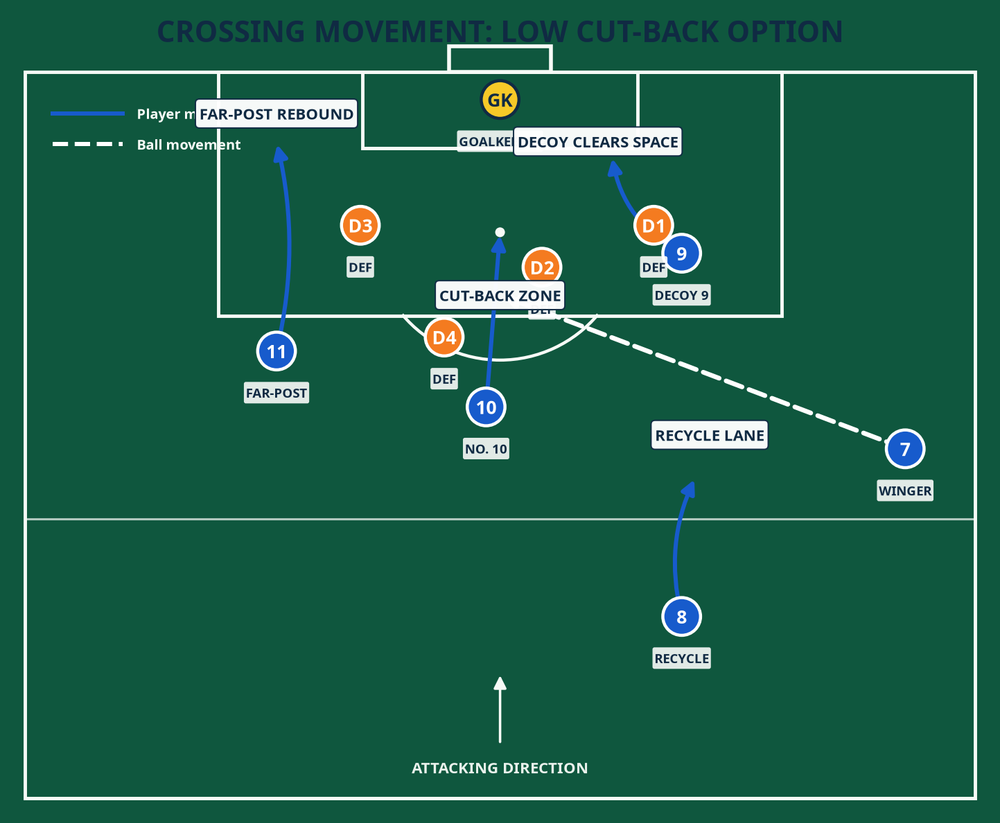
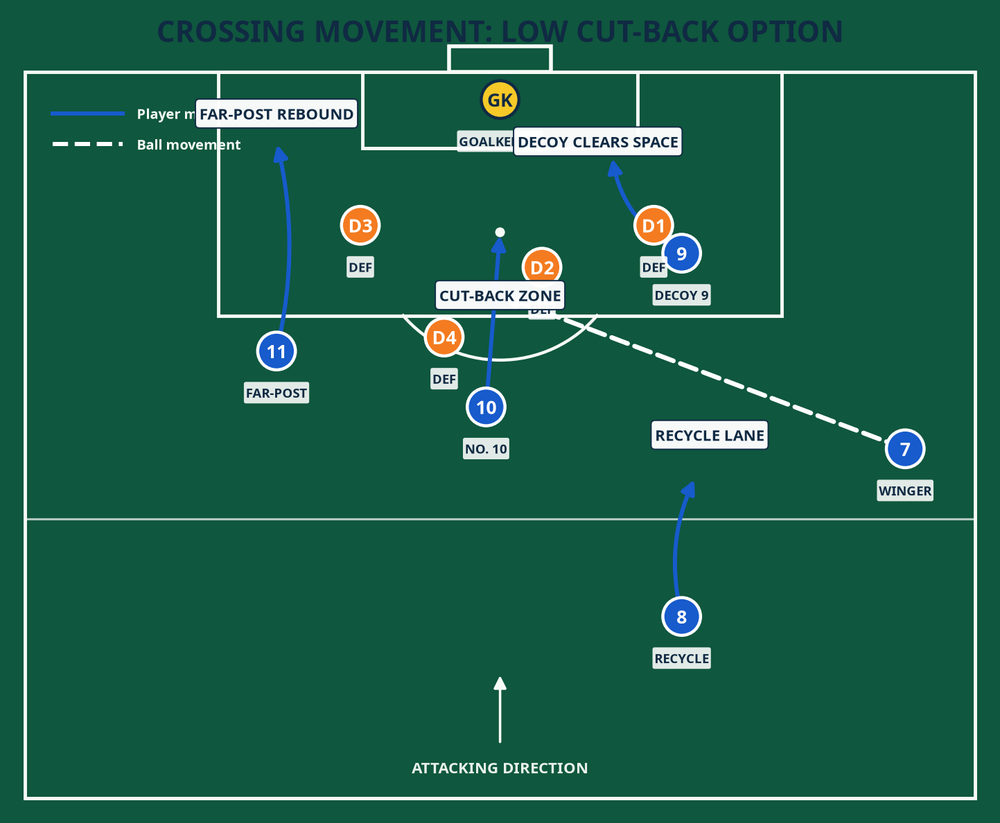
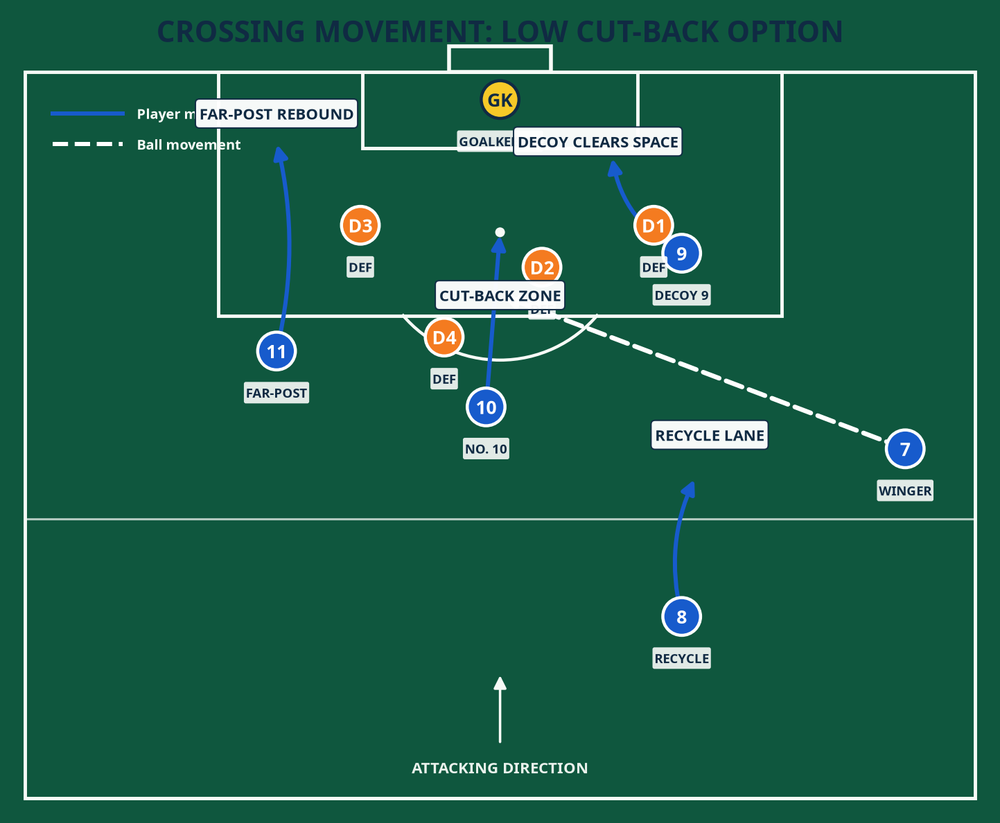
Variation 2 — live 5v4+GK with a low cut-back. Add defenders and allow No. 7 to choose the lofted far-post ball or a driven pass into the 8m x 6m cut-back zone. No. 9's near-post run now clears the route for No. 10, who finishes from the penalty spot.
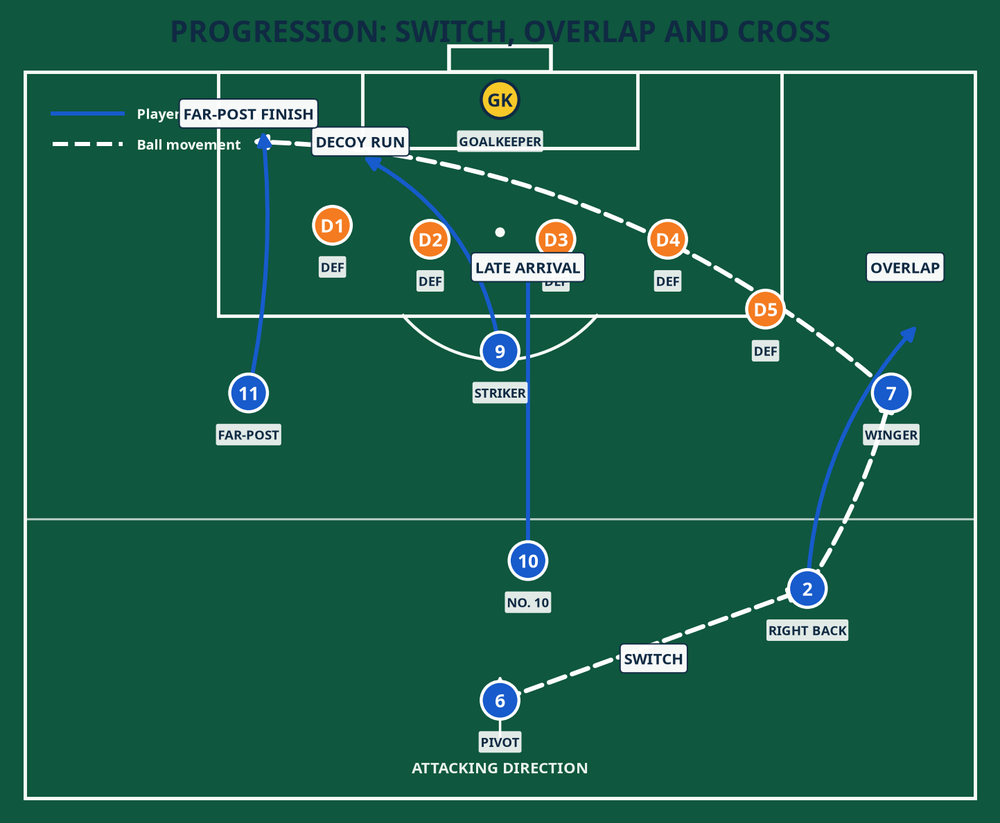
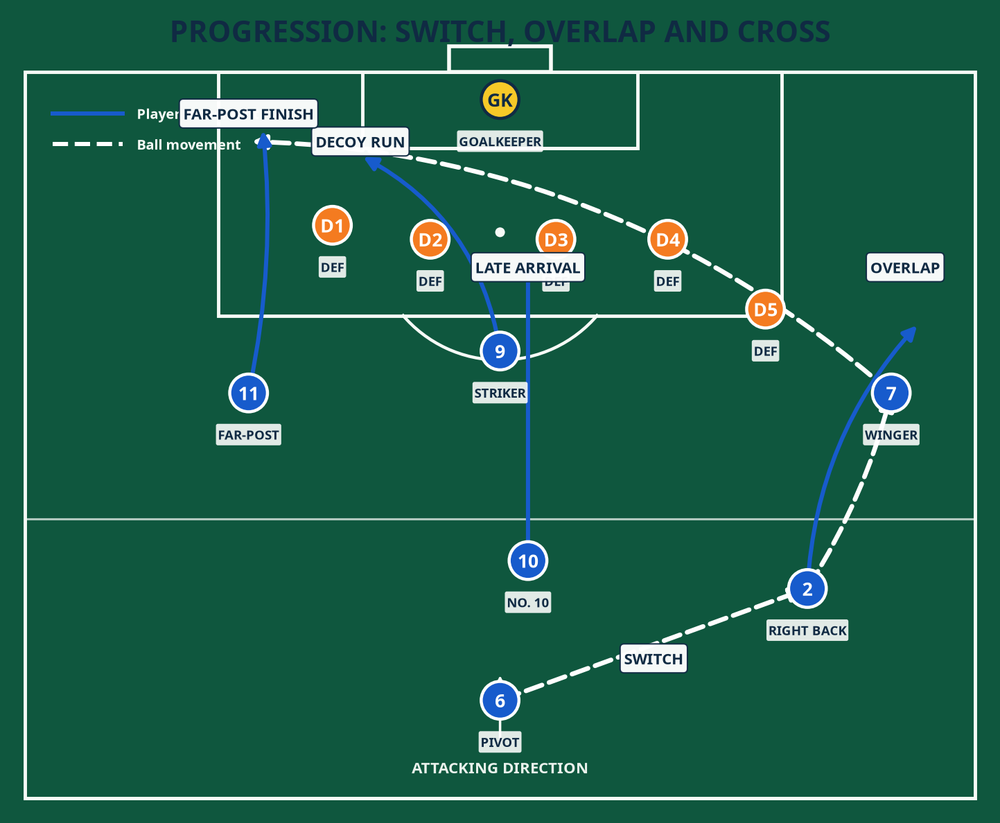
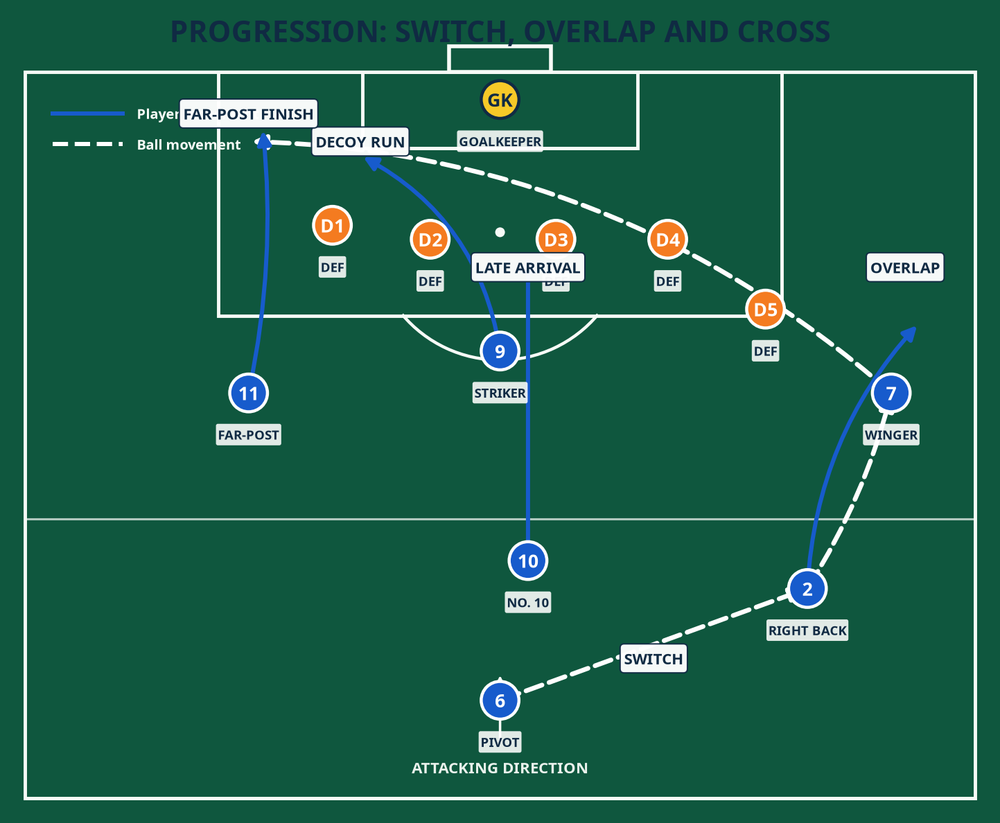
Progression 3 — switch, overlap and cross. Start with No. 6 on the opposite side. No. 6 switches 25-30m to No. 2, No. 2 overlaps No. 7, and the final delivery comes after the back line has shifted. Award two goals for a first-time finish from No. 10 or No. 11 and one goal for any other finish.
Age Adaptations
For Under-8 and Under-10, use a 28m x 24m area, 3 attackers versus 2 defenders, and name the lanes simply: front, middle and back. Remove offside and allow the crosser to serve from a static ball; your priority is recognising space and finishing with balance. For Under-12, use 36m x 30m with a goalkeeper and one recovering defender. Keep the same numbers but insist that the late runner starts outside the box.
For Under-14 and Under-16, use the full 44m x 40m space and introduce an active counter target for the defenders. Make the No. 8 responsible for the second ball and ask the No. 7 to read the defender's body shape before choosing a cross or cut-back. For open-age groups, add a live transition immediately after a defensive win and demand that No. 2 and No. 6 balance the attack behind the ball.
Coach's Closing Challenge
Finish with a 7-minute conditioned game in the same final-third area. A goal counts double only if it follows a wide delivery and there is a runner in each of the near-post, penalty-spot and far-post zones at the moment of contact. That scoring rule keeps the session honest: players learn that the cross is only the final action of a coordinated movement problem.
