

Football
4v4 Transition Small-Sided Game: High-Intensity Pressing & Counter-Attacking
Develop relentless counter-pressing and clinical attacking transitions in this high-intensity 4v4 small-sided game designed for match-realistic chaos.

What you need
4 mini goals, Flat markers or cones, Multiple footballs, 2 sets of coloured bibs
1. Overview
The 4v4 transition small-sided game (SSG) is a high-intensity coaching environment engineered to develop rapid decision-making the moment possession changes hands. In modern football, the immediate seconds following a turnover dictate the rhythm of the match. This drill exposes players to constant transitional chaos, forcing the team that loses the ball to execute an immediate, coordinated counter-press while challenging the team that wins possession to secure the ball and strike before the opposition can reorganise.
Coaches should utilise this session when their squad struggles to react to turnovers, either by dropping off too passively when losing possession or failing to capitalise on the disorganisation of the opponent when winning it back. By limiting the numbers to 4v4, every player remains engaged in the tactical problem, ensuring maximum repetitions of pressing triggers, forward passing angles, and recovery sprints.
2. Setup
To ensure the drill runs smoothly and replicates match intensity, the physical environment must be precise.
Pitch Dimensions:
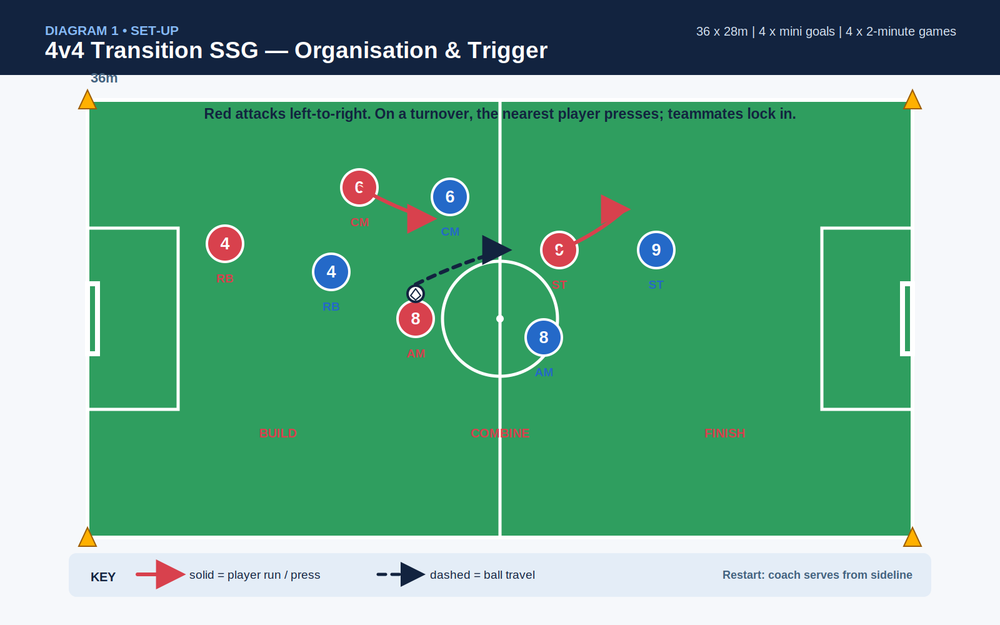
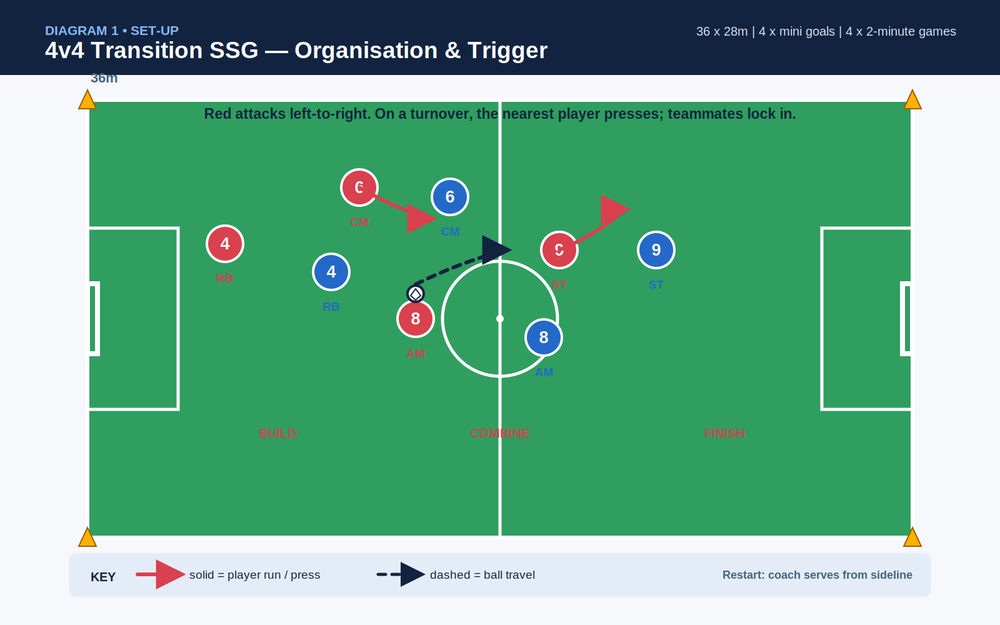
Mark out a playing area of 36 metres in length by 28 metres in width. This compact space limits time on the ball and encourages frequent transitions.
Equipment:
- 4 mini goals (two placed on each end line, approximately 4 metres in from the corners).
- A plentiful supply of footballs placed on the touchline with the coach to maintain tempo.
- Flat markers or cones to define the pitch boundaries.
- Two sets of distinct bibs (e.g., Red and Blue).
Player Positions:
Divide eight players into two teams of four. While formations in a 4v4 are fluid, organise each team into a functional shape resembling a diamond (1-2-1) or a box (2-2). For the purpose of instruction, identify the roles as one defender/cover player (e.g., Centre Back or holding midfielder), two wide support players (e.g., Fullbacks or wide midfielders), and one high target player (e.g., Striker).

3. Step-by-Step Instructions
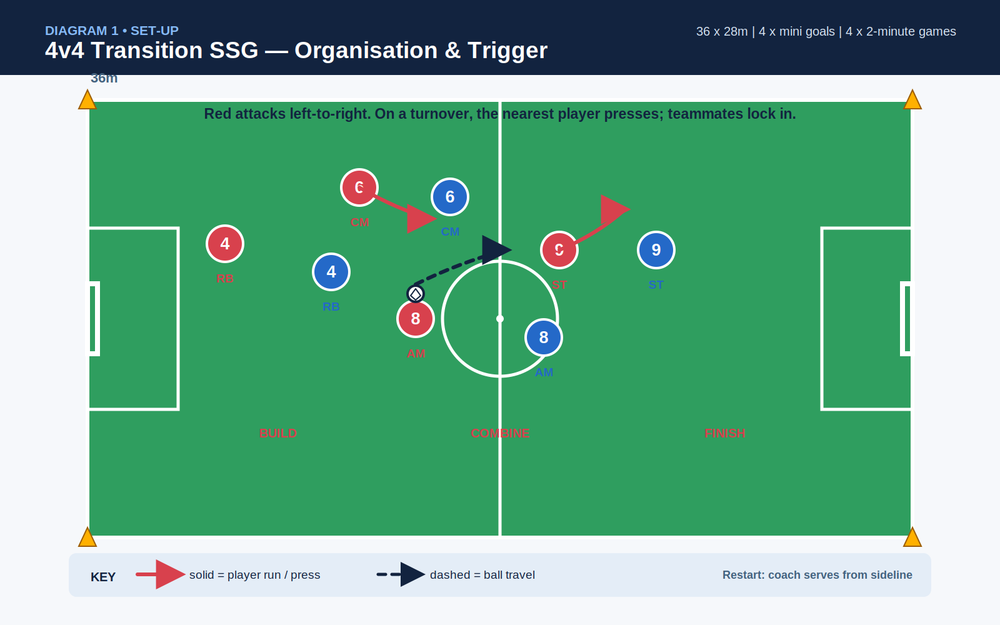
- Commence Play: The coach serves a ball from the touchline to the Red team to begin the game. The Red team attempts to build possession and score in either of the two mini goals at the far end.
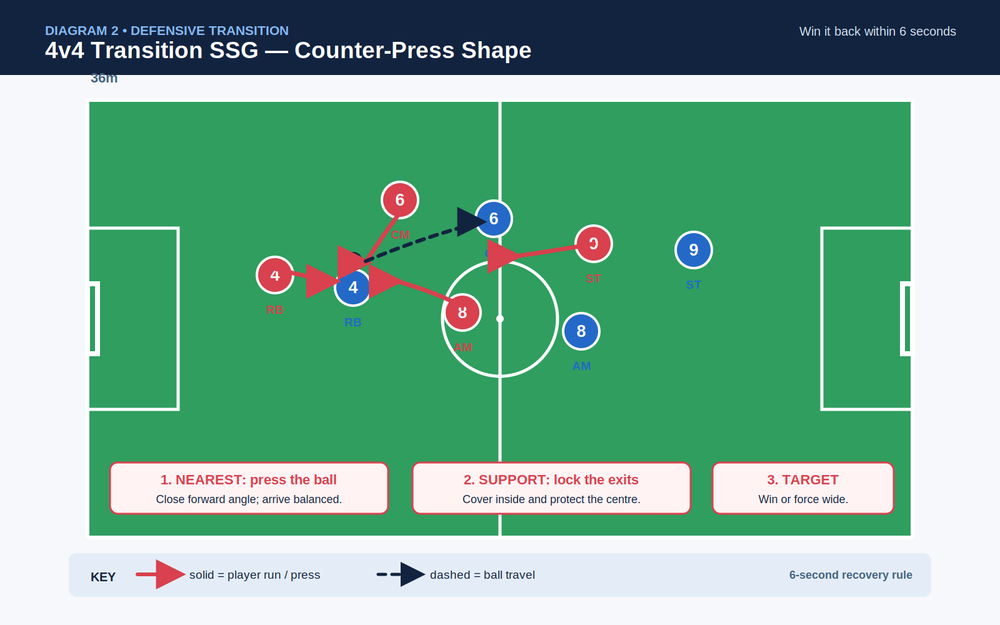
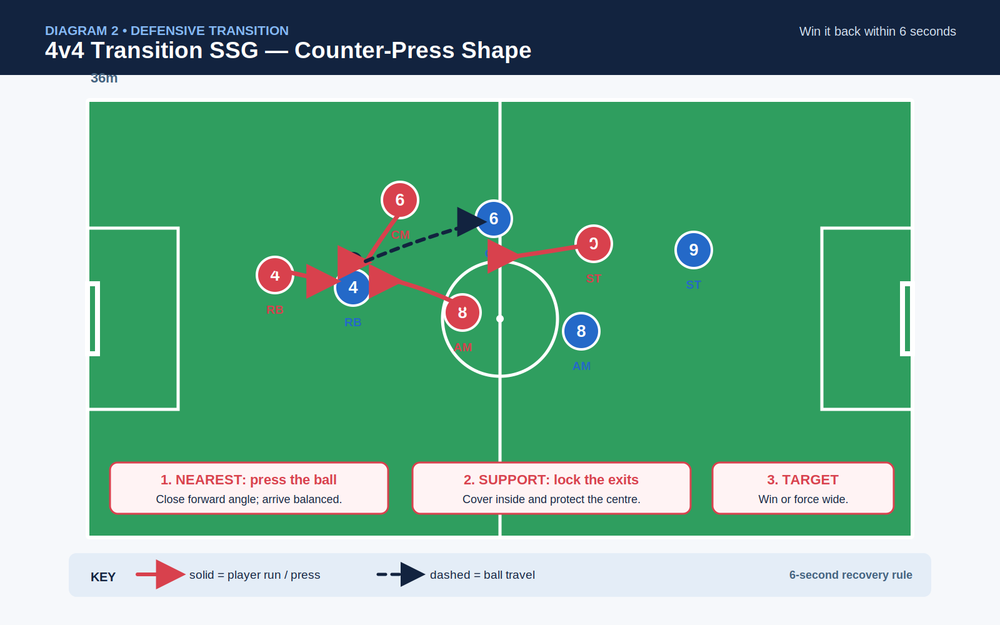
- Defensive Transition (Counter-Press): If the Blue team intercepts a pass or tackles a Red player, the Red team must immediately execute a counter-press. They have exactly six seconds to win the ball back or force the ball out of play. The nearest Red player must aggressively close the ball carrier while the remaining three lock onto the nearest passing options.
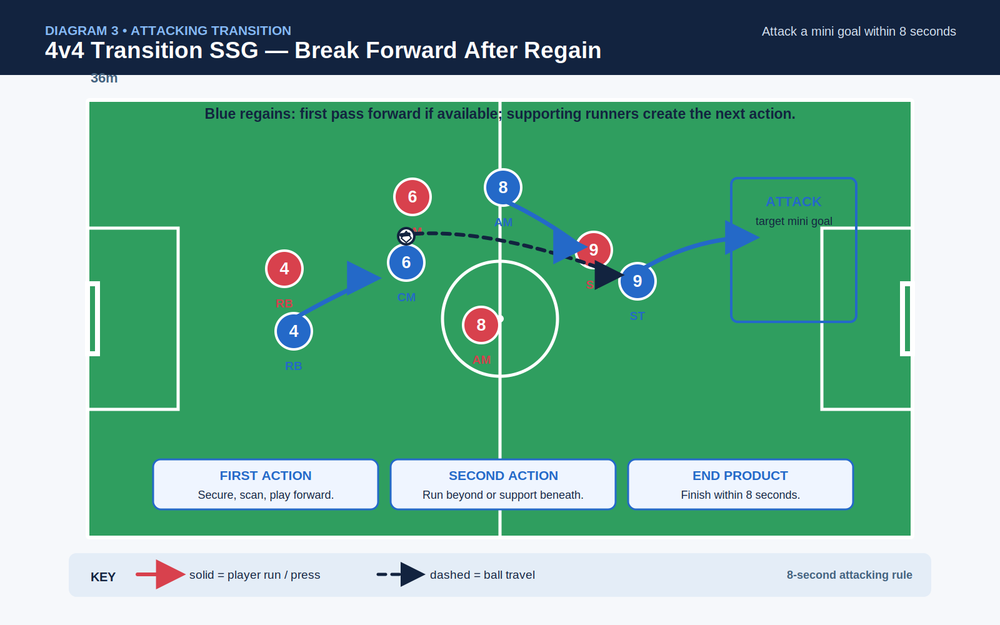
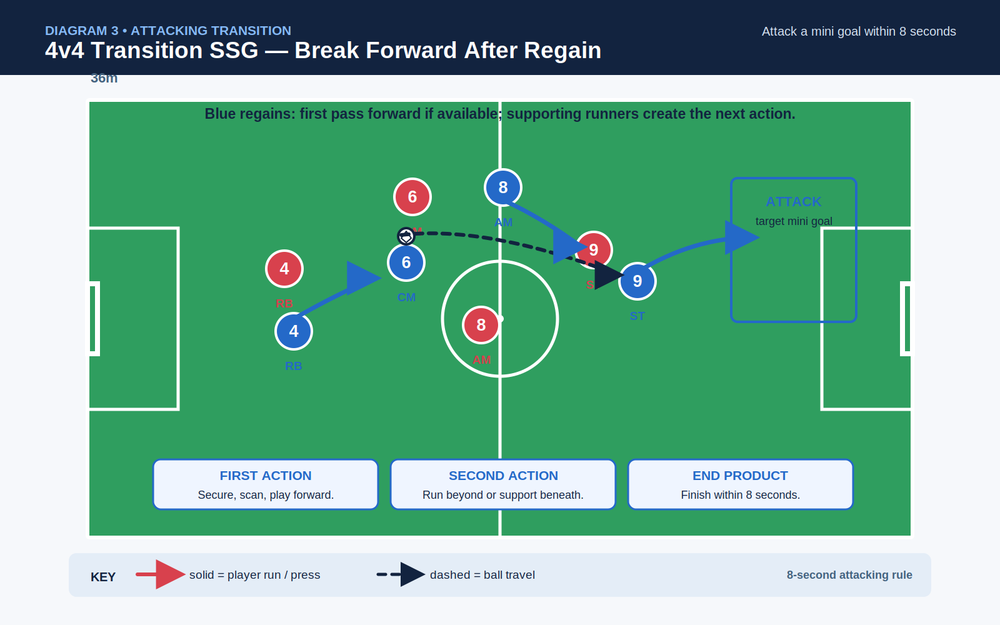
- Attacking Transition (The Break): Upon regaining possession, the Blue team must transition from defence to attack instantly. Their objective is to score in the opposite mini goals within eight seconds. The player who wins the ball should look for an immediate forward pass or drive into space, while teammates make explosive, supporting runs.
- Restarting the Chaos: If a goal is scored, the ball goes out of bounds, or a team fails to execute their transition within the time limits, the coach immediately fires a new ball to the team that was out of possession, instantly restarting the drill and creating a new transitional moment.
- Work-to-Rest Ratio: Play high-intensity blocks of two to three minutes, followed by one minute of active recovery. Complete four to six blocks depending on the squad's physical conditioning.
4. Key Coaching Points
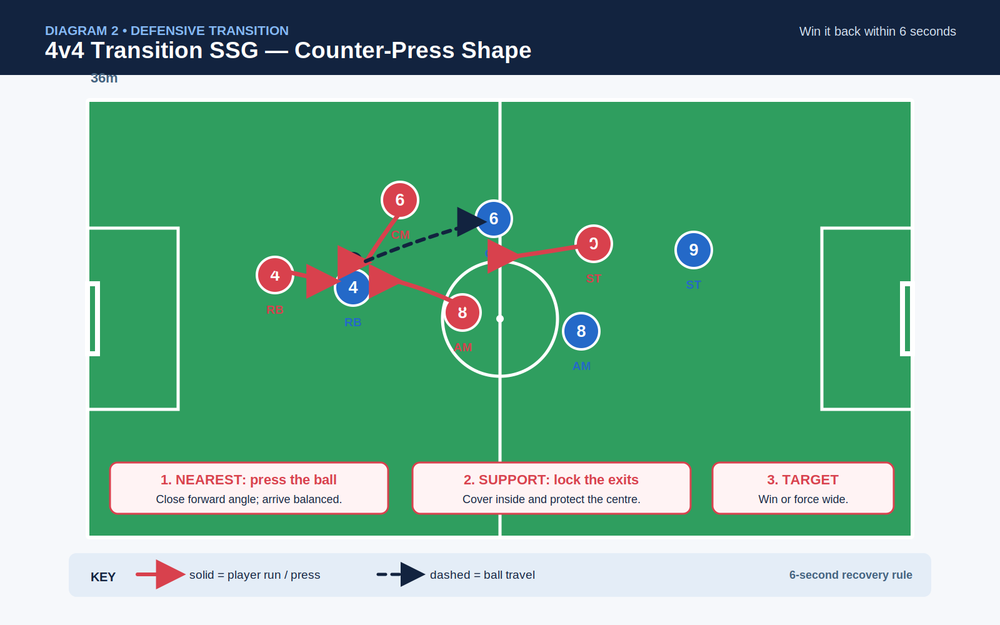
- Immediate Reaction to Loss: The psychological shift from attacking to defending must be instantaneous. The player closest to the ball must apply aggressive, balanced pressure to the ball carrier's forward foot, denying them the opportunity to lift their head and scan for a forward pass.
- Locking the Exits: The counter-press fails if it is a solo effort. While the first player presses the ball, the second and third players must anticipate the escape passes, stepping in front of receivers to intercept or force the ball backwards.
- The First Pass Forward: When possession is won, the first thought must be vertical. The player who regains the ball must secure it and look to play forward immediately, bypassing the opposition's counter-press before they can establish a defensive shape.
- Supporting Runs: An attacking transition requires off-the-ball movement. Teammates must sprint forward to provide options ahead of the ball, stretching the pitch and creating numerical overloads against the retreating defenders.
5. Common Mistakes
- Passive Reactions: Players dropping back toward their own goals after losing the ball rather than stepping forward to press. This invites pressure and allows the opponent to dictate the attack.
- Over-Committing the Press: The first pressing player diving in recklessly rather than slowing down on approach. A missed tackle entirely eliminates a player from the defensive shape, leaving the team exposed in a 3v4 situation.
- Negative First Touch on Regain: The player who wins the ball taking their first touch backwards or sideways. This allows the opposition time to recover their defensive shape and suffocates the counter-attack.
- Lack of Width in Attack: Upon winning the ball, teammates running in straight lines down the centre of the pitch. This congests the play; runners must fan out to create passing lanes and stretch the recovering defenders.
6. Variations & Progressions
- The Overload Transition: Introduce a neutral player (a 'Joker' or 'Magic Man') who always plays for the team in possession. This creates a 5v4 scenario, making it easier for the attacking team to retain the ball but significantly harder for the defending team to execute a successful counter-press, forcing them to be incredibly coordinated.
- Directional Targets: Replace the mini goals with two target players positioned on the end lines. Teams score by playing a firm, accurate pass into the target player's feet. This encourages precise, penetrative passing rather than long-range shots into empty nets.
- Touch Restrictions: Limit the team in possession to two touches. This artificially increases the speed of play and forces the defending team to press with even greater urgency, as the ball will move rapidly.
7. Age Adaptations
- Under 8s to Under 10s: Remove the strict time limits (six seconds to press, eight seconds to score) as these young players are still developing their technical consistency. Focus purely on the reaction: shout "Win it back!" when they lose the ball and "Go forward!" when they win it. Expand the pitch slightly to afford them more time on the ball.
- Under 12s to Under 14s: Introduce the time limits but be lenient. The focus should be on the shape of the counter-press (who presses the ball, who covers) and the quality of the first pass upon regaining possession.
- Under 16s to Senior: Enforce the time limits strictly. Demand high physical intensity, aggressive pressing, and clinical finishing. If a team fails to transition quickly enough, penalise them by awarding possession to the opposition.
