

Netball
Fast Break Centre Pass: Wide Release to Circle-Edge Finish
Teach your midcourt to turn a centre pass into a three-pass, high-tempo entry that reaches the shooting circle before the defensive unit can set.

What you need
1 regulation netball, 10–12 flat cones, 2 sets of bibs, whistle, stopwatch, full 30.5 m x 15.25 m court
Overview
This is a fast-break centre pass designed to turn the first possession into a purposeful attacking wave. It is not a pattern for passing the ball around the circle; it is a tempo play. The Centre (C) uses the first release to draw the opposing Centre, the Wing Attack (WA) creates genuine sideline width, and the C then bursts through the middle gate to link with the Goal Attack (GA) at the circle edge. The objective is a clean shooting opportunity in three or four passes, before the defensive circle can set.
Use it after a goal, at the start of a quarter, or whenever the opposition’s centre-pass defence is sitting narrow and watching the ball. The court is 30.5 m by 15.25 m, divided into equal thirds; the centre circle is 0.9 m in diameter and each goal circle has a 4.9 m radius.[1] Build the play at game pace only after players can maintain their positional discipline and recognise the defensive picture.
Coach’s intent: width first, then speed through the middle. If the first wide option is covered, do not force it; use the safety reset and re-attack on the next timing window.
Setup
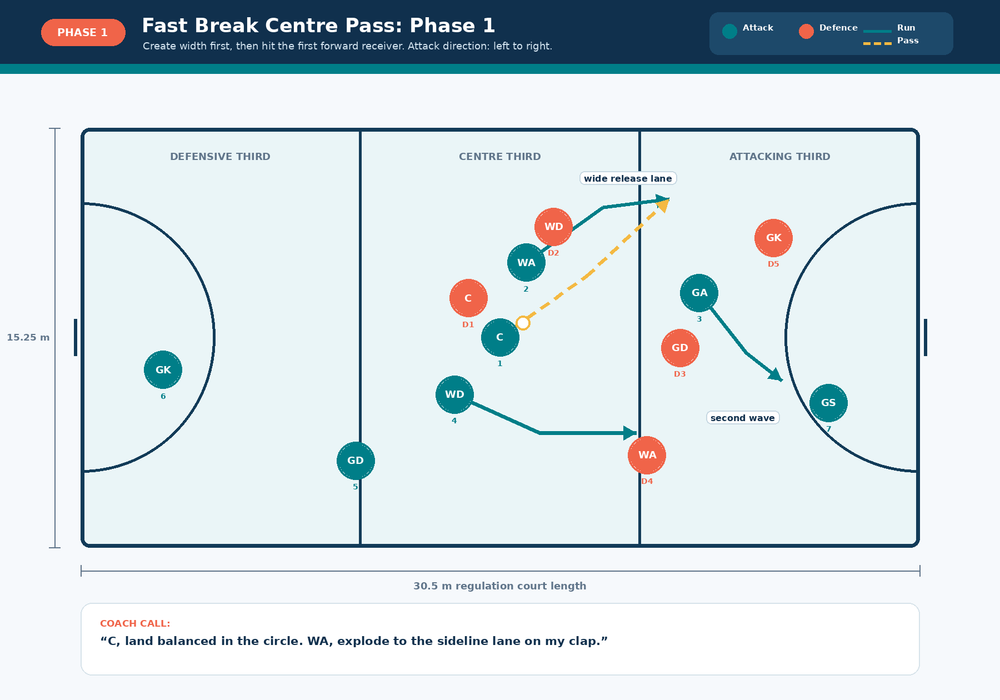
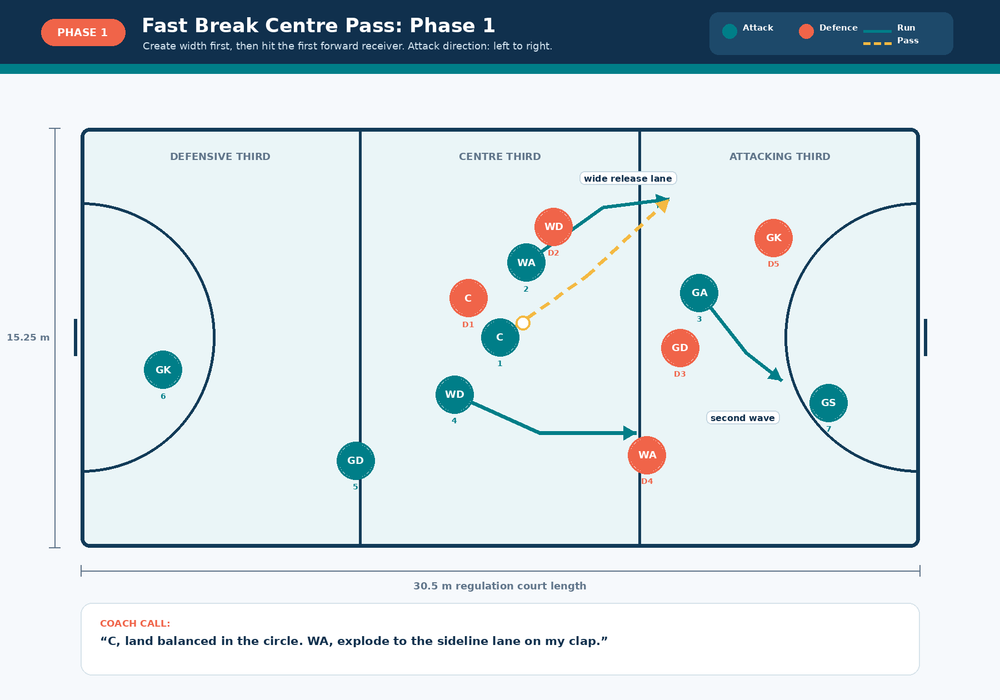
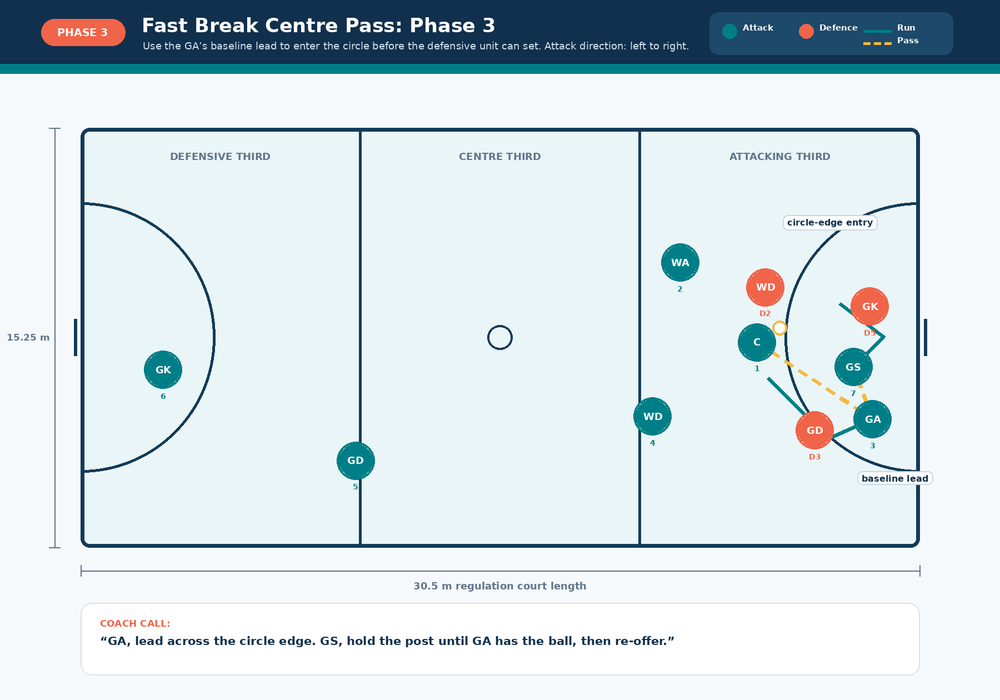
Set up on a full regulation court with seven attackers and, once the pattern is established, seven defenders. Place a flat cone 1.5 m inside each sideline to mark the WA’s wide-release lane, and a second pair of cones 2 m either side of the centre-third/goal-third transverse line to mark the C’s middle gate. The attacker numbering below is used throughout the diagrams and coaching calls.
| Number | Position | Starting job | First key space |
|---|---|---|---|
| 1 | C | Starts inside the centre circle with the ball | Middle gate, 2–3 m beyond the second transverse line |
| 2 | WA | Begins high and slightly wide in the centre third | Sideline release lane |
| 3 | GA | Starts just inside the attacking third | Circle-edge lead, then baseline option |
| 4 | WD | Provides the trailing safety and second-wave run | Far-side centre-third lane |
| 5–6 | GD and GK | Hold legal defensive-third balance in training | Safety outlets only |
| 7 | GS | Holds the post and presents late | Front or back space in the goal circle |
Use 10–12 flat cones, two sets of bibs, one match ball and a stopwatch. Allow 20 minutes: five minutes unopposed walk-through, seven minutes conditioned opposition, then eight minutes live centre-pass repetitions. Insist on legal landings and routes from the first repetition.[1]
Step-by-Step Instructions
1. Establish the start picture
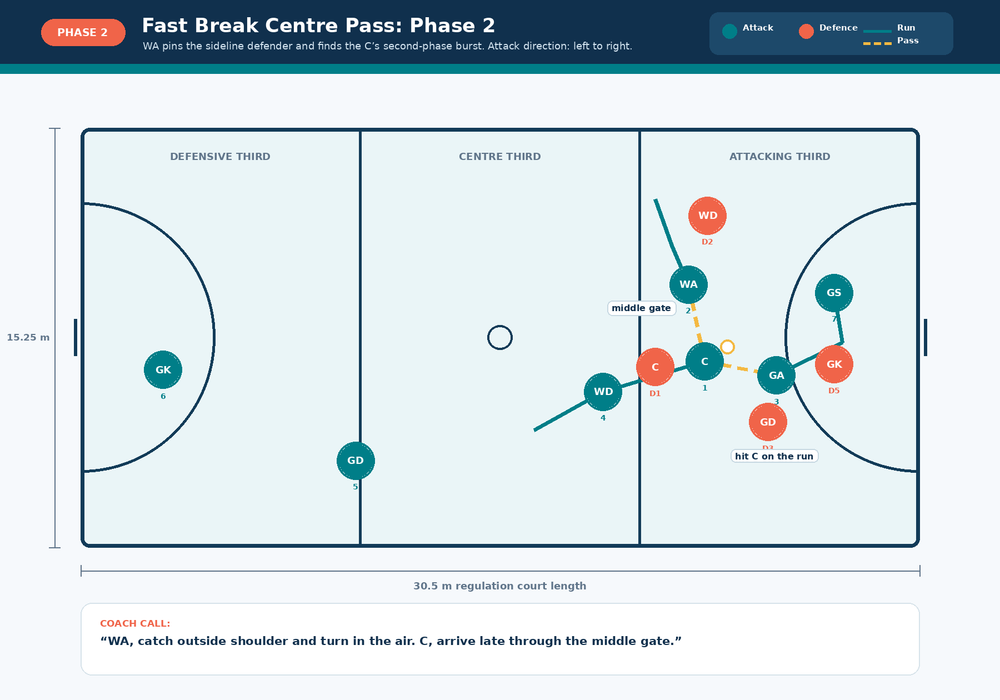
Place C (1) in the centre circle with the ball. WA (2) begins 1–2 m to the attacking-side shoulder of the circle, but not already on the sideline. GA (3) starts 2–3 m inside the attacking third, on the opposite half from WA. GS (7) stays deep in the goal circle, while WD (4) is the trailing safety below the ball line. On the whistle, C must establish balanced footwork before releasing; do not allow the first pass to become a rushed, flat lob.
2. Trigger the wide release
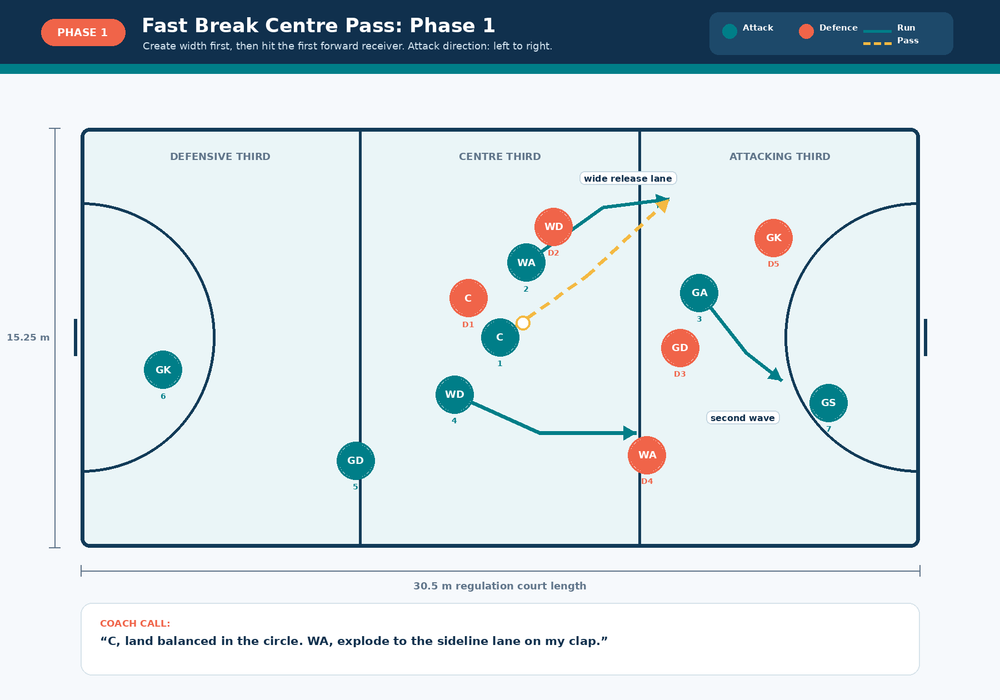
On C’s first step, WA drives hard for the cone lane, aiming to receive approximately 1.5 m inside the sideline and 3–5 m forward of the centre circle. C delivers a firm diagonal pass into WA’s outside shoulder, so WA can land facing downcourt. The ball should leave C’s hands within 1.5 seconds of the centre-pass whistle. GA moves on the opposite diagonal to pull the GD away from the middle lane; WD goes as the second wave, never ahead of the ball.
3. Make the second-phase C burst
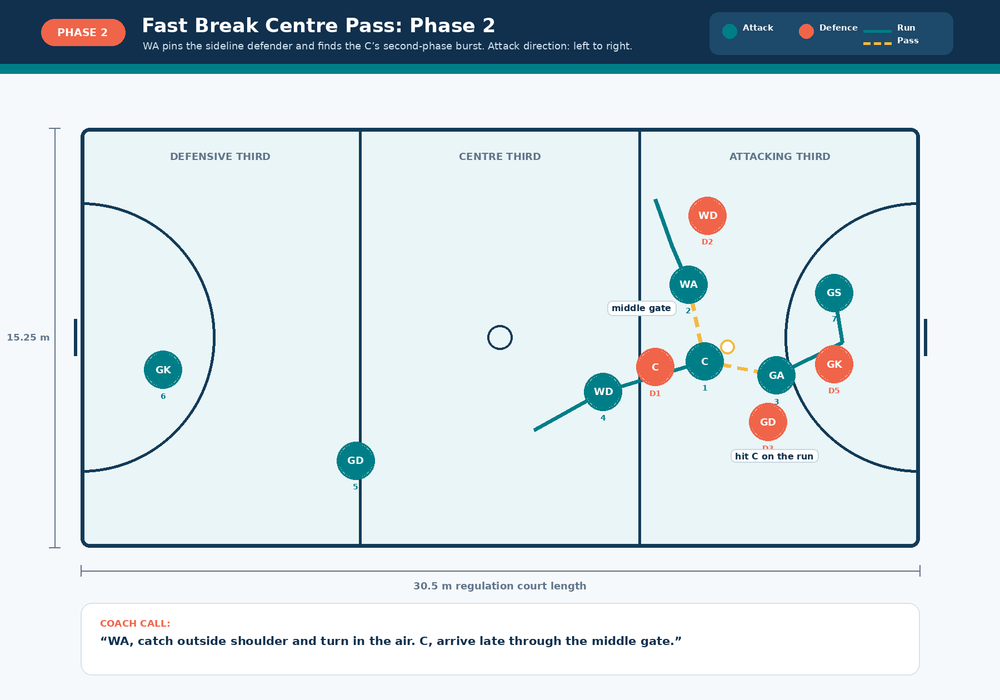
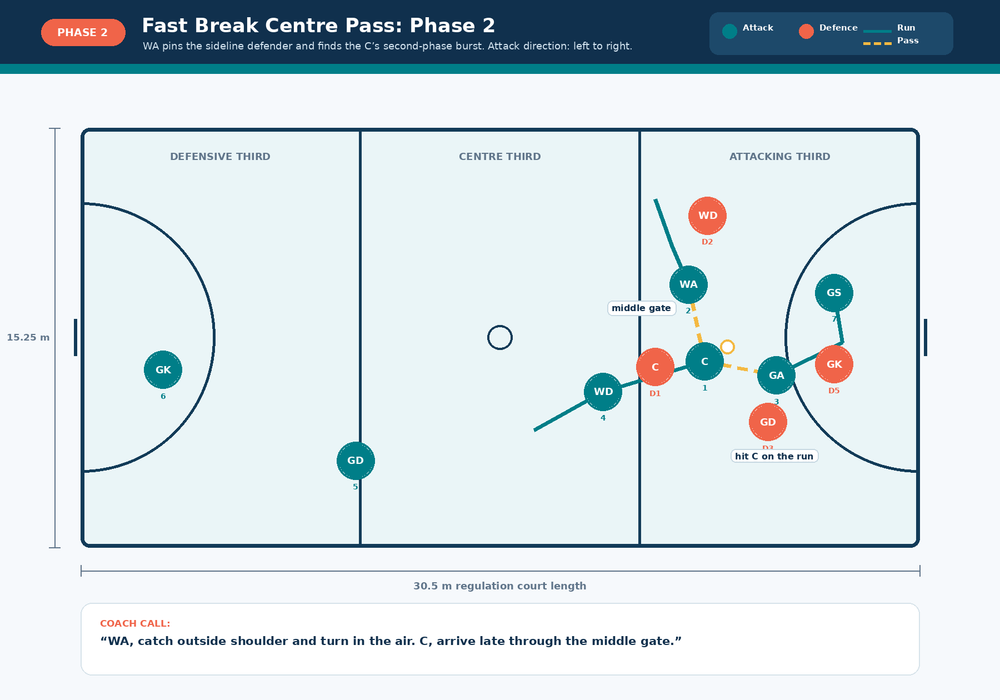
As WA receives, C does not spectate. C immediately sprints through the middle gate, timing the run to arrive just after WA has landed and turned. WA takes no more than two set-up steps, then feeds C on the run 2–3 m inside the attacking third. The key is the delay: if C leaves early, the opposing C simply tracks the obvious route; if C leaves late, WA sees a clear passing window behind the first defender.
4. Convert the advantage at the circle edge
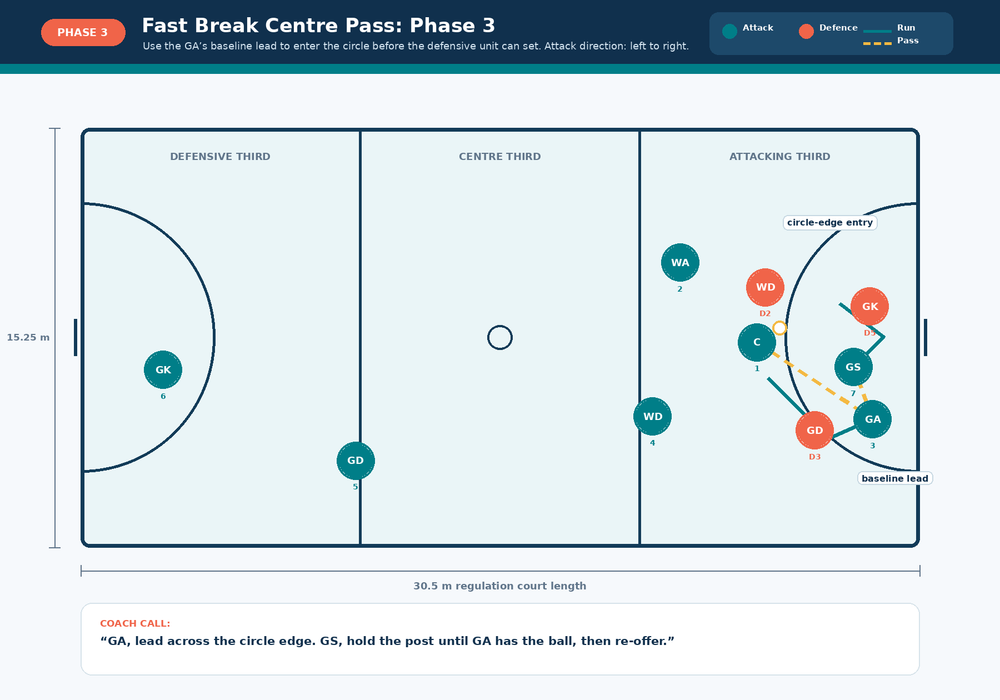
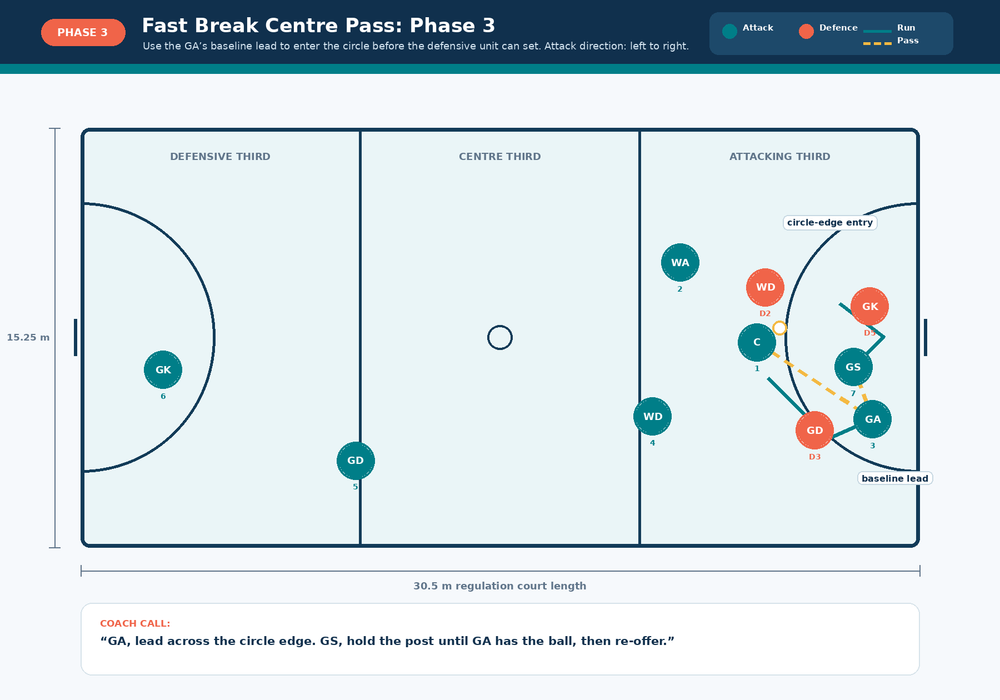
C catches with hips and shoulders pointed toward the circle. GA now leads across the circle edge toward the baseline, giving C a forward, away-from-defender target. C releases a decisive pass to GA, not a hopeful ball into a crowded circle. GS holds the post until GA has possession, then re-offers front or back space. GA either feeds GS immediately or takes the shot if free. Demand a shot, a clear circle entry or a safe reset within 6 seconds of the centre pass.
5. Use the safety answer when the wide lane is denied
If the opposing WD jumps the WA lane, C calls “reset” and uses WD (4) as the legal trailing outlet. WD returns the ball to C or, if C is marked, to WA on a second lead. Teach the group that abandoning the first picture is good decision-making, not failure. The set play succeeds when it creates an advantage, not when it is completed mechanically.
Key Coaching Points
| Coaching priority | What to coach | Observable standard |
|---|---|---|
| Width before speed | WA must run to space, not toward the ball. | The catch occurs at least 1.5 m inside the sideline. |
| Landing position | Receivers land side-on with eyes already scanning downcourt. | WA can pass forward without an extra pivot. |
| Second-phase timing | C leaves after the WA catches and turns, not before. | C receives with separation rather than body contact. |
| Pass quality | Use a driven shoulder pass into space, not a floated pass. | The receiver meets the ball at chest height while moving forward. |
| Circle discipline | GA leads outside first, then into the circle edge. | C has a visible, legal forward target. |
| Decision ownership | Players read defenders and select the reset when needed. | No forced pass into a covered lane. |
Common Mistakes
The most common error is a WA lead that is too shallow. Correct it by placing a cone lane 1.5 m inside the sideline and requiring every first catch to be outside the defender’s shoulder. The second is a C who admires the first pass; use a delayed clap so C learns to re-offer only after WA receives. Third, coaches often see GA drift too early into the circle, which compresses the attack. Start GA wider and demand a sharp circle-edge lead on C’s second catch. Finally, stop the drill when players throw a high, speculative ball over the top. A fast break is built on safe acceleration, not risk for its own sake.
Variations & Progressions
Make it easier. Begin 7 v 0 with cones as defenders. Allow WA a stationary catch, then progress to a jog before insisting on a full-speed lead. For younger groups, run only C, WA, GA and GS in the attacking half, with a coach serving the first ball.
Add a live read. Introduce an active opposing C and WD but keep GD and GK passive. WA must call either “wide” or “reset” before C releases. This develops scanning and communication without overwhelming the finishing phase.
Make it match-real. Play 7 v 7 with a six-second scoring-clock constraint. Award two points for a goal scored from three or four passes, one point for a safe reset and completed possession, and no points for a forced turnover. Change the defensive look every three repetitions: narrow press, sideline denial, then C block.
Age Adaptations
| Group | Adaptation | Coaching focus |
|---|---|---|
| Under 8–10 | Use half-court, three attackers and passive defenders; reduce the route to C–WA–GA. | Catching, stopping safely and finding space. |
| Under 12 | Run 5 v 5 with the sideline lane marked; give receivers up to four seconds initially. | Leading timing and a forward first look. |
| Under 14 | Use the full 7 v 7 pattern with passive-to-live defence. | Legal landings, second-phase C timing and reset decisions. |
| Under 16 and Open | Use scouting cues and live pressure; set the six-second finish target. | Disguised leads, pass selection and exploiting the defensive structure. |
Finish every session with three centre-pass attempts under match rules. World Netball’s 2024 rules are the current international framework, but local competitions may introduce variations, so confirm your association’s implementation and any modified junior rules before using the timing constraints.[2]
References
[1]: https://netball.sport/game/facilities-and-equipment/ World Netball — Facilities and Equipment
[2]: https://netball.sport/game/the-rules-of-netball/ World Netball — The Rules of Netball (2024 Edition)
