

Rugby
The Defensive Lineout Steal: Attacking the Middle Catch Point
Disrupt opposition possession and launch immediate counter-attacks by mastering the timing, lift, and execution of a middle-channel lineout steal.

What you need
Rugby balls, Bibs/pinnies (two colours), Cones for marking the 5m and 15m lines
1. Overview
A successful defensive lineout steal does more than just regain possession; it psychologically disrupts the opposition's set-piece foundation and provides an unstructured attacking platform from which to strike. This resource focuses on a coordinated middle-steal strategy against a standard five-man lineout, targeting the opposition's primary jumper (usually the 5). By matching their numbers and relying on a disciplined trigger rather than guesswork, defending teams can legally contest the throw and secure the ball above the shoulder line. When executed correctly, this play immediately transitions into a base exit, allowing your 9 and 12 to exploit a disorganised defensive line.
2. Setup
Pitch Location: Any defensive lineout between your own 22-metre line and the opposition's 22-metre line. It is most effective when the opposition has a full lineout (15m width) to defend on the subsequent phase.
Player Positions (Defending Team):
- 1 (Front Guard): Anchors the front of the lineout.
- 4 (Front Lifter): Positions directly opposite the opposition's front lifter.
- 5 (Target Lock): The designated jumper, aligning squarely with the opposition's primary target.
- 6 (Rear Lifter): Positions behind the 5, ready to drive vertically.
- 8 (Tail Guard): Covers the back of the lineout and defends the 15m channel.
- 9 (Base Receiver): Sweeps behind the lineout, tracking the ball's flight to arrive at the landing zone precisely as the jumper returns to ground.
- 12 (First Receiver): Holds depth 10m infield, ready to take a rapid exit pass from the 9.
3. Step-by-Step Instructions
Step 1: Match the Call and Attack the Catch Point

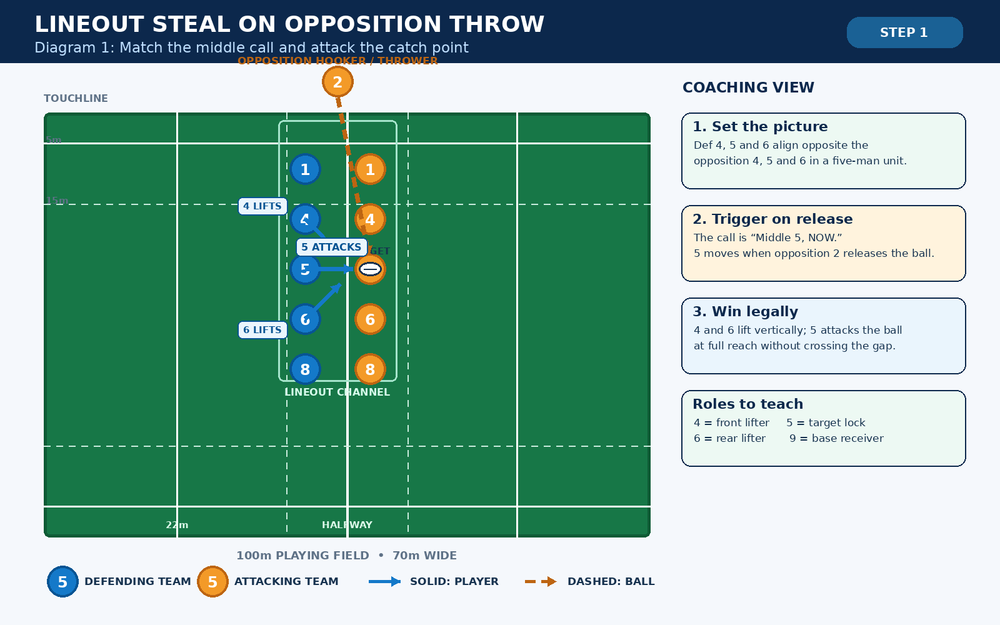
The foundation of the steal is alignment and patience. The defending pod (4, 5, and 6) must mirror the opposition's primary jumping pod. The coach or lineout captain calls “Middle 5, NOW,” but this is an organisational call, not the trigger to jump. The true trigger is visual: the defending 5 must watch the opposition hooker (2) and initiate movement only when the ball leaves the thrower's hands. Upon release, 4 and 6 execute an explosive, vertical lift. The 5 must attack the space directly above the middle channel, reaching with both hands to intercept the ball at its highest point without crossing the imaginary plane that separates the two teams.
Step 2: Secure the Steal and Launch from the Base
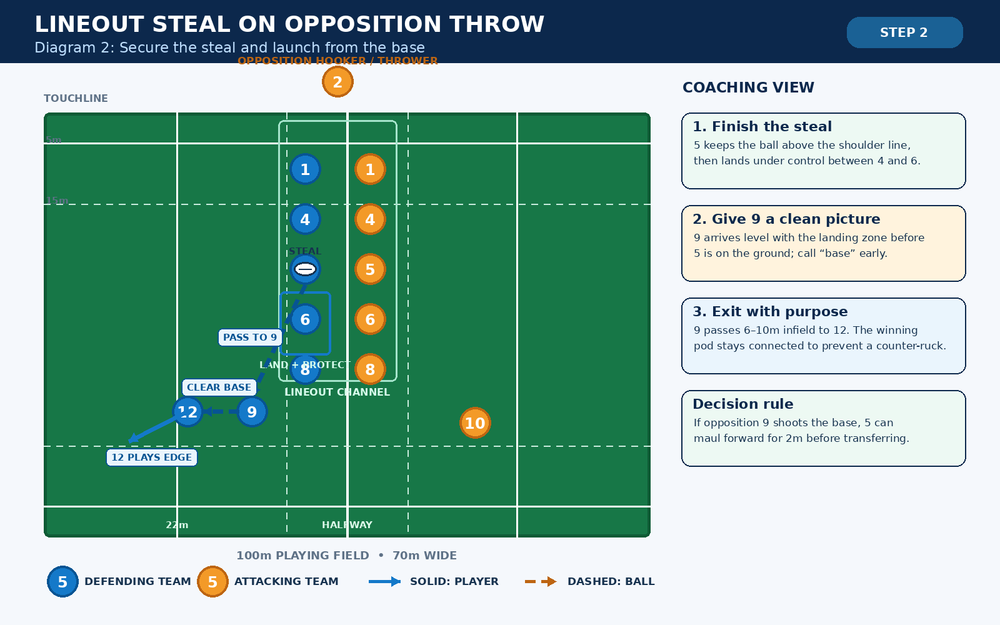
Winning the ball in the air is only half the battle. Once the 5 secures possession, they must keep the ball above their shoulder line to prevent an immediate wrap-up by the opposition lock. As the lifters safely return the 5 to the ground, the 9 must already be in position at the base. The 9's early arrival prevents the opposition from contesting the loose ball or driving a counter-ruck. The 5 transfers the ball immediately to the 9, who clears it with a crisp, flat pass 6–10m infield to the waiting 12. The original lifting pod (4, 5, 6) must stay tightly connected upon landing to protect the 9 and seal the breakdown edge.
4. Key Coaching Points
- Trigger Discipline: The jump must be initiated by the release of the ball from the hooker's hands, never by the opposition jumper's movement or a vocal dummy call. Jumping early guarantees a penalty or a missed contest.
- Vertical Lift: Lifters (4 and 6) must step in and drive straight up. Any horizontal movement across the gap will result in a penalty for interference.
- Two-Handed Attack: The jumping 5 must attack the ball with two hands aggressively. A one-handed tap is a last resort; securing the ball allows for a controlled exit.
- Base Anticipation: The 9 must anticipate the steal and arrive at the landing zone before the jumper's feet touch the ground. Late arrival invites a messy breakdown.
- Connected Landing: The lifting pod must not splinter upon landing. They must brace as a unit to absorb any immediate counter-drive from the frustrated opposition.
5. Common Mistakes
- Watching the Jumper Instead of the Ball: Defending locks often watch their opposite number and jump when they jump. This allows the attacking team to use dummy jumps to draw the defender off the ground early.
- Reaching Across the Gap: If the defending 5 leans across the 1-metre gap to swat the ball rather than jumping vertically, the referee will penalise them for playing the player in the air.
- Isolating the Jumper on Landing: If the lifters release the jumper too early or peel away immediately, the 5 lands isolated and is highly vulnerable to being held up in a choke tackle, resulting in a turnover scrum.
6. Variations & Progressions
Variation: The Tail Steal Against a Predictable Long Throw
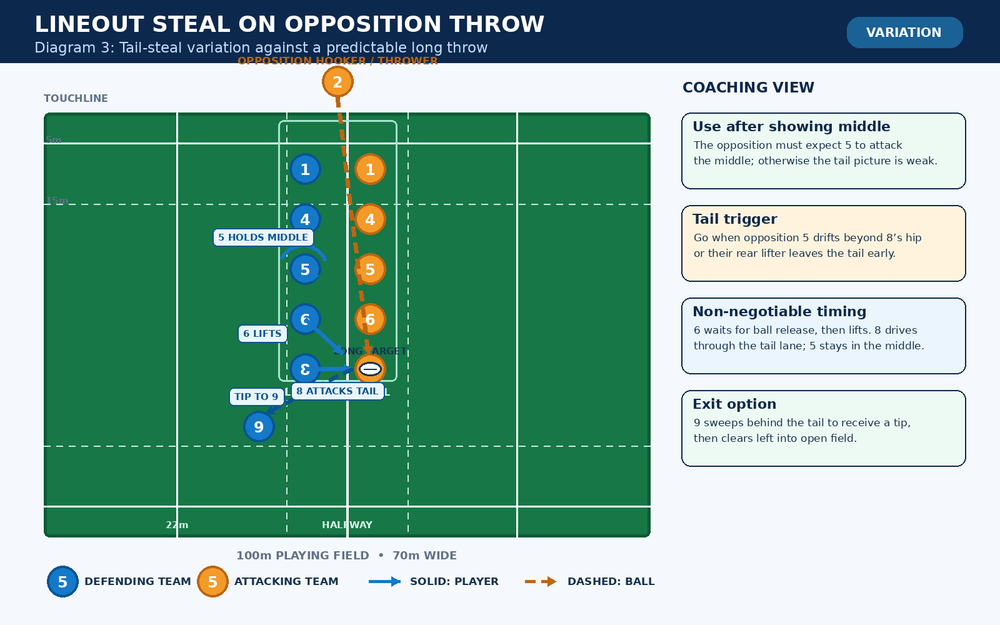
If the opposition begins throwing over the contested middle to their tail jumper (often the 8), use the middle pod as a decoy. The 5 holds their ground, presenting a credible threat to the middle. The trigger changes: when the opposition's rear lifter abandons the tail to support a middle jump, or the ball is clearly overthrown, the defending 6 becomes the front lifter for the 8. The 8 attacks the tail space, and the 9 sweeps wider to take a direct tip-pass from the air, instantly launching an attack down the short side.
Progression: The Mauling Steal
Once the team is proficient at winning clean ball, progress to a mauling steal. If the 5 lands and the opposition immediately engages rather than folding into the defensive line, the 4 and 6 bind aggressively onto the 5, and the 9 joins the drive. The team shifts from an exit strategy to a dominant defensive maul, driving the opposition backward to win a penalty or a turnover.
7. Age Adaptations
- Under 14s / Youth: Lifting is generally not permitted or is heavily restricted at this age grade. Focus entirely on the jumper's explosive vertical leap, reading the hooker's release, and two-handed catching technique without the aid of lifters.
- Under 16s: Introduce basic, safe lifting techniques focusing on core stability and safe return to ground. The priority is safety and legality rather than explosive height.
- Open / Senior: Full implementation of the rapid lift, aggressive in-air contest, and immediate high-tempo base exit as detailed in this resource.
