

Football
4v2 Rondo Passing & Possession: Play Through the Press
Run a high-tempo 4v2 rondo that develops scanning, first-touch direction, support angles and coordinated pressing under realistic pressure.
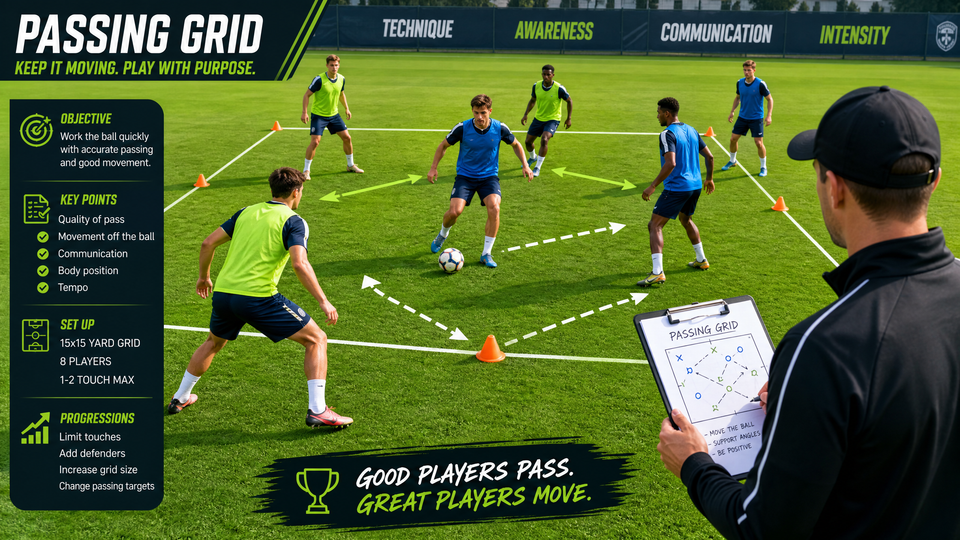
What you need
6 footballs, 4 flat cones, 6 bibs, stopwatch, scoreboard or coaching notebook
4v2 Rondo Passing & Possession: Play Through the Press
Overview
This is a 4v2 possession rondo for coaches who want more than neat passing patterns. The players outside the grid learn to recognise the spare player, receive with an open body, play away from pressure and support the next action immediately. The two central players learn to press as a pair: one player engages the ball while the other protects the pass through the middle. The outcome is a sharper possession group able to play through pressure, not merely circulate.
Use it after the warm-up, before a positional-possession practice, or as a competitive technical block. On a 100–110m x 64–75m pitch, place it in a near-side channel or one quarter while other units work. Keep it tight for quick decisions, yet large enough for clean technique.
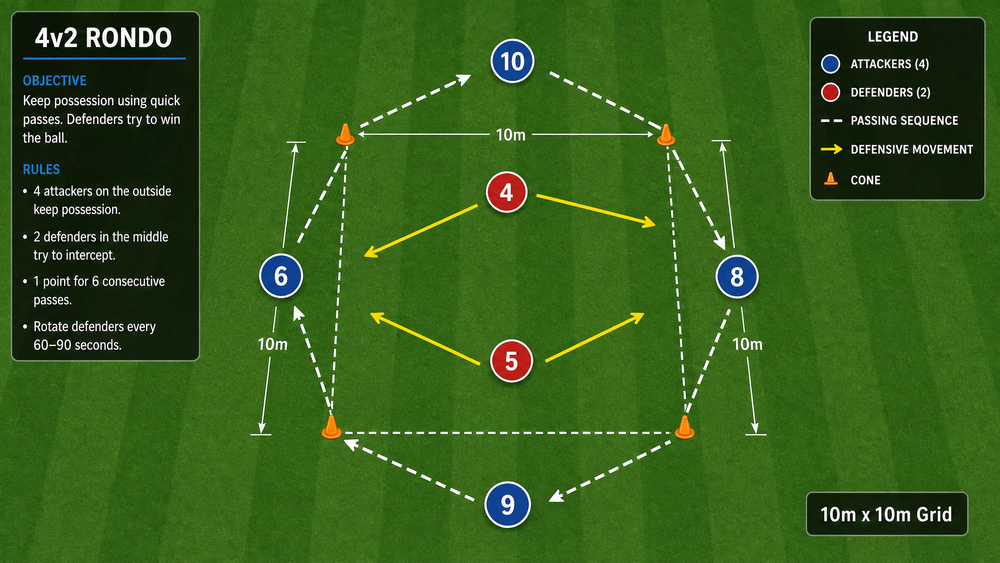
The base format has six active players: No. 6, No. 8, No. 10 and No. 9 outside against No. 4 and No. 5 inside. With eight players, the spare two count passes, return balls and rotate into defence. It is intermediate because decisions must be made under pressure at game speed.
Setup
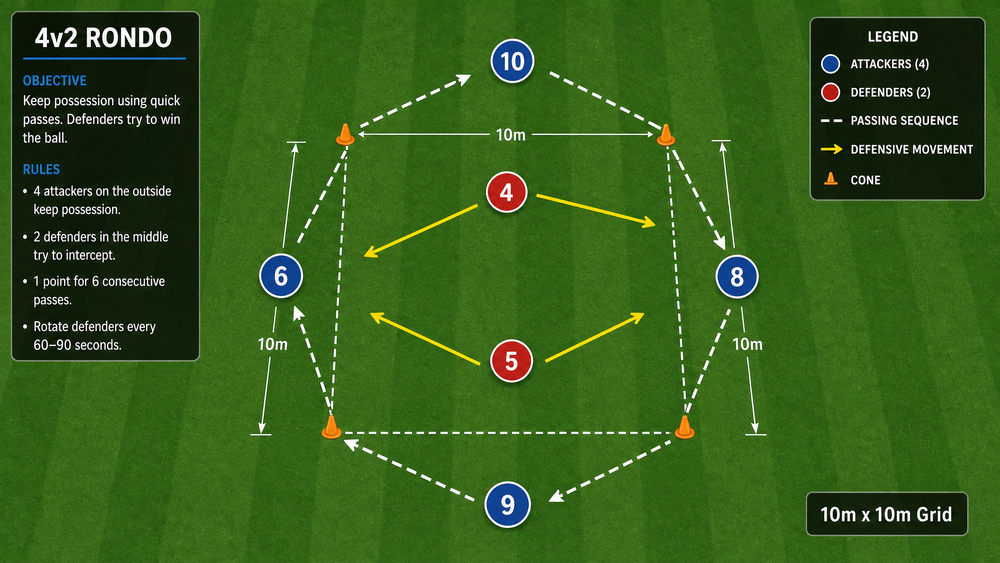
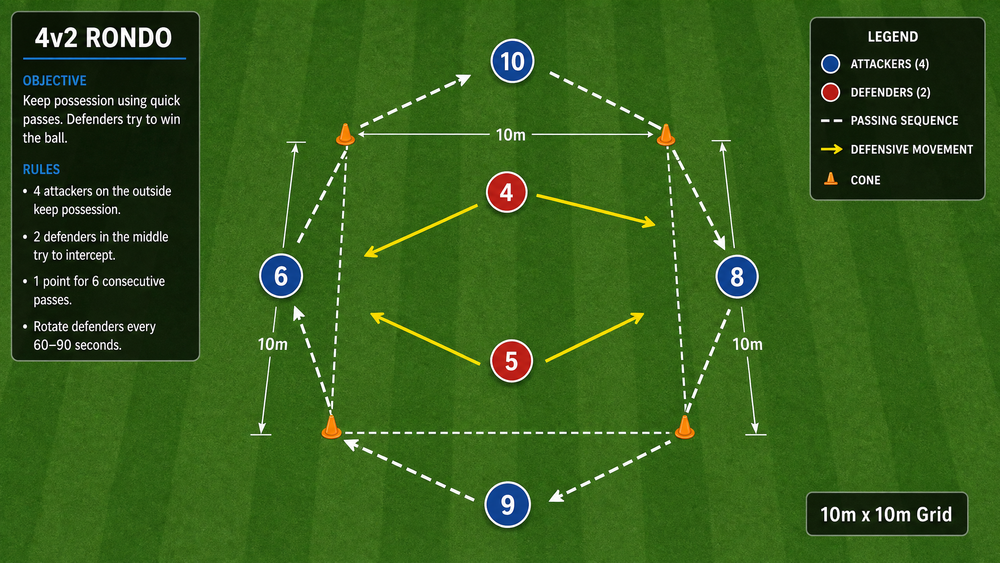
Mark a 10m x 10m square with four flat cones. Use 12m x 12m for a new group or heavy surface, and 8m x 8m only when technique remains secure. Put one blue-bibbed receiver one metre outside each side, not on the corners, to create better lanes. Position No. 6 left, No. 8 right, No. 10 top and No. 9 bottom; No. 4 and No. 5 start centrally.
| Item | Exact detail | Coach's purpose |
|---|---|---|
| Grid | 10m x 10m; cones at each corner | Creates tight, repeatable pressure and short pass distances. |
| Players | 6 active; 8 total preferred | Four retain possession while two press; two rotate and maintain tempo. |
| Work block | 4 x 75 seconds; 30 seconds recovery | Gives repeated, game-like technical actions without letting intensity drop. |
| Balls | 5–6 quality balls around the outside | Restart instantly after a turnover or ball out of play. |
| Bibs and cones | 4 blue, 2 red, 4 flat cones, 1 stopwatch | Keeps roles and boundaries unmistakable. |
Brief the players before the first rep. The ball starts with No. 6. Outside players are allowed two touches initially, while No. 4 and No. 5 have no touch limit. The possession group earns one point for six consecutive passes. The defending pair earns one point for a clean interception, a forced ball out, or a tackle that ends with controlled possession.
Step-by-Step Instructions
Set the reference positions. Put No. 6, No. 8, No. 10 and No. 9 around the outside as shown. Tell them that the position is a starting reference, not a statue: each player may slide along their side to open a clear passing lane, but cannot enter the grid.
Start with an intentional first action. No. 6 scans over both shoulders, receives the coach's service on the back foot and takes the first touch away from the nearest defender. No. 4 closes the ball; No. 5 takes a cover position that blocks the most dangerous next pass.
Keep the ball moving outside the pressure. Play firm floor passes. The receiver calls early, opens their hips, checks the defender and chooses the farthest available option. Do not demand one-touch play until two-touch actions have purpose.
Coach the defensive relationship. No. 4 presses on a curved, controlled line. No. 5 stays connected at 2–3m, blocks the opposite side and shifts as the ball travels. If No. 4 over-commits, No. 5 covers immediately.
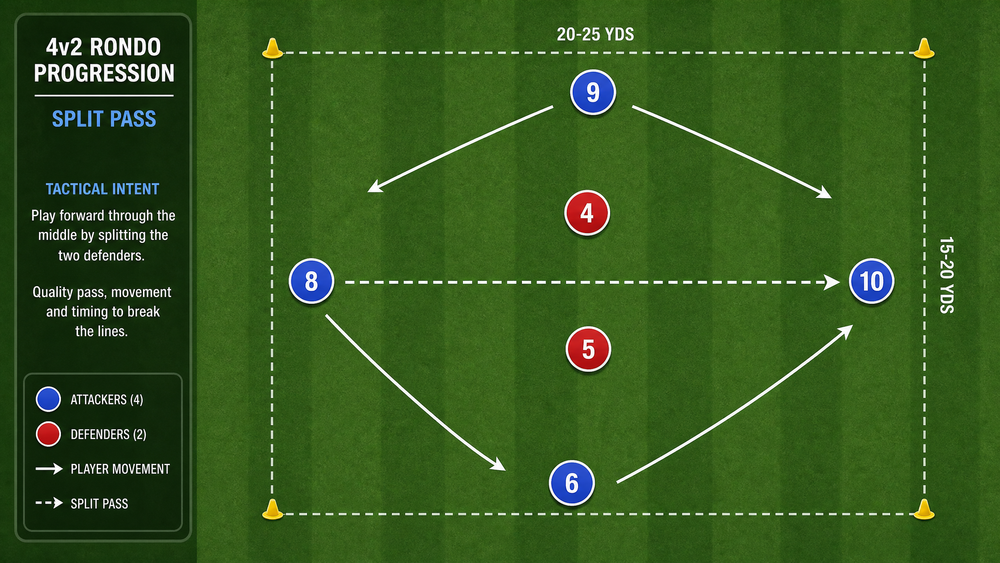
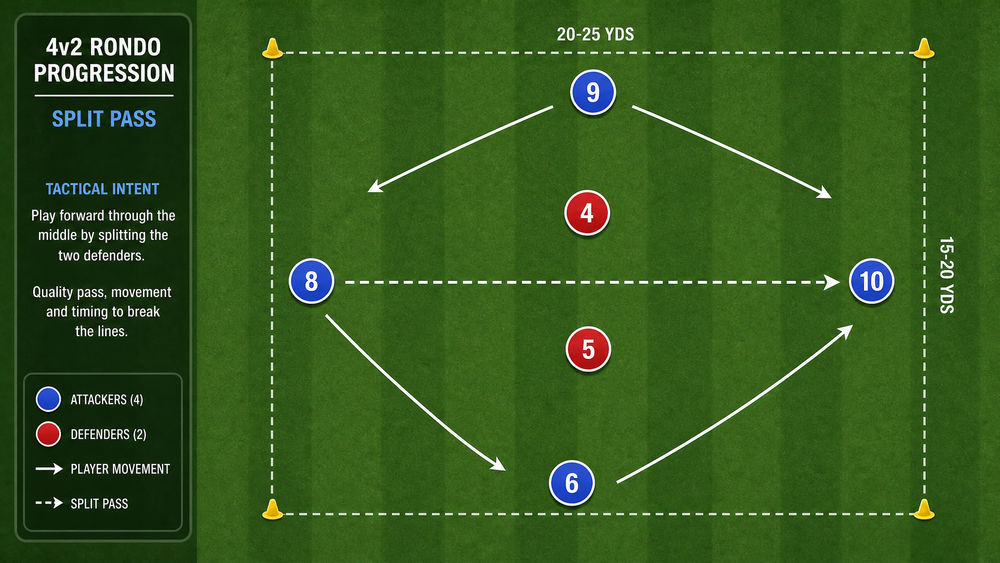
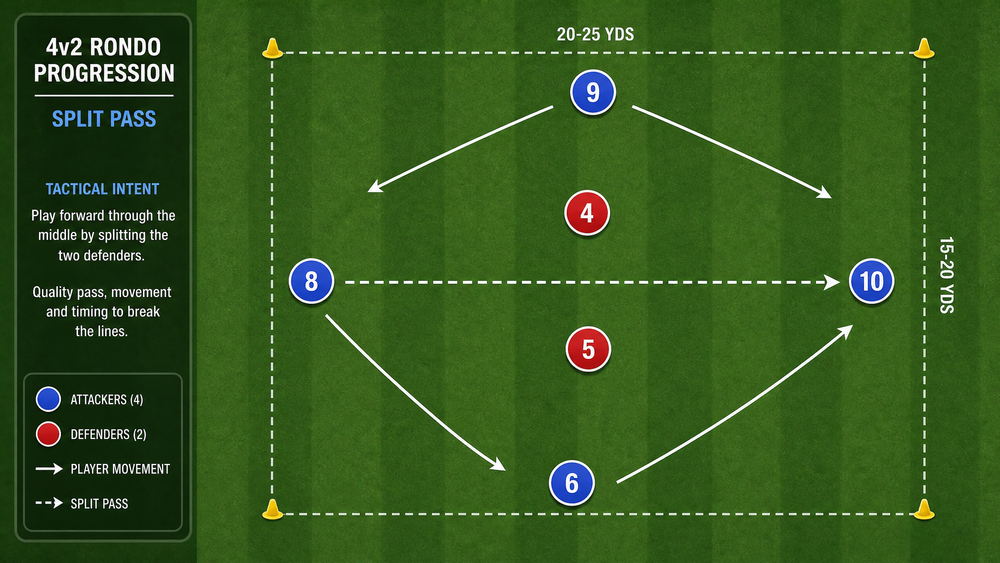
Reward the split pass. Award two points when a firm floor pass travels between No. 4 and No. 5 to the opposite player. It must arrive on the receiver's safe-side foot. Freeze only if the timing is not visible; otherwise coach live.
Make the turnover meaningful. When red wins it, the player who lost the ball enters as a defender; the longest-serving defender becomes the nearest outside receiver. Restart from a spare ball within three seconds if it leaves the grid.
Run the competitive block. Play four rounds of 75 seconds with 30 seconds recovery. Rotate the two waiting players in as defenders after every round, or after 45 seconds with an advanced group. Record each pair's score. Finish with a 90-second final where the losing pair completes the next group task, such as collecting all equipment.
Review one learning message. Ask: “When did the split pass become available?” Guide the response toward body shape, the first defender being drawn out, and the supporting player moving to create a passing lane. Keep the review concise, then restart.
Key Coaching Points
| Coaching point | What to demand on the grass |
|---|---|
| Scan before receiving | Players should check both defenders before the ball arrives, not after their first touch. |
| Open body shape | Receive side-on, with the hips pointed toward two potential exits; a closed body makes the next pass predictable. |
| First touch has direction | The first contact should move the ball away from pressure and into the line of the next pass, not simply stop it. |
| Support on a new angle | After every pass, adjust 1–2m along the side to avoid standing in the defender's cover shadow. |
| Pass with purpose | Use a crisp, weighted floor pass to the far foot. A soft pass invites the second defender to recover. |
| Press as a pair | The first defender hunts the ball while the second defender protects the split, communicates and closes on the travel. |
Common Mistakes
| Mistake | What it looks like | Immediate correction |
|---|---|---|
| Players stand on the cone | Passes become straight and the defenders can screen two options at once. | Tell players to slide along the line and create an angle before calling for the ball. |
| First touch stays under the body | The receiver needs an extra touch and gets trapped. | Rehearse the back-foot touch into space before restarting the competition. |
| Passer watches their pass | The next passing lane disappears because the player does not re-support. | Use the cue: "Pass, move, see the next picture." |
| Both defenders chase | The central channel is open and the split pass is too easy. | Reset the pair: one presses, one covers, then both shift on the ball's travel. |
| Possession becomes careless one-touch play | Players force passes without scanning or matching the pass to the receiver. | Restore a two-touch maximum until the detail returns; speed must follow control. |
Variations & Progressions
Start with a 4v1 familiarisation in the same 10m x 10m grid. Allow three touches and challenge the group to reach ten passes. This lets younger or less confident players rehearse technique without a second defender closing the space.
For the main progression, use the 4v2 split-pass game shown in Diagram 2. Enlarge the grid to 14m x 12m and demand that every sixth pass includes a ball through the middle. The wider shape creates a clear decision: play around the pressing pair, or wait until their distance opens the central lane. Award two points for a successful split pass and one point for six passes.
For an advanced version, play 4v2 with one-touch on the far side only. The player opposite the ball must play one touch, while the other three retain two touches. This creates a realistic trigger for scanning before receiving and forces the defenders to travel together. If the ball breaks free, red has five seconds to dribble through either side of the square for a bonus point.
Age Adaptations
| Group | Adjustment | What the coach should emphasise |
|---|---|---|
| Under 8–Under 10 | Use 12m x 12m, 4v1, three touches and 45-second rounds. | Enjoyment, calling for the ball and a controlled inside-foot pass. |
| Under 11–Under 12 | Use 10m x 10m, 4v1 then 4v2, two touches and 60-second rounds. | Receiving on the back foot, moving after passing and recognising pressure. |
| Under 13–Under 14 | Use the full 4v2 with the split-pass scoring rule and 75-second rounds. | Scanning, cover shadows, pressing partnerships and a purposeful first touch. |
| Under 15–Open age | Use 8m x 8m or the one-touch far-side condition; rotate defenders frequently. | Tempo under pressure, tactical communication and immediate transition on loss. |
Close by reinforcing that the aim is to find the spare player, draw pressure and play through it—not simply win a passing contest. Then carry that habit into the next possession game.
