

Football
Counter-Pressing After Loss: The Three-Second Regain Play
Teach your team to react as one after a turnover, win the ball back in the first three seconds, and turn the regain into an immediate scoring action.

What you need
16 flat cones, 2 sets of bibs, 8 footballs, 2 mini goals or 4 target-gate poles, whistle, stopwatch
Counter-Pressing After Loss: The Three-Second Regain Play
Overview
This transition play starts the instant your team loses the ball in the attacking half. Do not ask every player to chase: make the next pass predictable, close the ball with purpose, and either regain it or slow the opponent long enough to recover shape. Use it to keep opponents pinned in their half on a 100–110 m x 64–75 m pitch.
The trigger is the loss itself: a poor touch, intercepted pass, tackle, or rebound. The nearest player becomes the first defender; the nearest two become the cover and balance; players behind the ball form rest defence. Demand an explosive first three seconds, then judge the outcome. If the ball is regained, attack before the opponent can reorganise. If the opponent escapes, stop sprinting blindly and recover into your normal block.
| Team target | Coach language | Observable outcome |
|---|---|---|
| 0–3 seconds | “Close the ball.” | The first defender arrives under control and shows play away from the middle. |
| 3–5 seconds | “Lock the next pass.” | Two supporting players remove short exits and compact the ball zone. |
| 5–8 seconds | “Play forward or recover.” | A regain becomes an attack; an escape becomes an organised recovery. |
Setup
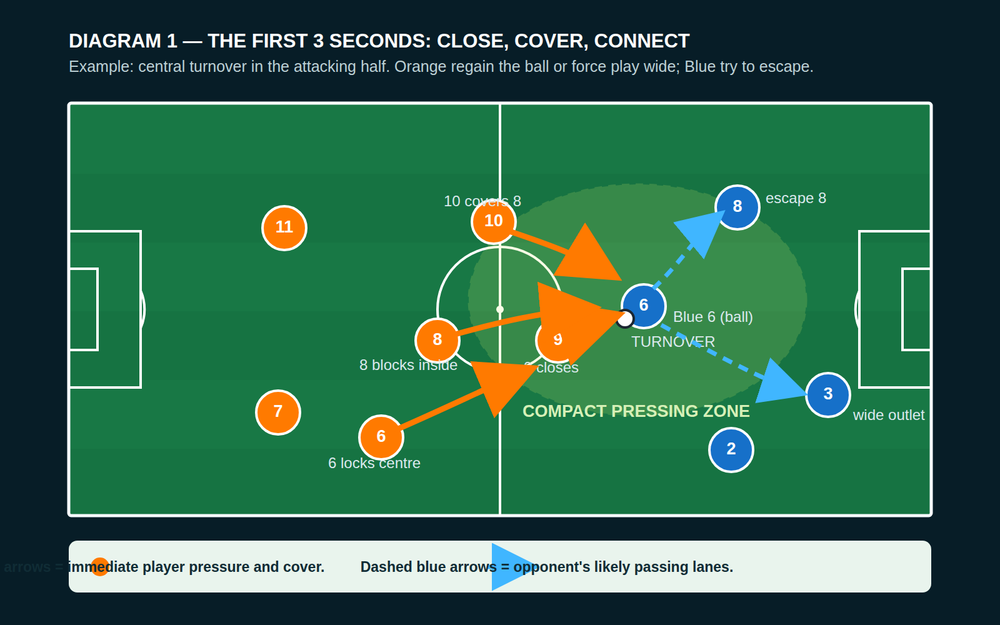
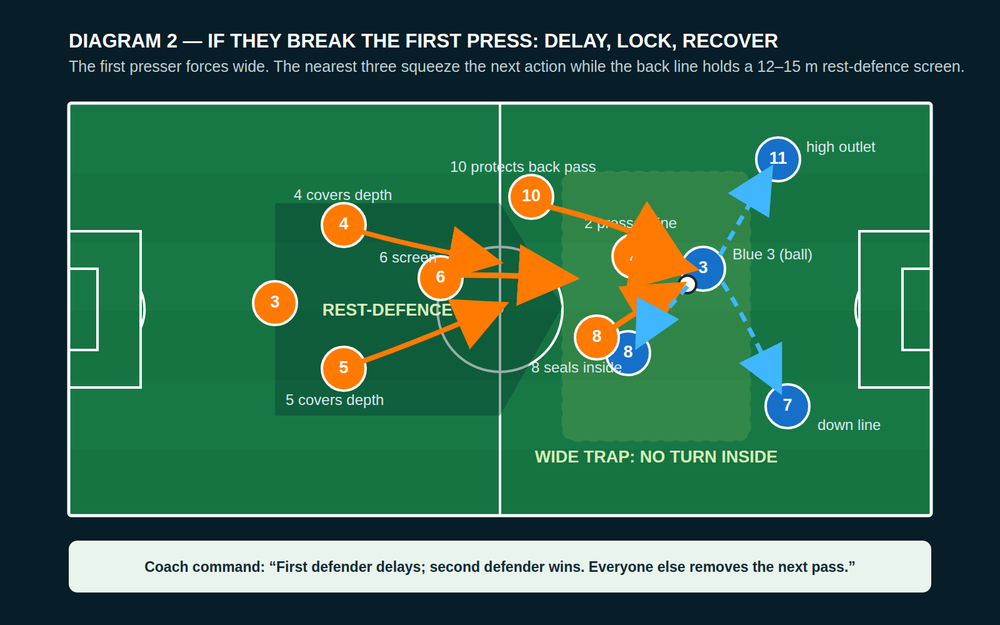
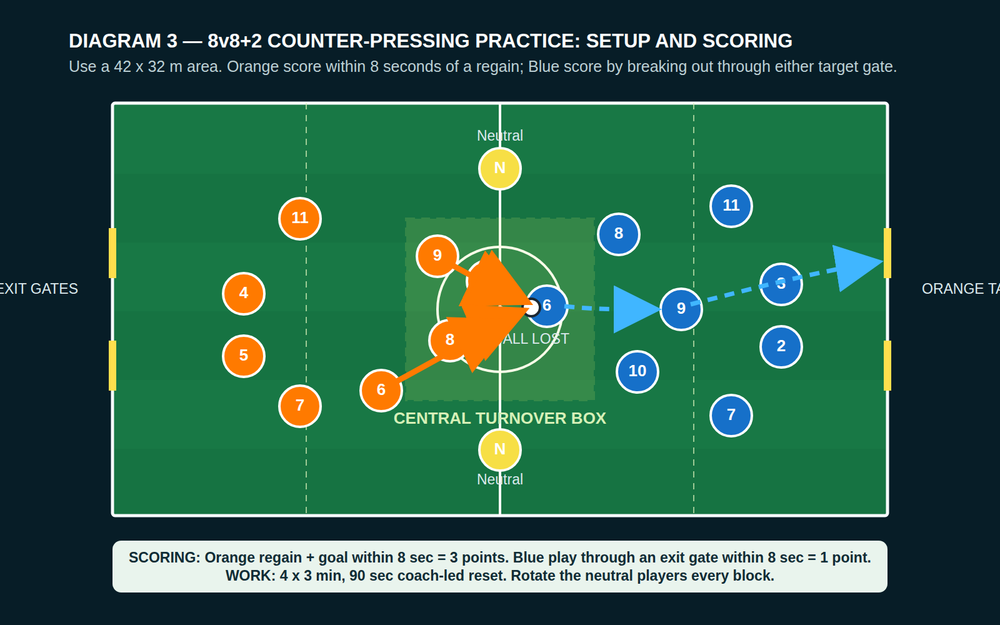
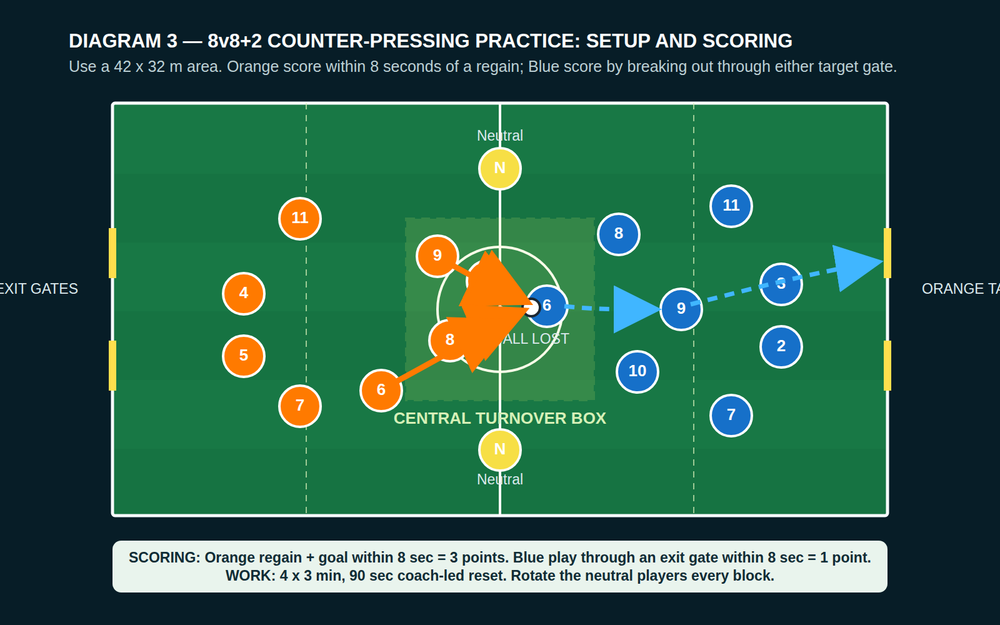
Use a 42 x 32 m area for the main practice, which transfers naturally to the central or wide attacking areas of an 11v11 pitch. Mark a 10 x 10 m central turnover box, two five-metre exit gates at one end, and two target gates at the other. Set up 8v8 plus two neutral players; use the neutral players on the outside of the turnover box so that the team in possession can create a realistic third-player option. You need 12–16 cones, two colours of bibs, eight balls around the edge, and two small goals or cone gates.
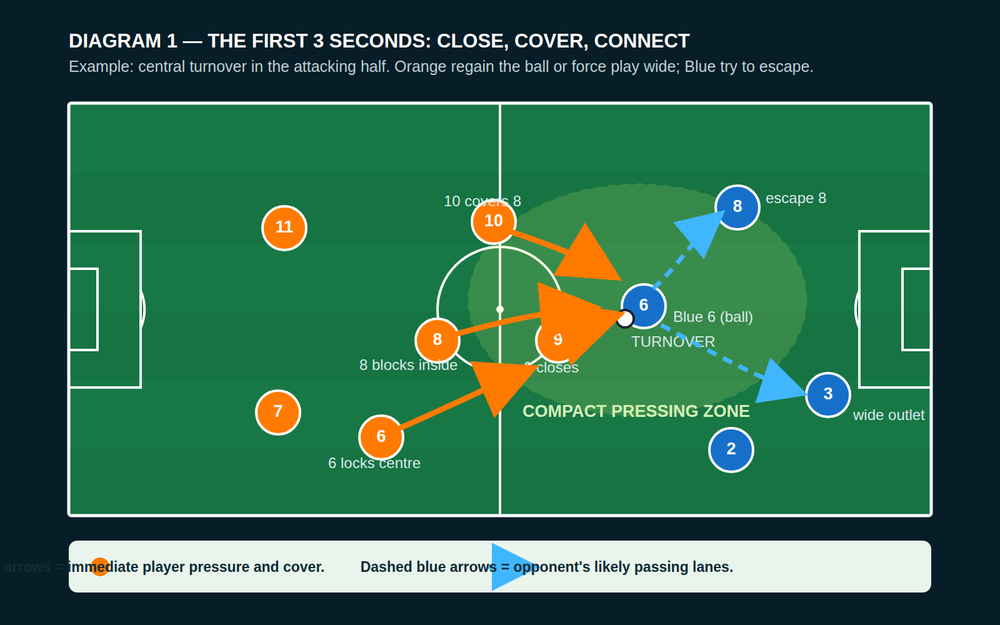
Use a simple 2-3-3 reference shape: back players 4 and 5, holding midfielder 6, wide defenders 2 and 3, central midfielders 8 and 10, and forwards 7, 9, 11. Formation is secondary to relationships: the nearest three are 5–8 m from the loss, #6 is 8–12 m behind, and the deepest pair protect depth.
Coach’s starting picture
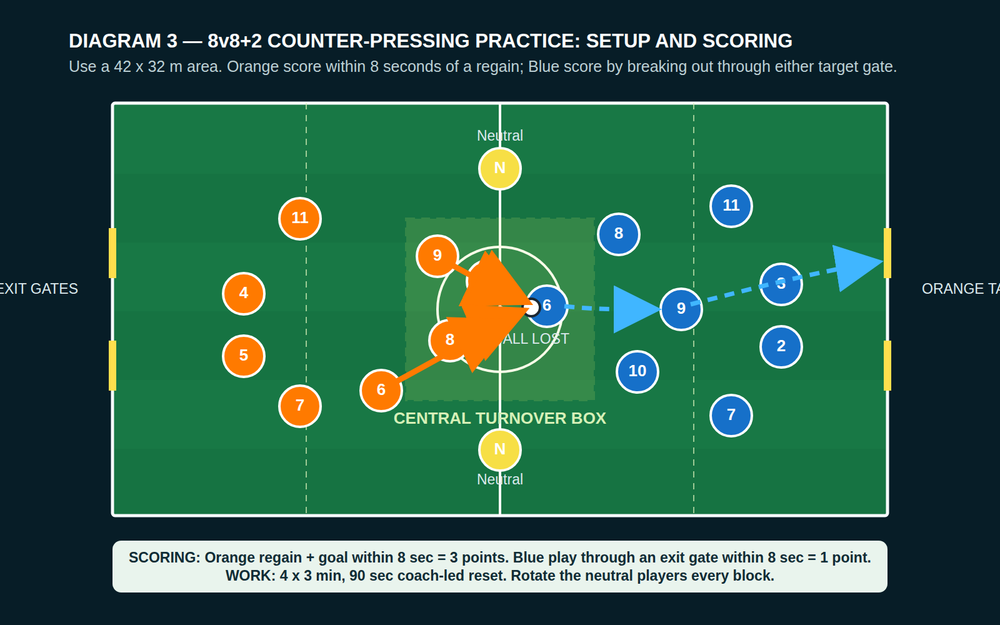
Start play with Orange in possession. Let them combine through the central box, but insist that #6 stays behind the attack and that one of #4 or #5 is always providing depth. Blue are encouraged to intercept and play forward immediately. The visual picture in Diagram 1 is the non-negotiable first reaction: #9 presses the ball carrier, #10 takes the inside-forward option, #8 screens the central release, and #6 locks the space behind the pressure.
Step-by-Step Instructions
Set the reference positions. Place #9, #10 and #8 around the box, #6 centrally behind them, and #4 and #5 staggered 10–15 m deeper. Insist on this spacing before the first ball.
Play to create a real loss. Orange make at least three passes and then try to break a line through the turnover box. Blue defend with realistic pressure. Avoid scripted giveaways; the receiving player must feel the consequence of an imperfect touch or risky pass.
Call the trigger on the loss. The coach shouts “loss” only if players do not recognise it. The player nearest the ball—often #9, #10, #7 or #11—accelerates immediately on a curved line. Their first job is to arrive close enough to affect the next touch, not to win a reckless tackle.
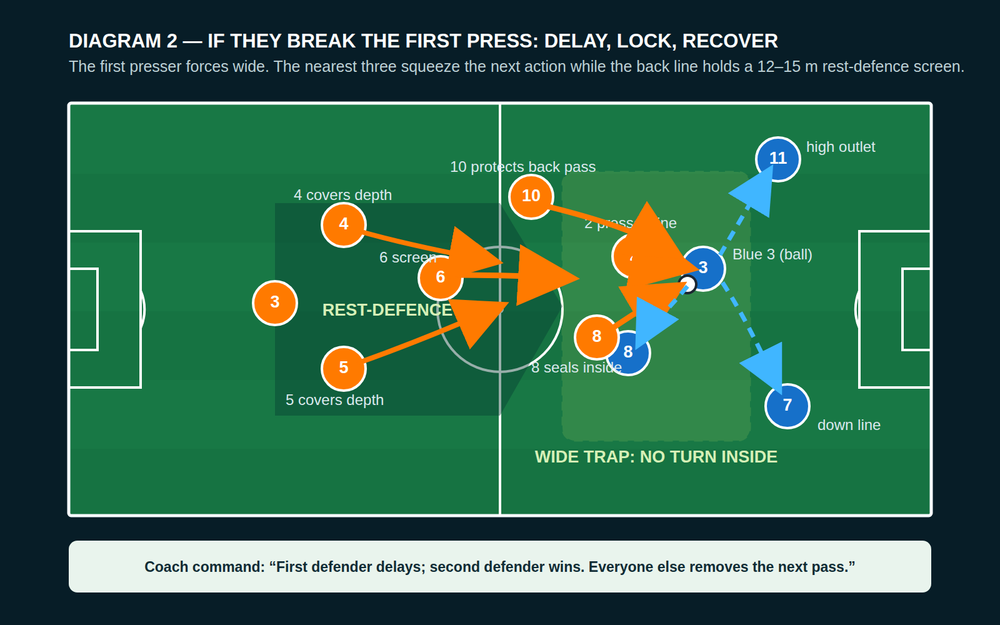
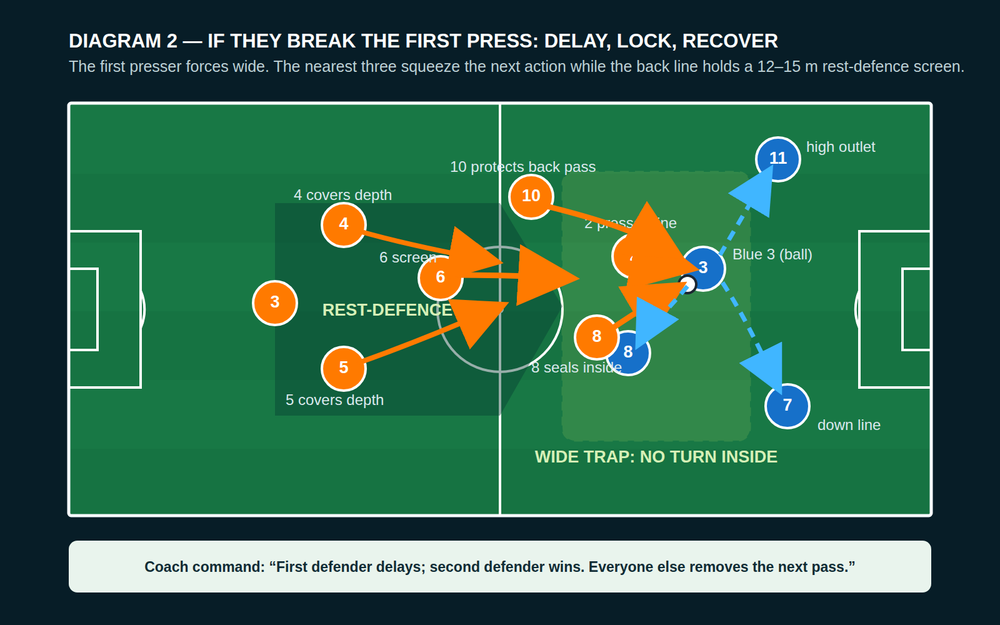
Give the first defender a clear job. #9 approaches side-on, decelerates in the final two metres, and uses their body shape to show the opponent toward the touchline or into the waiting cover. Coach the line of approach, not merely the sprint: the defender’s hips and front foot must block the direct route back through the centre.
Build the three-player cage. #10 denies the obvious forward or back pass while #8 blocks inside and hunts a loose touch. They arrive on different lines, 3–6 m from the ball, never behind #9.
Secure rest defence. #6 screens the far-side outlet. #4 and #5 narrow against the first ball over the top and the far-side wide player tucks in. This line delays any break.
Reward the regain with a forward action. When Orange regain, they have eight seconds to score through the target gate or small goal. The first pass should be positive if it is on; otherwise use a secure supporting pass and attack with the next action. This prevents the practice becoming a possession exercise with no consequence.
Punish a clean escape, not a hopeful clearance. Blue score one point for carrying or passing through an exit gate inside eight seconds. If Blue simply clear the ball without a controlled escape, restart with Orange. This rewards intelligent pressure and makes the players value the next pass after the turnover.
Intervene briefly. Run four three-minute blocks with 90 seconds between. Freeze only a clear spacing or body-shape error, recreate the ball position, ask about the next pass, and restart.
Key Coaching Points
| Focus | What to coach | What good looks like |
|---|---|---|
| Recognition | The loss is everyone’s cue, not a signal from the coach. | The nearest player moves before the opponent can lift their head. |
| First defender | Sprint, then brake; press on an angle. | The ball carrier is shown wide or back, not allowed to turn inside. |
| Cover and balance | First defender delays; second defender wins. | #10 and #8 remove two different short options. |
| Compactness | Squeeze around the ball without losing depth. | The nearest three are connected, while #6 and centre-backs protect the next phase. |
| Body shape | See ball, player and passing lane whenever possible. | Players arrive half-open and can intercept or react to a dribble. |
| Regain mentality | Win it to hurt the opponent. | The first attacking decision after regaining is made quickly and positively. |
Common Mistakes
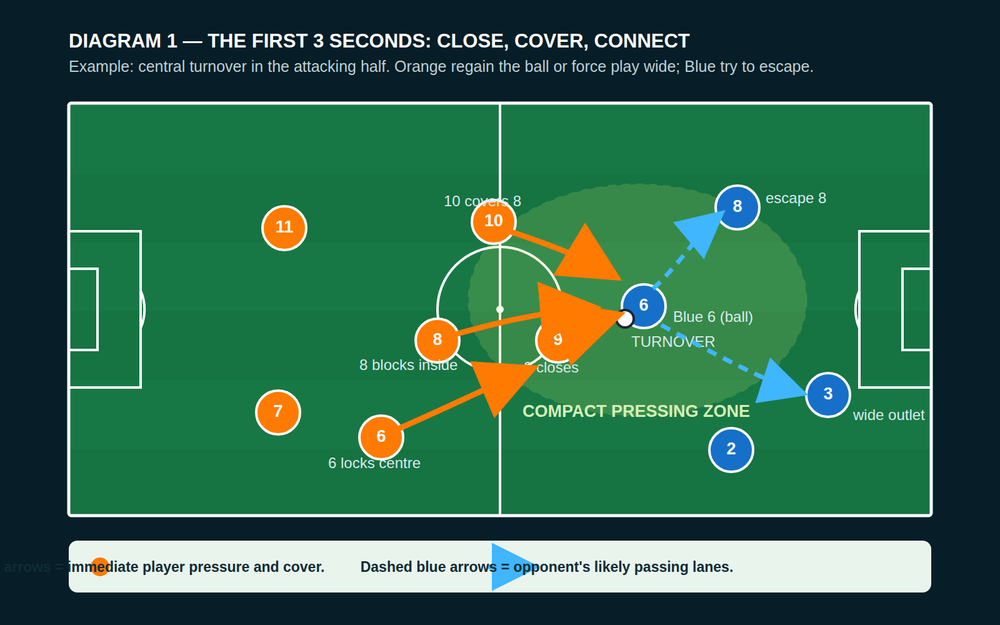
Everyone runs at the ball. This opens a gap behind the press. Give each player a lane: pressure, inside screen, forward-pass block, then #6 protects the central exit.
The first defender overcommits. A straight sprint or dive lets the opponent turn. In the last two metres, slow the feet, get side-on, and dictate the escape route.
#6 gets attracted to the ball. When the holding midfielder joins the first wave too early, there is no protection against the break. Mark a temporary 8–12 m recovery line in the practice and require #6 to hold it until the ball is visibly trapped.
Players regain then play backwards. They have won the ball against a disorganised opponent. Use the eight-second rule and praise the first positive pass.
Variations & Progressions
Make it easier: Begin with 6v6+2 in a 36 x 28 m area and allow the coach to serve a deliberately loose pass into the turnover box. Stop the ball after the loss and walk players into their pressing roles once before playing live.
Make it harder: Move to 8v8+2 in the 42 x 32 m area, remove the coach’s call, and award Blue two points if they can find the far-side exit gate. This forces Orange to connect the near-side press with far-side rest defence.
Add match realism: Expand to an 11v11 phase on two-thirds of a full pitch. Begin with your normal attacking structure, retain the three-second regain target, and allow the opposition to counter toward a full-size goal. Keep #1 as the communication point behind the defensive line.
Age Adaptations
For U8–U10, use 4v4 or 5v5 in 25 x 20 m, cue “win it back together,” and coach only the nearest two players. Give three bonus points for a regain within five seconds.
For U11–U12, use 6v6+1 in 32 x 25 m. Introduce the idea that one player presses while one player covers. Use coloured flat markers to show the central passing lane and keep the scoring rule simple.
For U13–U16, use the full 8v8+2 practice and coach #6, #4 and #5 as a genuine rest-defence unit. Demand clear roles, body orientation, and communication such as “press,” “inside,” “hold,” and “drop.”
For open-age teams, identify the first presser by zone, define where #6 or the nearest centre-back holds, and review whether the team recognises the turnover as one action.
Final coaching reminder: The counter-press is not a sprinting contest. It is a rehearsed collective picture: one player affects the ball, two players take away the exits, and the rest of the team make the next action safe.
