

Football
Goalkeeper Shot-Stopping: Set, Save, Recover
A progressive, match-relevant goalkeeper practice that sharpens set position, low-corner diving technique, rebound control, and recovery for a second shot.
What you need
1 full-size goal, 6 footballs, 12 flat cones, 4 tall cones, bibs, goalkeeper gloves, stopwatch
Overview
Goalkeeper Shot-Stopping: Set, Save, Recover is a 25-minute, intermediate practice for a goalkeeper who needs to turn a clean technical set into a decisive save under realistic shooting pressure. The session starts with a predictable service and a single shot, then layers in recovery and a second action only when the first save has quality. Use it after the goalkeeper’s handling warm-up, before a finishing block, or as the focused goalkeeper station within a full-session practice.
The work takes place at one end of a full football pitch. Use a standard adult reference pitch of 100–110m x 64–75m, but mark a compact 30m x 36m working area around the penalty area. That keeps the servers close enough to repeat good-quality actions while retaining the goal, 16.5m penalty-area line and goalmouth references that players will recognise on match day. Aim for short, sharp repetitions: the goalkeeper should face 8–10 controlled shots, rest for 45–60 seconds, then complete a second block with the same or slightly higher intensity.
Setup
| Element | Coach instruction |
|---|---|
| Players | Minimum six: 1 Goalkeeper (No. 1), two servers (Nos. 10 and 8), two strikers (Nos. 9 and 11), and one ball collector/rotating attacker. |
| Area | Full-size goal; use the final 30m x 36m of a 100m x 64m pitch. Mark the central shooting lane from 15.5–16m and two low-corner target gates, each 1.5m inside the posts. |
| Equipment | Six footballs, 12 flat cones, four tall cones, bibs, goalkeeper gloves, and a stopwatch. Keep spare balls with the servers, never behind the goalkeeper. |
| Roles | No. 1 starts 1m off the goal line. No. 10 serves. No. 9 receives and shoots. No. 11 waits to become the next server. The ball collector returns any ball safely outside the goal area. |
| Work:rest | Begin with four sets of four single-shot repetitions. Progress to two sets of four double-action repetitions. Work for 45–60 seconds, then coach for 30–45 seconds. |
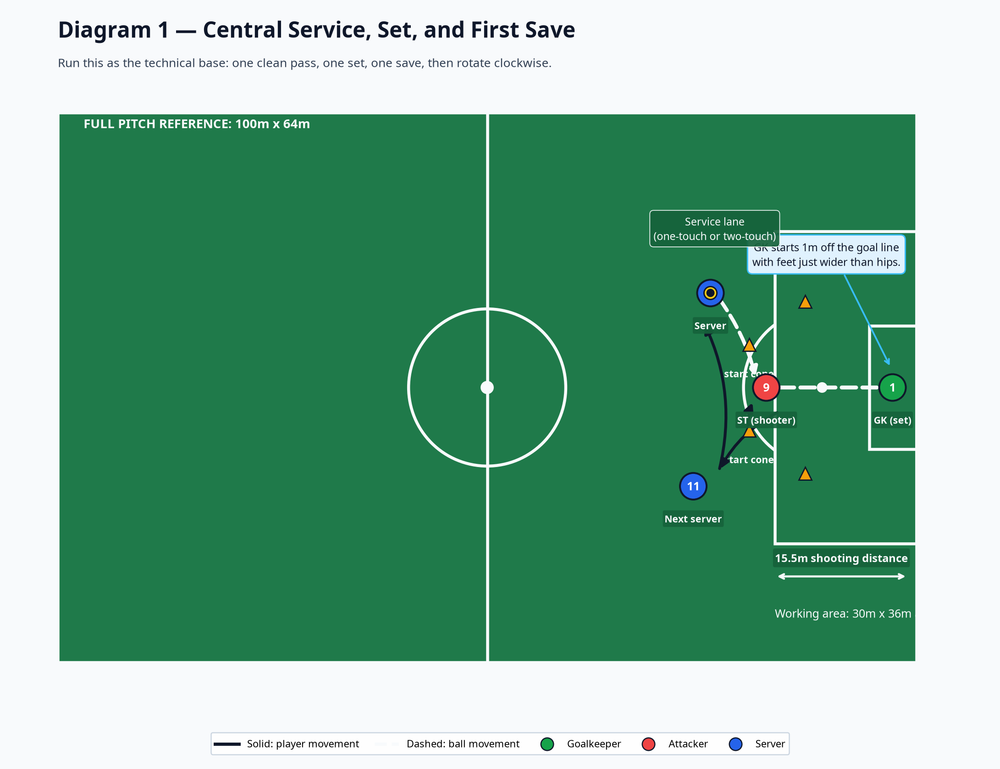
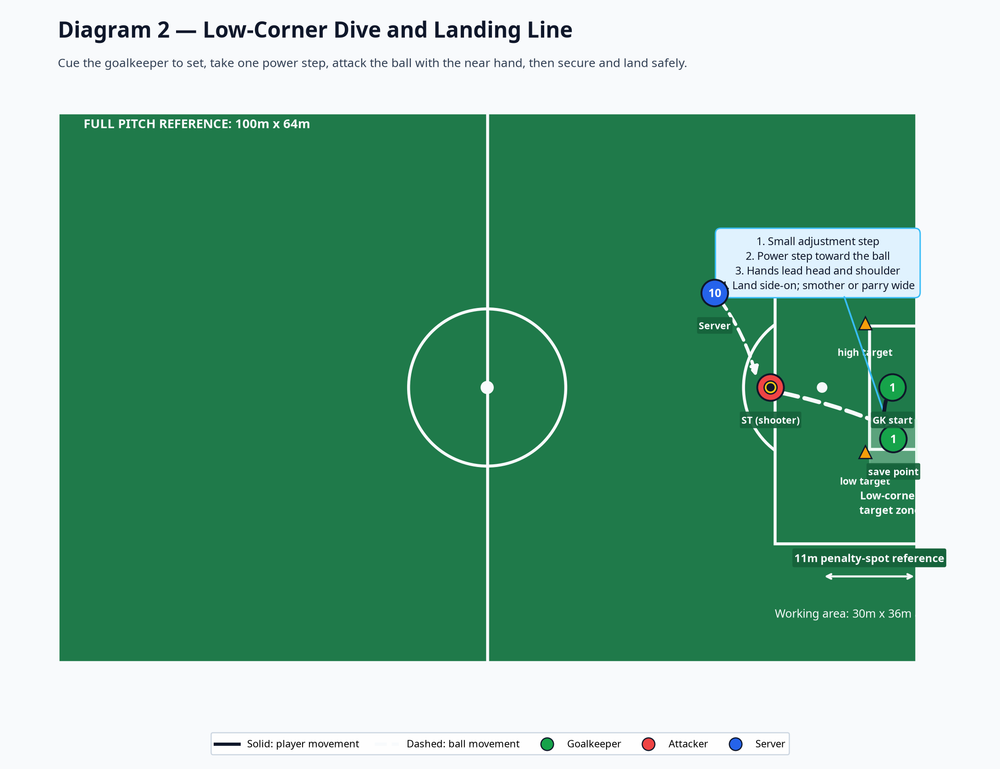
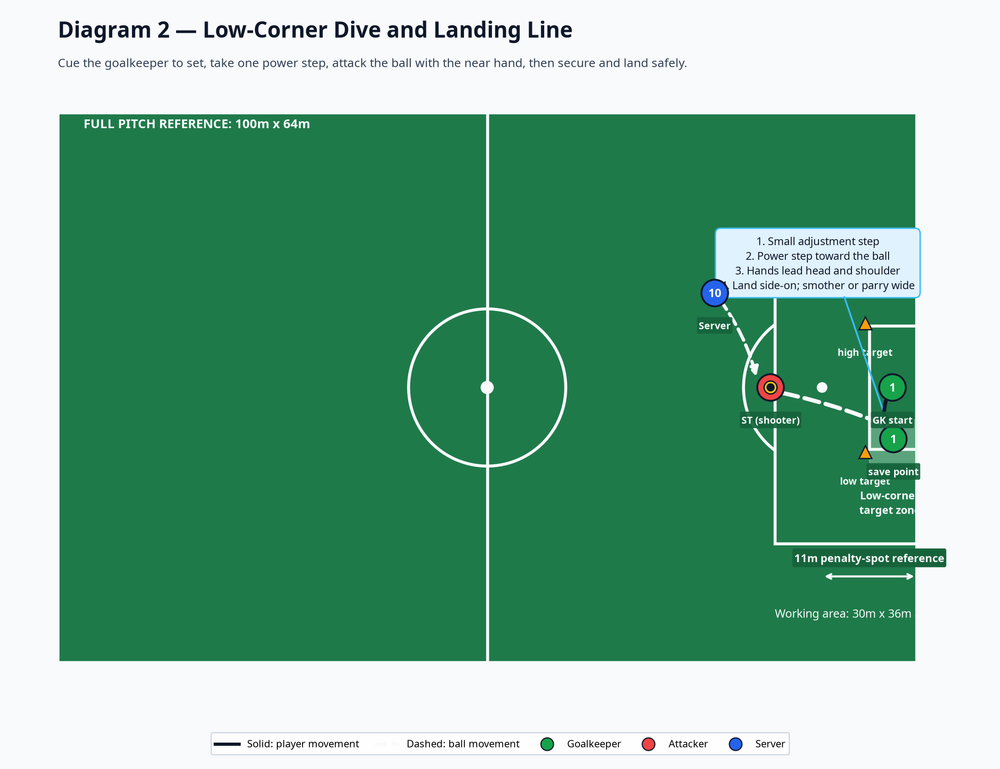
Place No. 9 centrally at the 15.5m shot line, with No. 10 6–8m diagonally behind him. Set two start cones around No. 9 so the striker must arrive to the ball rather than stand waiting. Keep No. 1 centred on the ball, not glued to the middle of the goal. Before the first repetition, make the finishing rule clear: early sets are firm, clean strikes at a controllable height; there is no crowded six-yard box and no uncontrolled rebounds.
Step-by-Step Instructions
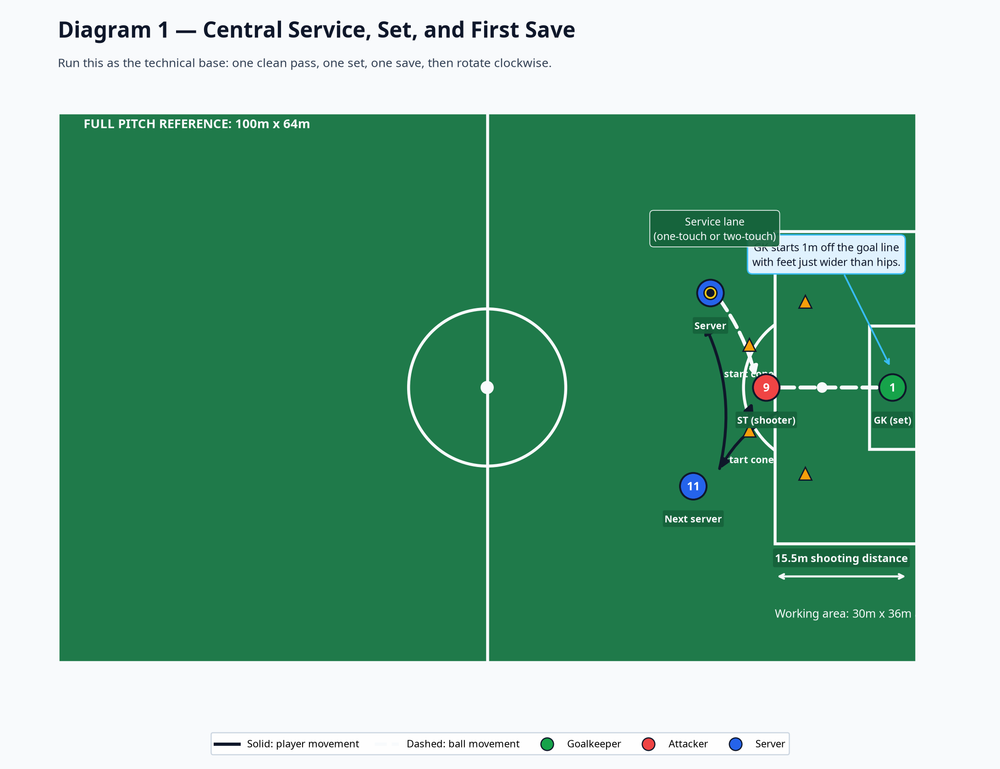
Frame the action. No. 1 begins one metre off the goal line with weight on the balls of the feet, hands in front of the body and eyes fixed on No. 10. The coach checks that the goalkeeper is square to the ball before allowing the service.
Serve and adjust. No. 10 plays a crisp pass into No. 9. As the ball travels, No. 1 makes small adjustment steps to stay on the ball line, then arrives in a balanced set just as No. 9 prepares to strike. Do not allow a deep backward shuffle that puts the goalkeeper on the goal line too early.
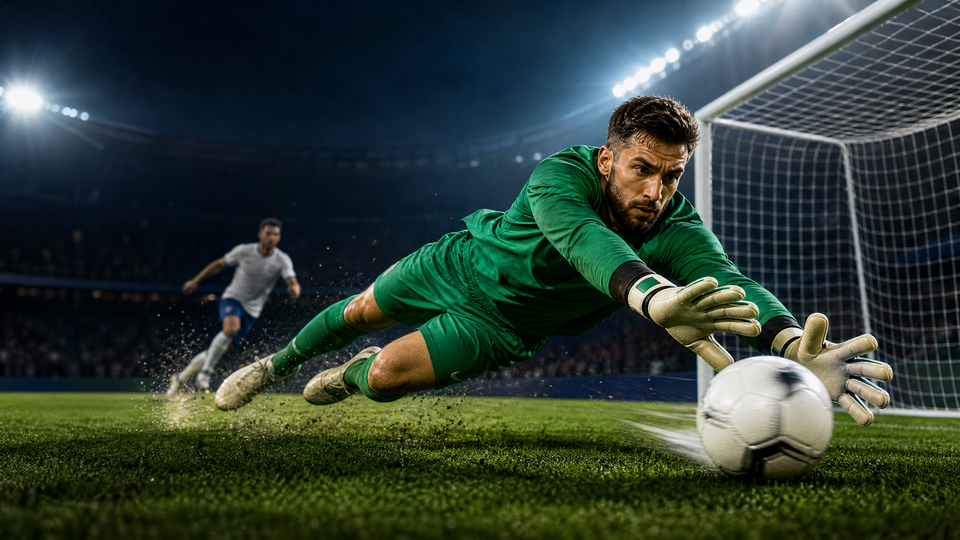
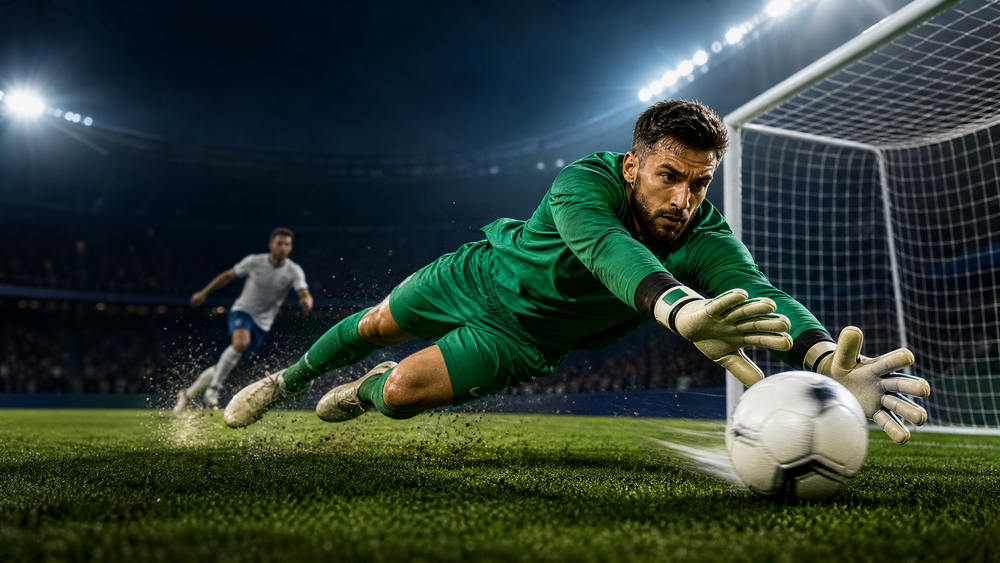
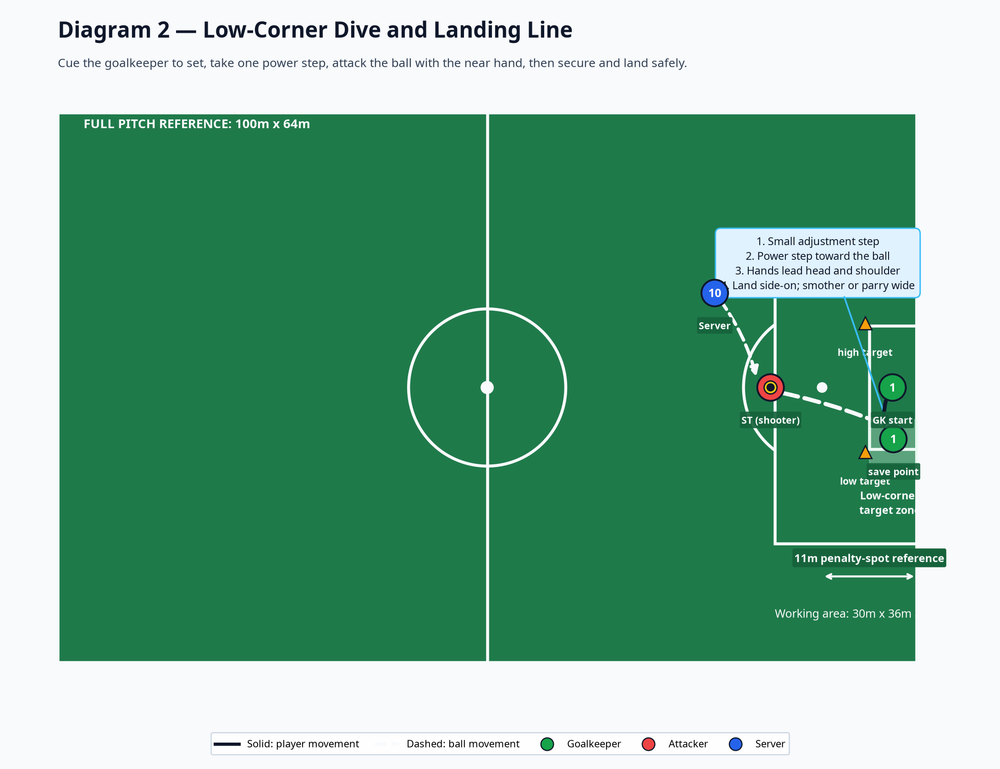
Finish the first shot. No. 9 shoots first time or after one touch, aiming into either low-corner gate. No. 1 decides whether to hold, smother, or parry. The saving action must direct the ball away from the central goal area; a parry back into No. 9’s path counts as an incomplete save.
Secure the landing. After a low save, No. 1 lands through the side of the body rather than on the elbows or knees. If the ball is held, the goalkeeper completes the action by presenting it safely to the coach. If it is parried, the goalkeeper calls “away” and recovers the feet immediately.
Rotate deliberately. No. 9 becomes the ball collector, No. 10 follows the pass to become the shooter, and No. 11 becomes the next server. Keep this rotation quiet and brisk so that No. 1 is not rushed by a loose ball or distracted by movement behind the goal.
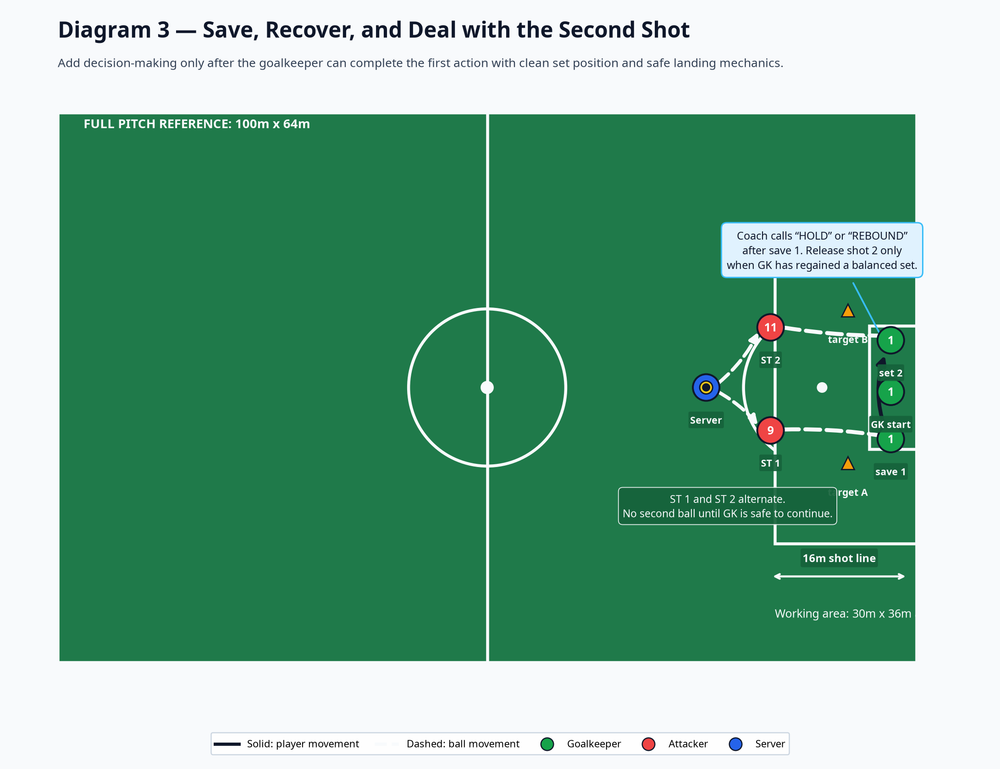
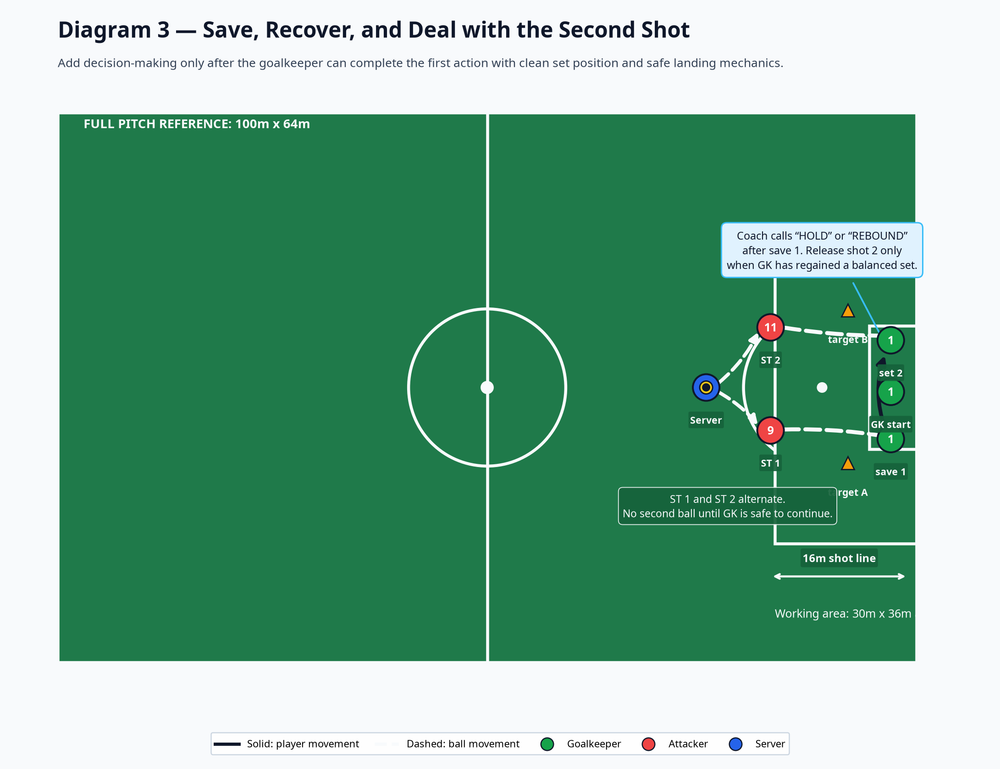
Add the second action. After four clean repetitions, use Diagram 3. Following save one, the coach calls “hold” (No. 1 presents a secured ball) or “rebound” (No. 1 recovers to a new set and faces No. 11’s shot). Release the second ball only after the goalkeeper is safely back on the feet and balanced.
Key Coaching Points
| Moment | Coach language | What good looks like |
|---|---|---|
| Set position | “Small feet; arrive set.” | The goalkeeper’s feet are just wider than hip width, heels light, knees soft, and chest slightly forward at the instant of the strike. |
| Ball line | “Get your nose behind the ball.” | The goalkeeper moves in small steps and stays square; they do not dive from an off-line or crossed-foot position. |
| Low save | “Hands lead; body follows.” | The near hand gets to the ball first, the top hand protects space above it, and the body lands behind the line of the ball. |
| Decision | “Hold if you can; parry wide if you cannot.” | A safe two-hand catch is preferred, but a firm deflection outside the post is better than a soft touch into the central zone. |
| Recovery | “Save, feet, set again.” | The goalkeeper gets up through a stable base, scans the next ball and regains a set without turning the back to play. |
Coach from the side of the goal rather than directly behind it. This gives you a clear view of the goalkeeper’s line to the ball and lets you correct the feet before you correct the hands. Give one technical cue per block, then let the goalkeeper solve the next three or four balls without constant interruption.
Common Mistakes
| Error to spot | Why it happens | Immediate correction |
|---|---|---|
| The goalkeeper is flat-footed at the strike. | They wait for the shot instead of preparing during the pass. | Freeze the picture, reset the server, and demand one small adjustment step before the shot. |
| The goalkeeper collapses backward. | They fear the pace of the ball or start too deep. | Move the start line one metre forward and coach chest over toes, with hands in front. |
| The diving hand reaches alone. | The goalkeeper chases with the arm instead of moving the body. | Slow the service down and cue: “power step, hands, shoulder, hip.” |
| A parry is pushed into the middle. | The wrists are soft or the goalkeeper has not chosen a safe deflection. | Put a 4m central rebound box in front of goal and make any ball into it a point for the striker. |
| The second shot comes while No. 1 is unsafe. | Servers are eager to keep the tempo high. | Reinforce that only the coach releases ball two; quality recovery takes priority over volume. |
Variations & Progressions
Easier: serve from the coach. Replace the pass into No. 9 with a coach-led, visible strike from 10–12m at 60–70% pace. This lets younger or developing goalkeepers rehearse the set and low landing without reading a receiver’s first touch.
Harder: change the striking picture. Allow No. 9 one touch either side of the central cone and require a finish across the goalkeeper. The goalkeeper must adjust angle and set after the touch rather than guessing the shot line. Keep the strike distance at 14–16m until the saves remain controlled.
Advanced: live second-ball decision. In the rebound phase, ask No. 10 to choose whether to shoot immediately, square to No. 11, or play a disguised low pass. No. 1 must call the ball, recover the correct angle and make a new decision. Limit this to four repetitions before rest; the intensity is high.
Age Adaptations
| Age group | Adaptation | Non-negotiable coaching focus |
|---|---|---|
| Under 8–Under 10 | Use a smaller goal if available, a 9–11m shot line and rolled or low-paced balls. Keep one action only and rotate frequently. | Ready stance, watching the ball, and safe side landing. |
| Under 12–Under 14 | Use the full goal, a 12–14m shot line and one-touch finishing only after the goalkeeper shows a stable set. | Moving feet before the shot and parrying away from danger. |
| Under 16–Open | Use the 15.5–16m line, varied service, stronger strikes and the live second-ball progression. | Angle, decision-making, rebound control and fast recovery to a second set. |
Finish by asking the goalkeeper to name one cue that made the best save possible. That short reflection gives you a useful individual target for the next session and prevents this drill becoming a sequence of shots without purposeful learning.
