

Football
Goalkeeper Shot-Stopping Drill: Set, See, Save
A progressive 35-minute goalkeeper session that coaches early set position, clear sight lines, decisive shot-stopping and rapid rebound recovery.
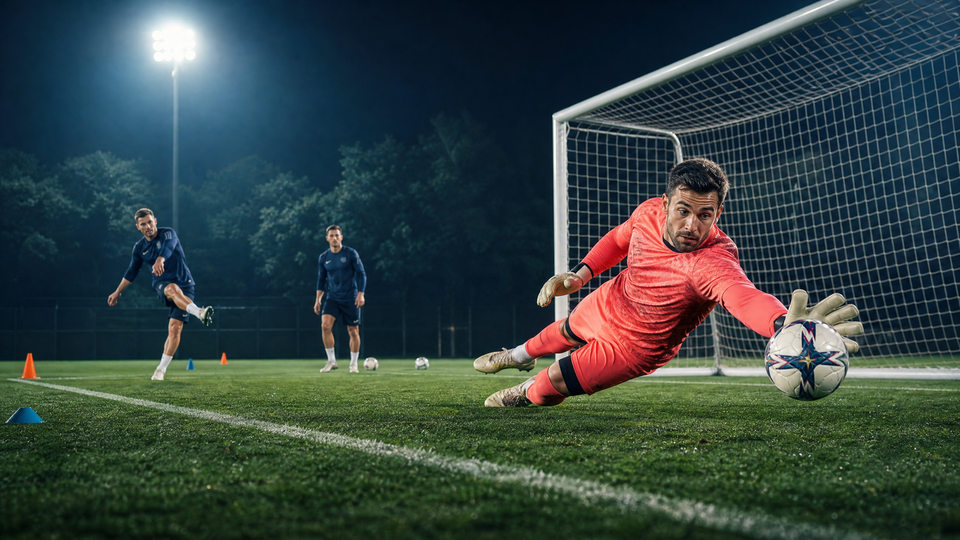
What you need
1 full-size goal, 10–12 footballs, 12 flat markers, 4 cones, bibs, stopwatch
Goalkeeper Shot-Stopping Drill: Set, See, Save
Overview
This 35-minute, intermediate goalkeeper practice develops the actions that decide a first save: early set position, efficient lateral travel, a clear eye line, positive handling or parry, and immediate recovery for the next ball. Use it as a goalkeeper-unit block within a team session, particularly before defending-the-box or transition work. It begins with a predictable strike so you can coach technique, then adds a late cue, screen and rebound to restore match realism.
Use one end of a full-size training pitch. International-match pitches sit within 100–110 m long and 64–75 m wide; this drill needs only a 33 m x 43 m goal-end channel, leaving the rest of the field free for team work. 1
| Session outcome | Organisation | Work : rest | Coach target |
|---|---|---|---|
| Set, sight line, save direction and recovery | 1 GK plus 4–6 outfield players | 4 x 4 min; 60–75 sec recovery | 12–16 purposeful shots per block |
Setup
Set a full-size goal, 10–12 footballs, 12 flat markers, four cones, bibs and a stopwatch. Mark a 33 m wide x 43 m deep working area. Position servers 7 and 11 18 m from goal and 12 m apart. Place striker 9 centrally in a 2 m gate, 15–18 m from goal. Goalkeeper 1 starts 1–1.5 m off the line, initially in line with the ball. If available, use 4 behind the finishing lane to recycle balls and call the next side.
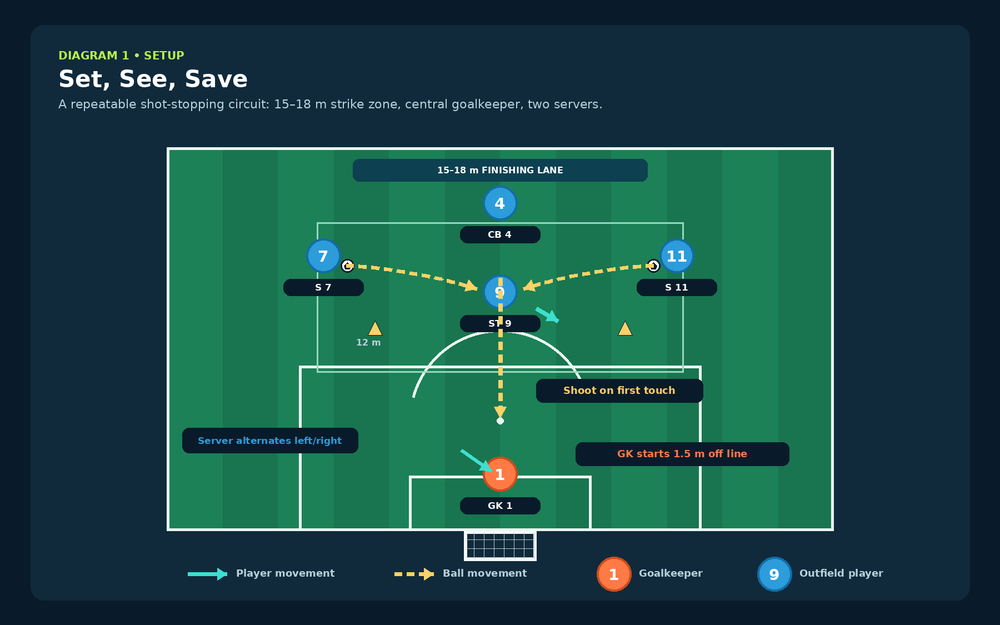
Give both servers a ball. In the opening block, ask for a firm but clean feed into 9, followed by a controlled strike below shoulder height. The aim is not maximum shot power; it is enough pace and variation to test the goalkeeper’s arrival into set. Rotate every 6–8 repetitions to keep the quality high.
| Position | Start point | Responsibility |
|---|---|---|
| 1 — Goalkeeper | 1–1.5 m off line, central | Set, save, secure or direct rebound, recover |
| 7 / 11 — Servers | 18 m from goal | Alternate the feed and reset rhythm |
| 9 — Striker | 15–18 m central gate | Receive/finish; attack one permitted rebound |
| 4 — Recycle/caller | Behind finishing lane | Collect, serve next ball, call live side |
Step-by-Step Instructions
Set the reference. Before the ball moves, make 1 scan ball, striker and goal. The goalkeeper settles with feet just outside hip width, knees soft, chest slightly forward and hands in front of the body. The target is a quiet set: able to move in either direction without a preparatory hop.
Initiate the feed. On the coach’s cue, 7 or 11 passes into 9. As the ball travels, 1 makes small adjustment steps to remain on the ball-to-goal line. Coach the goalkeeper to align with the likely shot line, not to stand rigidly in the centre spot.
Create the strike. 9 finishes first time or after one controlled touch from 15–18 m. For the first block, alternate low corner, body-line and mid-height shots. Do not allow the striker to shoot while the goalkeeper is still travelling; the rep should reward early movement and a true set.
Choose the save. Tell 1 to catch any ball safely inside the body frame. For wider or sharper shots, the goalkeeper parries with intent beyond the central rebound area. Use one clear block rule: “Hold central; push wide.” That gives every save a decision, not just a technical outcome.
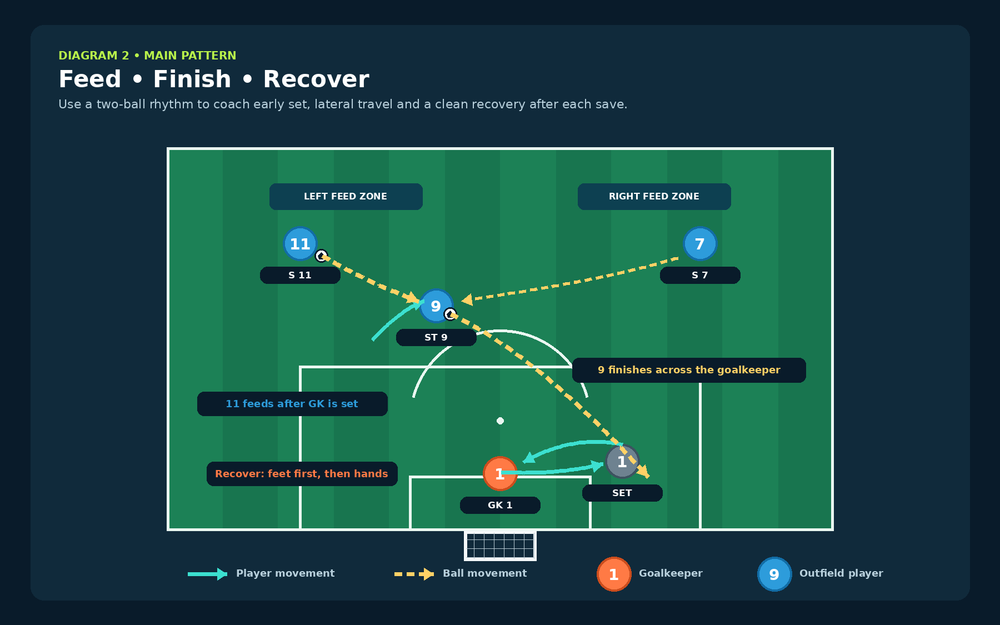
Complete the action. After a hold, 1 returns the ball to 4 and re-centres immediately. After a parry, allow 9 one live rebound in blocks two and three. The goalkeeper gets to feet through the nearest knee, regains the goal-side line and is ready within two seconds.
Reset and switch. Work six balls from each side, then take a 30-second coach reset. Change only one variable between blocks—service side, shot height, strike pace or rebound—so the goalkeeper can transfer the correction into the next action.
Stand beside or just behind 9 where you can see the goalkeeper’s line, hands and landing. Coach with short cues between reps: “set earlier,” “one adjustment step,” “show hands,” “push wide,” “feet first.” Stop the practice only when the same fault survives three repetitions.
Key Coaching Points
Arrive early, then become quiet. A goalkeeper travelling through the shot normally reaches across the body or collapses the hands. Demand small steps, an early arrival and a stable set before the striker’s final contact.
Protect the eye line. The goalkeeper should see the ball and striking surface as long as possible, with a still head, chin slightly forward and hands in peripheral vision. When a screen is added, move for sight rather than guessing the shot.
Save through the ball. Low saves require a positive step toward the ball line and hands travelling forward. Mid-height saves require a stable shoulder line. For wider shots, lead with the top hand and support with the lower hand whenever possible.
Make the parry safe. A central parry creates the next chance. Define the safe exit zones—wide of the post line or beyond the striker’s immediate path—and expect the goalkeeper to call “away” after a controlled push.
Recover as part of the save. The action is incomplete until 1 is back goal-side, balanced and ready. Do not allow the goalkeeper to admire the first stop, roll flat onto the back, or stand square to the goal.
Common Mistakes
Starting on the goal line makes the goal appear large and encourages a late dive. Place a flat marker 1–1.5 m in front of the line and require 1 to begin every first action from it.
A large hop before the shot usually signals late travel. Slow the service for two reps, demand small adjustment steps, then restore normal speed. The correction is “arrive earlier and quieter,” not “jump higher.”
Also look for hands dropping behind the hips, the head tipping away from the ball, and parries landing in the central six-yard area. Freeze the picture after the save and ask where the second striker would be; it makes the correction match-relevant.
Variations & Progressions
For an easier version, remove 9’s touch and have 7 or 11 strike directly from 16 m after a clear cue. Allow a full reset after every ball. This is ideal for the first block, a return-to-play goalkeeper or a new age group.
For the main progression, allow 9 to receive from either side, turn or set the ball with one touch, then finish across 1. Call “left” or “right” late so the goalkeeper must process, travel and set rather than rehearse one dive.
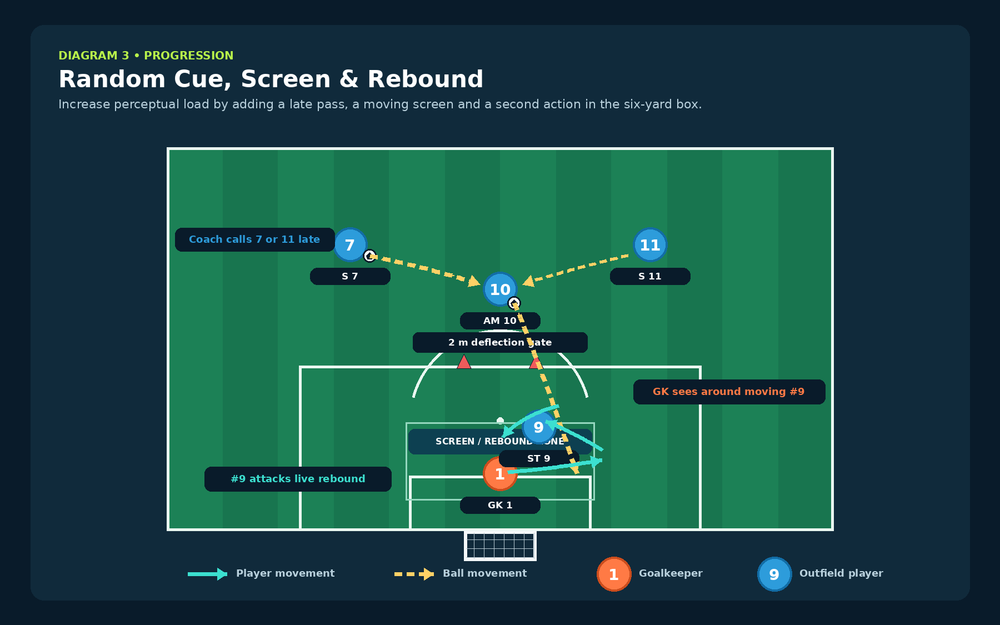
For the advanced version, add 10 above the D and use 9 as a moving screen/rebound player. Call 7 or 11 late; that server feeds 10, who shoots through the 2 m gate. 9 can screen legally and attack one rebound. Keep the second action live for no longer than three seconds.
| Level | Change | Success criterion |
|---|---|---|
| Easier | Direct, cued strike; full reset | 8 of 10 central shots held |
| Main | Alternating feed into 9 | Three blocks with no central parry |
| Advanced | Late cue, screen and one rebound | Goalkeeper re-sets goal-side within 2 sec |
Age Adaptations
For Under-8s and Under-10s, use a smaller goal, a 10–12 m shooting line and 60–90 second rotations. Give one instruction per block—such as “ready hands” or “move into line”—and remove live rebounds until basic save shape is consistent.
For Under-12s and Under-14s, use 12–16 m strikes and the alternating feed. Keep pace manageable, but expect players to describe the safe rebound zone and recover quickly after a parry.
For Under-16s and open-age groups, keep the 15–18 m range, increase ball speed, introduce the late cue and use the screened rebound. Score the block: three points for a hold, two for a safe wide parry and one for a recoverable save. Review the score alongside a short video clip as a prompt for individual work.
Coach’s Close-Out
Finish with a two-minute goalkeeper-led reflection. Ask which shot required the largest adjustment, which contact felt most secure and where the best parry landed. Leave the player with one carry-over cue for the next team practice: “Set before the strike, then own the rebound.”
