

Basketball
The Half-Court Trap Press: Suffocating Defense for Turnovers
Master the half-court trap press to disrupt opposing offenses, force high-value turnovers, and dictate the tempo of the game.

What you need
1 Basketball, Full standard FIBA basketball court (28m x 15m), Optional: Cones to mark trap zones
1. Overview
The half-court trap press is an aggressive defensive strategy designed to ambush the ball-handler just as they cross the half-court line. By executing a sudden, high-pressure double team in the corners of the half-court (the 'trap zones'), the defense aims to force panicked passes, backcourt violations, or immediate turnovers. This play is highly effective for changing the game's momentum, recovering from a deficit, or exploiting a team with weak ball-handling skills. It requires exceptional communication, quick rotations, and relentless energy from all five players on the floor.
2. Setup
Equipment Needed:
- 1 Basketball
- Full standard FIBA basketball court (28m x 15m)
- 10 Players (5 Offense, 5 Defense)
- Optional: Cones to mark the 'trap zones' near the half-court sideline intersections.
Player Positions (Defense):
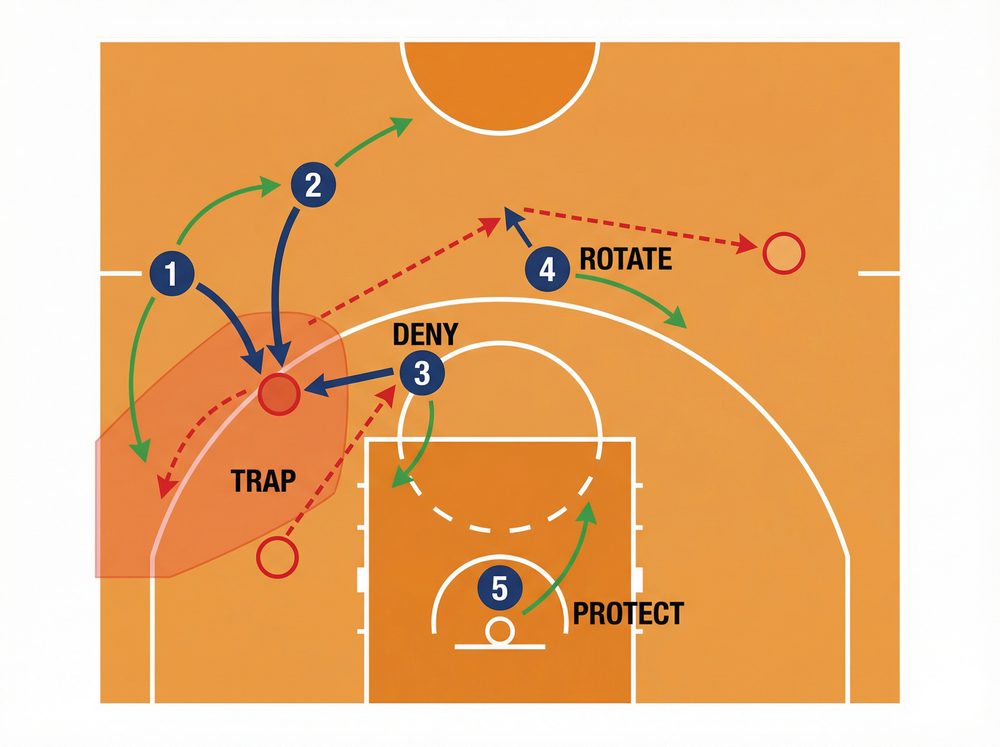
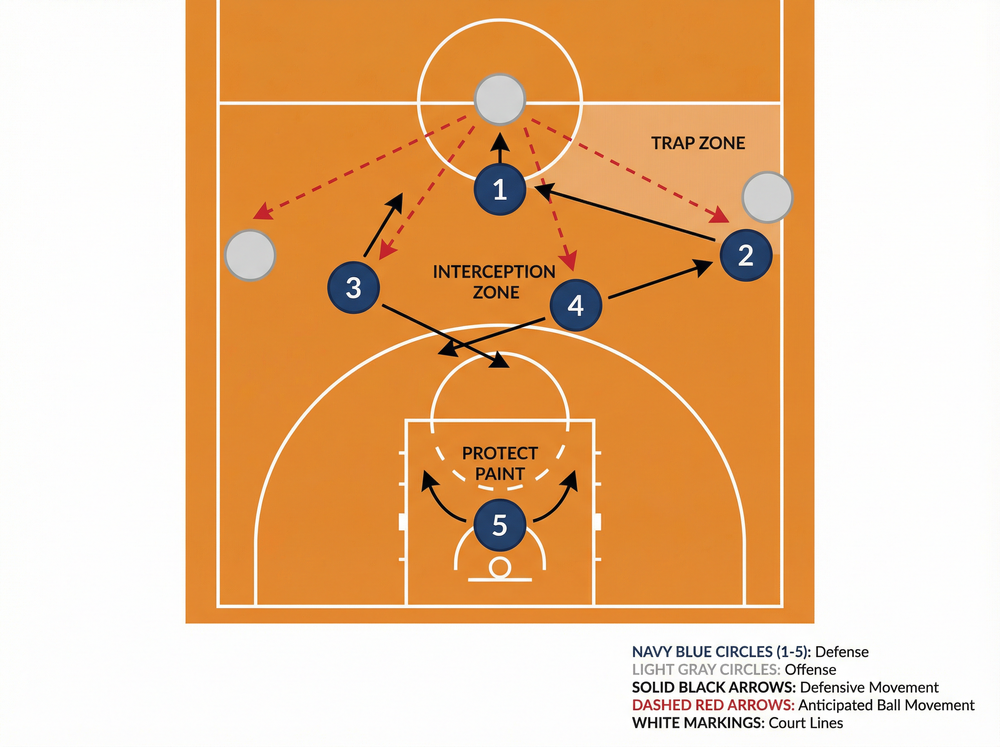
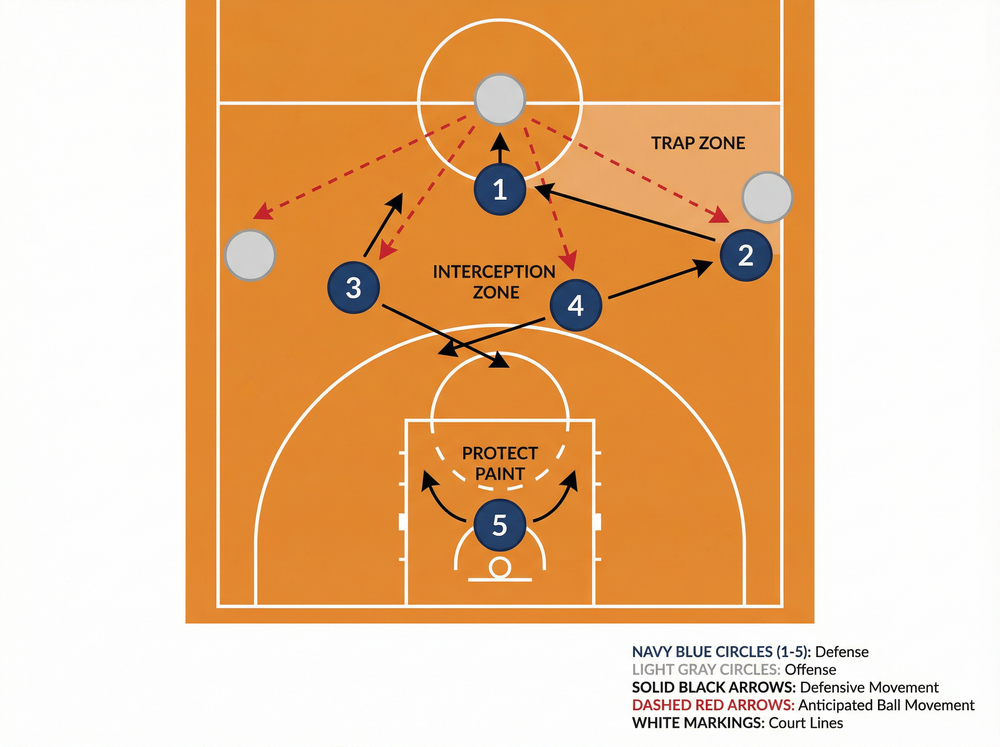
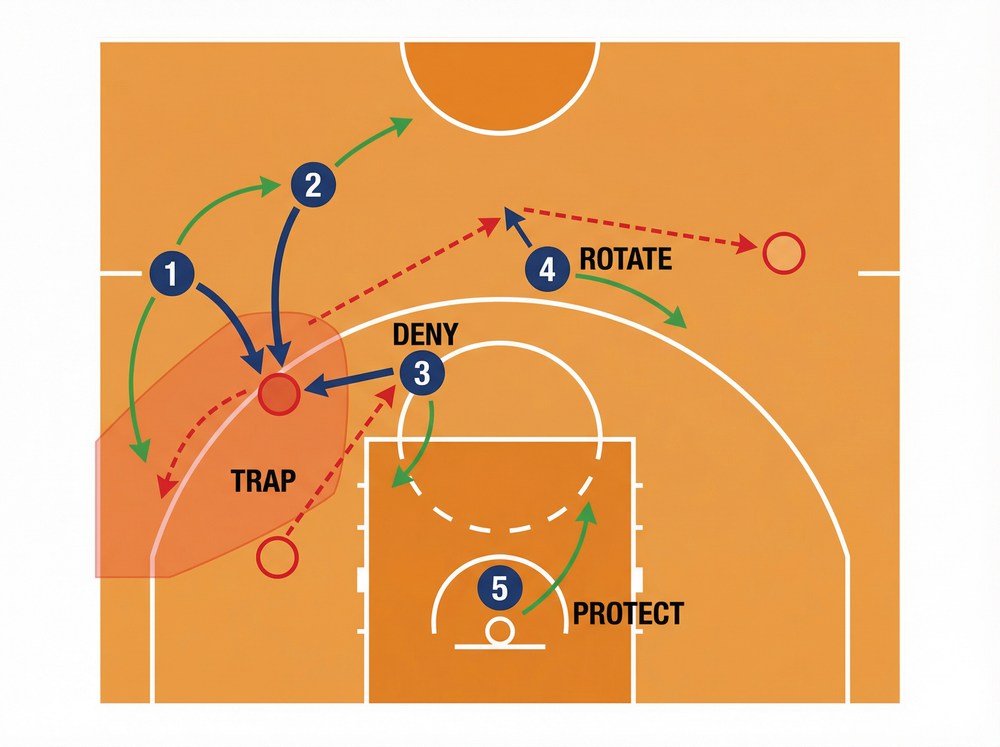
- Player 1 (Point Guard): Positioned near the half-court line, ready to apply initial pressure.
- Player 2 (Shooting Guard): Positioned slightly back along the sideline, ready to sprint into the trap.
- Player 3 (Small Forward): Positioned in the middle lane, ready to deny the primary passing outlet.
- Player 4 (Power Forward): Positioned on the weak side, ready to intercept cross-court skip passes.
- Player 5 (Center): Positioned deep in the paint, acting as the ultimate safety net.

3. Step-by-Step Instructions

Step 1: The Initial Bait
Allow the opposing point guard to bring the ball up the court with mild pressure. The goal is to lull them into a false sense of security and guide them toward the sideline near the half-court line. Player 1 should angle their body to force the ball-handler toward the sideline, denying the middle of the court.
Step 2: Springing the Trap
As soon as the ball-handler crosses the half-court line and commits to the sideline area, Player 1 and Player 2 must immediately sprint to converge on the ball. They must form a tight 'V' shape, interlocking their inside feet to prevent the ball-handler from splitting the double team. Their arms should be high and active, mirroring the ball to block passing lanes without reaching in and committing a foul.
Step 3: Denying the Outlets
Simultaneously, the remaining defenders must aggressively rotate to deny the closest passing options. Player 3 sprints to tightly guard the nearest offensive player (usually the shooting guard or small forward) who is the most obvious release valve. Player 4 shifts into the passing lane for any potential skip pass across the court.
Step 4: The Interception and Rotation
If the trapped player attempts a desperate pass, Players 3 and 4 must be ready to jump the passing lanes for an interception. If the offense manages to successfully pass out of the trap, the defense must immediately communicate and rotate back into their standard half-court defensive set (e.g., man-to-man or a 2-3 zone). Player 5 remains anchored in the paint to prevent any easy layups if the press is broken.
4. Key Coaching Points

- No Reaching: Defenders in the trap must use their bodies and active hands to smother the ball-handler, not reach in for a steal, which often leads to cheap fouls.
- Lock the Feet: The two trapping defenders must bring their inside feet together to form an impenetrable wall. If there is a gap, a skilled guard will split the trap.
- Anticipate, Don't React: The off-ball defenders (Players 3 and 4) must read the ball-handler's eyes and body language to anticipate the pass before it is thrown.
- Sprint to Recover: If the trap is broken, all five players must sprint back to protect the basket. Jogging back will result in giving up easy transition points.
- Vocal Communication: The entire defense must be talking loudly. The trappers need to communicate when they are springing the trap, and the off-ball defenders need to call out offensive player movements.
5. Common Mistakes
- Trapping Too Early: Springing the trap before the ball-handler has crossed half-court allows them to easily retreat or pass backward.
- Leaving the Middle Open: Allowing the ball-handler to penetrate the middle of the court completely neutralizes the sideline trap.
- Fouling in the Trap: Reaching in out of desperation instead of maintaining disciplined, vertical pressure.
- Slow Rotations: Off-ball defenders failing to immediately jump into passing lanes, giving the trapped player an easy escape route.
6. Variations & Progressions
- The 'Run and Jump' Variation: Instead of a planned trap in a specific zone, the defense randomly double-teams the ball-handler whenever they turn their back or pick up their dribble.
- Progression 1 (Drill): Start with 2-on-1 trapping drills in the corner to teach the mechanics of the trap without the complexity of full-court rotations.
- Progression 2 (Live Action): Run the full 5-on-5 press but restrict the offense from dribbling once they cross half-court, forcing them to focus on passing out of the trap.
7. Age Adaptations

- Under 10s: Focus heavily on the basic mechanics of a double team (high hands, no reaching) in half-court drills. Avoid full-court pressing as it can be overwhelming.
- Under 12s - Under 14s: Introduce the half-court trap as a situational play. Emphasize the importance of cutting off passing lanes rather than just chasing the ball.
- Under 16s - Open: Implement the full system with complex rotations and variations. Focus on the psychological aspect of relentless pressure and forcing the tempo.
